

Key takeaways
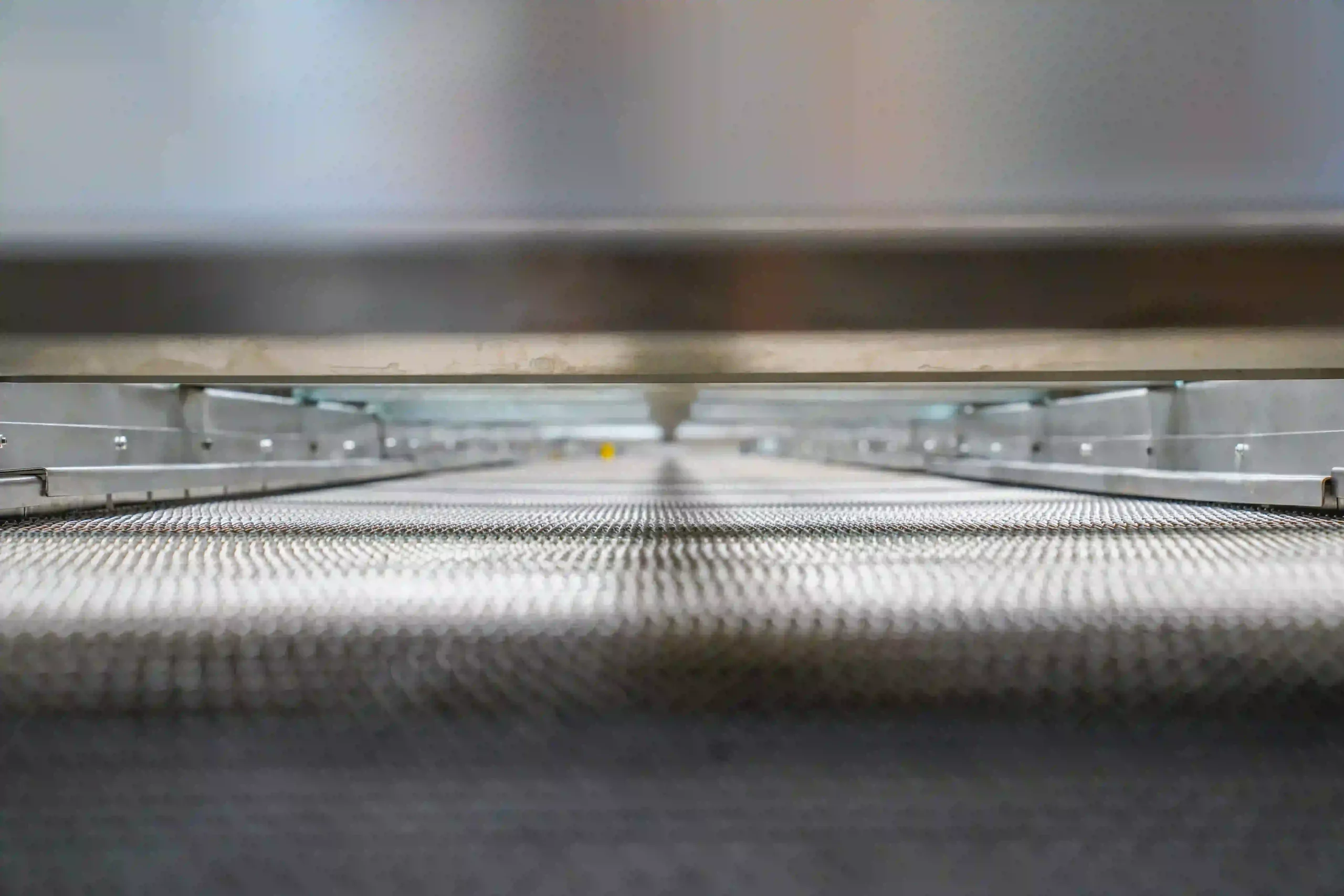
A modular belt conveyor looks like a belt conveyor with a plastic belt, and the important difference is not the material. It is how the belt is driven.
A conventional belt is pulled by friction between the belt and a drive pulley, which is why it needs tension, why it can slip, and why it wanders off center and has to be tracked. A modular belt is made of interlocking plastic modules joined by rods, and sprockets engage those modules directly. The drive is positive rather than frictional, and almost every practical advantage of the format follows from that one fact.
This guide covers what that changes, the belt styles available, where modular genuinely outperforms a conventional belt and where it does not.
What Positive Drive Changes
Three of the most persistent maintenance problems on conventional belt conveyors simply do not arise.
For a maintenance team, that combination is the argument. Tracking adjustment is one of the most common recurring interventions on conventional conveyors, and a modular belt eliminates it as a category rather than reducing it.
Repair by Module
The second structural advantage is what happens when the belt is damaged.
A conventional belt damaged anywhere along its length is damaged as a unit. A cut can propagate, and repair means either a vulcanized splice or replacing the whole belt, which is a significant cost and a long stoppage.
A modular belt is assembled from individual modules held by rods. A damaged section is removed by driving out two rods and replacing the affected modules, typically in minutes, using parts held on a shelf. A cut in one module does not propagate to its neighbours because they are separate components.
Over a long service life this changes the economics considerably. The initial belt costs more; the belt is repaired rather than replaced, and it is repaired during a break rather than during a planned shutdown.
Belt Styles
Modular belt is not one product. The module design determines what the belt can do, and selecting the style is most of the specification.
| Belt style | Construction | Suits | Watch for |
|---|---|---|---|
| Flush grid | Open area through the belt surface | Draining, cooling, washing and airflow through the product | Small items can catch in the openings |
| Flat or solid top | Closed surface with no through-openings | Small, unstable or fine products that would fall through | No drainage, so liquid sits on the belt |
| Raised rib | Ribs running along the direction of travel | Inclines and products that need lateral stability | Harder to clean than a flat surface |
| Friction top | A high-grip elastomer surface molded onto the modules | Inclines where product would otherwise slide back | The grip surface wears and is not always food-grade |
| Roller top | Rollers set into the module surface | Accumulation and side transfer without belt-to-product scuffing | More components in the belt, higher cost |
| Radius or side-flexing | Modules that allow the belt to curve horizontally | Layouts needing direction changes without a transfer | Requires a wider path and specific sprocket arrangements |
The flush grid and solid top choice is the one that most often gets revisited after installation. Open construction is excellent for draining, washing and blowing air through product, and it is unforgiving of small or thin items, which stand up in the openings or fall through. Where a line handles mixed product sizes, the smallest item decides.
What a Conventional Belt Cannot Do
Turn corners
A flat belt runs in a straight line. Changing direction means a transfer onto a second conveyor, with the gap, the potential for tipping and the additional machine that implies. Side-flexing modular belt curves horizontally, so a line can change direction on one continuous surface with no transfer at all.
That matters more than it sounds. Transfers are where most conveying problems occur, so removing one removes a failure point as well as a machine.
Run wet and drain
Open belt construction allows liquid to pass through rather than pooling on the surface. For washing lines, draining after a wet process, or cooling with air blown up through the product, this is a functional capability rather than a convenience.
Spiral travel
Modular belt can be built to travel in a spiral, which is what makes spiral coolers, freezers and proofers possible. A long dwell time is achieved in a small footprint, and no conventional belt arrangement provides it.
Where a Conventional Belt Is Still Better
Modular belt is not a universal upgrade, and the cases against it are real.
The design and sizing considerations for conventional belt conveying are covered in the guide to flat belt conveyors.
 “Automation does not end when a valve receives an open or close command – the system must confirm that the valve actually reached the required position.“

See it in action
Hygiene: Open Construction Cuts Both Ways
Modular belt is frequently specified on hygiene grounds, and the reasoning deserves examining rather than accepting.
The advantage is genuine. Open construction lets cleaning solution and water pass through the belt rather than running off it, so both surfaces are reachable. The belt can be lifted or the return run accessed for cleaning, and plastic materials tolerate the chemicals and temperatures a food plant uses. There is no fabric carcass to absorb liquid, and no fraying edges to shed fibers.
The complication is that a modular belt has far more geometry than a plain belt. Every module hinge, every rod and every joint between modules is a place product can lodge, and a belt with hundreds of modules has a great deal of such geometry. Cleaning a modular belt properly takes more effort than cleaning a smooth one, and it takes attention to the hinge areas specifically.
The practical conclusion is that modular belt is a hygienic choice when it is cleaned as a modular belt, with spray coverage designed to reach the hinges and a procedure that accounts for them. Specified as a smooth belt and cleaned as one, it can be worse rather than better.
Materials and Temperature
Module material determines chemical and temperature tolerance, and the common options behave differently.
Polypropylene is the general-purpose choice for food handling at moderate temperatures with good chemical resistance. Polyethylene tolerates low temperatures well, which is why it appears in freezing and chilled applications. Acetal offers higher strength and better wear resistance, suiting heavier loads and longer runs. Nylon handles higher temperatures than the others but absorbs moisture, which affects dimensional stability in wet environments.
Manufacturers state specific limits for their own products, and those limits assume dry conditions. Chemical exposure, sustained load and wet operation all reduce them, so the operating envelope should be discussed against the actual duty rather than read from a datasheet.
Applications
Selection Points
Conveying from Cybernetik
Cybernetik engineers conveying as part of complete process and packaging lines, which means belt construction is selected against the product, the cleaning regime and the layout rather than chosen as a default. The range covers flat and trough belt conveying, flight cleated belts raising product up to 6 m on washable polyurethane extruded belts, screw conveying to 40 m and 10 tons per hour, vibratory conveyors, bucket elevators and cooling conveyors, all under process automation solutions.
The comparison across conveyor types, and how they behave when connected into a network, is covered in the guides to conveyor belt machines and industrial conveyor systems.
Cybernetik has operated for more than three decades, is headquartered in Pune with additional facilities in Gujarat and Raigad and international offices in the United States and UAE, and has installed over 6,000 systems across 30 plus countries, including more than 400 custom automation solutions. Further background is on the Cybernetik about page.