
Key takeaways
A wet cake comes off a centrifuge or filter still holding 20 to 40 percent water or solvent. Before it can be milled, blended or packed, that liquid has to go. For many products, simply heating the cake in hot air is not an option. The product may degrade above 60°C, it may oxidize, or the liquid may be a flammable solvent that cannot be released into the plant. That is where a rotary vacuum dryer comes in.
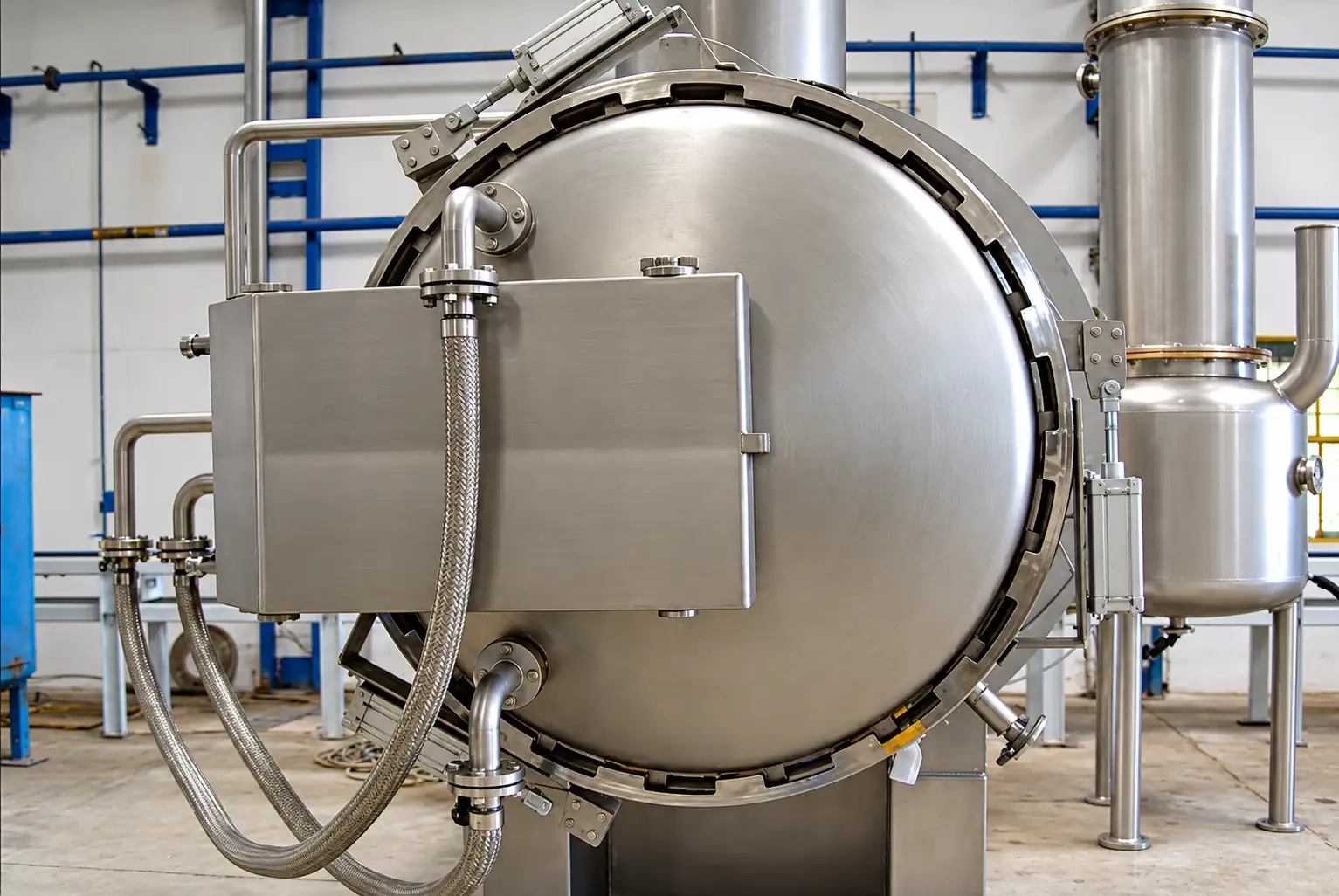
A rotary vacuum dryer is a closed, jacketed vessel that dries wet solids under reduced pressure while the product is kept moving, either by rotating the whole vessel or by an agitator inside it. Lowering the pressure lowers the boiling point of the liquid, so drying happens at a much lower temperature, and the vapor is condensed and recovered rather than vented. It is used to dry pharmaceutical APIs, specialty chemicals, agrochemicals, food ingredients and other heat-sensitive or solvent-wet materials.
This guide explains how a rotary vacuum dryer works, the main designs, where they are used, how to size and select one, and what keeps the drying cycle consistent batch after batch.
How a Rotary Vacuum Dryer Works
Think of a pressure cooker run in reverse. Instead of raising pressure so water boils hotter, the dryer pulls pressure down so water boils cooler. Heat flows from the jacket into the wet product, the vacuum system keeps the pressure low, and constant movement brings fresh wet particles against the hot wall.
Three things have to work together. Heat must reach the product, which under vacuum happens almost entirely by conduction from hot metal, since there is little air left to carry it. The liquid must boil off at a low temperature, which depends on how low the pressure is held. And the vapor must leave the vessel quickly, so the pressure does not climb back up. If any one of the three falls behind, the batch slows down.
Why vacuum lowers the drying temperature
A liquid boils when its vapor pressure matches the pressure around it. Reduce the surrounding pressure and boiling starts at a lower temperature. The effect on water is large.
| Absolute pressure | Boiling point of water | What it means for drying |
|---|---|---|
| 1,013 mbar (atmospheric) | 100°C | Tray dryers and ovens must push product close to this |
| 500 mbar | About 81°C | Mild vacuum, limited benefit for sensitive products |
| 200 mbar | About 60°C | Typical early in the cycle, when vapor load is highest |
| 100 mbar | About 46°C | Common working range for heat-sensitive products |
| 50 mbar | About 33°C | Deep vacuum for removing the last traces of moisture |
Solvents such as methanol, ethanol, acetone and toluene follow the same rule. Under vacuum they evaporate well below their normal boiling points, which is why vacuum drying is the standard route for solvent-wet pharmaceutical and chemical cakes.
Why the product stays cooler than the jacket
While liquid is still evaporating, it absorbs heat as latent heat of vaporization. The product therefore sits close to the boiling point at the operating pressure, even when the jacket is much hotter. Only when most of the liquid has gone does the product temperature start to climb toward the jacket temperature. This is both the dryer’s main protection for sensitive products and the most useful signal that the batch is nearly done.
Parts of a Rotary Vacuum Dryer
| Part | What it does |
|---|---|
| Jacketed vessel | Holds the product under vacuum while hot water, steam or thermic fluid circulates in the jacket |
| Agitator or rotating drive | Keeps the product moving, either with paddles on a shaft or by turning the whole vessel |
| Charging and discharge ports | Let wet cake in and dry powder out, ideally through closed connections |
| Vapor dome and dust filter | Holds back fine powder so it does not travel with the vapor |
| Condenser and receiver | Turns the vapor back into liquid and collects it for reuse or disposal |
| Vacuum pump | Removes air and gases that do not condense, holding the vessel at working pressure |
| Controls and instruments | Measure product temperature, jacket temperature, pressure and agitator load |
The vapor path deserves as much attention as the vessel. If the filter, condenser or pump is undersized, pressure rises during the heavy early evaporation, the boiling point climbs with it and drying slows. Many “slow dryer” complaints turn out to be a vapor train problem rather than a vessel problem.
Types of Rotary Vacuum Dryers
All rotary vacuum dryers combine heat, vacuum and movement. They differ in what moves and how much heated surface touches the product.
| Type | How it differs | Typical use |
|---|---|---|
| Double cone (tumble) dryer | The whole jacketed vessel rotates slowly, tumbling the product inside | Free-flowing wet powders and crystals, especially pharmaceutical APIs |
| Rotary vacuum paddle dryer (RVPD) | A fixed horizontal vessel with a rotating shaft of paddles; in many designs the paddles are heated too | Slurries, pastes and wet cakes, including products that pass through a sticky phase |
| Conical dryer with orbiting screw | A fixed vertical cone with a screw that turns and orbits around the wall | Wet cakes and powders where batch sizes vary |
Double cone dryers
Because nothing turns inside the product, a double cone dryer has no shaft seal in the product zone and is easy to clean. It is gentle on fragile crystals. The trade-offs are a smaller heated area per liter of product, a limited fill level and no mechanical action to break lumps, so pastes tend to ball up or coat the walls.
Rotary vacuum paddle dryers
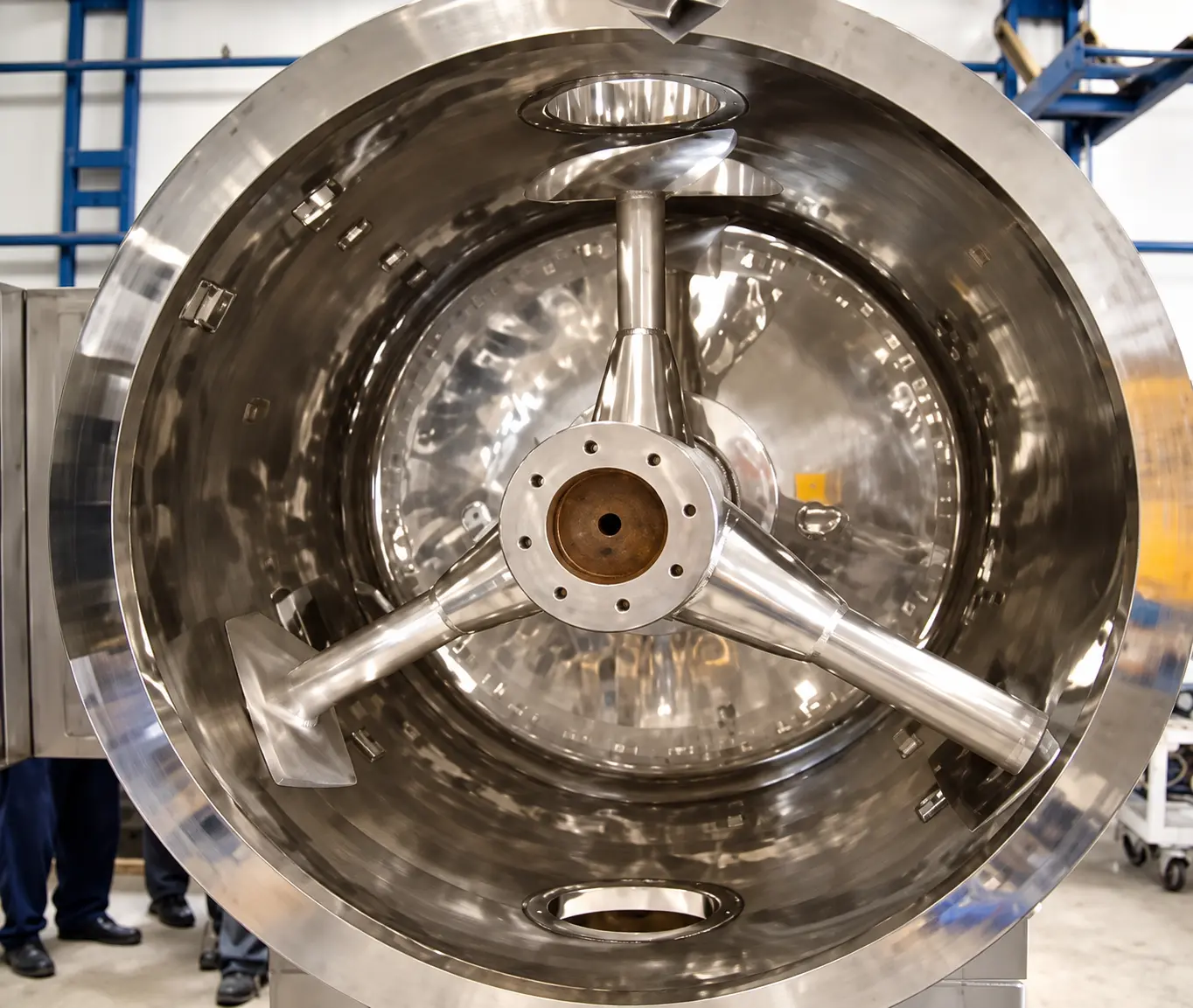
A paddle dryer works the material mechanically. The paddles lift and turn the batch continuously, keep temperature even and carry the product through the sticky phase many wet cakes go through as they dry. Where the shaft and paddles are heated, the heat transfer area rises significantly, which shortens the cycle. Shaft seals sit in the product zone under vacuum, so their design and maintenance matter.
Where Rotary Vacuum Dryers Are Used
Rotary vacuum dryers appear wherever a product must be dried gently, kept enclosed or freed of a solvent that has value or poses a hazard.
In Indian plants, the most common duty is drying solvent-wet cakes after filtration in API, intermediate and agrochemical manufacturing. The dried powder then moves on to sizing, blending and packing, often through closed transfer in IBC containers.
Benefits of a Rotary Vacuum Dryer
Rotary Vacuum Dryer or Another Dryer?
A rotary vacuum dryer is a batch machine with a higher capital cost, and because it relies on conduction it is slow for very large tonnages of water-wet product. It earns its place where product value, temperature sensitivity, solvents or containment matter more than raw throughput.
| Dryer | Strength | Limitation |
|---|---|---|
| Rotary vacuum dryer | Low temperature, solvent recovery, closed handling, uniform drying | Batch operation and higher cost per kg for large water-wet volumes |
| Tray dryer (atmospheric or vacuum) | Simple and low cost for small batches | Manual loading, uneven drying and operator exposure |
| Fluid bed dryer | Fast drying of free-flowing granules | Needs fluidizable product; solvents need inert gas loops |
| Flash or spray dryer | High continuous throughput | Higher temperatures, large footprint, no solvent-wet cakes |
 “Integrating vacuum drying with automated material handling improves process control and batch consistency. A connected system supports efficient transfer, controlled discharge, and dependable downstream operations.”

See it in action
How to Size a Rotary Vacuum Dryer
Dryer size is a volume, but batches are planned in kilograms. Start from the wet cake bulk density and the working fill the design allows. For example, 800 kg of wet cake at 0.6 kg/L takes up about 1,330 liters. If the dryer works best at around 60 percent of its gross volume, it needs roughly 2,200 liters gross. Sizing on dry product density instead of wet cake density is a common mistake that leaves the vessel too small.
The vapor train is sized on evaporation load. Taking the same 800 kg batch at 30 percent moisture dried to 0.5 percent, the dry solids weigh 560 kg and about 237 kg of liquid must be removed. Over an eight-hour drying time that averages about 30 kg per hour, but the early part of the cycle can run at two to three times the average. The condenser and vacuum pump must be sized for that peak, not the average.
The drying cycle stage by stage
| Stage | What happens | What to watch |
|---|---|---|
| Charging | Wet cake is loaded through a manhole or closed transfer | Fill level within the working volume |
| Pull-down and heat-up | Vacuum is drawn and the jacket begins heating | Lower pressure in steps so powder is not pulled into the filter |
| Constant-rate drying | Surface liquid evaporates quickly at the boiling point for that pressure | Peak load on condenser and pump; sticky phase in some products |
| Falling-rate drying | Liquid has to travel out from inside particles, so evaporation slows | Product temperature rises; avoid overheating |
| Endpoint and cooling | Target moisture is reached and the jacket switches to cooling | Confirm with a loss-on-drying or residual solvent test |
| Vacuum break and discharge | Vacuum is released, often with nitrogen, and powder is discharged | Complete discharge without dead pockets |
Selection Checklist
Running a trial on real production material is the most reliable way to confirm the choice. It shows the drying curve, any sticky phase, whether lumps form and the final particle size. If the dried product forms agglomerates, plan for a lump breaker or a powder grinder after the dryer.
Maintenance and Troubleshooting
A rotary vacuum dryer usually shows problems as longer cycle times before anything fails outright. Recording product temperature, pressure and condensate collected for every batch makes the drift easy to spot.
| Problem | Likely cause | What usually fixes it |
|---|---|---|
| Batch takes longer than before | Air leaks, fouled condenser or blocked dust filter raising pressure | Leak-test the system, clean the condenser and filter |
| Pressure will not pull down | Worn shaft seals, door gaskets or leaking joints | Replace seals and gaskets; check flanges and instrument fittings |
| Powder in the condensate | Vacuum pulled down too quickly or damaged filter element | Lower pressure in steps; inspect and replace filter media |
| Lumps or balls in the product | Sticky phase not handled, or jacket too hot early in the cycle | Adjust heating profile and agitator speed; add downstream sizing |
| Product discolored or degraded | Product temperature too high late in the cycle | Lower jacket temperature in the falling-rate period |
| Product left after discharge | Dead pockets around the outlet or poor discharge design | Use a flush-mounted discharge valve and run the agitator during discharge |
In automated plants, the dryer’s temperatures, pressure and agitator load can feed the wider control system, linking it with charging, transfer and packing. How these pieces fit together is covered in the guide to material handling automation. Where products change often, cleaning between batches can be automated too, and nozzle positions are far easier to plan at the design stage, as set out in the guide to choosing a CIP system.
Rotary Vacuum Paddle Dryers from Cybernetik
Cybernetik Technologies has been delivering turnkey automation since 1989, with more than 600 employees and over 6,000 projects installed. Its process division designs and builds powder and liquid handling systems for food, pharmaceutical and chemical plants, from charging and conveying to mixing, drying and packing.
For low-temperature drying of powders, slurries and pastes, Cybernetik builds the Rotary Vacuum Paddle Dryer (RVPD). Heat reaches the product from both the jacket and the paddles, which have low thermal inertia, so the batch heats quickly and evenly while the paddles keep it moving.
| Cybernetik RVPD | Specification |
|---|---|
| Capacity | Up to 5,000 liters per batch, customizable |
| Material of construction | SS304 and SS316 |
| Heat transfer | Jacket and paddles with low thermal inertia, with continuous agitation |
| Process control | Step-less speed control and recipe selection for different products |
| Discharge | Pneumatic discharge valve that avoids dead zones |
| Door design | Teethed bayonet design that prevents leakage |
| Construction | Hygienic GMP design; optional ASME-compliant pressure vessel |