
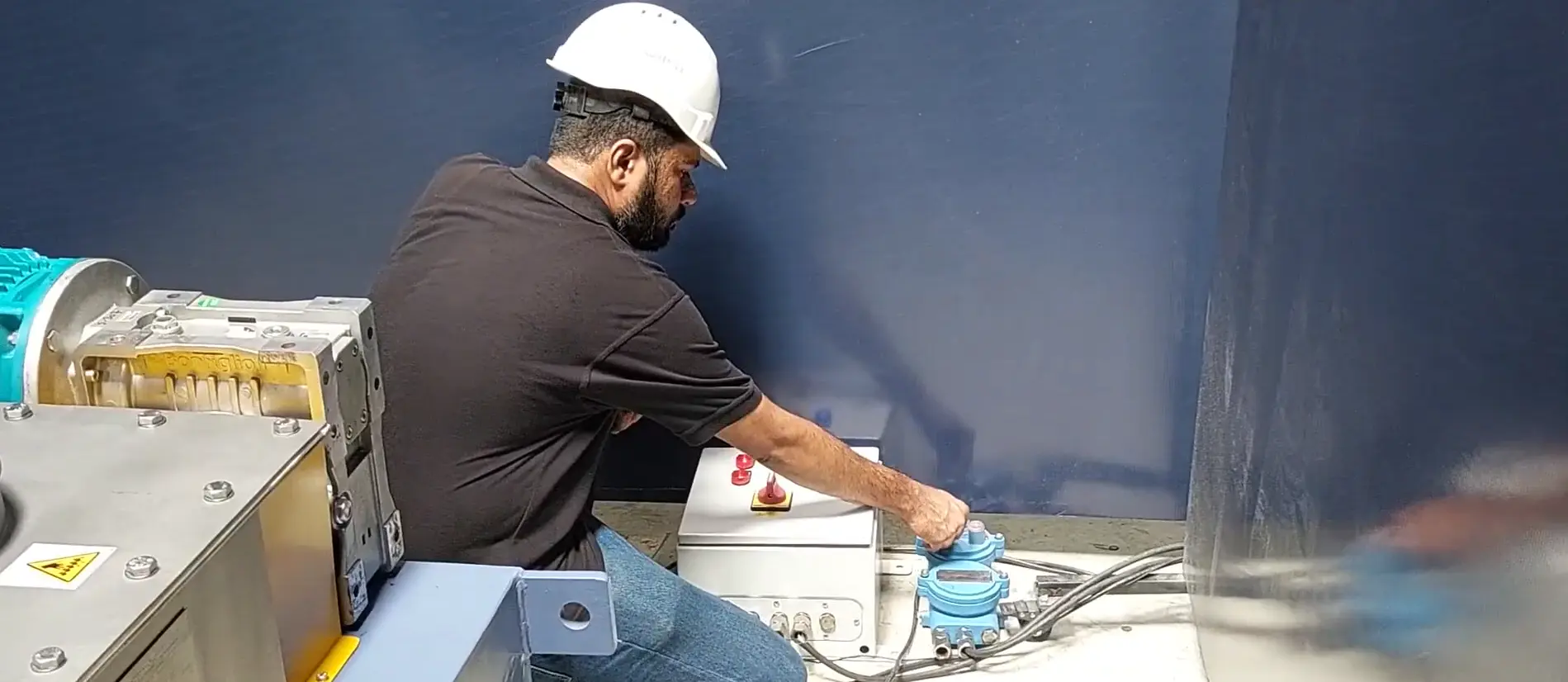
Key takeaways
Powders do not stay loose. Given time, moisture, pressure or a temperature swing, most of them cake, and a material that discharged freely when it went into storage arrives at the process as a mixture of powder and lumps.
A lump breaker exists to undo that, and the important word is undo. Its job is to return agglomerated material to the particle size it had originally, not to make it finer. That distinction sounds academic and is the difference between a machine that protects your product and one that quietly changes it.
This guide covers why lumps form, how a lump breaker works, why it is not a mill, where it belongs in a line and what it prevents downstream.
Why Powders Form Lumps
Caking is not a single mechanism, and knowing which one is at work tells you how hard the lumps will be to break.
| Cause of caking | What happens | Where it shows up |
|---|---|---|
| Moisture uptake | Hygroscopic powder absorbs water, liquid bridges form between particles and then solidify | Sugar, salt, starch and dairy powders after storage in humid conditions |
| Consolidation under load | Particles are pressed together by the weight of material above them | The bottom of silos, bulk bags and stacked sacks |
| Temperature cycling | Warming and cooling drives moisture migration and recrystallization at contact points | Outdoor storage and unconditioned warehouses |
| Fat or binder migration | A liquid or low-melting component moves to particle surfaces and sets | Cocoa, dairy blends and fat-containing seasonings |
| Process agglomeration | Particles bond during drying, granulation or spraying | Discharge from dryers and granulators |
| Static and cohesion | Fine particles cling together without any bonding mechanism | Micronized powders and very fine milled products |
The practical consequence is that lump hardness varies enormously between materials and between batches of the same material. A powder that cakes through simple consolidation breaks apart with very little force. One that has recrystallized after moisture uptake forms a hard solid, and a machine sized for the first will stall on the second.
Not All Lumps Should Be Broken
Worth saying before the equipment discussion. A lump breaker will attempt to break whatever enters it, and not everything in a powder stream should be broken.
Foreign material, tramp metal, packaging fragments, hardened deposits from a vessel wall, should be removed rather than reduced. Breaking them distributes contamination through the batch instead of concentrating it where it can be rejected. This is why magnetic separation belongs upstream of a lump breaker rather than downstream of it, and why sifting after breaking catches what neither prevented.
How a Lump Breaker Works
The mechanism is straightforward and the design detail is where the differences lie.
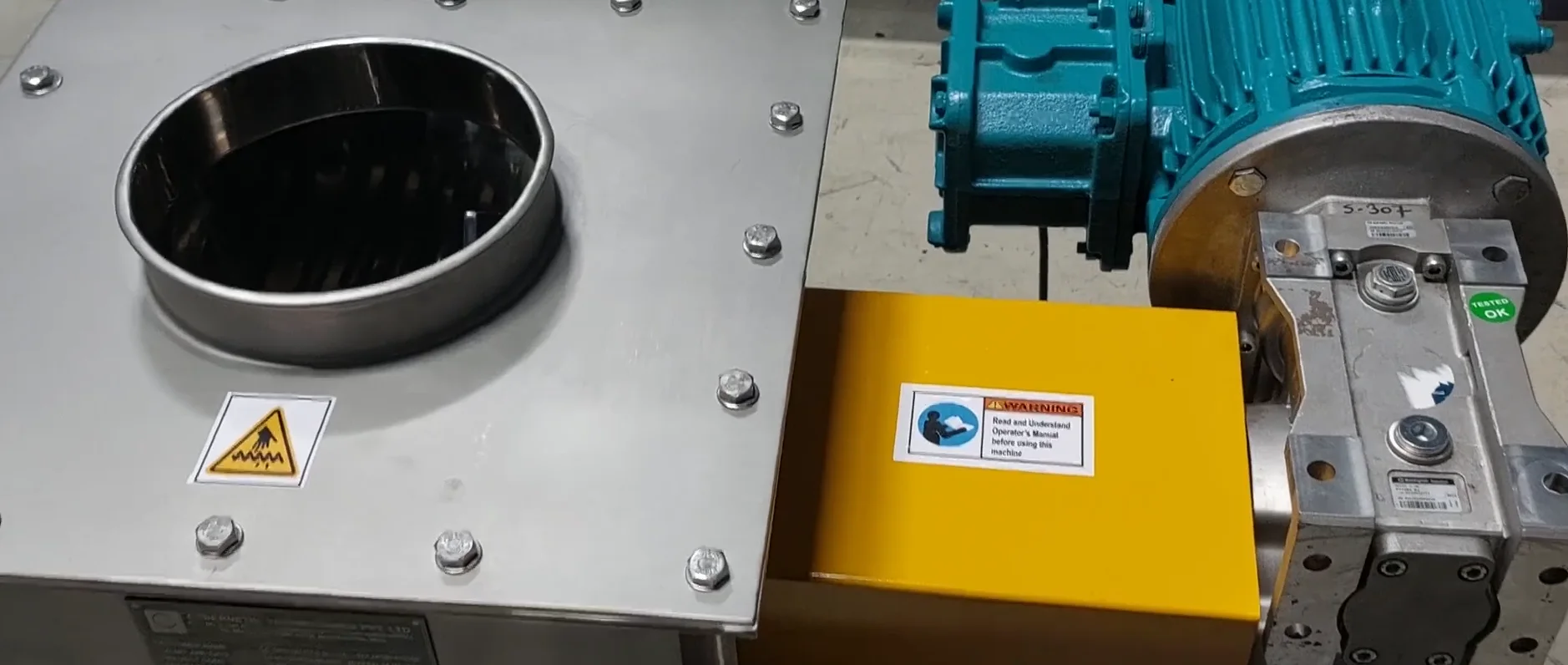
Material falls into a housing containing a rotating shaft fitted with blades. As the shaft turns, the blades pass in close proximity to fixed elements, either stationary breaker bars or a screen, and any lump caught between the two is sheared apart. Broken material passes through and continues down the line; the size of the opening beneath sets the maximum size that leaves.
Two characteristics distinguish it from other size reduction equipment. Speed is low and torque is high, because the objective is to apply force to a lump rather than energy to a particle. And the action is shearing rather than impact, because shear separates bonded particles while impact fractures the particles themselves.
Single rotor or dual
A single rotor handles most duties. A second rotor, counter-rotating, gives stronger action for harder cake, improves intake by drawing material in rather than letting it sit on top, and is more self-clearing when a difficult lump arrives. Where material cakes hard or arrives inconsistently, the dual arrangement earns its cost.
Blade and clearance design
The gap between rotating blade and fixed element determines both the force applied and the size of material that passes without being touched. Tighter clearance breaks more thoroughly and generates more fines; wider clearance is gentler and lets larger fragments through. This is the parameter to discuss with a supplier against your actual material.
Lump Breaker or Mill?
This is the most consequential distinction in the article, and specifying the wrong one damages product in a way that is difficult to reverse.
A mill reduces particles below their original size. It runs at high speed, applies high energy, generates heat and produces fines as a matter of course. That is what it is for.
A lump breaker restores particles to their original size. It runs slowly, applies force rather than energy, generates minimal heat and should produce very few fines. Ideally, the material leaving it is indistinguishable from the material before it caked.
Choosing a mill where a lump breaker would suffice changes the product. Fines alter bulk density, which affects filling weights and pack fill. They alter flow behavior, which affects hopper discharge and dosing accuracy. In food products they alter dissolution and mouthfeel. And in a combustible powder, generating fines raises the dust hazard rather than leaving it unchanged.
The test is simple. If the requirement is to recover material that has caked, use a lump breaker. If the requirement is a finer particle size than the material ever had, use a mill.
Where It Belongs in the Line
A lump breaker is almost never a standalone machine. It sits at points where caked material enters a process or where agglomerates are created.
What It Delivers
 “Pressure versus atmospheric cooking is not simply an equipment choice – it is a process decision that can determine cook time, product quality, operating complexity, and ultimately production capacity..“

See it in action
Design Features That Matter
Containment
A lump breaker is a dust generation point, because breaking agglomerates releases fines that were bound up in them. A fully enclosed housing with a sealed shaft keeps that dust inside. Gland packing on the shaft is what prevents leakage along the drive, and it is a detail worth confirming rather than assuming.
Mounting arrangement
The most practical arrangement for retrofitting is an inline sandwich design, where the unit fits between two flanges in the existing pipework much like a butterfly valve. That means it can be added to a line without new supporting structure and without rerouting, which is frequently what determines whether a lump breaker is installed at all.
Cleanability
Blades, breaker bars and screens are exactly the geometry that traps residue, so in multi-product plants access matters. Establish how the unit opens, whether the rotor can be withdrawn, and how long a full clean takes between products.
Hazardous area rating
Where the powder is a combustible dust, breaking it creates fines and a dust cloud in an enclosed space with a rotating mechanical element. Explosion-resistant construction is a specification item rather than an option, and it cannot be added later.
Overload behavior
Something too hard to break will eventually arrive. Torque limiting, overload protection or a reversing facility determines whether that produces a two-minute clearance or a damaged machine.
Applications
Lump Breakers from Cybernetik
Cybernetik builds the lump breaker as part of complete powder handling lines, so it is specified alongside the intake, sifting, conveying and packing equipment around it rather than added as a remedy afterward.
| Cybernetik lump breaker | Specification |
|---|---|
| Capacity | Up to 6,000 kg/hr |
| Breaking elements | High-strength blades for smooth breaking action |
| Rotor options | Second rotor available where stronger action is required |
| Drive | Geared motor driving the rotor at controlled speed |
| Mounting | Fully enclosed sandwich unit fitted between two flanges in a butterfly-valve-type housing |
| Shaft sealing | Gland packing, preventing leakage along the shaft |
| Construction | Welded, robust build |
| Hazardous area | Explosion-resistant ATEX version available |
| Build standard | Hygienic, GMP construction, easy to clean and maintain |
| Integration | Fits with bag discharge stations, sifters, powder transfer and valves |
| Industries | Food, pharmaceuticals, chemicals and general manufacturing |
Three of those specifications address problems raised above directly. The sandwich mounting between flanges means the unit can be inserted into existing pipework without new structure, which is what makes retrofitting practical. Gland packing on the shaft prevents the dust leakage that an enclosed breaker would otherwise produce along the drive. And the second rotor option provides stronger action for hard cake without moving to a mill and accepting the fines that come with one.
Downstream, breaking pairs naturally with screening. A turbo sifter at up to 6,000 kg/hr with mesh from 7000 down to 40 microns catches anything the breaker did not resolve, which is the arrangement that gives real control over what leaves the stage.
Cybernetik has operated for more than three decades, is headquartered in Pune with additional facilities in Gujarat and Raigad and international offices in the United States and UAE, and has installed over 6,000 systems across 30 plus countries, including more than 400 custom automation solutions. Further background is on the Cybernetik about page.