
Key takeaways
A filter cake straight from a centrifuge can be the most awkward material in a plant. It is wet, sometimes full of solvent, often sticky, and the product inside may be damaged by too much heat. Spread it on trays and it dries unevenly and slowly. Put it in a hot oven and the active ingredient may degrade. The rotary vacuum paddle dryer was developed for exactly this kind of material.
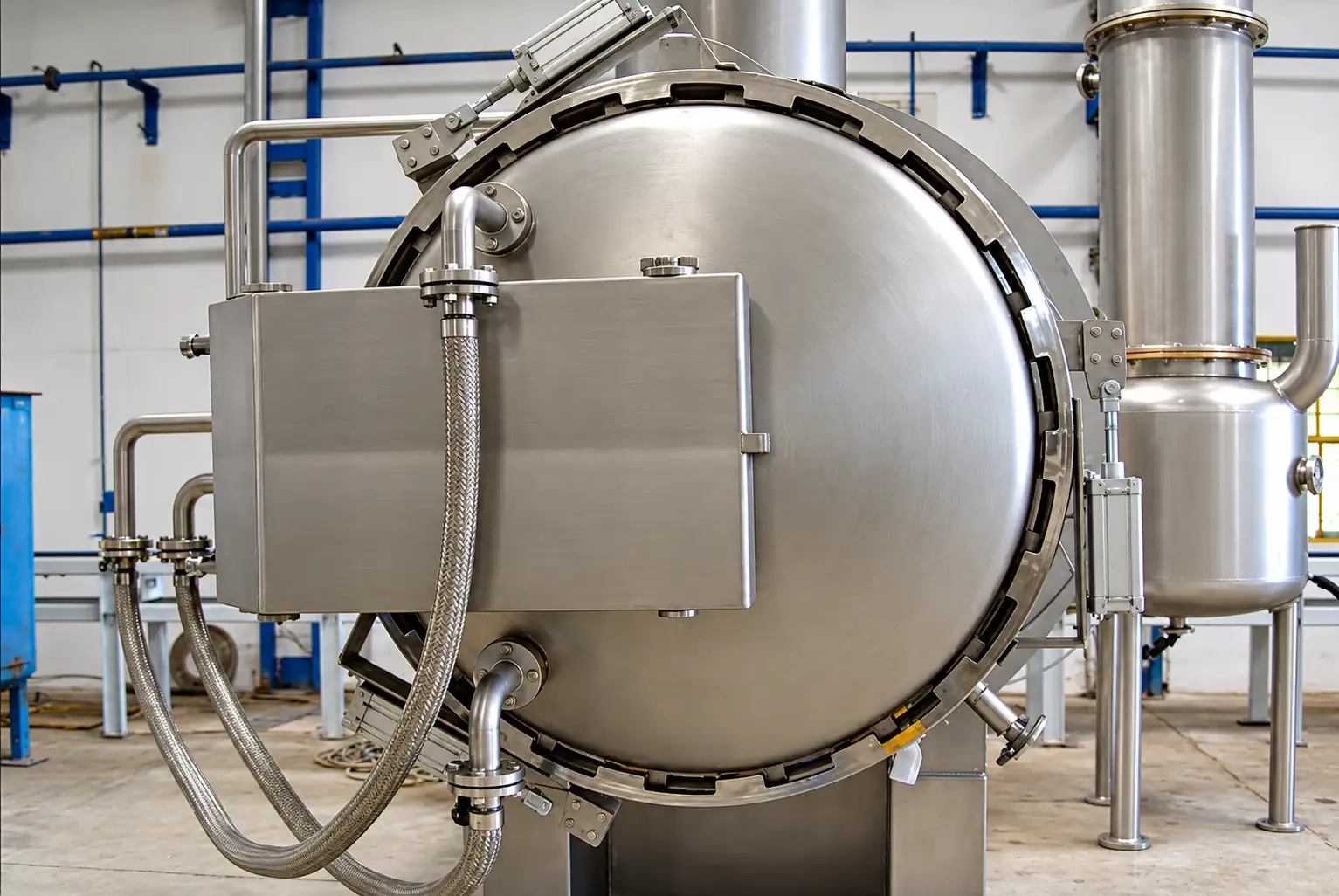
A rotary vacuum paddle dryer (RVPD) is a horizontal, jacketed vessel in which heated paddles continuously turn a wet batch while a vacuum lowers the boiling point of water or solvent. Heat from the jacket and paddles evaporates the liquid at a low temperature, the vapor is drawn off through a filter to a condenser, and the dried powder is discharged through a bottom valve. It suits heat-sensitive, solvent-wet and sticky products in pharmaceuticals, chemicals, agrochemicals, pigments and food.
Key takeaways
How a Rotary Vacuum Paddle Dryer Works
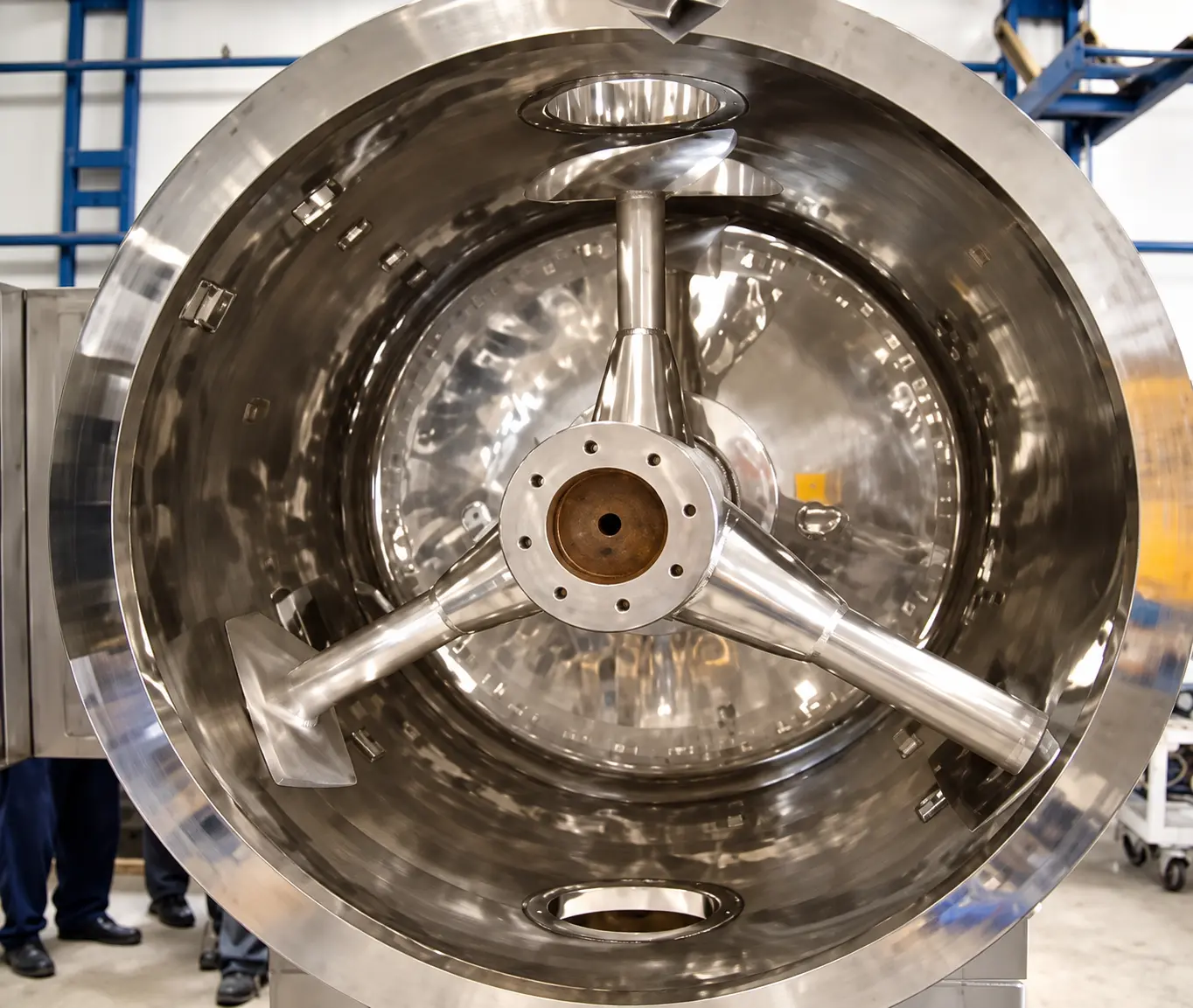
The dryer is a horizontal cylindrical drum surrounded by a heating jacket. Running through the center is a shaft fitted with paddles. Hot water, steam or thermal oil flows through the jacket, and in many designs through the shaft and paddles as well, so heat reaches the product from the shell wall and from the moving paddles at the same time.
Once the batch is loaded, the vacuum system lowers the pressure inside the drum. At reduced pressure, water and most solvents boil at much lower temperatures, so the batch can dry quickly while the product stays relatively cool. The paddles turn continuously, lifting and mixing the batch so that every particle keeps coming back into contact with the heated surfaces.
Vapor leaving the batch passes through a dust filter that holds back fine powder, then into a condenser where it turns back to liquid. The liquid collects in a receiver. When the product reaches its target dryness, it is discharged through a valve in the bottom of the drum, usually with the paddles still turning to clear the vessel.
The RVPD is one type within a wider family of vacuum dryers. How it compares with double cone and other rotary vacuum designs is covered in the guide to rotary vacuum dryers.
Main Parts of an RVPD
| Part | What it does |
|---|---|
| Horizontal drum (shell) | Holds the batch under vacuum; usually a cylindrical vessel with a heating jacket |
| Heating jacket | Carries hot water, steam or thermal oil to heat the shell wall |
| Agitator shaft and paddles | Turn and lift the batch continuously; in many designs the shaft and paddles are also heated |
| Vacuum system | Lowers the pressure so moisture or solvent boils at a lower temperature |
| Dust filter | Stops fine powder being carried into the vacuum line with the vapor |
| Condenser and receiver | Turn vapor back into liquid and collect it, allowing solvent recovery |
| Discharge valve | Empties the dried product from the bottom of the drum |
| Drive and controls | Set paddle speed, temperatures, vacuum and the drying recipe |
Why the Paddles Matter
The paddles set the RVPD apart from dryers that rely on tumbling or static contact. They do three jobs at once.
The agitation principle is closely related to the paddle action used for mixing powders, explained in the article on paddle mixers. In a dryer, the same lifting and turning motion is used to move heat into the product rather than to blend ingredients.
Paddle design involves trade-offs. Faster speeds and more aggressive paddle shapes improve heat transfer but can break fragile crystals or create fines. Gentler designs protect particle size but may lengthen the cycle. Variable speed control lets the operator adjust through the cycle, for example running faster through the sticky phase and slower at the end.
The Drying Cycle, Stage by Stage
| Stage | What happens |
|---|---|
| Loading | Wet cake, paste or slurry is charged into the drum, often from a filter or centrifuge |
| Heating up | The jacket and paddles bring the batch to drying temperature while vacuum is drawn |
| Constant-rate drying | Most free moisture or solvent evaporates; the rate is limited mainly by heat transfer |
| Sticky or paste phase | Many products pass through a stiff, sticky stage; paddle design and drive torque matter most here |
| Falling-rate drying | Remaining moisture moves out of particles more slowly; temperature and time are controlled closely |
| Cooling | The product is cooled under vacuum or with the jacket before discharge, where needed |
| Discharge | The dry powder leaves through the bottom valve, often with the paddles running to clear the drum |
Recipes control these stages. Setting jacket temperature, vacuum and paddle speed for each phase, rather than holding them constant, usually gives faster drying and better product quality.
Where RVPDs Are Used
| Industry | Typical products |
|---|---|
| Pharmaceuticals | Active pharmaceutical ingredients, intermediates and excipients that are heat sensitive or solvent wet |
| Specialty and fine chemicals | Organic and inorganic compounds, catalysts and intermediates |
| Agrochemicals | Pesticide and fungicide technical materials and intermediates |
| Pigments and dyes | Wet cakes from filtration that must dry without losing color quality |
| Food and nutraceuticals | Heat-sensitive extracts, powders and ingredients |
| Polymers and resins | Materials that need gentle drying and solvent removal |
What these products share is sensitivity. They may degrade at high temperature, contain flammable or valuable solvents, or need careful control of particle size and residual moisture. Where a product is robust and dries easily, simpler dryers may be more economical.
Benefits of a Paddle Dryer
Operating Parameters to Control
| Parameter | Why it matters |
|---|---|
| Jacket and paddle temperature | Sets the driving force for heat transfer; too high risks product damage |
| Vacuum level | Lower pressure lowers the boiling point and speeds drying at a given temperature |
| Paddle speed | Faster turning improves heat transfer but can break fragile particles |
| Batch fill | Too little reduces heat transfer area in contact; too much slows drying |
| Product temperature | The real limit for heat-sensitive products; monitored throughout the cycle |
| End point | Confirmed by product temperature, vapor flow or sampling, rather than time alone |
Solvent Recovery and Environmental Benefits
Many pharmaceutical and chemical products are filtered from organic solvents, and the cake that reaches the dryer can carry a large amount of solvent. Because the RVPD is a closed vessel under vacuum, almost all of that solvent can be condensed and collected rather than released to the atmosphere.
Recovered solvent can often be purified and reused, which lowers raw material cost, or sent for proper disposal. Keeping solvent vapor inside a closed system also improves workplace safety and helps plants meet emission limits. The condenser needs to be sized for the vapor load at the fastest stage of drying, not the average.
After Drying: Delumping and Handling
Even with continuous agitation, some products leave the dryer with lumps or agglomerates. A delumper or mill after the discharge valve brings the powder to a consistent particle size before packing or further processing. How these machines work is covered in the guide to lump breakers.
Closed transfer from the dryer to the next step is also worth planning. For potent or sensitive products, contained discharge into drums, IBCs or a conveying system protects both the product and the people handling it.
Cleaning and Changeover
In multi-product plants, cleaning between batches can take as long as drying. Smooth internal surfaces, a door that gives good access, a discharge valve without dead pockets and spray nozzles for wet cleaning all reduce changeover time. Plants planning automated cleaning across several vessels can find guidance in the article on choosing a CIP system.
Safety Considerations
An RVPD often handles flammable solvents under vacuum and heat, so safety is part of the design. The vessel must be rated for the vacuum and any pressure it may see, electrical equipment must suit the hazardous area classification, and nitrogen blanketing is often used to keep oxygen levels low when flammable solvents are present.
Process controls add further protection: interlocks on temperature and vacuum, monitoring of shaft seals and safe sequences for loading, discharge and breaking vacuum. For high-potency products, containment measures protect operators during charging and discharge.
Common Problems and What Helps
| Problem | What usually helps |
|---|---|
| Drying takes longer than expected | Check vacuum level, condenser capacity, heating medium temperature and batch fill |
| Lumps or balls in the product | Adjust paddle speed through the sticky phase, or add delumping after discharge |
| Product degraded or discolored | Lower jacket temperature, improve vacuum and watch product temperature closely |
| Fine powder carried into the vacuum line | Check the dust filter and reduce vapor velocity at the start of drying |
| Product left in the drum | Run the paddles during discharge and check the discharge valve design |
| Leaks at the shaft seals | Inspect and maintain seals regularly, since they work under vacuum in the product zone |
 “A dryer designed for difficult materials must do more than evaporate liquid – it must keep the product stable through every stage.”

See it in action
RVPD Versus a Vacuum Tray Dryer
Plants moving from small-scale production often compare the RVPD with the vacuum tray dryer, a cabinet in which product is spread on heated shelves under vacuum. Tray dryers are simple and suit very small batches or products that must not be agitated. But they are labor intensive, the product dries unevenly from top to bottom, and loading and unloading trays exposes operators to the product.
The RVPD replaces that manual work with a closed, agitated vessel. Drying is more even, cycles are usually shorter, and charging and discharge can be contained. For plants scaling up a solvent-wet or heat-sensitive product beyond a few trays, that change is often the main reason to move to a paddle dryer.
From Pilot Trial to Production
Drying behavior can change with scale. A larger drum has less heated surface per liter of product, so the cycle may lengthen unless heated paddles make up the difference. Sticky phases can also be more demanding in a full-size batch, because the paddles must move more material at once.
Pilot trials with real product, at a scale close to production where possible, help set realistic cycle times and confirm paddle speed, temperature and vacuum settings. Ask the supplier how their trial results translate to the production dryer, and what margin they build into the sizing.
Sizing and Selection
RVPD from Cybernetik
Cybernetik Technologies, headquartered in Pune and delivering turnkey automation since 1989, builds thermal processing equipment as part of its process automation range. Its rotary vacuum paddle dryer handles powders, slurries and pastes at up to 5,000 liters per batch, with customizable capacities.
Heat transfer from the jacket and paddles is rapid and uniform, helped by their low thermal inertia, while continuous agitation keeps the product temperature even and vacuum heating at low temperature prevents thermal degradation.