
Key takeaways
Watch a paddle mixer run with the lid off and the first thing you notice is movement. Material is not just stirred, it is lifted, thrown, folded and dropped again, over and over, in every direction at once. That constant turnover is what makes paddle mixing fast, and understanding why it happens tells you a lot about where these machines fit.
This article looks at how paddle mixers actually work, what separates the different mixing regimes, where they are used and why, and how to keep one performing over years of service. If you are at the point of comparing machines to buy, the companion piece on choosing a paddle mixer machine goes through the specification decisions.
The Basic Mechanism
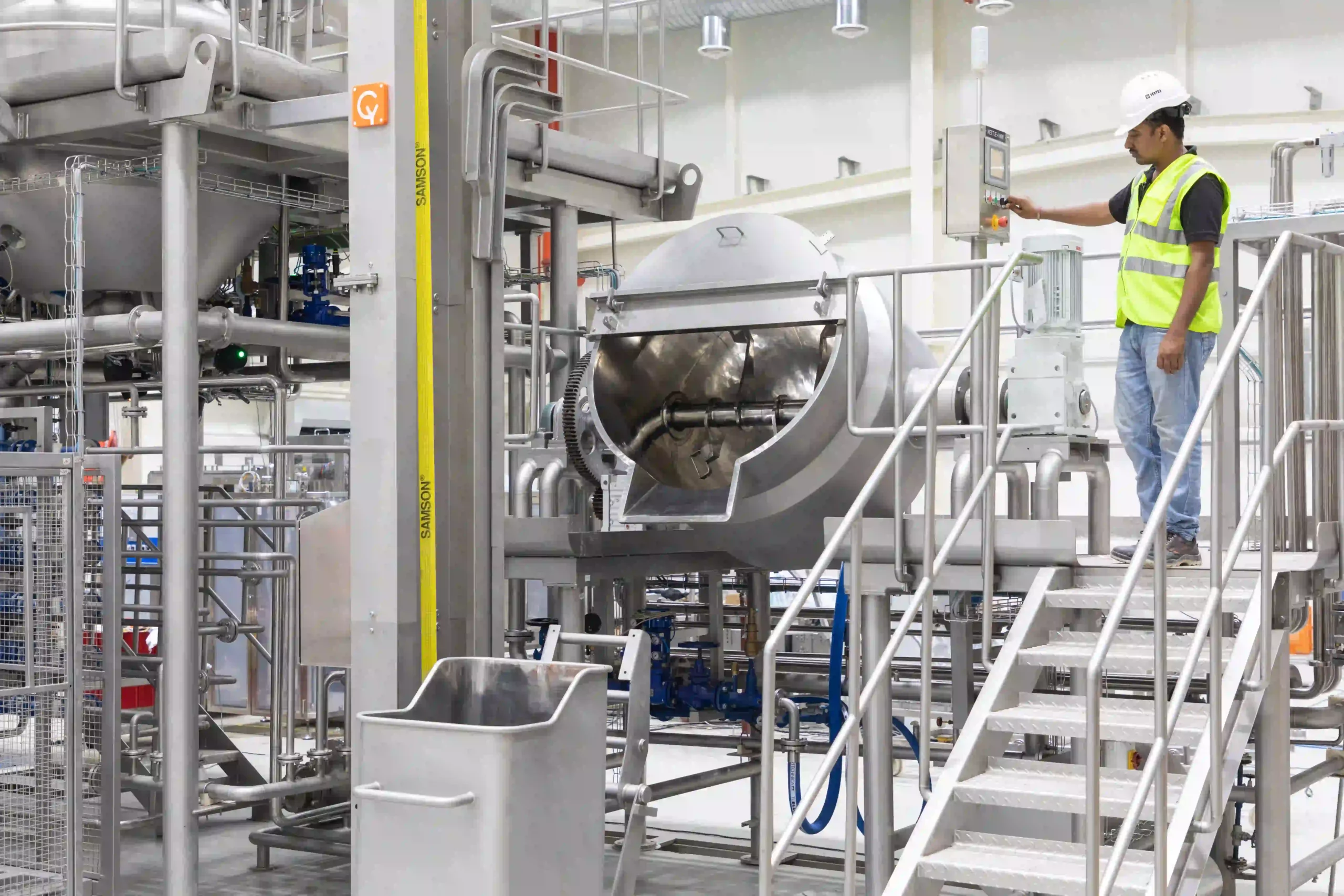
A paddle mixer is a horizontal trough with one or two shafts running along it. Each shaft carries arms, and each arm ends in a flat paddle set at an angle to the direction of rotation.
As the shaft turns, each paddle does two things. It lifts material upward, and because it is angled, it also pushes that material along the trough. Paddles at different positions along the shaft are arranged so some push one way and some the other, which sets up movement back and forth along the mixer as well as up and over.
The result is three-dimensional movement: across the trough, along it and vertically. Particles do not follow a single path around the mixer; they are constantly being redistributed. That is why paddle mixers reach a uniform blend quickly compared with designs that move material in a more orderly way.
Three Things That Shape Performance
Paddle angle
The angle of each paddle decides the balance between lifting and pushing. A steeper angle moves material along the trough more strongly; a flatter one lifts more. Many designs allow the angle to be adjusted, which lets the mixing action be tuned for a particular product.
Tip clearance
The gap between the paddle tips and the trough wall matters more than it looks. A small gap keeps material moving right up to the wall, so nothing sits undisturbed along the bottom. A larger gap leaves a layer of material that barely moves, and that layer is where poorly mixed product and cross-contamination between batches hide.
Speed
Shaft speed decides which mixing regime the machine operates in, and that is important enough to need its own section.
Mixing Regimes and the Froude Number
Engineers describe how a mixer moves material using a simple ratio called the Froude number. It compares the outward force from rotation with the pull of gravity. The ratio depends on paddle speed and the radius the paddles sweep, and it predicts how the material behaves.
| Mixing regime | Froude number | What the material does | Typical mixer |
|---|---|---|---|
| Gravity dominated | Well below 1 | Rolls and slides, pulled back down by gravity | Ribbon blenders and slow paddle mixers |
| Fluidized | Around 1 | Lifted and briefly suspended, close to weightless | Twin-shaft paddle mixers |
| Centrifugal | Above 1 | Thrown outward against the wall and back through the bed | Ploughshare mixers |
A worked example makes this concrete. Paddles sweeping a radius of half a meter at 40 rpm give a Froude number close to 0.9, right in the fluidized range. Double the speed to around 60 rpm with the same radius and it climbs to about 2, into the centrifugal regime. Small changes in speed move a mixer between quite different behaviors.
The fluidized regime is where twin-shaft paddle mixers do their best work. Material thrown by one shaft meets material thrown by the other in the overlapping zone between them, and for a moment particles are suspended rather than resting on anything. Because segregation is driven mainly by gravity acting on differences in particle size and density, briefly taking gravity out of the picture is what lets these mixers blend difficult formulations so quickly.
Running below that range gives gentler, slower mixing. Running above it moves toward a ploughshare-style action, which is more aggressive and useful for different jobs.
Single Shaft and Twin Shaft
Single-shaft paddle mixers lift and fold material along one trough. They are simpler, cheaper and perfectly adequate for many blends, with mixing times typically measured in minutes.
Twin-shaft mixers use two counter-rotating shafts whose paddle paths overlap. That overlap is what creates the fluidized zone described above, and it is why twin-shaft machines can reach a uniform blend in a cycle often under two minutes. They cost more and draw more power, and they earn that back where cycle time or segregation is the problem.
Where paddle mixers sit alongside ribbon, ploughshare, tumble and high shear designs is covered in the guide to industrial blenders.
Where Paddle Mixers Are Used
| Application | The mixing challenge | Why paddle mixing suits it |
|---|---|---|
| Animal feed premixes | Vitamins and trace minerals added at very low inclusion rates | Fluidized mixing distributes small additions quickly without long cycles |
| Fertilizer blends | Granules of different sizes and densities that want to separate | Gentle action avoids crushing granules while resisting segregation |
| Dry mortar and renders | Fine binders, coarse sand and small additive doses together | Handles wide particle size ranges and additions in one batch |
| Food and seasoning blends | Delicate particles plus oil or flavor sprayed on | Distributes liquid fast and handles friable pieces gently |
| Bakery premixes | Flour-based blends with minor ingredients and fats | Short, uniform mixing of large batches |
| Detergent powders | Base powder with liquid actives added during mixing | Good liquid distribution without forming wet lumps |
The common thread in that table is a mix that is awkward for gentler or slower designs. Very small additions that must spread evenly, components that want to separate, particles that break easily and liquids that need spreading through a powder all favor the fast, three-dimensional action of a paddle mixer.
Feed premixes are a good example of why this matters. Trace ingredients may make up a tiny fraction of the batch, yet every bag has to contain its share. A mixer that leaves those ingredients unevenly spread produces feed that is under-dosed in some bags and over-dosed in others, which is a real problem for animal health and for regulatory compliance.
Adding Liquids
Paddle mixers handle liquid addition well, and it is one of the main reasons they are chosen.
When liquid meets a slow-moving powder, it soaks into whatever it lands on and forms wet lumps that are hard to break down again. In a paddle mixer, the powder is constantly being lifted and exposed, so sprayed liquid spreads across a far larger surface in a short time.
Getting it right still depends on the setup. Spray bars that spread liquid across the width of the mixer work much better than a single injection point. Where formulations carry a lot of liquid, high-speed chopper blades mounted in the trough wall break up any lumps as they form. Timing matters too, since liquid added before the dry ingredients are spread tends to leave wet and dry patches that never fully even out.
The Benefits in Practice
Batch and Continuous Operation
Paddle geometry works well in continuous form, where ingredients are fed steadily in at one end and a blended stream comes out at the other. A continuous paddle mixer removes the fill, mix and empty cycle altogether, which suits long runs of a single product.
The catch is that there is no batch to sample and approve. Uniformity depends on how accurately the feeders meter each ingredient and how long material spends in the mixer, so feeder accuracy becomes as important as the mixer itself. For plants that change products often, batch mixing is usually the better fit.
 “The right paddle angle, tip clearance, and shaft speed determine how effectively a mixer lifts, folds, and redistributes material.”

See it in action
Keeping a Paddle Mixer Performing
Paddle mixers are robust, but a few things quietly degrade their performance over time if they are not watched.
Paddle tip wear
Abrasive products such as sand, minerals and fertilizers wear paddle tips down. As they wear, the tip clearance grows, and the layer of barely moving material along the trough gets thicker. Mixing slowly gets worse without any obvious fault. Replaceable or adjustable tips let the clearance be restored rather than replacing whole paddles.
Shaft seals
Where the shafts pass through the trough ends, fine powder tries to escape and work its way into bearings. Seals designed for powders, sometimes purged with air to keep dust out, protect the bearings and stop product loss. A failing seal usually shows up first as dust around the shaft ends.
Lumps before they arrive
A mixer spreads ingredients; it does not reliably break hard lumps that arrive with them. Caked raw materials are better dealt with before the mixer, a subject covered in the article on lump breakers.
Cleaning
Paddle arms, shafts and trough corners are exactly where residue collects. In plants running several products, easy access, removable parts and full discharge decide how quickly the mixer can change over without carrying one product into the next.
Mixing Equipment from Cybernetik
Cybernetik builds mixing equipment across several designs and specifies it against the material rather than from a single machine type. Alongside the continuous paddle mixer, ploughshare mixers cover the more aggressive centrifugal regime for mixes that need it.
| Cybernetik mixing equipment | Specification |
|---|---|
| Continuous paddle mixer | Continuous-flow paddle mixing for steady-state production |
| Ploughshare mixer | 500 to 5,000 liters, customizable, inlet and outlet 150 to 300 NB |
| Ribbon blender | 100 to 10,000 liters, 5 to 100 hp, double ribbon with plug valve discharge |
| Column lift high shear mixer | 500 liters at up to 3,000 rpm, for dispersion rather than distribution |
| IBC blender | Tumbling of containers up to 2,000 liters |
| Materials of construction | SS304 or SS316 product contact |
| Hazardous area | ATEX construction available where combustible dust applies |
| Control | Recipe-based operation under unified PLC and SCADA architecture |
Having several mixer types in one range matters for the reason set out above. Different products want different mixing regimes, from gentle gravity-dominated blending through fluidized paddle mixing to centrifugal ploughshare action. A supplier offering only one of those will naturally recommend it.
Cybernetik has been building automation for more than three decades. It is headquartered in Pune with facilities in Gujarat and Raigad and offices in the United States and UAE, and has installed over 6,000 systems in more than 30 countries, including over 400 custom automation solutions. More background is on the Cybernetik about page.