
Key takeaways
A melter does something that sounds trivial and is not: it turns a solid into a liquid at a controlled rate, at a controlled temperature, without damaging it.
The reason it deserves dedicated equipment rather than a heated tank is that melting is a phase change, and phase changes behave differently from heating. Raising a material to its melting point is the easy part. Getting it through the transition consumes far more energy than the warming did, and the material spends that whole period sitting at temperature, which is exactly when heat damage occurs.
This guide covers how melters work, what they replace, the main configurations, and where they are used across food and process manufacturing.
What a Melter Actually Does
Two thermal loads are involved, and they are very different in size.
Sensible heat raises the material to its melting point, and it is straightforward to calculate and relatively small. Latent heat then converts solid to liquid at constant temperature, and for food fats it is typically on the order of a hundred to a hundred and sixty kilojoules per kilogram. That second load dominates, which is why a vessel that heats a liquid quickly can take a surprisingly long time to melt the same mass of solid.
It also explains why melt rate rather than vessel volume is the meaningful specification. A melter is rated in kilograms per hour, because what a plant needs to know is how fast solid becomes usable liquid, not how much liquid the machine can hold.
The third factor is contact. Heat only enters where solid touches something hot, so melt rate depends heavily on how much surface the material presents. A single large block melts slowly not because it needs more energy per kilogram but because only its outer face is receiving any.
What a Melter Replaces
The alternative to a melter, and still common practice in many plants, is a hot room.
Pallets of solid material are moved into a warm room and left for a day or more until they are liquid enough to use. It requires no capital equipment beyond the room itself and it works, in the sense that the material does eventually melt.
What it costs is less visible.
A melter converts that into an on-demand operation measured in minutes rather than days, with a known temperature and a known rate. For plants where the hot room is a bottleneck on planning flexibility rather than on capacity, that is usually the argument that carries the investment.
Types of Melter
| Melter type | How it works | Suits | Limitation |
|---|---|---|---|
| Grid or block melter | Blocks rest on a heated grid and melt progressively, with molten material draining away | Solid blocks of fat, chocolate or wax as delivered | Melt rate limited by contact area with the grid |
| Tank melter with agitator | A jacketed vessel with an agitator melts and holds a charge | Batch melting where the molten product is also held or blended | Slower on large solid blocks unless they are broken down first |
| Scraped surface melter | Blades continuously clear the heated wall as product melts | Products that foul the wall, such as those carrying sugar or milk solids | More moving parts and higher cost |
| Drum or tote melter | Heat is applied to the shipping container itself | Material received in drums or IBCs that must not be decanted solid | Slow, and heat reaches product through the container wall |
| Tunnel or conveyor melter | Product passes through a heated tunnel on a belt | Continuous melting of discrete pieces | Larger footprint and limited to products that hold shape while softening |
The grid melter deserves comment because it addresses the contact-area problem directly. Blocks rest on a heated grid, melt at the contact surface, and the molten material drains away, which continuously exposes fresh solid to the heat. That progressive action is why grid designs handle whole blocks efficiently while a plain heated tank struggles with them.
Melt on Demand or Melt and Hold
The second architectural decision, and it has consequences well beyond the melter.
Melt on demand produces liquid at the rate the process consumes it, so material spends the minimum possible time hot. Quality is best protected this way, and the melter must be sized against peak consumption rather than average.
Melt and hold produces a buffer of molten material that the process draws from. It decouples melting from consumption, which allows a smaller melter and smooths demand, at the cost of material sitting at temperature in the holding vessel. Where the product tolerates it, this is efficient. Where the product is heat sensitive, the holding tank becomes the quality problem the melter was bought to avoid.
Most installations sit between the two, with a modest buffer covering short-term variation rather than a full shift of material. Sizing that buffer against the actual draw-down pattern, rather than defaulting to a large holding tank, is worth doing deliberately.
What Determines Melt Rate
Materials Melters Handle
The equipment is most associated with confectionery, and the application range is wider.
The reasons fats in particular are difficult to process, melting ranges rather than melting points, cumulative heat damage and burn-on, are covered in the guide to fat processing machines.
 “The true measure of a melter is not how much liquid it holds, but how reliably it converts solid material into usable liquid at the rate the production line consumes it.”

See it in action
Benefits
Where Melters Are Used
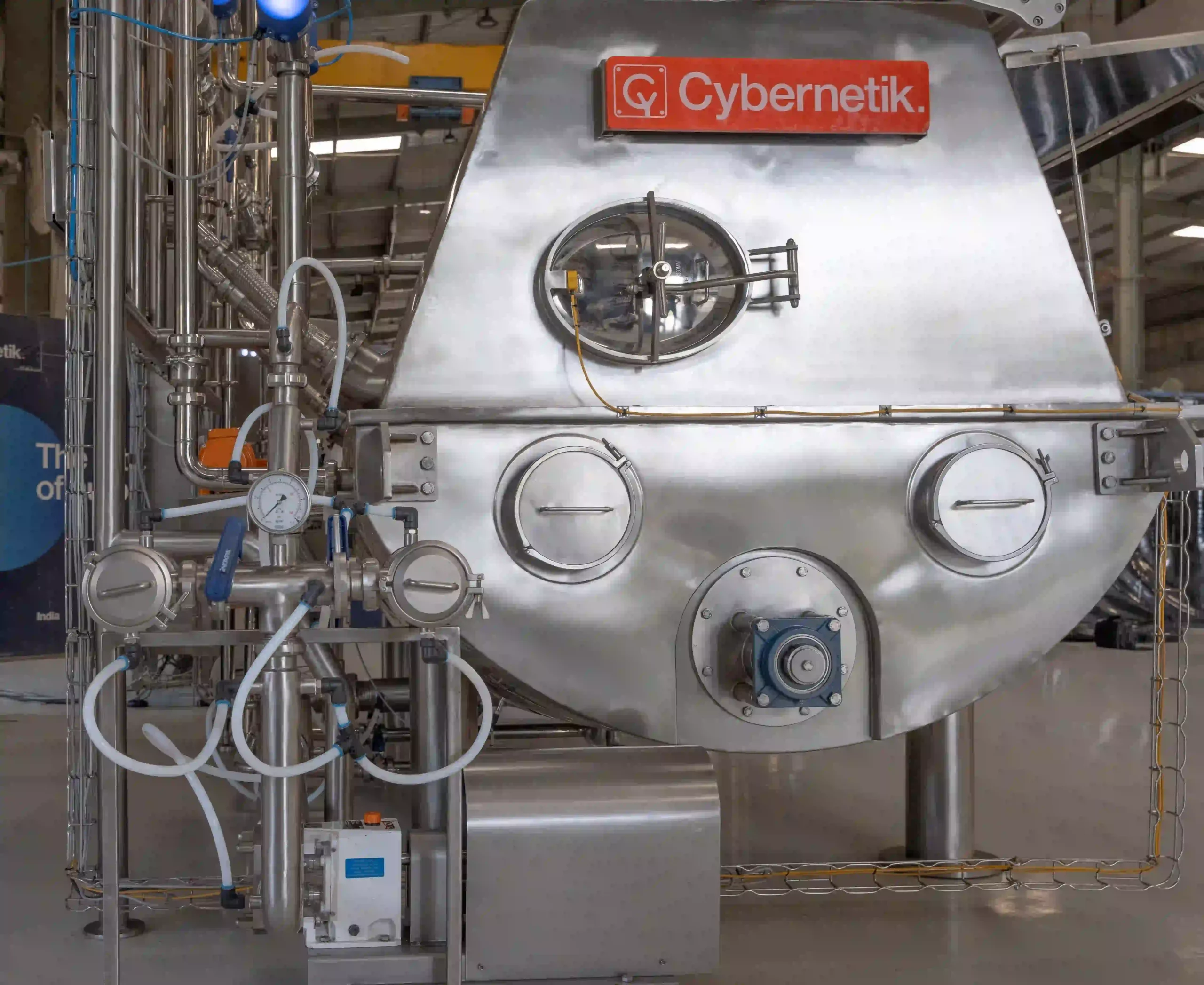
Melters from Cybernetik
Cybernetik builds the melter as part of complete food processing lines, so it is specified alongside the equipment that consumes the molten product rather than as a standalone unit.
| Cybernetik melter, INCO-MELT range | Specification |
|---|---|
| Capacities | 500, 700, 1000, 1200, 1500 and 2000 kg/hr, customizable |
| Materials of construction | SS304 or SS316 |
| Chamber design | Closed chamber, preventing contamination and material loss |
| Temperature control | Automatic, holding setpoint rather than relying on operator judgment |
| Agitation | Agitator screw for thorough mixing and assisted discharge |
| Difficult materials | Vibratory grid breaking down tough-to-melt blocks to speed heat transfer |
| Build standard | Hygienic, GMP built |
| Integration | Automation options for downstream processes |
| Products handled | Chocolate, butter, concentrated butter, cocoa butter, cocoa liquor, palm oil fat, palm kernel fat, coconut fat, melano fat and cheese |
| Downstream equipment | Cooking kettles to 2,000 liters, tilting kettles to 1,500 liters, high shear mixing and CIP systems |
Three of those specifications answer problems raised above. The vibratory grid attacks the contact-area constraint by breaking blocks down as they melt, which is what allows whole blocks to be charged as delivered rather than cut by hand first. The agitator screw keeps material moving so melted product does not sit against the heated surface insulating what is behind it, and it assists discharge of a viscous liquid that will not drain willingly. And the closed chamber excludes the moisture that causes cocoa-based products to seize.
Downstream, the melter feeds equipment specified with it: cooking kettles handling pressure cooking to 2,000 liters, tilting kettles to 1,500 liters, high shear mixing and clean-in-place systems sized for the cleaning that fat-bearing equipment requires.
Cybernetik has operated for more than three decades, is headquartered in Pune with additional facilities in Gujarat and Raigad and international offices in the United States and UAE, and has installed over 6,000 systems across 30 plus countries, including more than 400 custom automation solutions. Further background is on the Cybernetik about page.