
Key takeaways
Every plant manager recognizes the symptom. Filling and primary packaging are running fast, but the secondary stage is starving and surging in waves , operators frantically catching up at the case packer, half-loaded cases piling up at the wrong station, the palletizer waiting two minutes out of every five. The actual filler may be rated for 200 bottles per minute or 400 pouches per minute, but the line as a whole moves at the pace of its slowest, most operator-dependent stage. That stage, in most plants, is the case packing line.
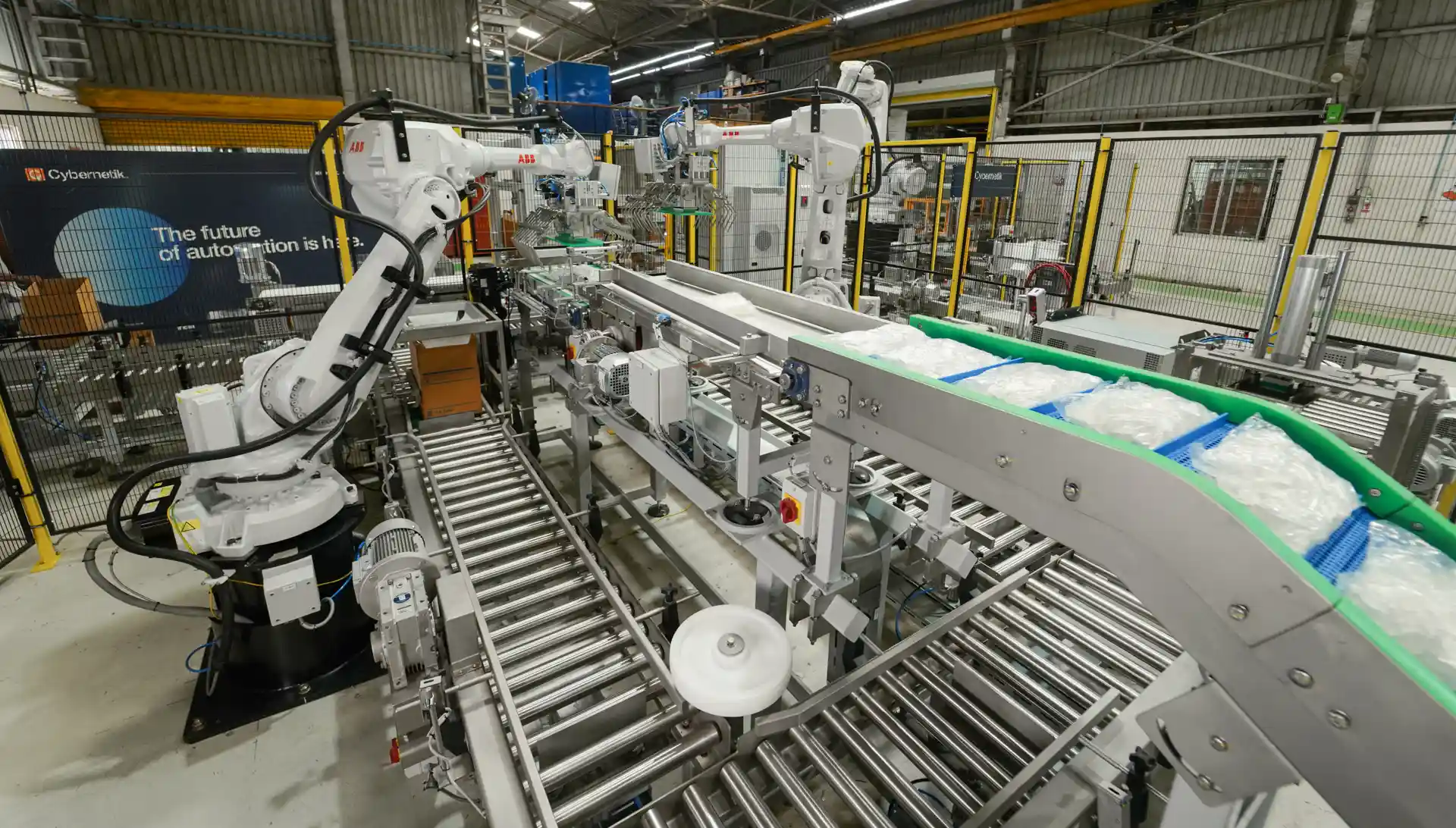
This guide explains what a case packing line actually is, how an integrated architecture, from a carton box forming machine at the front to a robotic palletizer at the back , delivers measurable efficiency gains, and how Cybernetik configures the full chain under a single PLC and SCADA architecture for food, pharmaceutical, FMCG and chemical manufacturers. If your secondary packaging is currently a collection of standalone machines stitched together with manual transfers, the difference an integrated case packing line makes to OEE is rarely under 15 percent.
What Is a Case Packing Line?
A case packing line is the sequence of secondary packaging machines that takes primary-packed product , pouches, bottles, sachets, blister packs, flow-wrapped bars , and groups, loads, seals and palletizes it into shipping cases or cartons. The line typically starts with an automatic carton box making machine (also called a carton erector or case erector), continues through the case packer itself where primary packs are loaded, then a case sealer, and finishes at a robotic carton palletizer that stacks loaded cases onto a pallet for dispatch.
On a well-designed case packing line, all of these stages run as a single system: one PLC orchestrates the cadence, one SCADA holds the recipes for every SKU, one safety chain interlocks every machine, and one HMI lets the operator switch the entire line between products in under five minutes. On a poorly designed line, each stage is a standalone island , and the operator becomes the integration layer.
Cybernetik’s integrated case packing line replaces operator integration with engineered integration. The result is a stage-to-stage hand-off that runs at the rated speed of the slowest deliberate stage , not the slowest operator.
How an Integrated Case Packing Line Improves Packaging Efficiency
1. Continuous Case Supply from an Automatic Carton Box Making Machine
Every case packing line is upstream-limited by carton supply. An automatic carton box making machine , also called a carton box forming machine or carton erector , picks flat carton blanks from a magazine, opens them into three-dimensional cases, folds and seals the bottom in a single uninterrupted cycle. With shift-autonomous magazine capacity and 15–30+ cartons per minute throughput, the carton box forming machine ensures the downstream case packer never starves and never waits for the operator to hand-fold a blank.
2. Synchronized Case Loading at Filler Cadence
On Cybernetik’s case packing line, the case packer itself reads the upstream filler’s cadence via the line PLC and matches its loading cycle accordingly. There is no buffer of half-filled cases waiting for operators; there is no operator frantically pushing cases through. The robot picks, the case loads, the sealer closes , all in a single synchronized rhythm that absorbs minor upstream surges through a deterministic conveyor buffer.
3. Unified Line Control and Single-Recipe Changeover
Multi-SKU production is the norm in modern food, pharma and FMCG. The efficiency penalty for a multi-SKU line is changeover time , every machine on the line must be reset to the new product. On an unintegrated line, this means three or four operators running through SOPs at three or four machines, often in sequence. On Cybernetik’s integrated case packing line, the operator selects the SKU once on the HMI; the carton erector, case packer, sealer and palletizer all reconfigure together , typically in under five minutes.
4. Quality Control at Every Stage, Not Just at the End
End-of-line inspection catches defects only after value has been added to them. An integrated case packing line distributes inspection across every stage: vision systems verify carton erecting; weight checkers verify pack loading; vision rejects mis-oriented or under-filled cases before sealing; a final check at palletizing verifies case integrity before stacking. The net effect is far fewer downstream rejects and far less rework.
5. End-of-Line Hand-Off to Palletizing Without Human Intervention
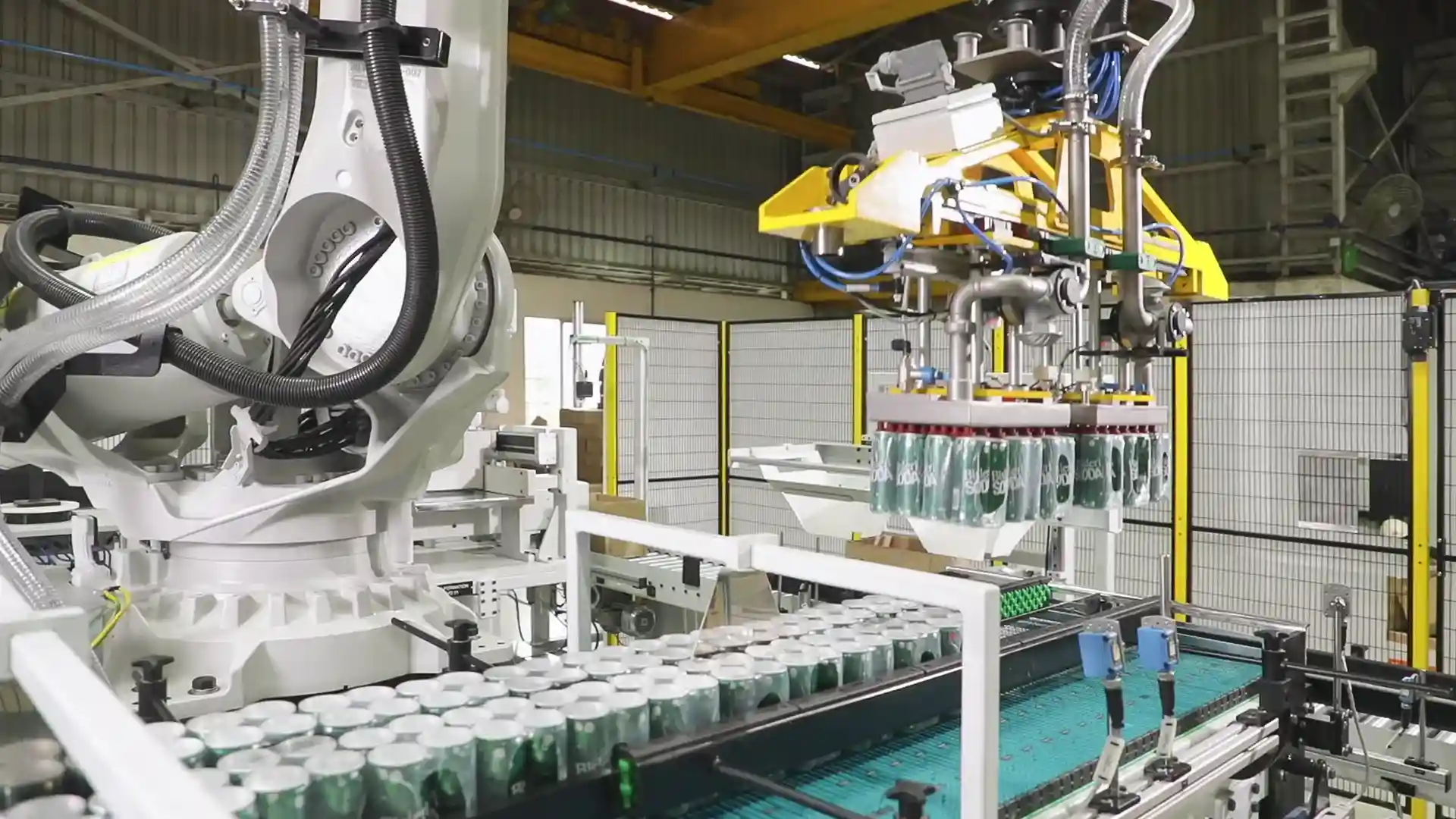
The final stage of any case packing line is the palletizer. Cybernetik’s robotic carton palletizer handles cartons, rigid boxes and corrugated cases of varying sizes , capable of simultaneously palletizing up to three boxes , with servo or pneumatic end-of-arm grippers and customized pallet matrix formations. Because the palletizer shares the line PLC, it knows in advance which SKU is arriving, what matrix to build, and which pallet to assign , eliminating the staffing requirement at the final stage entirely.
Linear vs Robotic vs Hybrid Case Packing Lines: Which Architecture Fits Your Volume?
Cybernetik builds case packing lines in three primary architectures. The right choice depends on throughput, SKU mix and the cost dynamics of your specific industry.
Linear Case Packing Line
In a linear architecture, mechanical pushers and conveyor-mounted indexers load each case at a fixed cycle, with all stages arranged in a single inline pass. Best suited to high-volume single-SKU lines, water, beverage, soft drinks at extreme throughput, where capex efficiency and steady-state throughput matter more than SKU flexibility. Cybernetik recommends linear case packing where the SKU is locked and rate exceeds what a single robotic arm can sustain.
Robotic Case Packing Line
In a robotic architecture, six-axis or SCARA arms perform pickup, loading and sometimes palletizing. SKU changes require only a recipe change on the HMI and a brief end-of-arm tooling swap , no mechanical reset. Throughputs up to 60 cases per minute on a six-axis case packer combined with 120 bottles per minute on bottle lines or 40 pouches per minute on pouch lines make this the right specification for multi-SKU food, FMCG and pharma manufacturers.
Hybrid Case Packing Line
For lines where some stages are best served mechanically and others robotically , for example, a linear case packer paired with a robotic palletizer , Cybernetik builds hybrid case packing lines that combine the capex efficiency of linear loading with the SKU flexibility of robotic palletizing, all under a single PLC architecture.
Side-by-Side Specifications
The table below compares the three architectures on the parameters that matter most for a packaging engineer or plant head evaluating a case packing line investment.
| Specification | Linear Line | Robotic Line | Hybrid Line |
|---|---|---|---|
| Throughput | Up to 100+ cases/min | Up to 60 cases/min | Up to 80 cases/min |
| SKU Flexibility | Low; mechanical reset | High; HMI recipe | Mid; mixed |
| Changeover Time | 30–60 min | Under 5 min | 10–15 min |
| Capex | Lower per unit | Higher per unit | Mid-range |
| Hygiene Build | Available | GMP-built option | GMP-built option |
| Footprint | Long but narrow | Compact, vertical | Medium |
| Best For | Single-SKU high-volume | Multi-SKU regulated | Mid-volume multi-SKU |
 “A modern case packing line doesn’t just automate secondary packaging; it unifies carton forming, robotic case packing, sealing, and palletizing into one intelligent, high-performance workflow.”

Cybernetik packaging engineering team
See it in action
Products and Cases Cybernetik’s Case Packing Line Handles
Primary packs loaded into the case
Case formats supplied by the carton box forming machine
Sealing and finishing
The Cybernetik Advantage: Engineering an Integrated Case Packing Line
Across more than 30 countries and four manufacturing facilities, Cybernetik has refined the build standards that make an integrated case packing line measurably more efficient than the sum of its parts:
When Should You Move to an Integrated Case Packing Line?
If your line shows any combination of the symptoms below, an integrated case packing line will pay back faster than incrementally upgrading individual machines:
Where two or more of these are true simultaneously, the business case for a Cybernetik integrated case packing line is typically self-funding within 18 to 30 months on labor, scrap, uptime and changeover savings combined.