
Key takeaways
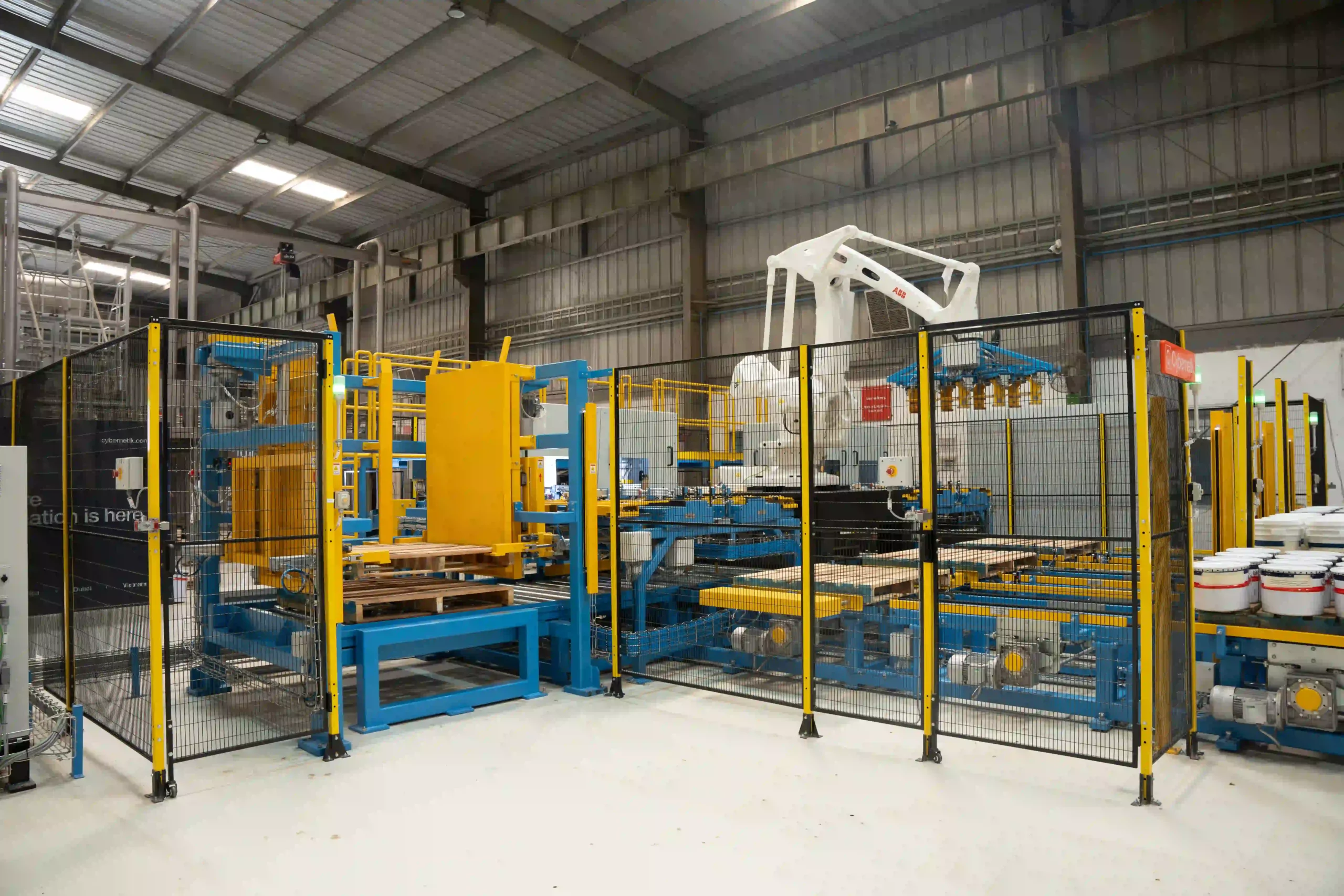
The word ‘system’ in automatic robot palletizing system is doing more work than it appears. When someone searches for a robotic palletiser, they usually have a mental image of a robotic arm stacking cases. What they receive, when they buy from a manufacturer who delivers a complete solution is an automatic robot palletizing system: an infeed conveyor with product registration, a robotic arm with purpose-designed end-of-arm tooling, an automatic pallet supply and completed pallet discharge mechanism, a downstream handoff to stretch-wrap, and a unified control architecture that runs all five as a single coordinated unit. The arm is not the system; the arm is one component in the system.
This guide explains each component of an automatic robot palletizing system in the depth that makes a procurement brief accurate and a supplier evaluation meaningful. If you have been comparing palletizer quotes that specify only the arm, throughput, payload, reach, without specifying the rest of the system, the framework below gives you the full picture that the quotes are missing.
What Is an Automatic Robot Palletizing System?
An automatic robot palletizing system is the complete assembly of machines, conveyors, controls and safety infrastructure that automates the palletising stage of a packaging line from product arrival to completed pallet dispatch, without requiring operator involvement between pallet loads. The ‘automatic’ qualifier means the full cycle, product infeed, matrix stacking, pallet supply and pallet discharge, runs under PLC control. The ‘robot’ qualifier means the pick-and-place stacking motion is performed by an articulated robotic arm with software-defined motion paths rather than by fixed mechanical sweeps.
What distinguishes a system from a machine is integration. A standalone robotic arm can be placed at the end of a packaging line and operated manually around it, an operator loads pallets, positions products by hand and removes completed pallets. That is a robotic arm, not a robot palletizing system. An automatic robot palletizing system integrates the upstream case packing line, the product infeed conveyor, the robotic arm, the pallet supply, the outfeed to stretch-wrap and the downstream dispatch lane under a unified PLC + HMI architecture that coordinates all stages without operator handoffs.
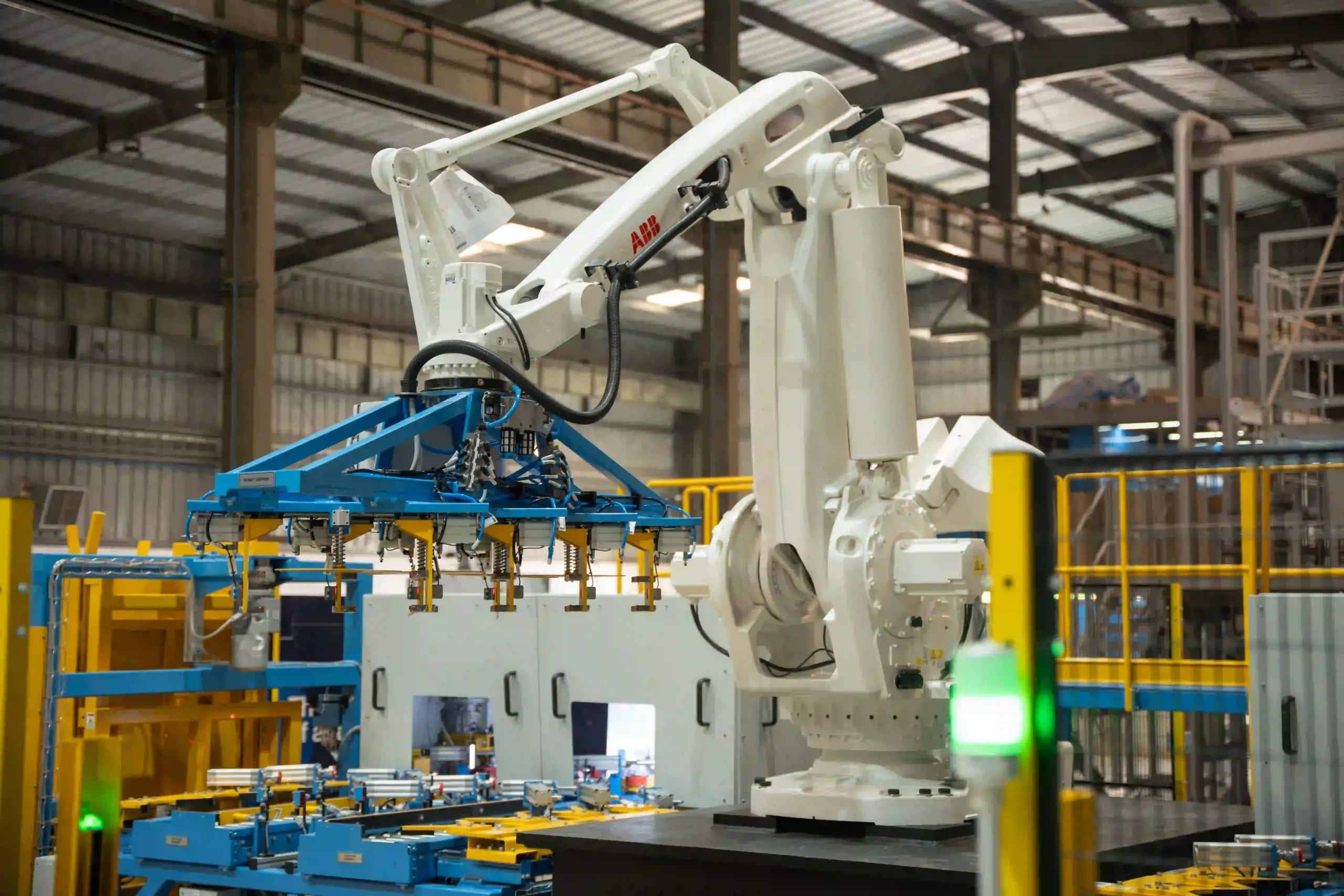
Cybernetik designs automatic robot palletizing systems as integrated solutions. The system includes: product infeed conveyor with case registration system; six-axis, gantry or cobot robotic arm with application-specific end-of-arm tooling; automatic pallet dispenser with up to 10-pallet magazine; completed pallet outfeed with roller conveyor to stretch-wrap interface; and unified PLC + HMI control architecture that receives SKU data from the upstream case packing machine and passes pallet completion data downstream. Every Cybernetik automatic robotic palletizer is delivered as this complete system.
Five Components of an Automatic Robot Palletizing System
1. Product Infeed Conveyor with Case Registration System
The product infeed is the interface between the upstream case packing machine and the automatic robot palletizing system. Its function is not merely to transport cases , it registers each arriving case at the correct position and orientation before the robotic arm attempts a pick. Without a dedicated registration system, positional error accumulates across picks and layers until the pallet is unstable. Cybernetik’s automatic robot palletizing system includes a dedicated case registration conveyor that positions each case precisely within the arm’s pick zone, independent of upstream conveyor variability.
2. Robotic Arm with Application-Specific End-of-Arm Tooling
The robotic arm executes the pick-and-place motion. In an automatic robot palletizing system, the arm’s motion path is fully software-defined, every pick position, every place position, every deceleration curve is stored in the recipe and executable without mechanical adjustment. The arm topology (six-axis, gantry or cobot) determines payload and throughput; the end-of-arm tooling determines whether the arm can actually pick the product reliably. Servo, pneumatic and vacuum EOAT options cover boxes, bags, drums, pails and mixed formats.
3. Automatic Pallet Supply and Dispenser
The automatic pallet supply is the component that converts a theoretically high-throughput robotic arm into a genuinely high-throughput automatic robot palletizing system. With manual pallet loading, the inter-pallet pause is an operator-response-time event, typically 1 to 3 minutes per pallet change. With an automatic pallet dispenser holding up to 10 pallets per magazine, the inter-pallet gap is the mechanical transfer time of the pallet alone, typically 10 to 20 seconds. At 1,200 cases per hour, this difference is 20 to 40 cases per pallet change, multiplied by the number of pallet changes per shift.
4. Completed Pallet Outfeed and Downstream Interface
When the recipe-defined stack height is reached, the completed pallet must leave the palletising station and the next empty pallet must arrive simultaneously , both without operator intervention. Cybernetik’s automatic robot palletizing system includes a roller conveyor outfeed that transfers the completed pallet to the downstream stretch-wrap station while the automatic pallet dispenser supplies the next empty pallet. The completed pallet’s dimensions, weight and SKU are communicated to the stretch-wrap PLC before the pallet arrives.
5. Unified PLC and HMI Control Architecture
The control architecture is what makes the automatic robot palletizing system automatic rather than automated-around-an-operator. The unified PLC receives SKU identification from the upstream case packing machine, pre-stages the correct pallet matrix recipe before the first case of each batch arrives, monitors arm health, registration accuracy and EOAT integrity in real time, and coordinates the pallet supply and outfeed timing. The HMI provides the operator with recipe management, alarm response and throughput monitoring, not production coordination.
Three Automatic Robot Palletizing System Configurations
Cybernetik builds automatic robot palletizing systems in three configurations that differ in throughput, integration scope and capital profile.
Standard Turnkey Automatic Robotic Palletizer System
Six-axis or gantry arm, product infeed with registration, automatic pallet dispenser, completed pallet outfeed, unified PLC + HMI, safety architecture. Delivered as a single integrated system. Throughput: six-axis up to 1,200 boxes/hr or gantry 210 units/hr. Best for single-line food, FMCG, chemical and pharmaceutical end-of-line operations specifying their first complete automatic robot palletizing system.
Full End-of-Line Integrated Palletizing System
The automatic robot palletizing system integrated with the upstream case packing machine and downstream stretch-wrap and dispatch under a single line PLC. SKU transitions from the case packing machine propagate to the palletizing system recipe automatically. Pallet completion data triggers the stretch-wrap cycle. No operator coordination between secondary and tertiary packaging stages. Best for multi-SKU operations where the case packing and palletising stages must run as a single coordinated unit.
Multiline Automatic Palletizing System
A single robotic arm handles product arriving from multiple upstream case packing lines sequentially or simultaneously, assigning each to the correct product pallet in the correct recipe matrix. One PLC manages all upstream line identifications, recipe assignments and pallet tracking. Eliminates the capital cost of a dedicated palletising system per production line. Best for multi-product food, FMCG and chemical manufacturers running parallel production lines converging at a single dispatch stage.
Automatic Robot Palletizing System, Configuration Comparison
The table below compares the three automatic robot palletizing system configurations on the parameters most relevant to integration scope and investment decisions.
| Specification | Standard Turnkey | Full End-of-Line | Multiline |
|---|---|---|---|
| Throughput | Up to 1,200 boxes/hr | Up to 1,200 boxes/hr | Combined multi-line |
| Case Packing Integration | Infeed interface | Full shared PLC | Full shared PLC multi-line |
| Stretch-Wrap Integration | Outfeed handoff | Coordinated PLC handoff | Coordinated PLC handoff |
| SKU Recipe Pre-Staging | Operator-selected | Automatic from case packer | Automatic from each line |
| Pallet Dispenser | Auto , 10-pallet mag | Auto , 10-pallet mag | Auto , 10-pallet mag |
| Operator Coordination | Recipe supervision | None between stages | None between stages |
| Single-Vendor Scope | Palletizing system | Case packer + palletizer | All lines + palletizer |
| Best For | Single-line first install | Multi-SKU integrated line | Multi-line converging |
What Cybernetik’s Automatic Robot Palletizing System Handles
Products handled across system configurations
System integration points
Control and monitoring capabilities
 “The true strength of an automatic robot palletizing system lies in the integration of every component, from product infeed to pallet dispatch, into one coordinated workflow.

See it in action
When an Automatic Robot Palletizing System Replaces a Palletizer
The step from a standalone robotic palletizer to a complete automatic robot palletizing system is justified when two or more of the following apply.
Where two or more apply, upgrading from a standalone palletizer to a Cybernetik complete automatic robot palletizing system typically recovers the throughput gap between the case packer’s rated output and actual palletised cases per shift within twelve to twenty-four months.