
Key takeaways
Walk into almost any FMCG, food, or chemical plant today and you will find the same bottleneck at the end of the line: a pallet being built by hand. Despite upstream automation , filling, sealing, case-packing , the final stacking step still depends on people in many facilities. It is slow, inconsistent, and in high-throughput environments, it is the single biggest constraint between the line and the loading dock.
This guide puts the two approaches side by side , automated palletiser vs manual palletizing , across every metric that matters to a plant head or operations director: speed, cost, safety, flexibility, hygiene, and total return on investment. The objective is not to sell automation for its own sake, but to give you the data you need to make the right decision for your throughput, your product, and your plant.
What Is an Automated Palletiser, and How Does It Work?
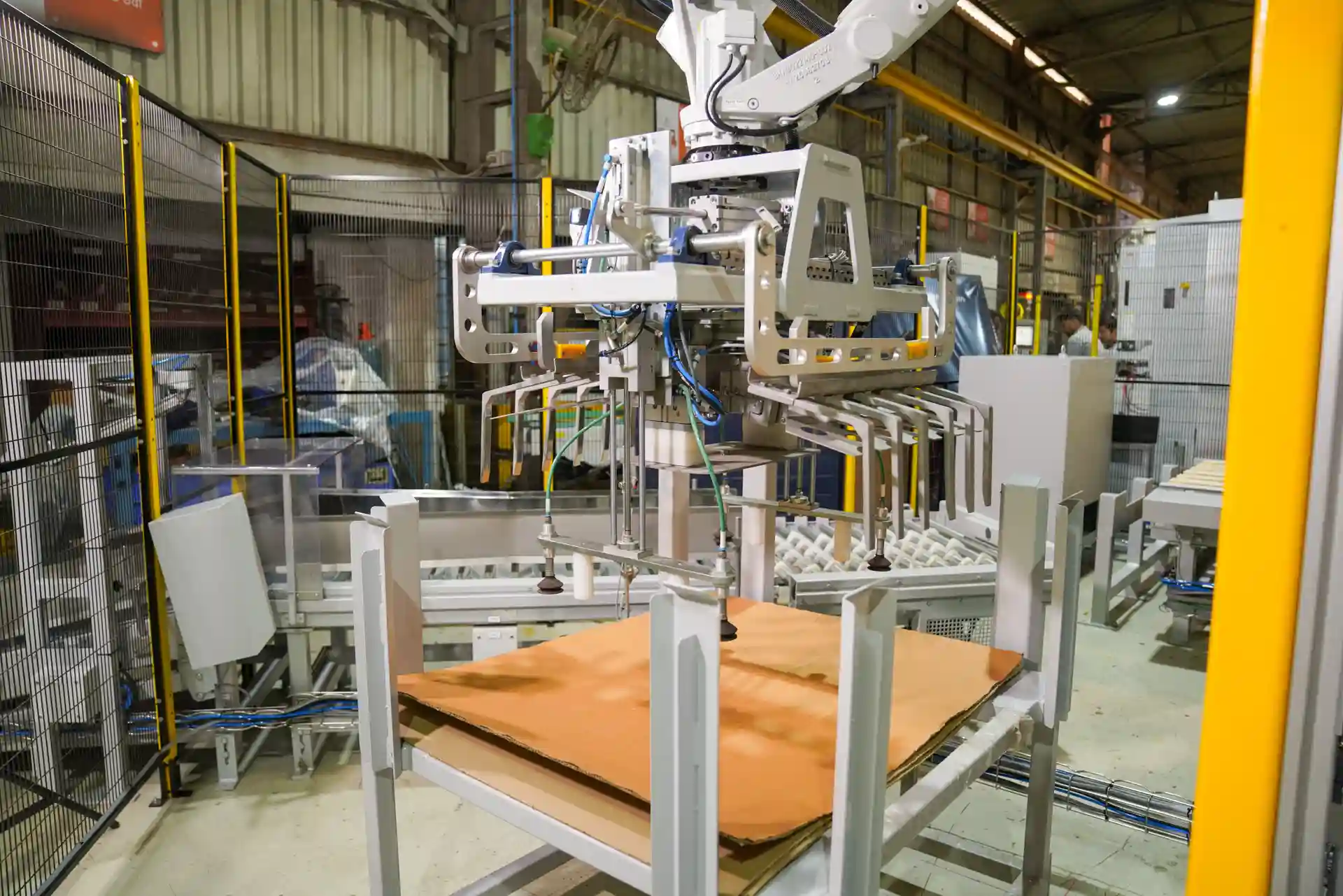
An automated palletiser is a machine that receives filled and sealed cases, bags, drums, or pails at the end of a packaging line and stacks them onto a pallet in a pre-programmed matrix pattern , without manual intervention. The system operates in a continuous loop: receive a unit, position it, place it, build the layer, move to the next layer, until the pallet is complete.
Cybernetik builds four types of automated palletisers, each matched to a specific load type and throughput requirement:
All configurations share a common engineering platform: modular design, upstream and downstream integration capability, customizable gripper tooling, and a single PLC/SCADA architecture for recipe management and safety interlocks.
Head-to-Head: Automated Palletiser vs Manual Palletizing
The table below compares the two approaches on seven parameters that plant engineers and operations directors use to build the business case.
| Parameter | Automated Palletiser | Manual Palletizing |
|---|---|---|
| Speed | Up to 15 cartons/min; 28 pails/min; 10 bags/min , consistent, 24/7 | 5–8 units/min per operator; degrades over shift |
| Consistency | ±0 mm pallet pattern; every pallet identical | Variable, errors increase with fatigue |
| Labour Cost | 1 operator for supervision (multiple lines) | 2–4 operators per line per shift |
| Injury Risk | Near zero, guarded cell + safety interlocks | High, repetitive strain, crush, slip injuries |
| Hygiene | No hand contact with product or primary pack | Direct contact possible; contamination risk |
| Flexibility | Recipe change on HMI; automatic pallet dispenser for multiple pallet sizes | Manual re-training required for each SKU |
| ROI Horizon | Typically 18–36 months on labour + yield savings | No capex; high opex (wages, errors, injuries) |
Why the Layer Palletizer Architecture Changes the Equation
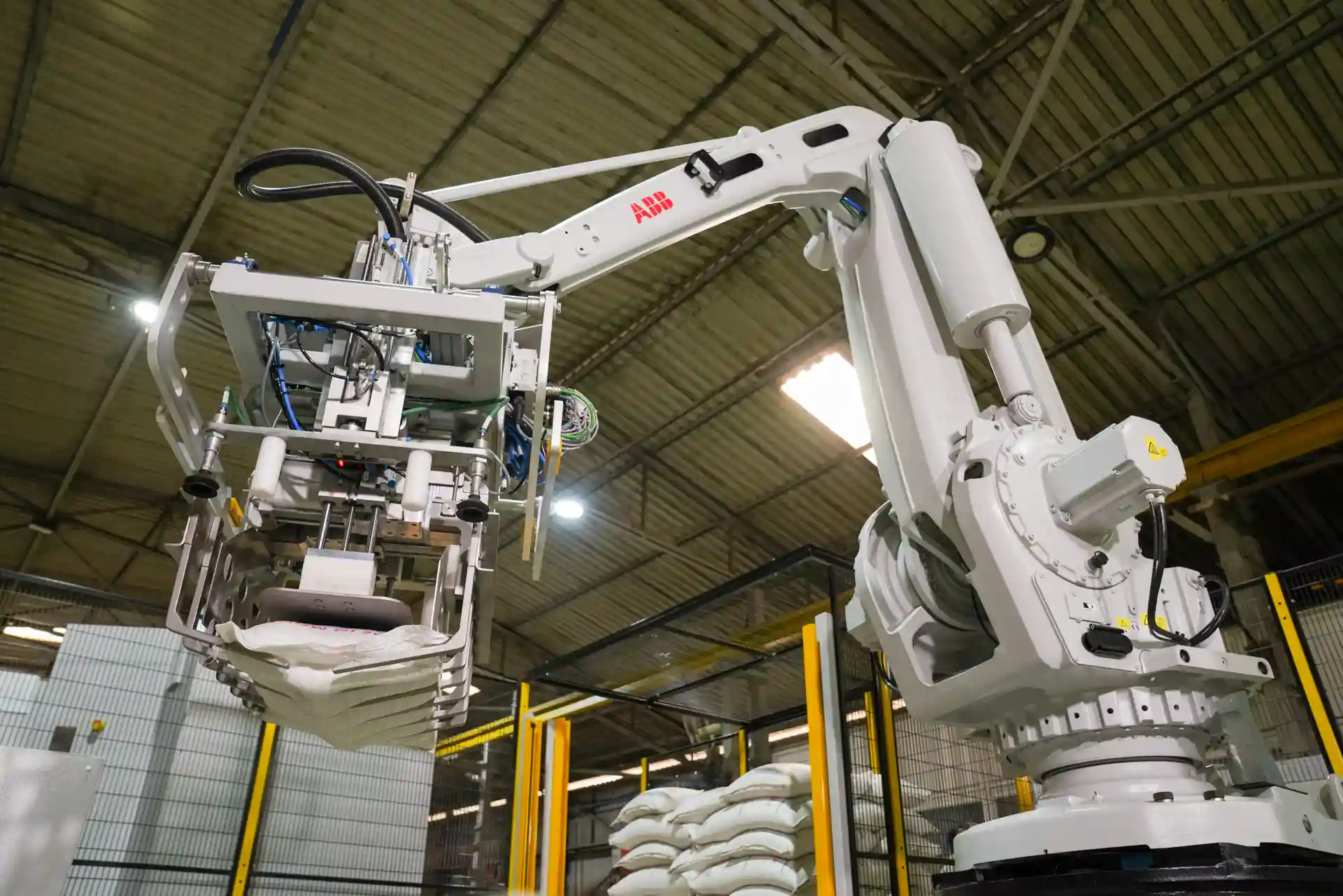
Within the automated palletiser category, the layer palletizer deserves special attention. A layer palletizer builds complete pallet layers simultaneously , rather than unit by unit , which dramatically increases throughput for high-volume, uniform-SKU applications such as carton cases in food and beverage, shrink-wrapped trays in FMCG, and sacked product in chemicals and fertilisers.
Key advantages of layer palletizer architecture over single-unit robotic stacking:
For mixed-SKU operations where the pallet pattern changes frequently, a six-axis robotic palletiser with an automated tool changer is the better fit. For dedicated, high-volume lines, the layer palletizer delivers the lowest cost per pallet.
Five Operational Arguments for Automating Your Palletizing Stage
1. Speed That Does Not Degrade Over a 12-Hour Shift
Manual palletizing output drops measurably after the fourth hour of a shift. Studies across food and chemical manufacturing consistently show 20–30% throughput reduction between the start and end of a manual palletizing shift. An automated palletiser runs at rated speed continuously , whether it is the first pallet of the morning shift or the last pallet of the night shift.
2. Workplace Safety and Compliance
Repetitive manual stacking of 15–25 kg cases is one of the leading causes of musculoskeletal injury in manufacturing. In regulated markets , EU, USA, Australia , employers face increasing liability and workers’ compensation exposure from manual palletizing stations. Cybernetik’s automated palletisers are built with guarded cells, safety interlocks on all access points, and light-curtain options, removing the primary cause of end-of-line injuries.
3. Pallet Quality and Downstream Logistics
A manually built pallet varies in pattern, overhang, and stability , creating problems at the stretch-wrapping stage and in transit. An automated palletiser produces a dimensionally consistent pallet, every time, which reduces film usage at wrapping, reduces in-transit damage claims, and improves warehouse slot efficiency. This is especially important when the pallet feeds a stretch-wrapping line further downstream.
4. Hygiene in Food and Pharmaceutical End-of-Line
For food, confectionery, and pharmaceutical plants operating under GMP or HACCP requirements, manual handling at the palletizing stage introduces contamination pathways , perspiration, particulates, and microbiological load from operator contact with secondary packaging. Cybernetik’s robotic palletisers eliminate this pathway entirely, and the stainless steel contact-part construction is compatible with washdown environments.
5. Scalability Without Proportional Labour Growth
Manual palletizing scales linearly with labour: double the throughput, double the headcount. An automated palletiser scales differently , one system can handle multiple lines, and adding a second robot or a second gripper typically costs a fraction of adding an equivalent number of operators. As throughput requirements grow, Cybernetik’s modular palletizer platform can be expanded without re-engineering the cell.
 “As production volumes increase, automated palletizing transforms end-of-line operations from a labour-intensive task into a predictable, high-performance process.

See it in action
Cybernetik Automated Palletiser Range: Specifications at a Glance
| Palletiser Type | Payload | Speed | Best For | Link |
|---|---|---|---|---|
| Six-Axis Robotic | Up to 150 kg | Up to 15 cartons/min | Mixed SKU, changeover-heavy lines | View |
| Gantry Palletiser | Custom | High-volume dedicated | Single SKU, max throughput | View |
| Cobot Palletiser + Case Printer | Up to 20 kg | Compact cycle rates | Small footprint, human-robot coexistence | View |
| Bag & Drum Palletiser | Up to 120 kg | Up to 12 drums/min | Chemicals, agro, powders | View |
| Multiline Pail Palletiser | Up to 80 kg | Up to 28 pails/min | Paints, coatings, adhesives | View |
Industries That Benefit Most from Automated Palletising
Cybernetik’s automated palletisers are deployed across more than 30 countries and across the following industry verticals: