
Key takeaways
When a manufacturer first scopes an EV battery line, the shopping list is usually a list of machines. A welder, a tester, a few robots, some conveyor. After the first visit to a plant that is actually running, the list gets rewritten as a list of interfaces. That rewrite is most of the education.
EV battery manufacturing equipment does not behave like a set of independent purchases. Every station depends on what the one before it did to the cell, so the value of any single machine is capped by the quality of its handoff. A welding cell rated for 40 joints per minute is worth nothing if the sorting station upstream cannot deliver matched cells at that rate, and a testing bench is worth nothing if the traceability system cannot tell you which cell it just tested.
This guide covers what sits inside an EV battery pack line, what each piece of equipment actually does, the specifications worth comparing once quotes land, and the questions that separate a machine which performs in a demo from one that performs across a shift. If you want the process view rather than the equipment view, the lithium battery pack assembly process guide covers the same line from the other direction.
First, Separate Cell Manufacturing from Pack Assembly
The term EV battery manufacturing equipment covers two very different capital programs, and conflating them is the fastest way to waste six weeks of vendor conversations.
Cell manufacturing equipment produces the cells themselves. Electrode coating and drying, calendering, slitting, winding or stacking, electrolyte filling, formation and aging. This is gigafactory territory, measured in hundreds of millions of dollars, with cleanroom and dry room requirements attached.
Pack assembly equipment takes finished cells and turns them into modules and packs. Sorting, cleaning, insulation, welding, BMS integration, sealing and end of line testing. This is where most EV manufacturers, tier one suppliers and pack integrators actually invest, and it is the scope covered by EV battery pack assembly automation. Everything below sits in this second category.
The Core Equipment Stack in an EV Battery Pack Line
1. Cell unloading and feeding systems
Cells arrive in trays, cartons or bandoliers and have to enter the line without damage or polarity confusion. Robotic pick and place heads, usually SCARA or six axis with vacuum or mechanical grippers, unload cells onto the feed conveyor. On cylindrical lines this station sets the ceiling for the entire line, because everything downstream is fed from here. Feed rates on automated systems reach 6,000 cells per hour.
2. Cell testing and sorting equipment
Test benches measure open circuit voltage, internal resistance and alternating current internal resistance on every cell, and sorting equipment routes cells onto parallel conveyors by result. This is the station that determines how uniformly the finished pack will age, and it is the one most often underspecified. Contact fixture design matters more here than headline test speed, because worn or inconsistent contacts quietly widen the sorting bands.
3. Surface preparation equipment
Plasma cleaning systems strip oxide layers and handling residue from cell terminals ahead of welding. Without it, weld strength scatters and nobody can trace why. The equipment is compact and inexpensive relative to the rest of the line, and one of the higher return items on the list.
4. Insulation and gasket application stations
On cylindrical cells, an insulation ring is applied to the positive terminal so busbars cannot short against the can rim. Application heads place the paper or gasket and a vision system confirms position on every cell. Vision confirmation is the whole point of this station. Placement without verification just relocates the defect rather than removing it.
5. Welding equipment
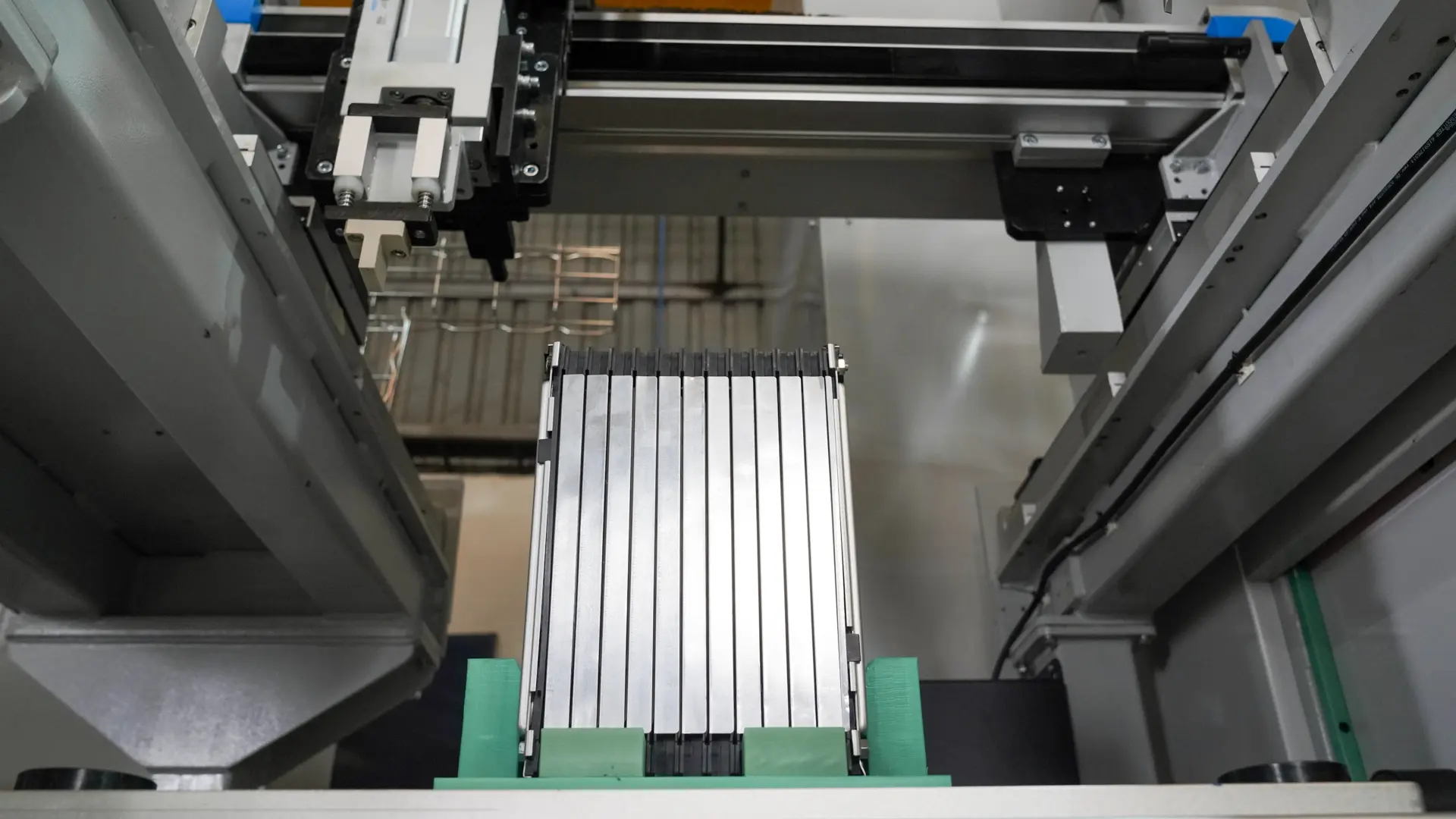
Laser welding systems join busbars to terminals at high speed with low heat input, which is why they dominate cylindrical and prismatic module assembly. Wire bonders are specified where a fusible connection is preferred so a failing cell isolates itself. Ultrasonic welders handle pouch cell tabs. What matters commercially is not the welding technology but whether weld integrity is measured inline on every joint or inspected on a sampling plan.
6. Module and pack assembly stations
Holder loading, busbar placement, module stacking, enclosure loading, thermal interface material dispensing and cover fastening. These stations carry the mechanical tolerances of the pack. Dispensing accuracy and torque control are the two specifications that decide whether thermal performance and sealing hold up in service.
7. BMS programming and end of line test benches
The battery management system is mounted, flashed and paired to the pack identifier, then the pack goes through insulation resistance and dielectric testing, a charge and discharge cycle, communication checks and leak testing before laser marking. End of line equipment is where most manufacturers discover their test coverage was written for a prototype rather than for volume.
8. Traceability and data infrastructure
Barcode and RFID readers, station level data capture and MES connectivity are not accessories to the line. They are the reason a warranty claim can be answered with a record instead of an apology. Specify data depth at cell level from the start, because retrofitting traceability into a running line is expensive and rarely complete.
Specifications Worth Comparing When Quotes Arrive
Equipment quotes are difficult to compare because vendors describe the same capability in different vocabulary. These are the seven points that make quotes comparable, along with the question that gets a straight answer.
| Specification | Why it matters | What to ask the vendor |
|---|---|---|
| Cell format range | A line locked to one diameter becomes scrap when the product roadmap changes cell. | Which formats are supported by recipe change alone, and which need tooling change? |
| Sustained vs rated throughput | Brochure figures are usually peak. Plant economics run on shift averages. | What is the demonstrated output across a full eight hour shift at a reference site? |
| Weld verification method | Sampled inspection on a pack with thousands of joints is not verification. | Is every joint measured inline, and what is the recorded reject criterion? |
| Changeover time | Multi variant production loses more hours to changeover than to breakdowns. | What is the timed changeover between two of our actual variants, not a family average? |
| Traceability depth | Warranty defense depends on cell level records, not batch level ones. | Is data captured per cell or per tray, and how does it reach our MES? |
| Testing coverage | Gaps in end of line testing become field failures. | Which tests run on every pack versus on a sample, and what is the false reject rate? |
| Service and spares | Downtime cost on a battery line dwarfs the spares budget. | Where is the nearest service team, and what is the guaranteed response time? |
Buying Machines Versus Buying a Line
The genuine decision in EV battery equipment procurement is not which welder or which tester. It is whether to buy best in class stations from multiple vendors and integrate them yourself, or to buy an integrated line from a single supplier.
Multi vendor procurement usually looks cheaper on the capital line, often by ten to fifteen percent. The cost reappears during commissioning as interfaces nobody owns, data formats that do not match, cycle time mismatches that only surface under load, and a support structure where every vendor can point at another one. On a battery line, where one station failure stops the whole chain, that ambiguity is expensive.
Single vendor line procurement carries a higher capital number and removes the integration risk. One party owns the takt calculation, the data architecture and the ramp curve. For manufacturers building their first line, or scaling from pilot to volume, this is usually the lower total cost outcome. It is also the reason battery pack assembly automation is typically scoped as a turnkey program rather than an equipment list.
 “The value of EV battery manufacturing equipment is determined not by individual machine performance, but by how effectively every station works together as one connected production line.”

See it in action
Equipment Cybernetik Supplies for EV Battery Manufacturing
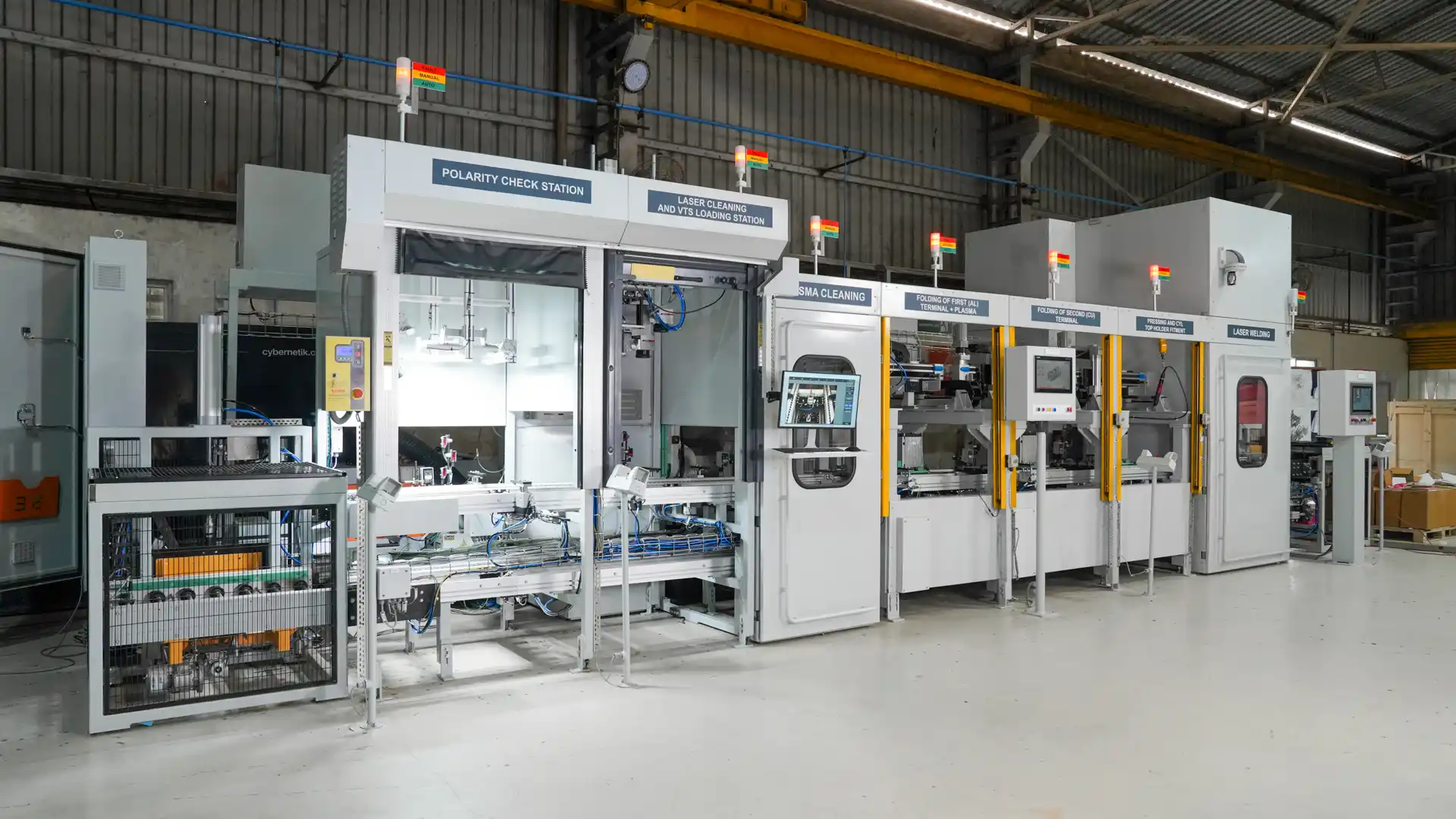
Cybernetik designs, builds, installs and supports complete EV battery pack assembly lines rather than individual machines. Founded over three decades ago and headquartered in Pune with offices in the United States and the UAE, the company has installed more than 6,000 systems across 30 plus countries, including over 400 custom robotic automation solutions. In the EV and energy storage space that work has been delivered for manufacturers such as Hero MotoCorp, TVS Motor, Livguard and Matter.
The equipment scope covers the full chain described above, engineered as one line rather than assembled from parts.
Why manufacturers bring Cybernetik in early
The same equipment platform is configured differently for stationary storage, where BESS battery pack assembly lines are built around large format cells and modular scalability rather than vehicle packaging constraints.