
Key takeaways
A battery plant is not a battery line in a larger building. The line converts cells into packs; the plant has to receive, store, condition and deliver those cells, remove the finished product, supply utilities at a demanding profile, and contain a hazard that behaves unlike anything else in general manufacturing.
Those requirements are decided at facility level and they are expensive to change afterward. A line can be rebalanced; a building cannot be re-laid out, and the storage and fire provisions that a plant needs are structural rather than operational.
This article covers the plant-level decisions that determine whether a well-designed line performs. The line itself is covered in the guide to battery production lines.
Material Flow Through the Building
The first plant-level decision is the path material takes, and it is worth drawing before anything is positioned.
Cells arrive on pallets and leave as packs, and between those two points they are stored, graded, consumed and replaced by an assembly that grows steadily in size and value. The flow is therefore asymmetric: high-count small items entering, low-count large items leaving. A layout that treats receiving and dispatch as mirror images will size one of them wrongly.
Three principles hold in most plants. Material should move in one direction rather than crossing back on itself, because crossing flows produce congestion and mixing risk. Storage should sit between receiving and production rather than beside production, so that the fire compartmentation discussed below is achievable. And the finished goods route should not pass through the cell storage area, since packs and cells have different handling and containment requirements.
Cell Storage: The Constraint Nobody Plans For

Cell storage is routinely treated as warehousing and is closer to a process step. It is also the most common facility-level oversight in a new battery plant.
| Storage factor | Why it matters | What the facility has to provide |
|---|---|---|
| State of charge | Cells ship at partial charge and self-discharge in storage, drifting out of the band they were graded into | Stock rotation discipline and re-verification after extended storage |
| Temperature | Elevated temperature accelerates both aging and self-discharge, so cells stored hot arrive degraded | Temperature-controlled storage rather than ambient warehouse conditions |
| Fire load | A quantity of charged lithium cells represents a significant and unusual fire risk | Compartmentation, detection, suppression and separation from production |
| Segregation | Damaged, returned or quarantined cells must not re-enter normal stock | A defined quarantine area with its own containment |
| Traceability by location | Grading is worthless if bins are mixed in storage | Location-level records linking each tray to its grade and batch |
| Access | Manual handling of cell trays is repetitive and introduces contamination | Automated retrieval and delivery rather than forklift and hand movement |
Two points deserve expansion.
The first is that cells change in storage. They self-discharge, and the rate rises with temperature, so a cell graded into a band on arrival may not belong in that band three months later. That undermines the grading discipline the line depends on, which is why stock rotation and re-verification after extended storage are quality requirements rather than housekeeping. The reasoning behind grading is set out in the guide to cell sorting and grading.
The second is fire load. A warehouse holding a large quantity of charged lithium cells presents a risk profile that conventional industrial fire provisions were not designed around, and it is the reason cell storage requires compartmentation, dedicated detection and separation from the production area rather than a corner of the main hall.
Internal Logistics
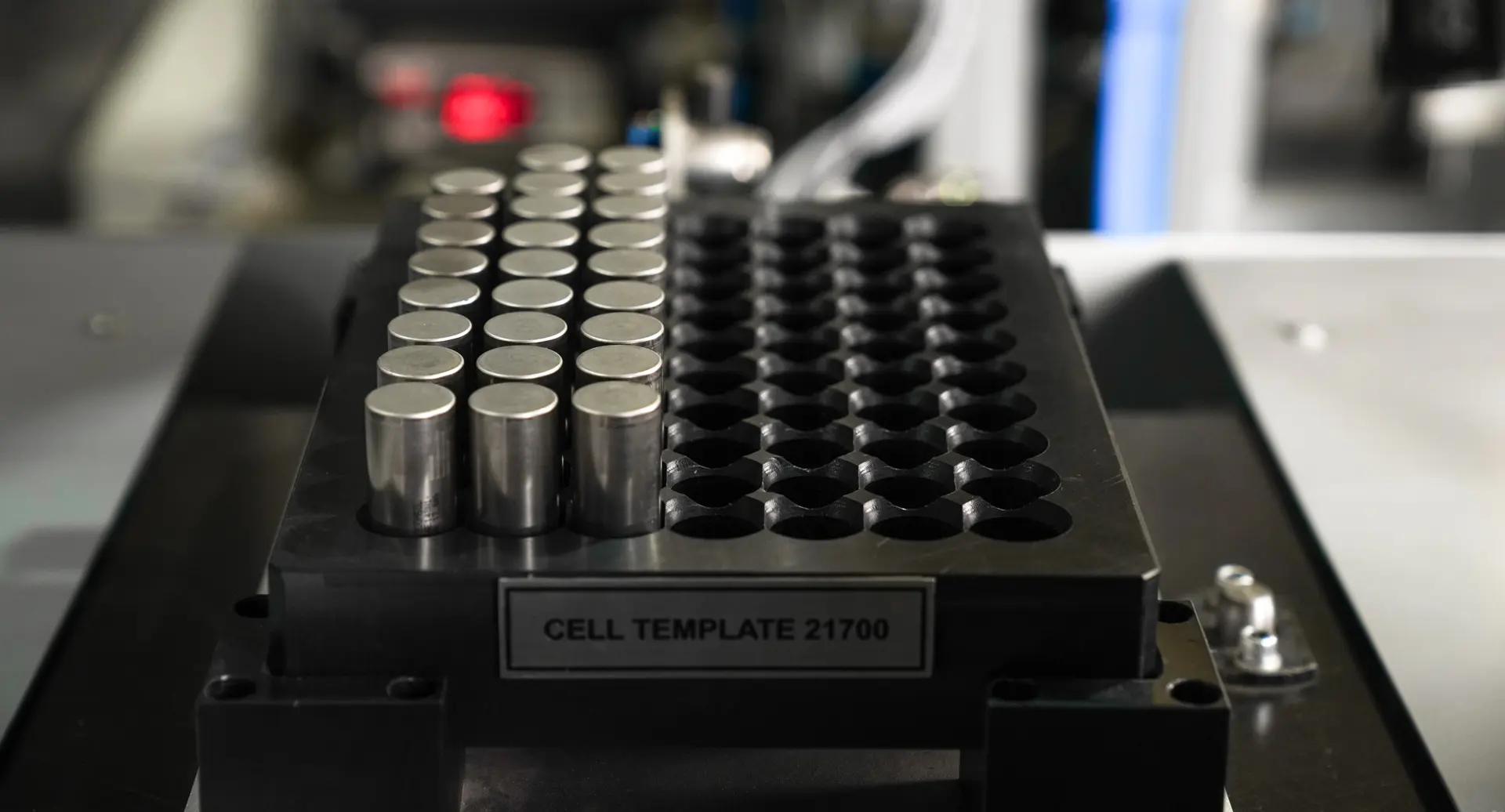
Moving material between storage and the line is where plant automation delivers most of its measurable return, and it is frequently left manual while the line itself is fully automated.
The logistics case is usually easier to justify than the line case, because manual material movement is visible, measurable and consumes labor continuously rather than at a station.
Utilities as a Design Input
Battery lines impose an unusual utility profile, and sizing on average consumption produces a plant that underperforms in a way nobody traces to the building services.
The last of those is worth emphasizing. Leak testing responds to temperature far more strongly than to a leak, so an assembly hall with poor temperature stability produces leak test failures that appear random and are environmental.
Fire Safety and Thermal Event Containment
This is the requirement most specific to battery plants and the one least transferable from other manufacturing experience.
A lithium cell in thermal runaway generates its own oxygen and cannot be extinguished by conventional means. The response is cooling and containment rather than extinguishing, and that changes what the facility needs to provide.
These provisions are structural. A plant that did not allocate space and services for them at design cannot easily add them once production is running, which makes this the clearest example of a facility decision that cannot be corrected at line level.
Multiple Lines Sharing Infrastructure
Most plants eventually run more than one line, and the shared infrastructure decisions made for the first one determine how easily the second is added.
Utilities are the obvious case: a compressed air system sized precisely for one line requires replacement rather than extension when a second arrives. Less obvious are storage and logistics, since two lines drawing from one store need retrieval capacity for both, and kitting that was manual for one line rarely scales.
The data layer matters too. Two lines with separate control architectures produce two data islands, and consolidating them afterward is a project. Specifying a common architecture when the first line is built costs almost nothing and saves that project entirely.
 “The performance of a battery plant is determined before the line starts running, through decisions on cell storage, material flow, utility capacity, internal logistics, and fire containment.“

See it in action
Designing for Expansion
Battery plants scale in a pattern that is reasonably predictable, and provision for it is cheap at design and expensive later.
Three provisions cover most cases. Floor space reserved adjacent to the first line rather than filled with storage that then has to be relocated. Utility headroom, particularly in compressed air and electrical capacity, since these are the services most often found short. And control system capacity for equipment not yet installed, which is far less disruptive than adding panels to a running plant.
The provision that cannot be retrofitted usefully is the same at plant level as at line level: the data architecture. A facility that begins capturing production records in its second year has no baseline for the units built in its first, and those are the units most likely to generate field questions.
What Plant-Level Automation Actually Means
Bringing these together, plant automation in a battery facility is less about robots than about three things.
Material arriving at the line in the right condition, from the right grade band, without manual intervention deciding which tray gets used.
Infrastructure sized against the demanding condition rather than the average one, so building services are not quietly limiting the equipment they support.
And containment designed in, because the specific hazard a battery plant carries is not one that can be managed operationally once the building exists.
A plant that gets those three right can run a line at its designed rate. One that does not will find its line underperforming for reasons that appear to be equipment problems and are not.
Battery Lines from Cybernetik
Cybernetik supplies battery pack assembly automation as complete lines, with the equipment specified against the utilities, layout and material flow of the facility it sits in rather than in isolation from them.
| Cybernetik battery line capability | Specification |
|---|---|
| Line structure | Three zones covering cell to module, pack assembly and end of line testing |
| Line rate | Up to 6,000 cells per hour |
| Cell formats | Cylindrical 18650, 21700 and 32140, plus prismatic, pouch and blade |
| Incoming verification | OCV, IR and ACIR testing on every cell with robotic sorting onto parallel conveyors |
| Surface preparation | Plasma cleaning ahead of testing and joining |
| Joining | Laser and resistance welding with inline weld integrity testing on every joint |
| End of line | BMS and TCU programming, air leakage testing, electrical testing and laser marking |
| Traceability | Barcode and RFID capture with MES connectivity and process logging |
| Control architecture | Unified PLC and SCADA with recipe-based operation across stages |
| Delivery model | Design, build, installation, commissioning and support from one engineering team |
| Robotics base | More than 400 custom robotic automation solutions delivered |
Two aspects of that specification matter at plant level rather than line level. A unified control architecture across all stages avoids the data islands that separately procured equipment produces, which is the decision that determines whether a second line can share infrastructure with the first. And barcode and RFID capture from the first station is what allows a grade band established in storage to remain attached to a cell through to the finished pack, rather than being lost the moment a tray is opened.
Cybernetik has operated for more than three decades, is headquartered in Pune with additional facilities in Gujarat and Raigad and international offices in the United States and UAE, and has installed over 6,000 systems across 30 plus countries, including more than 400 custom robotic automation solutions. In battery manufacturing that work has been delivered for manufacturers including Hero MotoCorp, TVS Motor, Livguard and Matter. Further background is on the Cybernetik about page.