
Key takeaways
Battery equipment quotations are unusually difficult to compare, because the machines are only part of what is being bought. Two suppliers can quote what looks like the same line at different prices, and the gap is almost never in the equipment. It is in what each of them has taken responsibility for.
That makes scope the first decision rather than specification. A plant that has settled which supplier owns the interfaces, the takt, the data and the ramp is in a position to compare quotes. One that has not is comparing lists of machines.
This guide covers the kinds of supplier available, what a buyer has to bring to the conversation, the questions that reveal capability, and the scope gaps that cause disputes. The equipment itself is described in the guide to EV battery manufacturing equipment.
Four Kinds of Supplier
| Supplier type | What they provide | Suits | What stays with you |
|---|---|---|---|
| Station OEM | One machine type, such as a welder, tester or dispenser | Adding or replacing a single station on an existing line | Integration, interfaces, takt matching and the data architecture |
| Cell equipment specialist | Coaters, calenders, formation and cell assembly machinery | Cell plants only; a different capital category entirely | Everything downstream of the cell |
| Line integrator | A line assembled from bought-in machines plus their own engineering | New lines where no single builder covers every station | Commercial exposure if a sub-supplier underperforms |
| Turnkey automation builder | Design, build, installation and commissioning of the whole line | New lines and capacity additions where one owner is wanted | Utilities, civil work and cell supply |
None of these is better in the abstract. Replacing a welder on a line that works is a station OEM purchase, and involving an integrator would be overspending. Commissioning a new line and buying stations individually means the integration work exists and has become yours, usually discovered during commissioning rather than during procurement.
The error that costs most is approaching a station supplier with a line problem. A welder manufacturer will quote an excellent welder. Whether it can be fed at takt, whether its data reaches your systems, and whether it hands off correctly to the next station are questions they were never asked and cannot answer.
What You Must Bring to the Inquiry
Suppliers can only design against what they are given, and battery lines are unusually sensitive to inputs that buyers often leave until later.
A supplier who asks for all of this before quoting is designing a line. One who quotes from an output figure and a cell type is quoting equipment.
The Questions That Reveal Capability
What do you measure on every unit, and what do you sample?
This is the single most revealing question in battery equipment procurement, because it exposes a quality philosophy rather than a specification.

A pack contains thousands of welded joints. A supplier who verifies every joint inline is offering a fundamentally different product from one who samples, and the difference does not appear in a machine list. Sampling finds nothing at the defect rates that matter in battery assembly, where a single weak joint fails years later under vibration.
The same applies to cell testing, insulation placement and polarity. Ask specifically which characteristics are verified on every unit and which are inferred. The reasoning behind that distinction is set out in the guide to battery quality control.
What physically changes when we move to a different cell?
Every supplier claims flexibility. This question makes the claim concrete.
The answers range widely. At one end, a recipe change and a short setup. At the other, new grippers, new fixtures, new nest plates and a lead time measured in weeks, with a cost that was not in the original quotation. Both are legitimate designs, and they are very different purchases if your cell roadmap is uncertain.
Ask for the timed changeover, the parts required and their cost, between two formats you might realistically run.
What data leaves the line, and how?
Traceability cannot be added to a running line usefully, so it has to be specified now. Ask what is captured, against what identifier, in what format, and how it reaches your systems. A supplier whose answer is that data is available on the HMI has not answered the question.
What rate will it hold, and how was that established?
Distinguish demonstrated rate from calculated rate. A line rate derived from adding up station cycle times assumes nothing ever stops, which is not a rate anyone achieves. Ask what allowance has been made for availability and where the buffers are.
Scope Gaps in Battery Equipment Projects
Battery line quotations vary in scope more than most equipment categories, and the gaps are consistent.
Asking every supplier to price the same explicit list, marking exclusions rather than omitting them, is the only way to compare quotations that describe different things.
Factory Acceptance and Ramp
Two provisions determine whether a line reaches production smoothly, and both are agreed before signing rather than afterward.
Factory acceptance testing proves the line at the supplier works before it ships. What matters is what is proven: rate on your actual cells, every format the line must handle, the full test sequence, data flowing to a representative system, and fault recovery performed by someone from your team under timed conditions. Correcting a problem at the supplier works costs a fraction of correcting it on your floor with the line waiting.
Ramp support is the second. A battery line does not reach rate on the day it is commissioned, and the period afterward is when problems surface. Establish who is on site, for how long, what response time applies once they leave, and what happens if the line does not reach its contracted rate. That last clause is worth negotiating while there is still commercial leverage.
Service, Spares and Distance
This deserves particular attention for manufacturers in India and elsewhere outside the traditional equipment supply regions.
A significant share of battery line equipment is built in Europe, China, Japan and Korea. That equipment can be excellent and the support model still be unworkable, because a specialist flying in and a part shipped through customs turn a two-day problem into a two-week one.
The questions to settle are where engineers are based, what response time is contractually committed, what spares are held in country, and whether documentation and training are provided in a form your maintenance team can use. Where the answers involve another continent, the practical availability of the line is lower than its technical availability regardless of how good the machines are.
Red Flags
 “A claimed production rate means little without demonstrated performance; reliable battery equipment must prove its rate on representative cells while accounting for availability, buffers, and real production conditions.”

See it in action
A Selection Checklist
- Decide the scope split before approaching suppliers, and put it in writing.
- Supply cell format, cells per pack, output, shift pattern, architecture, test and traceability requirements at inquiry.
- Ask what is verified on every unit against what is sampled.
- Ask what physically changes for a format change, with time and cost.
- Confirm what data leaves the line, against what identifier, and how.
- Distinguish demonstrated rate from calculated rate, and ask about buffers.
- Price the same explicit scope list with every supplier, exclusions marked.
- Agree factory acceptance criteria and ramp support before signing.
- Establish where engineers and spares actually are.
Battery Lines from Cybernetik
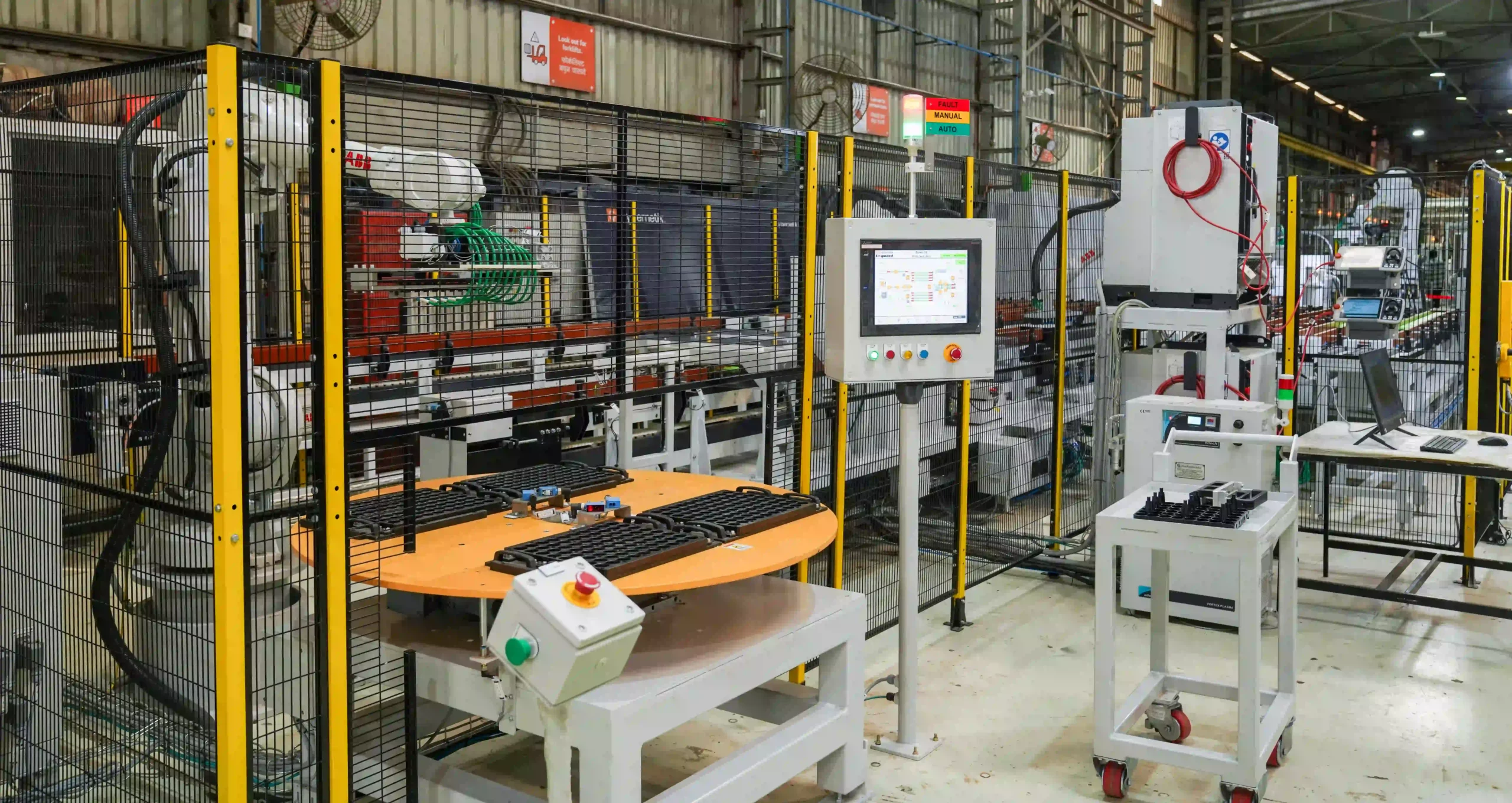
Cybernetik supplies battery pack assembly automation on a turnkey basis, taking responsibility for design, build, installation, commissioning and support of the complete line rather than for individual stations within it.
| Cybernetik battery line capability | Specification |
|---|---|
| Scope | Design, build, installation, commissioning and support of complete pack assembly lines |
| Line structure | Three zones covering cell to module, pack assembly and end of line testing |
| Line rate | Up to 6,000 cells per hour |
| Cell formats | Cylindrical 18650, 21700 and 32140, plus prismatic, pouch and blade |
| Cell diameters | 32, 33, 35, 40, 42 and 46 mm |
| Module flexibility | Assembly lines adaptable to multiple module configurations |
| Verification on every unit | OCV, IR and ACIR on every cell; weld integrity on every joint and both module faces; insulation detection and polarity checking |
| End of line | BMS and TCU programming, air leakage testing, electrical testing and laser marking |
| Traceability | Barcode and RFID capture with MES connectivity and process logging |
| Validation | Factory acceptance testing before dispatch |
| Track record | Over 6,000 systems in 30 plus countries, more than 400 custom robotic solutions |
Three rows in that table answer questions raised earlier. The verification row states plainly what is measured on every unit rather than sampled. The format rows describe the range covered without a tooling change, which is what a flexibility claim should look like. And factory acceptance testing before dispatch means the line is proven at works rather than commissioned for the first time on the customer floor.
Cybernetik has operated for more than three decades, is headquartered in Pune with additional facilities in Gujarat and Raigad and international offices in the United States and UAE, and has installed over 6,000 systems across 30 plus countries, including more than 400 custom robotic automation solutions. In battery manufacturing that work has been delivered for manufacturers including Hero MotoCorp, TVS Motor, Livguard and Matter. Further background is on the Cybernetik about page.