
Key takeaways
Every processing plant has to gain height somewhere. Product leaves a machine at working level and has to reach a hopper, a weigher or a packing line above it, and the floor length available for that climb is whatever the layout left over.
That constraint is what makes inclined conveying a design problem rather than a purchase. The required angle follows from lift height divided by available length, and the angle then determines which conveying technology is even possible. Choosing the conveyor before establishing the angle is the most common sequence error in this part of a plant, and it is why so many inclined installations spill, slip or underperform.
The Angle Decides the Technology
Bulk materials slide back down a belt once the slope exceeds what friction and their own angle of repose will hold. Where that limit sits varies by material, but the practical bands are well established.
| Incline angle | Technology that works | What decides it |
|---|---|---|
| Up to 15 degrees | Plain flat belt | Most free-flowing materials and packaged goods stay in place without assistance |
| 15 to 20 degrees | Plain belt, marginal | Depends entirely on the material; a rough-top or textured belt extends the range for unit loads |
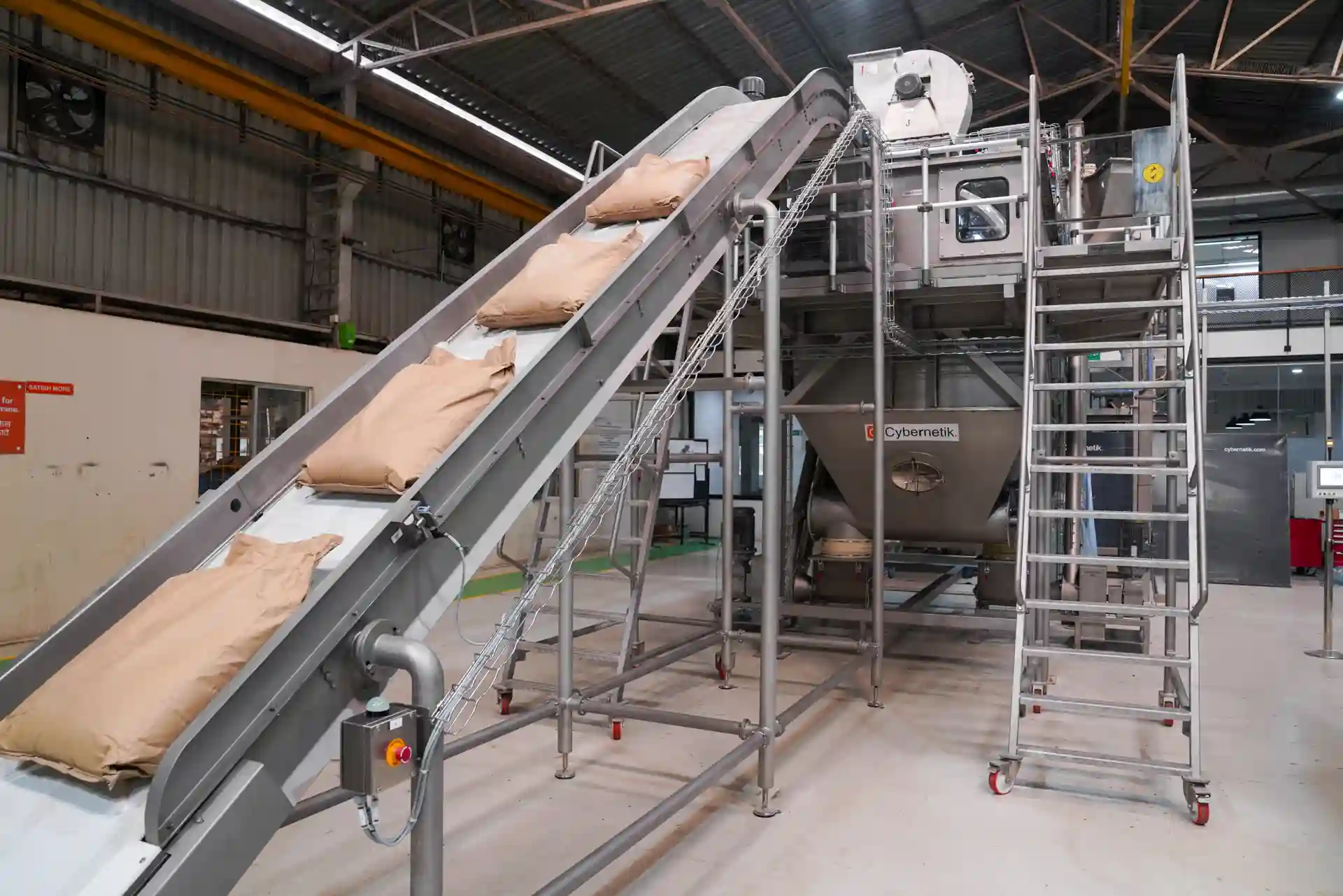
| 20 to 30 degrees | Troughed belt | Trough containment holds bulk material against rollback; Cybernetik trough belts convey upward to 30 degrees at 1,500 to 3,000 kg/hr |
| 30 to 45 degrees | Cleated belt | Cleats hold material in pockets; Cybernetik flight cleated belts raise product up to 6 m |
| 45 to near vertical | Cleated belt with corrugated sidewalls | Sidewalls close the ends of each pocket so fine material cannot cascade off the edges |
| Vertical | Bucket elevator | Beyond practical belt angles, buckets carry material up a vertical path more efficiently |
Two points about that table. The bands are guidance rather than guarantees, because a damp, rounded or free-flowing material will fail earlier than a coarse angular one. And the transition between bands is not gradual: a plain belt at 22 degrees does not carry slightly less than at 18, it begins returning a significant fraction of the load to the feed point and throughput falls away sharply.
What Changes When a Conveyor Is Tilted
Material rolls back before it slides back
Rounded products fail first and fail differently. Granules, pellets and round packages roll rather than slide, so they defeat an incline at angles where irregular material would still be held. Where a product range includes both, the rounded item sets the limit for the whole line.
Drive power rises with lift, not with length
A horizontal conveyor consumes power overcoming friction. An inclined one adds the work of raising the load, and that component grows directly with lift height and throughput. Sizing an inclined conveyor drive from a horizontal calculation leaves the motor unable to start under full load, which is a commissioning failure rather than a performance one.
Transitions need geometry, not corners
Where a horizontal section meets an inclined one, the belt cannot bend sharply. A transition curve of adequate radius is required, and its length has to be designed in. Plants that discover this late end up shortening the incline or raising the angle, both of which compromise the original calculation.
Runback becomes a safety question
A loaded inclined belt that loses drive will run backwards under the weight of its own load. On any significant lift, a holdback device or motor brake is a safety requirement rather than an option, and it should appear in the specification rather than being discussed after installation.
Spillage concentrates at the loading point
On an incline, material fed onto the belt has a component of its momentum working against the direction of travel. Feed geometry matters more than it does horizontally, and skirting has to extend further along the run before the load settles.
Types of Inclined Belt Conveyor
Plain inclined belt
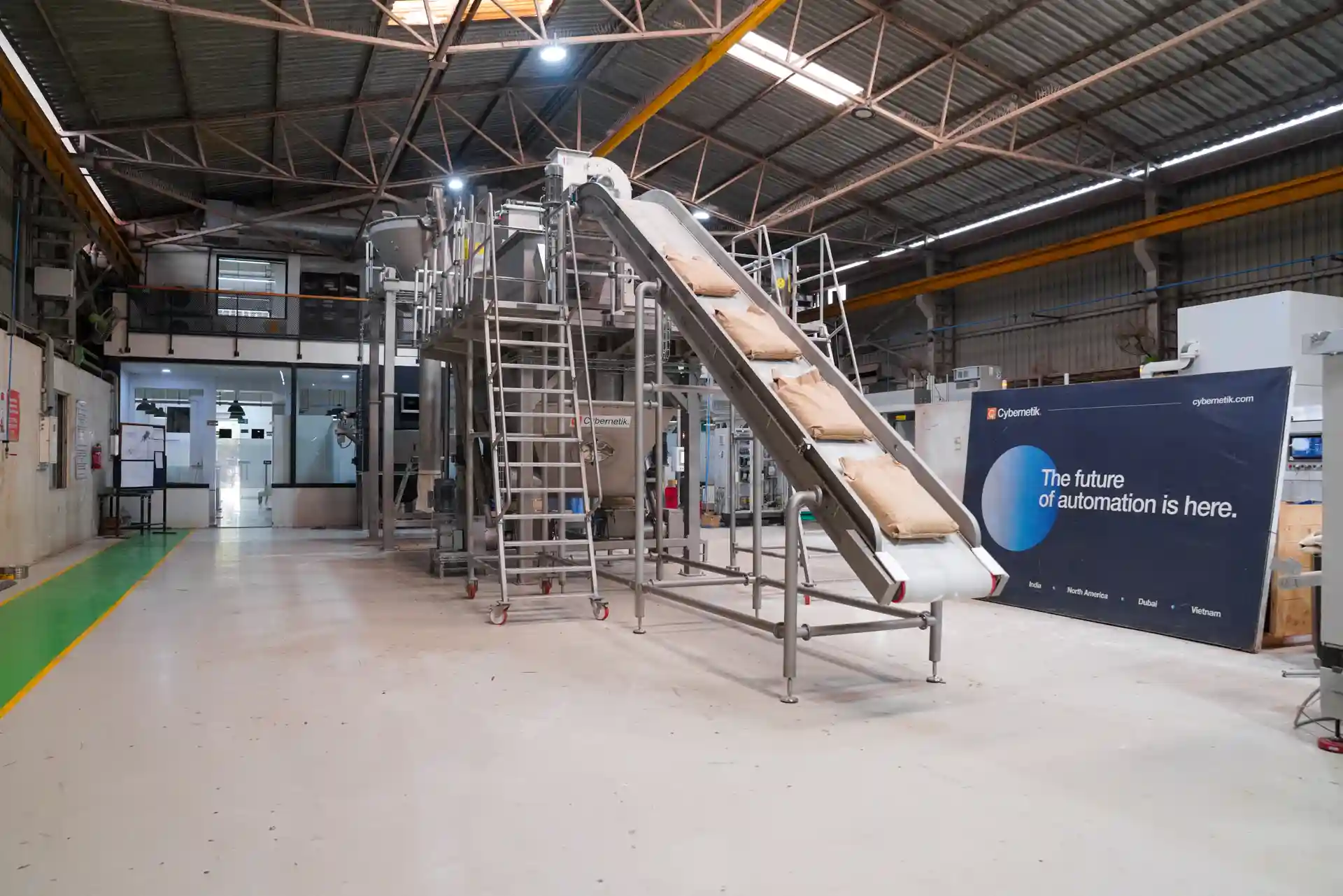
The simplest arrangement, a flat belt conveyor set at an angle within the limits of the material. Suits packaged goods, cartons and stable unit loads, and remains the cheapest option where the required angle is modest.
Troughed inclined belt
Angled idlers form the belt into a trough, which both increases carrying capacity and helps contain bulk material against rollback. A trough belt conveyor handles upward conveying to 30 degrees with bulk and overhead transfer in hygienic cGMP construction, which covers a large share of moderate-lift bulk duty.
Cleated or flight belt
Raised cleats bonded to the belt hold material in discrete pockets so it cannot slide or roll back. A flight cleated belt conveyor raises product up to 6 m using a polyurethane extruded belt chosen for hygiene and washability, in cGMP construction. This is the standard answer for steep lifts in food processing.
Sidewall belt
Corrugated sidewalls bonded to the belt edges close the ends of each cleat pocket, containing fine material that would otherwise cascade sideways. Necessary for powders at steep angles, and the configuration that extends belt conveying closest to vertical.
Combination or Z-profile
A single conveyor with a horizontal infeed section, an inclined middle and a horizontal discharge. The horizontal infeed allows product to settle into cleat pockets before the climb begins, and the horizontal discharge presents product level to the receiving machine. For feeding packaging equipment this profile solves both the loading and the discharge problem at once.
Selection Criteria
 “As conveying moves uphill, every design decision changes: drive power must account for lift, transitions require controlled geometry, and runback protection becomes a critical safety requirement.”

See it in action
Applications
When Not to Incline at All
Where the requirement is substantial vertical lift in a small footprint, a bucket elevator does the job more efficiently than an inclined belt long enough to reach the same height, and occupies a fraction of the floor area.
For powders where dust containment matters, an inclined screw conveyor moves material fully enclosed. Capacity falls as the angle increases, because gravity pulls material back down the flight, so inclined screws are designed with reduced pitch rather than by simply tilting a horizontal design. But containment is absolute, which an open belt cannot match.
Inclined Conveying from Cybernetik
Cybernetik engineers conveying as part of complete process lines, which means the incline angle, belt type and transitions are specified against the material and against the equipment at both ends rather than selected from a catalogue.
The conveying range covers flat and trough belt conveyors, flight cleated belts, bucket elevators, screw conveyors, vibratory conveyors and cooling conveyors, alongside the grinding, mixing, sifting, storage and packing equipment they connect. The full range sits under process automation solutions.
Cybernetik has operated for more than three decades, is headquartered in Pune with additional facilities in Gujarat and Raigad and international offices in the United States and UAE, and has installed over 6,000 systems across 30 plus countries, including more than 400 custom automation solutions. With over 600 employees and divisions spanning Process Automation, Packaging Automation, CleanTech, Extraction, Labs and Defence, an elevating conveyor is designed with knowledge of everything it feeds.