
Key takeaways
Renewable energy has spent two decades winning an argument about cost. It largely won. What it inherited in return is a manufacturing problem, because the price levels that made wind and solar competitive were achieved by promising further cost reduction, and those reductions now have to come out of the factory rather than out of subsidy.
That is a different discipline from the one the sector grew up with. Building a hundred battery packs is engineering. Building a hundred thousand identical battery packs, each with a traceable record and a twenty year warranty behind it, is production. The technologies below are what carry an operation from the first to the second.
Why Manual Methods Stop Working
Three pressures arrive at the same time in renewable manufacturing, and they compound rather than trade off.
Volume is the obvious one. Demand has moved from pilot quantities to industrial scale in under a decade, and manual processes scale linearly with headcount while demand does not.
Precision is less obvious but more binding. Products in this sector are safety critical and long lived. A battery pack must age uniformly for a decade; a blade root joint must survive a hundred million load cycles; a catalytic converter must still meet its emissions limit at 150,000 kilometres. Tolerances that manual work can hold for an hour need to hold for a shift, a quarter, a production run.
Evidence is the third. Regulators, OEM customers and warranty departments increasingly expect records at part level rather than batch level. A process that cannot produce that record is not a compliance risk in theory. It is an unwinnable warranty claim waiting to be filed.
The Technologies Doing the Work
Industrial robotics and precision motion
SCARA arms for high speed pick and place, six axis robots for complex orientation, and gantry systems for parts too large to reach any other way. In renewable manufacturing, robots are used less for raw speed than for repeatability. A robot places the four thousandth cell exactly as it placed the fourth, which is a claim no operator can make at the end of a shift.
Machine vision and automated inspection
Vision confirms polarity before welding, verifies insulation placement on every cell, checks bead geometry on adhesive dispensing and inspects surfaces for defects. Its real value is that it converts sampling into inspection. Checking one part in fifty tells you about that one part; checking every part tells you about the process.
Inline metrology and part referencing
Measurement built into the line rather than bolted on at the end. The critical version of this is referencing: measuring the actual part in front of the machine and cutting to that, rather than cutting to nominal drawing coordinates. On moulded composite structures, where every part differs slightly from the design, this distinction is the difference between holding tolerance and accumulating error.
Laser processing
Laser welding joins busbars to cell terminals at speed with low heat input, which matters because heat is what damages cells. Laser marking writes permanent identifiers for traceability. Both replaced mechanical alternatives largely because they apply energy precisely enough to work near sensitive components.
Traceability and MES connectivity
Barcode and RFID capture at every station, written to a database and connected to the manufacturing execution system. This is the least visible technology on the list and often the most valuable. It is what allows a field failure to be traced to a batch, a station and a shift, and what turns a warranty dispute into a documented answer.
Predictive maintenance and process analytics
Instrumented motion, torque, temperature and vibration data feeding models that flag wear before failure. On a line where one station stopping halts the whole chain, moving maintenance from scheduled to predicted removes a category of unplanned downtime rather than reducing it.
Recipe driven changeover
Product variants selected by recipe rather than reconfigured by hand. In a sector where cell formats, blade programs and substrate specifications change faster than capital equipment does, the ability to switch variants without retooling is what protects the asset from becoming obsolete before it is depreciated.
How This Plays Out by Sector
The technologies are shared. Where they are applied, and which number they move, differs considerably.
| Sector | Where automation is applied | The metric it moves |
|---|---|---|
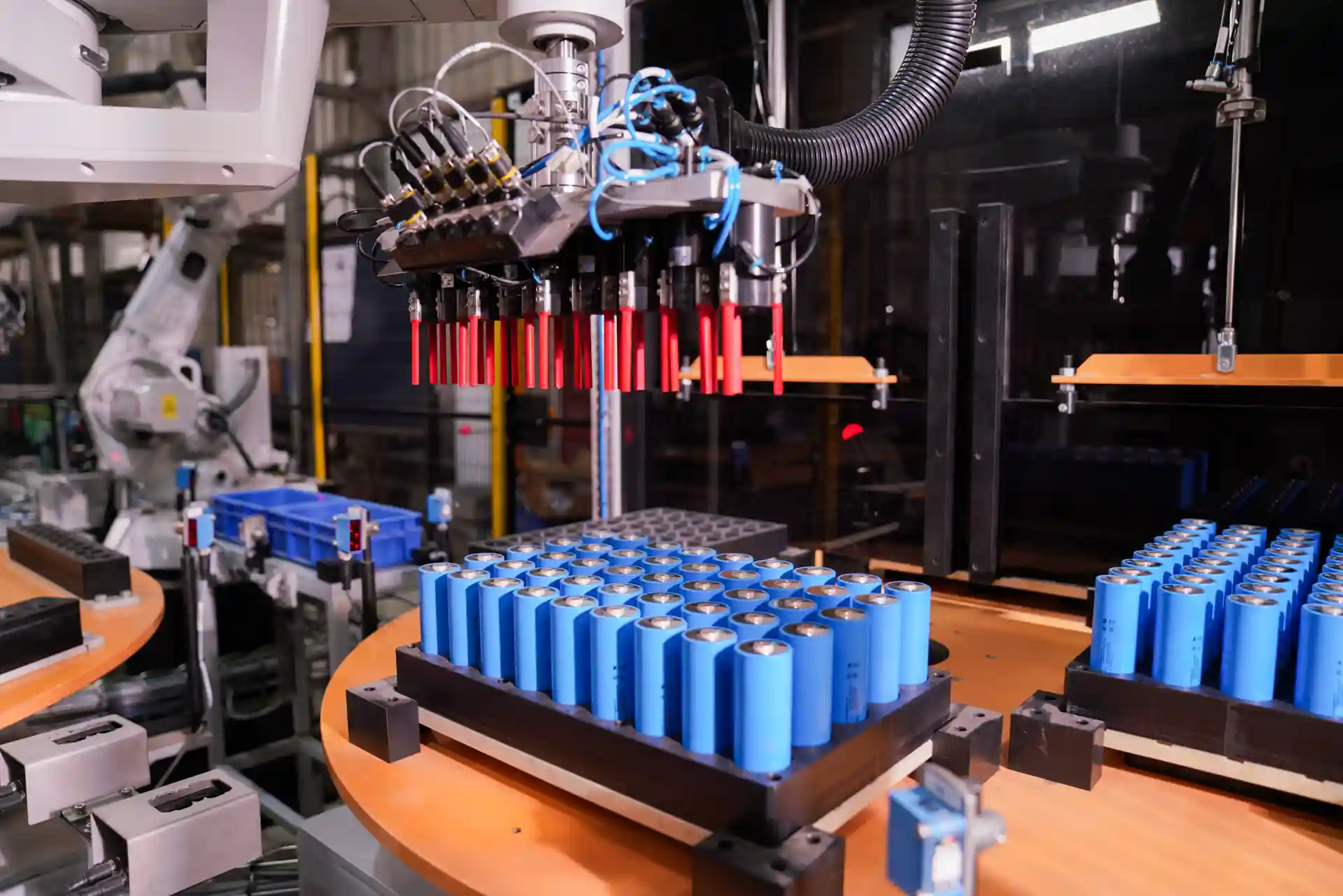
| EV battery packs | Cell feeding, electrical testing and sorting, plasma cleaning, insulation placement, welding, BMS integration, end of line testing | Pack uniformity and first pass yield, plus cell level traceability for warranty |
| Stationary storage | Large format cell handling, modular rack assembly, cell testing, thermal interface application, containerised integration | Scalability from pilot to multi megawatt hour output without redesigning the line |
| Wind turbine blades | Root end sawing, milling and drilling, referencing, ring removal, dimensional verification | Hole position accuracy on a multi metre pitch circle, and rework driven toward zero |
| Emissions control components | Washcoat blend preparation, coating and air stripping, drying and calcining, back pressure and weight verification | Coating uniformity, precious metal cost control, and part level compliance records |
What Automation Actually Delivers
 “The challenge in renewable energy manufacturing is no longer simply producing more – it is producing at scale with the precision, consistency, and traceability required for long-life, safety-critical products.“

See it in action
Where Automation Programs Go Wrong
Cybernetik’s Role in Renewable Energy Manufacturing
Cybernetik designs, builds, installs and supports turnkey automation across the renewable and clean energy value chain rather than supplying individual machines. The company has operated for more than three decades, is headquartered in Pune with offices in the United States and the UAE, and has installed over 6,000 systems across 30 plus countries, including more than 400 custom robotic automation solutions. Further background sits on the Cybernetik about page.
In electric mobility and stationary storage, battery pack assembly automation covers cell handling across cylindrical, prismatic, pouch and blade formats at up to 6,000 cells per hour, with OCV, IR and ACIR testing, robotic sorting, plasma cleaning, vision confirmed insulation placement, laser and resistance welding with inline weld integrity testing, and end of line zones for BMS programming, leak testing and laser marking. That work has been delivered for manufacturers including Hero MotoCorp, TVS Motor, Livguard and Matter.
In wind energy, Cybernetik built the first robotic machining system of its kind for root end machining of turbine blades, covering root pitch circle diameters from 2,800 to 4,800 mm and blades up to 100 metres, holding PCD to within a millimetre and cutting cycle time by up to 50 percent against special purpose machines. Customers include Siemens Gamesa and Suzlon.
In emissions control, catalytic converter substrate coating systems span washcoat blend preparation, coating and air stripping, drying and calcining, robotic handling and quality verification through back pressure checking and three stage weighing. That work has been delivered for manufacturers including BASF, Dinex, Mitsui Kinzoku and Süd-Chemie.