
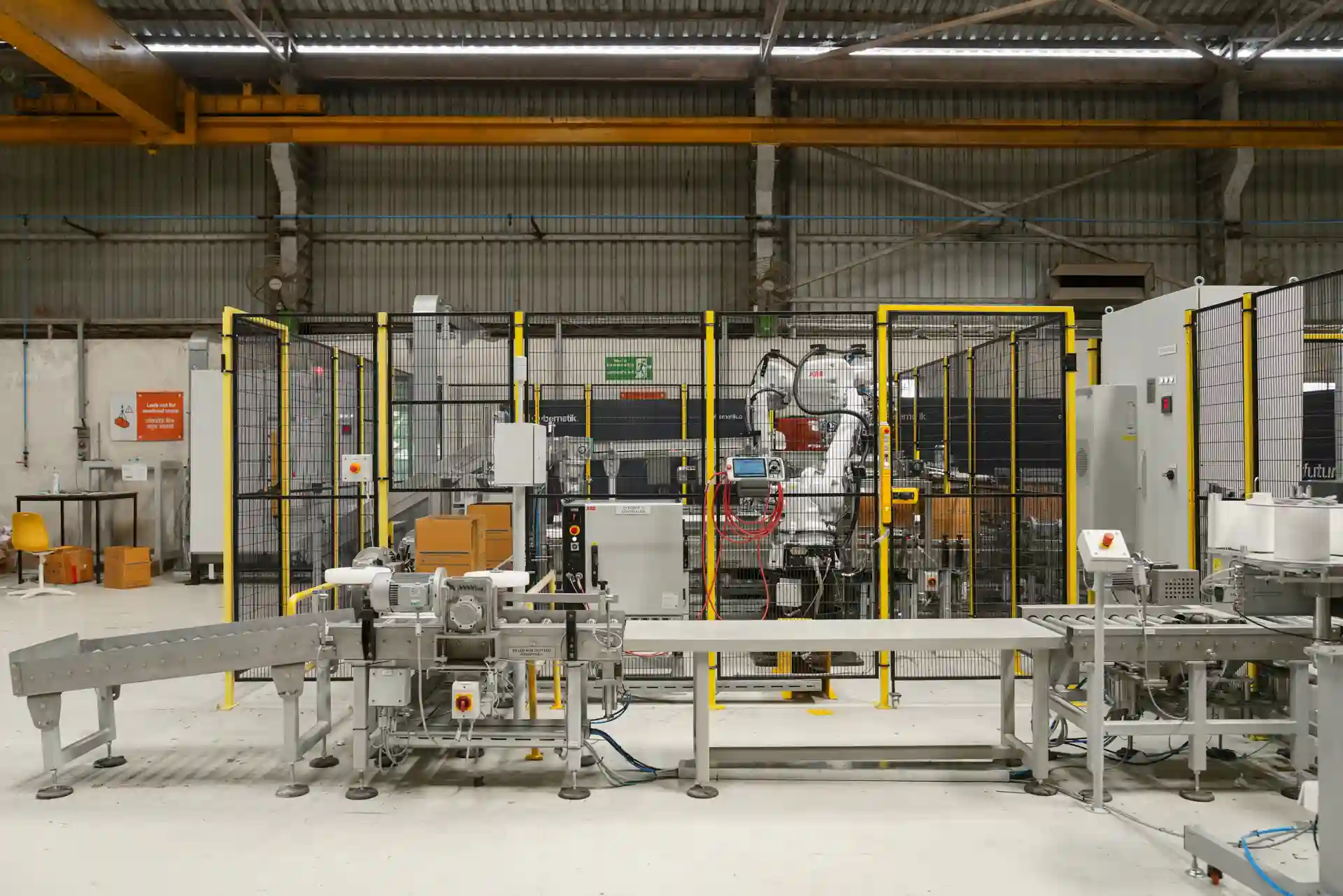
Key takeaways
High-volume manufacturing lines run on seconds. A product sitting on an infeed conveyor without a case to go into, a robot waiting for a case erector that is not keeping pace, or an operator manually stuffing pouches into cartons at two-thirds the wrapper speed , every one of these scenarios is costing margin that will not show up until the OEE report lands on Friday.
That is the role of case packing equipment. Secondary packaging automation bridges the gap between your primary packaging line , the flow wrapper, the bagging machine, the filling station , and the palletizer at the end of the line. When it is specified correctly, it converts a fragmented, labour-dependent secondary packaging operation into a synchronized, high-throughput case packing solution.
This guide covers how robotic case packing equipment eliminates bottlenecks, the technology behind Cybernetik’s Case Packers portfolio, and the specifications that determine whether a system delivers on its promise across the next decade of production
What Is Case Packing Equipment?
Case packing equipment is the automated system that loads primary-packaged products , pouches, bottles, shrink packs, chocolate bars, blister packs , into secondary cases or cartons in a defined matrix formation. It sits between primary packaging and end-of-line palletizing, and its job is to absorb the speed, orientation, and format variability that upstream machines create, and deliver uniform, correctly-loaded cases downstream , ready for taping, labelling, and palletizing.
In a manual secondary packaging setup, operators load cases by hand. That creates three compounding problems at any meaningful scale:
Cybernetik’s case packing solutions resolve all three at once. Across the full case packers range , from SCARA-robot pouch packers to six-axis bottle case packers , the common thread is consistent, high-speed, quality-controlled loading with minimal manual intervention.
How Case Packing Equipment Works
Modern case packing solutions combine robotic pick-and-place, servo-driven conveyors, vision systems, and recipe-based HMI control. The specific architecture varies by product type and throughput target, but the operational sequence follows a consistent pattern:
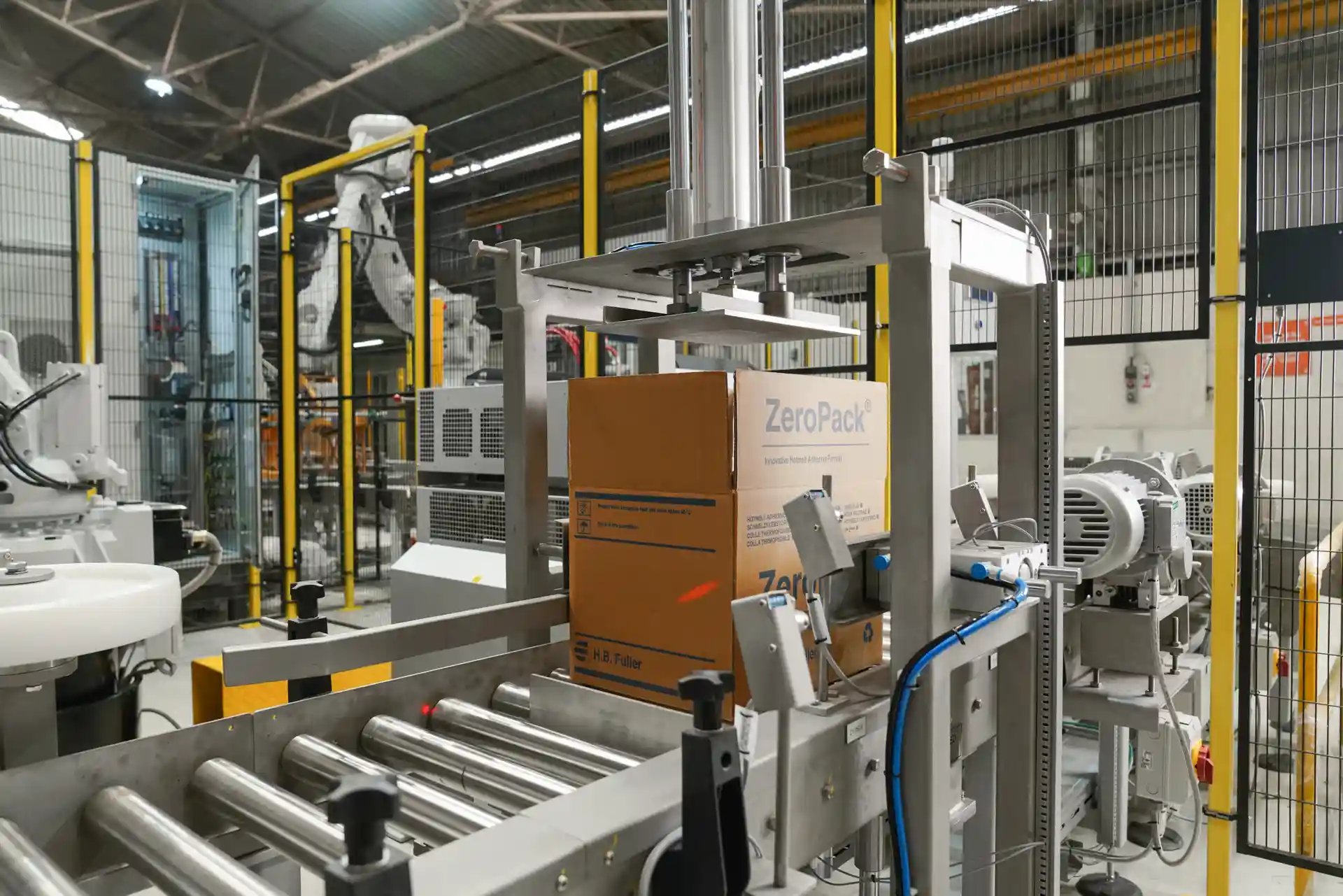
Credits: Name of the photographer
Manual vs. Automatic Case Packing: The Real Performance Gap
A manual line typically caps at 60–80 units per minute per operator, and quality drifts as fatigue sets in. An automatic wrapper feeding system runs at 100 to 300 packages per minute consistently across an entire shift no breaks, no orientation errors, no rework. With 70% of flow wrap machinery sales now going to automated systems, the market has already made its decision.
| Parameter | Manual Case Packing | Automatic Case Packing Equipment |
|---|---|---|
| Throughput | 10–20 cases/hr per operator | 40–120 units/min consistently |
| Packing density | Inconsistent; depends on operator | Maximised via vibratory & staggering systems |
| Quality control | Visual; fatigue-dependent | Vision + check weigher; in-line rejection |
| Hygiene | Direct hand contact | GMP-built; minimal human touchpoints |
| Changeover time | 30–60 min mechanical reset | Under 10 min via HMI recipe selection |
| SKU flexibility | Limited by operator training | One gripper handles multiple SKU variants |
| Compliance | Operator-dependent | CE-certified; FDA-compatible builds available |
 “Case packing equipment does not just automate packing it synchronizes the entire packaging line.“

Cybernetik packaging engineering team
See it in action
Case Packing Solutions: Side-by-Side Specifications
| System | Robot Type | Throughput | SKU Flexibility | Best For |
|---|---|---|---|---|
| Case Packer for Pouches | 6-Axis / SCARA | Up to 40 pouches/min | Single or multi-SKU | Snacks, pharma, agri-chem |
| Horizontal Pouch Case Packer | SCARA | Up to 12 pouches/min (720/hr) | Multi-SKU, same gripper | Flexible FMCG lines |
| Robotic Case Packer – Density | Dual 6-Axis | High-speed dual robot | Single format | Max density , biscuits, snacks |
| Multiple SKU Case Packer | SCARA / 6-Axis | Up to 60 pouches/min | Multiple variants, one gripper | Multi-SKU pharma & FMCG |
| Case Packer for Bottles | 6-Axis | Up to 120 bottles/min | Multiple bottle types | Beverages, personal care |
| Case Packer for Shrink Packs | 6-Axis | Two packs per cycle | Multiple shrink variants | Beverage shrink formats |
| Chocolate Bar Case Packer | Customised | Line-matched | Bar variants | Confectionery lines |
Industries That Benefit Most From Case Packing Solutions
Food and Beverage
High-volume, fast-moving product formats, pouches, bottles, shrink packs require case packing systems that keep pace with filling and wrapping lines running continuously. Cybernetik’s case packing equipment is deployed across snacks, biscuits, beverages, dairy, and sauces. Downstream integration with a Bag Palletizer or Box Palletizer completes the end-of-line automation stack.
Confectionery
Chocolate bars, pouched candies, and enrobed products are fragile and run on high-speed primary lines. A secondary packaging bottleneck at the case loading stage is the single most common cause of line-wide slowdowns on confectionery packaging operations. Cybernetik’s Chocolate Bar Case Packer and pouch case packing solutions are purpose-built for this sector.
Pharmaceuticals
API pouches, drug granules, and blister packs require case packing systems with documented GMP compliance, CE certification, and validated quality control. Cybernetik’s automated case packing equipment meets these standards out of the box and integrates with upstream primary packaging and downstream serialization systems.
Personal Care and Household
Soap bars, shampoo bottles, and household chemical pouches run in high-SKU environments that demand flexible case packing solutions. Multi-SKU gripper compatibility and recipe-based HMI changeovers make Cybernetik’s case packers the right choice for personal care packaging lines where three to five format changes per shift are normal.
Specialty Chemicals and Agriculture
Fertilizer, pesticide, and herbicide pouches require robust case packing equipment built for harsh-environment operation. Cybernetik’s case packers handle chemical pouch variants in CE-compliant builds with in-line metal detection and check weighing for weight compliance at every case.
Industries That Benefit Most From Case Packing Solutions
Across more than 30 countries and four manufacturing facilities, Cybernetik has built a set of engineering standards that translate directly into uptime, flexibility, and total cost of ownership for the customer: