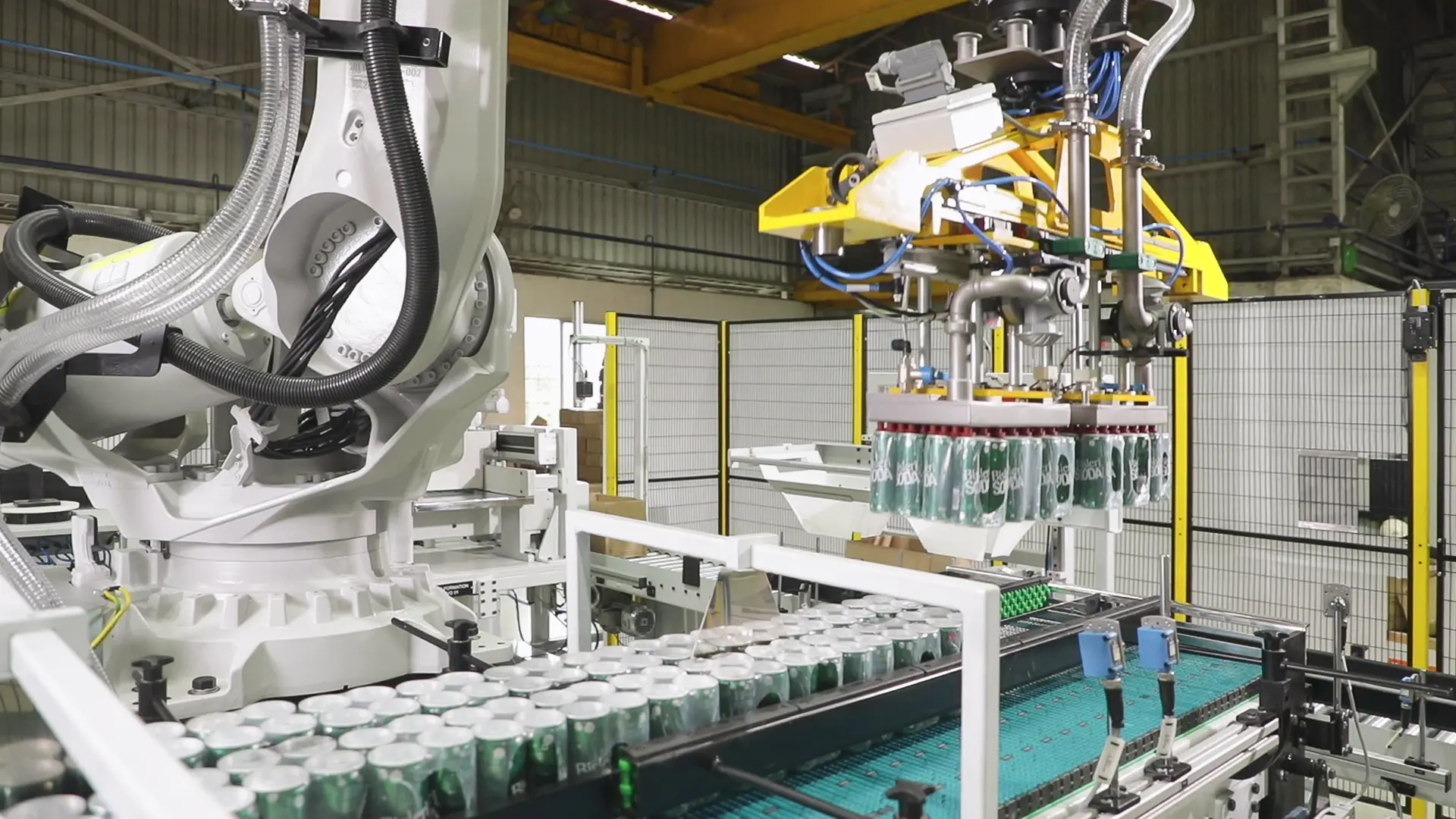
A robotic palletizer is not a single product; a gantry system handling 210 units/hour at 10 kW and a six-axis system handling 1,200 boxes/hour with a 150 kg payload and full ISO 12100 enclosure are both robotic palletizers but serve entirely different requirements and budgets.
Throughput and payload are the primary cost drivers; increasing either requires greater arm capability, motor sizing, control complexity, and safety engineering, making over-specification one of the most common procurement mistakes.
Automation scope determines the real investment; a standalone palletizer may appear cheaper, but integration consulting, conveyor modifications, and PLC bridging often increase the total installed cost.
Safety architecture follows operational risk; full ISO 12100 enclosures, light curtains, and collaborative safety systems are application-specific requirements, not interchangeable budget options.
An automated tool changer allows a single six-axis robotic palletizer to handle bags, boxes, and drums, eliminating the need for multiple dedicated palletizing systems.
When manual labour exceeds 20% of end-of-line costs, pallet instability causes transport claims, throughput is constrained, injury risks increase, or new case dimensions cannot be accommodated, robotic palletizing typically delivers a 12–24 month payback for six-axis systems and 12–18 months for gantry systems.
Nobody publishes robotic palletizer prices , and there is a reason that goes beyond competitive sensitivity. The same procurement request , ‘we need a robotic palletizer’ , can generate quotes that differ by a factor of five depending on throughput tier, payload class, format handled, automation scope and safety architecture. A gantry palletizer moving 210 units per hour on 10 kW of power with one operator is a robotic palletizer. A six-axis system picking 1,200 boxes per hour with a 150 kg payload, automated pallet dispensing, servo grippers and full ISO 12100 enclosure is also a robotic palletizer. Comparing their price tags without comparing their specifications is comparing two entirely different engineering solutions to different production problems.
This guide is the cost breakdown and buying framework that makes robotic palletizer investment decisions defensible. It walks through the five engineering factors that move the quote, the three configuration tiers Cybernetik builds with verified specifications, the total cost of ownership model that usually favours robotic palletizing over manual operation within 12 to 24 months, and the buying checklist that ensures your RFQ generates comparable quotes rather than incommensurate ones. If your last robotic palletizer evaluation felt like guesswork, the framework below replaces it with engineering.
Robotic palletizers are automated tertiary packaging machines that use one or more articulated robotic arms , six-axis, gantry, delta or collaborative , to pick packed units from an upstream conveyor and stack them onto pallets in recipe-defined layer patterns. Unlike conventional high-level palletizers that use fixed mechanical sweeps and pushers, robotic palletizers define their stacking motion in software, making them inherently flexible across formats, pallet sizes and matrix patterns.
The cost variation in robotic palletizers reflects genuine differences in engineering scope. A gantry robotic palletizer is a 3-axis servo system with a compact footprint, light curtain safety and a single operator for pallet changeover; it delivers 210 units per hour on 10 kW of power and is specifically suited to operations handling up to 1,500 units per day at low capital cost. A six-axis robotic palletizer is a full articulated arm system with payload up to 150 kg, throughput up to 1,200 boxes per hour, simultaneous multi-unit picking, servo and pneumatic gripper options, automated pallet dispensing and full ISO 12100 enclosed guarding. These are not the same machine at different price points; they are different engineering solutions to different production volumes.
Cybernetik’s robotic palletizer portfolio spans all three tiers , six-axis, gantry and cobot , on a common platform philosophy: modular design for plant layout, recipe-driven HMI for SKU flexibility, and verified technical specifications published per configuration rather than estimated. The buying framework below uses these tiers to anchor the cost comparison.
1. Throughput Tier and Payload Class
Throughput and payload are the primary cost drivers because they determine the robotic arm class. Cybernetik’s bag palletizer delivers up to 600 bags per hour at 50 kg payload; the box palletizer reaches 1,200 boxes per hour at 150 kg payload; the gantry processes 210 units per hour at lower payload. Each step up the throughput and payload ladder adds arm capability, motor sizing, control architecture and safety engineering , all cost-bearing. Specifying a higher throughput tier than the line actually needs is the most common source of over-investment in robotic palletizer procurement.
2. Format Handled and End-of-Arm Tooling Complexity
A bag palletizer needs a gripper engineered for flexible, deformable surfaces with variable fill levels; a box palletizer needs a gripper designed for rigid corrugated edges with predictable geometry; a drum palletizer needs a different attachment mechanism entirely. End-of-arm tooling is a significant cost component , and an automated tool changer that enables the same robotic arm to handle multiple formats adds meaningful capex but often lowers TCO for operations running mixed formats. Cybernetik’s optional automated tool changer enables one robot to palletize bags, drums and boxes from the same base unit.
3. Automation Scope: Standalone vs Integrated Line
A robotic palletizer quoted standalone , robot arm, conveyor, basic controls , costs less upfront than one quoted as part of an integrated line with automated pallet dispenser (up to 10 pallets per magazine), downstream stretch-wrap coordination, upstream case packer integration and unified PLC. The integration scope changes the quote materially; but plants that buy standalone palletizers typically spend the capex saving plus more on integration consulting, conveyor retrofits and PLC bridging downstream. Cybernetik specifies integration scope inline to make the comparison honest.
4. Safety Architecture: Enclosure, Light Curtain or Cobot
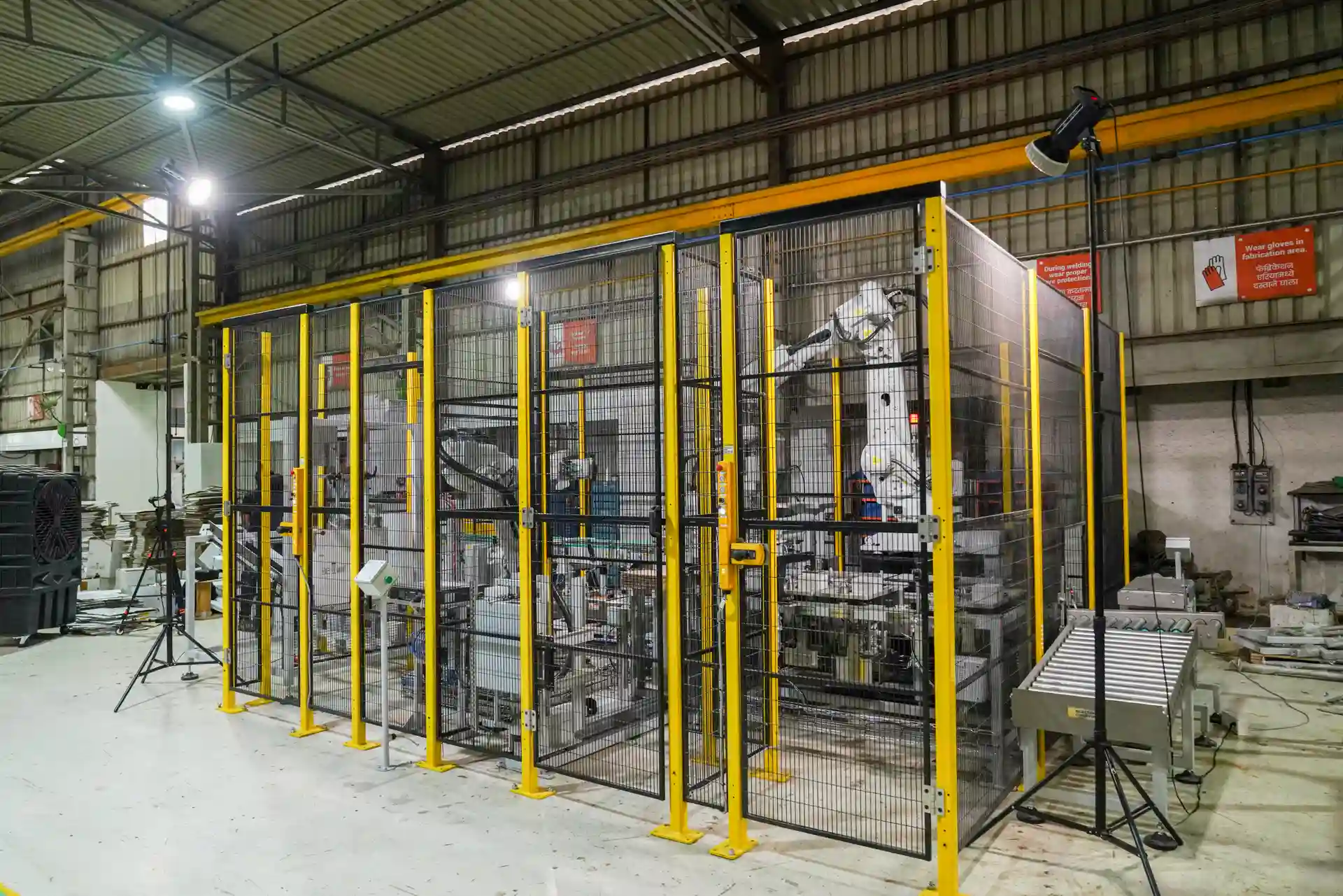
Full ISO 12100 enclosed guarding with interlocked access gates is the highest-cost safety specification and the right one for high-throughput environments where forklifts and robotic arms share a floor zone. Light curtain safety , used on Cybernetik’s gantry palletizer , costs less and installs more compactly, but limits the robotic arm’s operating envelope. Cobot safety (inherent collision detection, no guarding required) costs less again but limits throughput and payload. Safety architecture is not a cost lever to pull carelessly; it is a regulatory and operational requirement that follows the actual risk profile of the installation.
5. After-Sales Scope: Installation, Training and Service Network
Robotic palletizer quotes differ significantly in after-sales scope. A quote that excludes installation, commissioning and operator training is cheaper on paper; the hidden cost is the time from delivery to production readiness, which typically runs weeks longer on unsupported installations. Cybernetik’s robotic palletizer quotes include installation, commissioning, operator and maintenance training, SOP handover and access to a global service network across more than thirty countries , making the after-sales scope explicit in the comparative evaluation.
Multiple Orientation Robotic Carton Palletizer
Cybernetik’s robotic palletizer portfolio spans three cost tiers. Understanding what each tier delivers , and what it trades off , is the core of the buying decision.
Six-Axis Robotic Palletizer , Highest Throughput, Lowest TCO at Scale
Six-axis articulated arm, payload up to 150 kg (boxes) or 50 kg (bags), throughput up to 1,200 boxes per hour or 600 bags per hour, simultaneous multi-unit picking, servo and pneumatic gripper options, automated pallet dispensing with 10-pallet magazine, stack height up to 1,800 mm, footprint approximately 28 m², power 28.7–35 kW, ISO 12100 full enclosure. Highest upfront capex in the portfolio; lowest total cost of ownership at production volumes above 500 units per hour. The right configuration for high-throughput manufacturing, beverage bottling, large 3PL facilities and chemical packing lines.
Gantry Palletizer , Lowest Capex, Lowest Opex for Mid-Volume
3-axis servo-actuated gantry system, 210 units per hour, 9 seconds per cycle, maximum pallet height 2,000 mm, up to 10 SKU matrix formations via rotary axis end-of-arm tooling, 10 kW power, one operator for semi-automatic pallet changeover, compact footprint with light curtain safety. Suited to operations handling up to 1,500 units per day. Lowest capital cost and lowest running cost in the six-axis tier equivalent; easiest to integrate into existing lines with low footprint. The right configuration for mid-volume food, pharma and 3PL operations where payback speed matters more than peak throughput.
Cobot Palletizer , Operator-Proximate Flexible Deployment
Collaborative robot arm with inherent safety, no full guarding enclosure required, operator-proximate operation, lower payload and throughput than six-axis. Designed for environments where operators need frequent physical access to the palletizing area, where floor layout makes full enclosure impractical, or where throughput requirements are low and SKU variety is high. Cybernetik’s cobot palletizer configuration suits low-volume flexible operations including artisan food production, pharma distribution and co-packing facilities.
The table below maps the three robotic palletizer configurations to the cost-bearing specifications that determine the price tier.
Specification | Six-Axis Robotic | Gantry | Cobot |
Throughput (boxes) | Up to 1,200 boxes/hr | 210 units/hr | Low throughput |
Throughput (bags) | Up to 600 bags/hr | Up to 210 bags/hr | Low throughput |
Payload | Up to 150 kg (boxes), 50 kg (bags) | Format-matched | Low (operator-safe) |
Power Consumption | 28.7–35 kW | 10 kW | ~3–5 kW |
Max Stack Height | 1,800 mm | 2,000 mm | ~1,500 mm |
Safety Architecture | Full ISO 12100 enclosure | Light curtains + guards | Inherent cobot safety |
Operators Required | 1 (supervision) | 1 (pallet changeover) | 1 (proximate) |
CAPEX Profile | Highest in portfolio | Lower | Lowest |
OPEX at Volume | Lowest (throughput/kW) | Very low (10 kW) | Low |
TCO Payback | 12–24 months at scale | 12–18 months mid-vol | 18–30 months low-vol |
| Specification | Conveyorized Flow Wrapper | Robotic Flow Wrapper |
|---|---|---|
| Speed | Up to 400 parts/min | 100 parts/min per robot (up to 480 parts/min in 4-robot pick & place line) |
| Material of construction | SS (contact), CS (non-contact), food-grade belts | SS (contact), CS (non-contact), food-grade belts |
| Sound level | Up to 80 dB | Under 80 dB |
| Footprint | 3.5 × 1 × 2 m | 5 × 2 × 4 m (full line) |
| Best for | In-transit, oriented naked products | Random orientation; vision-guided pick & place |
| Typical application | Cookies, biscuits, energy bars | Enrobed chocolates, candies, soft confectionery |
| Quality control | Empty + double pack rejection | Vision rejects broken/out-of-shape; empty + double pack rejection |
| Hygiene | GMP-built, food-grade contact parts | GMP-built, food-grade grippers |
Six-axis robotic palletizer format range
• Boxes and cartons , corrugated RSC cases, rigid cases and handle-with-care boxes up to 150 kg payload
• Bags and sacks , gusseted bags, flat-bottom bags, polyethylene and polypropylene sacks up to 50 kg payload
• Drums , up to 120 kg payload at up to 12 drums per minute
• Pails and buckets , up to 80 kg payload at up to 28 pails per minute
• Mixed formats , automated tool changer option enables one robot to handle bag, box and drum variants
Gantry palletizer format range
• Bags, sacks and bales , food grains, fertilisers, chemical powders, pharmaceutical powders
• Boxes and cartons , biscuit packs, snack pouches, FMCG cases at 210 units per hour
• Pails and tins , lubricants, paints, specialty chemicals
• Up to 10 SKU matrix formations per machine via rotary axis end-of-arm tooling
• Multiple pallet sizes: 1200 × 1200 mm, 1200 × 1000 mm, 1145 × 1145 mm
Pallet handling across all configurations
• Pallet types: wooden, plastic, metal across standard and custom dimensions
• Automatic pallet dispenser: up to 10 pallets per magazine load
• Completed pallet transfer to downstream stretch-wrap via roller conveyor
• Stack height: up to 1,800 mm (six-axis) or 2,000 mm (gantry)
• Recipe-defined layer patterns, rotation sequences and interlayer sheet options
Cybernetik packaging engineering team
Cybernetik’s robotic palletizer portfolio is designed to be bought honestly , every specification below is verifiable from the live product pages, not from catalogue estimates.
Industries Evaluating Robotic Palletizer Cost Against Manual and Conventional Alternative
Food Manufacturing: Grain, snack, dairy and packaged food plants where manual pallet stacking is the last un-automated stage; six-axis and gantry configurations both serve within the same portfolio.
A robotic palletizer is an automated tertiary packaging machine that uses an articulated robotic arm , six-axis, gantry or collaborative , to pick packed units from an upstream conveyor and stack them onto pallets in a software-defined layer pattern. Unlike conventional palletizers with fixed mechanical sequences, robotic palletizers reconfigure their stacking logic through recipe selection, making them flexible across formats, pallet sizes and matrix patterns.
Where manual palletizing represents more than 20 percent of end-of-line labour cost, and the operation shows symptoms of pallet instability, throughput constraints or injury risk, the ROI on a Cybernetik robotic palletizer typically runs 12 to 24 months on the six-axis tier (at high volume) and 12 to 18 months on the gantry tier (at mid-volume), calculated on labour, transport damage, injury and throughput-recovery savings combined.
A six-axis robotic palletizer uses an articulated arm with spherical motion envelope, payload up to 150 kg and throughput up to 1,200 boxes per hour. A gantry palletizer uses a 3-axis linear servo system with compact footprint, throughput of 210 units per hour, 10 kW power and one operator for pallet changeover. The gantry costs less to buy and run; the six-axis delivers higher throughput and multi-format flexibility through a broader motion envelope.
Yes. Cybernetik’s six-axis robotic palletizer with automated tool changer can palletize bags, boxes and drums from the same base unit, switching formats through tool change without a separate machine per format. The gantry configuration supports up to 10 SKU matrix formations via rotary axis end-of-arm tooling , both options reduce capex for multi-format operations significantly.