
Key takeaways
Walk into any plant that mixes dry powders in batches and there is a good chance a ribbon blender is doing the work. It has been the default industrial mixer for decades, not because it is sophisticated, but because a simple helical ribbon turning in a U-shaped trough moves a large batch thoroughly at a reasonable cost.
A ribbon blender mixes dry powders and granules using two helical ribbons on a single shaft. The outer ribbon pushes material in one direction along the trough while the inner ribbon moves it back the other way, and that opposing flow is what turns the batch over and blends it. It suits free-flowing to moderately cohesive powders in batches from around a hundred liters to several thousand.
How the Ribbon Shape Works
The agitator is the whole idea. Two ribbons wind around the same shaft in opposite hands, so when the shaft turns, one ribbon drives material toward one end of the trough and the other drives it back.
That sets up a continuous circulation. Material travels along the outer path, is turned at the end, comes back along the inner path and meets fresh material on the way. Ingredients that started in separate layers are cut, folded and redistributed across the batch rather than simply stirred in place.
The mixing is mostly convective, which means large groups of particles are moved around rather than individual particles being shuffled. That makes ribbon blenders fast at spreading ingredients through a batch and less effective at breaking down lumps or dispersing an ingredient that clings to itself.
What a Ribbon Blender Is Made Of
| Part | What it does |
|---|---|
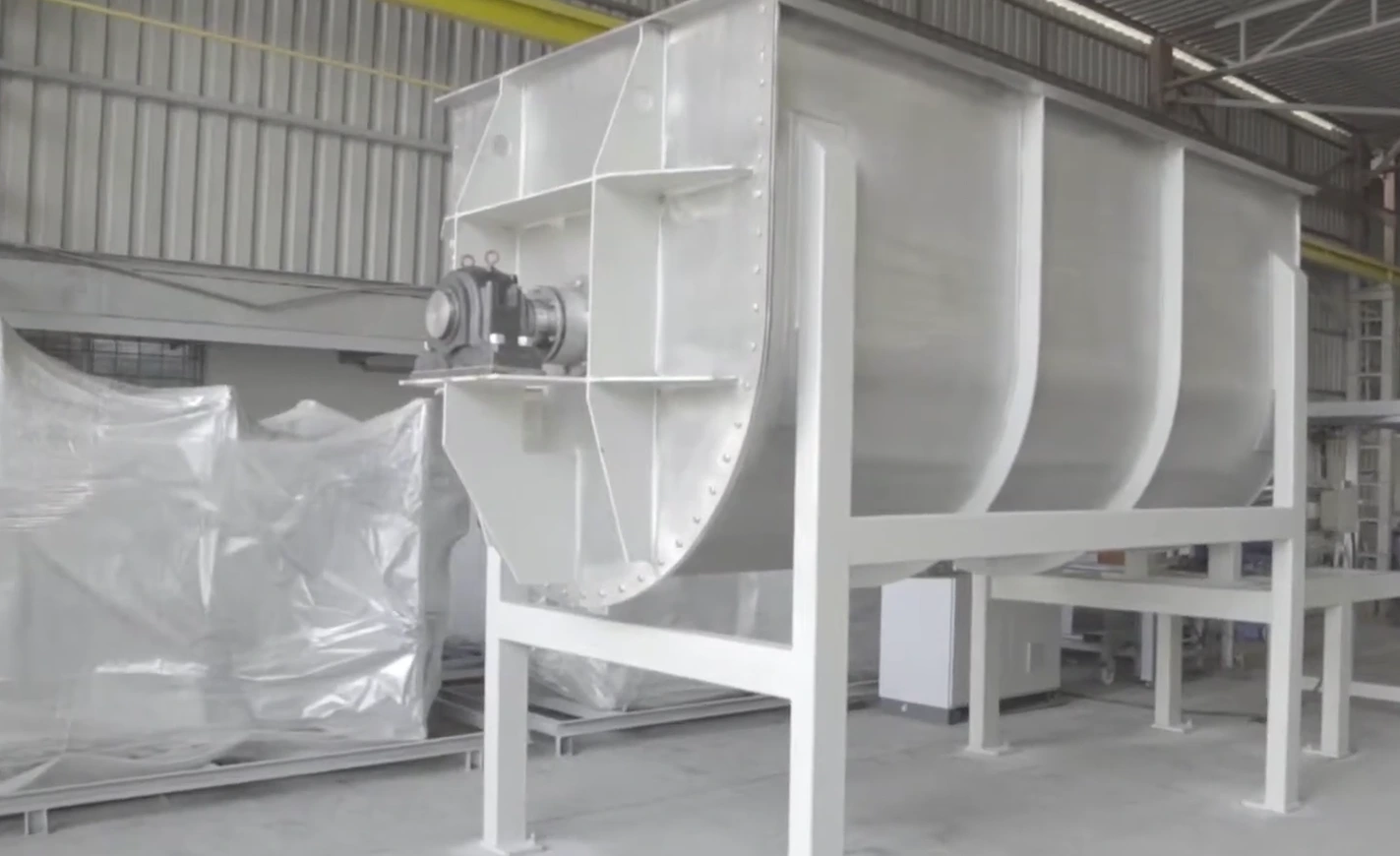
| U-shaped trough | Holds the batch and matches the path the ribbons sweep |
| Double ribbon agitator | Two helical ribbons that move material in opposite directions |
| Shaft and end bearings | Carry the agitator, usually with bearings mounted outside the trough |
| Shaft seals | Keep powder inside and protect the bearings |
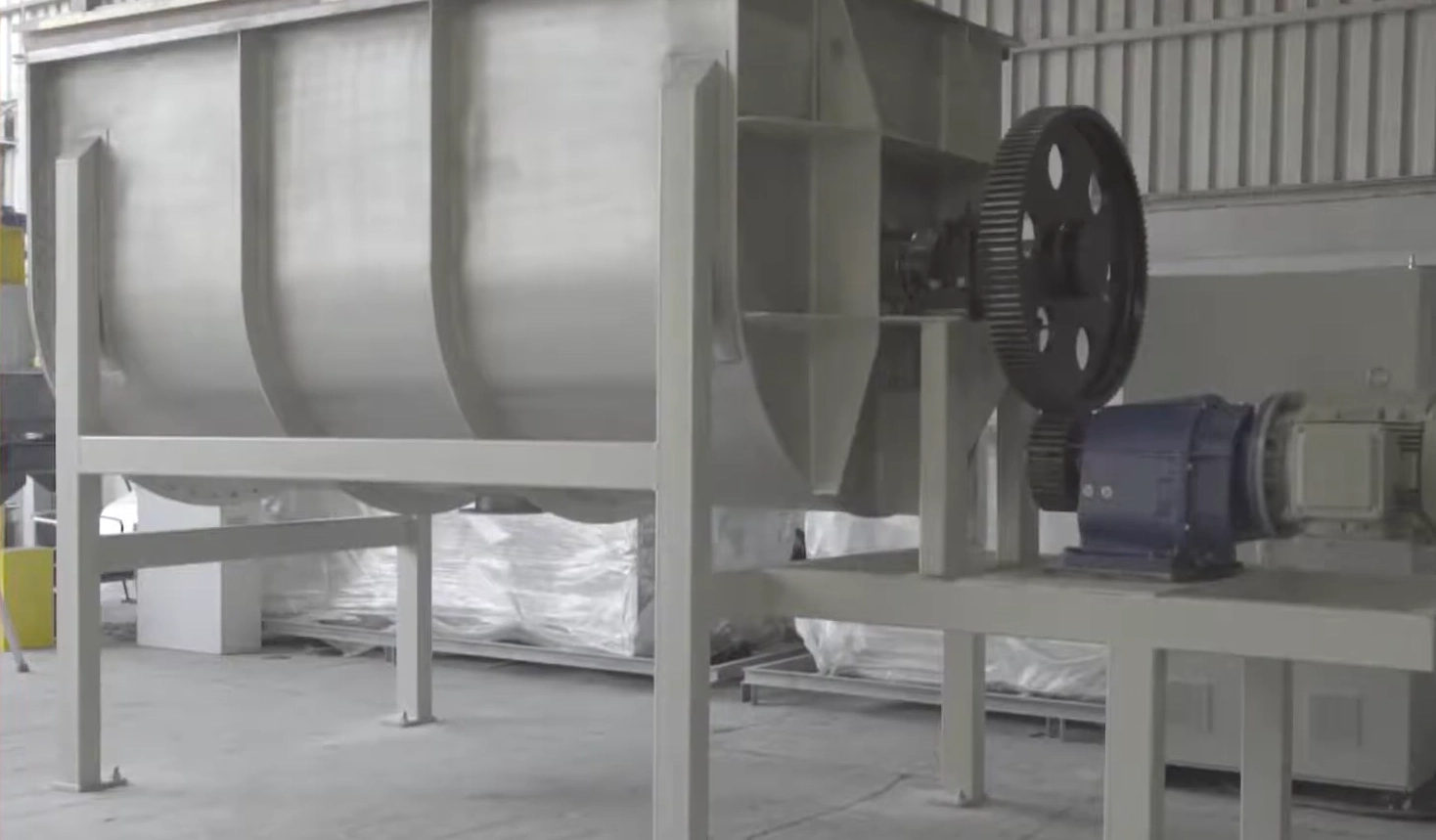
| Drive | Motor and gearbox sized for a full trough at start-up, not just for running |
| Discharge valve | Releases the batch, ideally without leaving pockets of product behind |
| Cover and inlets | Close the trough, with charging points and any liquid spray connections |
| Optional choppers | High-speed blades that break lumps and help with liquid addition |
Two of those parts deserve more attention than they usually get during buying: the discharge valve, because a valve that leaves product behind causes cross-contamination on the next batch, and the shaft seals, because a leaking seal loses product and damages bearings.
Ribbon Geometry Decides Performance
Clearance to the trough wall
The gap between the outer ribbon and the trough wall is one of the most important dimensions on the machine. Too large and a layer of material sits against the wall barely moving, so part of the batch is never properly mixed and product builds up between batches. Too small and the ribbon can rub, wearing both itself and the trough.
The gap is set during manufacture and widens as the ribbon wears, especially with abrasive products. A blender that mixes less well than it used to, with material caking on the wall, is often telling you the clearance has grown.
Pitch and ribbon width
Pitch controls how quickly material travels along the trough, and ribbon width controls how much it moves per turn. The two are balanced so that the outer and inner flows are roughly matched. If they are not, material piles at one end and mixing slows.
Speed
Ribbon blenders run slowly compared with high-shear machines, typically tens of revolutions per minute. Higher speeds do not usually improve mixing much and can damage friable products, so speed is chosen for the material rather than pushed for output.
Fill Level Matters More Than Buyers Expect
A ribbon blender is rated by working volume, not by the total volume of the trough, and it needs the batch to reach the ribbons to work properly.
Running well below the rated volume is the most common cause of poor mixing. With too little material, the ribbons turn largely in air and the circulation pattern never forms, so the batch takes far longer to blend or never becomes uniform. Overfilling causes the opposite problem, because material above the agitator is not lifted and simply rides on top.
Where batch sizes vary widely, one blender rarely covers the range well. It is usually better to size the machine for the most common batch and accept that very small batches will be mixed elsewhere, rather than buying a large blender that runs a quarter full most of the time.
How Long to Mix
There is a point at which a batch is as uniform as that blender will make it, and mixing past it wastes time and can make things worse by breaking particles or letting a blend start to separate again.
The way to find it is to take samples from several points in the batch at intervals, measure how much the results vary and see where the variation stops improving. That number becomes the mix time for that product, and it belongs in the recipe rather than in an operator’s judgment.
How uniformity is measured, and why sampling itself can mislead, is covered in more detail in the guide to industrial blenders.
Liquids, Lumps and Choppers
A plain ribbon blender spreads ingredients. It does not break agglomerates apart, and it handles liquid addition poorly on its own, because liquid landing on slow-moving powder forms wet balls that the ribbons simply carry around.
Choppers solve both problems. These are small high-speed blades mounted in the trough wall, driven separately, that break lumps and disperse liquid as material passes them. For blends with a small liquid addition, such as oils, flavors or binders, a chopper plus a spray bar across the trough width is the usual arrangement.
Where the lumps arrive with the raw material rather than forming during mixing, dealing with them before the blender is more effective, which is the job described in the article on lump breakers.
Discharge Is Part of the Mix
A batch can be blended perfectly and still arrive at the next stage uneven, because discharge can undo the work. Two things matter. The valve should not leave dead pockets where product sits, since that material carries into the next batch and is an allergen or cross-contamination risk in food and pharmaceutical plants. And discharge should be reasonably quick and complete, because a slow trickle from a large trough gives fine and coarse particles time to separate on the way out.
Plug valves are common on hygienic machines because they close flush with the trough and leave little behind. The ability to run the agitator in both directions also helps, since reversing assists discharge of products that cling.
Power and Drive Sizing
Drive power scales with volume, density and how the product behaves. Across a typical range, a 100 liter machine may need around 5 hp while a 10,000 liter machine needs closer to 100 hp, so power per liter falls as machines get larger.
The figure that matters more is starting torque. A blender that stops with a full trough has to restart against the entire batch, and a drive sized only for steady running will trip. Dense products, wet blends and any material that settles and packs during a stoppage all raise that demand.
 “Proper drive sizing, efficient discharge, and controlled mixing cycles help minimize downtime and product loss. These design considerations support reliable performance across repeated production batches.”

See it in action
Where Ribbon Blenders Are Used
When a Ribbon Blender Is Not the Right Machine
It is worth knowing the limits, because ribbon blenders are often bought by default. Fragile products can be damaged, since material is dragged along the trough wall rather than lifted gently. Blends with very different particle sizes or densities can separate again during discharge. Cohesive powders that form hard agglomerates need shear that a plain ribbon does not provide. And very small batches in a large machine will not mix well regardless of how long they run.
Where the requirement is to break structures apart rather than to spread ingredients evenly, a different machine is needed altogether, as explained in the article on high shear mixers.
Order of Addition and Small Ingredients
What goes into the trough first, and where, affects how long mixing takes. Large ingredients usually go in first to form the bed, with smaller additions placed on top of that bed rather than against the trough wall, where they can sit in the slower moving layer.
Ingredients added at very low inclusion, such as vitamins, colors or actives, are the hardest to spread evenly. Adding them directly to a large batch means a small quantity has to travel through the whole trough, which takes far longer than most operators expect. Pre-blending the small ingredient with a portion of a main ingredient first, then adding that pre-blend, gives it a head start and usually shortens the total cycle.
Liquid should go in after the dry ingredients are distributed. Added early, it creates wet regions the ribbons carry around as lumps.
Wear, Inspection and Upkeep
Ribbon blenders are robust and they do wear in predictable places. Ribbon edges thin on abrasive products, which widens the clearance and slowly reduces mixing quality. Shaft seals are the usual maintenance item, and dust appearing around the shaft ends is the first sign one needs attention. Discharge valve seats wear too, and a valve that no longer closes cleanly both leaks and leaves residue.
A short routine covers most of it: check clearance and ribbon condition at planned intervals, watch motor current for a gradual rise, and confirm the trough still empties completely.
Common Problems and Their Causes
| Problem | Likely cause | What usually fixes it |
|---|---|---|
| Blend is not uniform | Underfilled trough or too short a mix time | Correct the fill level and set mix time by testing |
| Product left after discharge | Dead pockets at the valve or a shallow trough end | Plug valve, better valve seating, complete discharge design |
| Product degrading | Ribbon speed too high or mixing continued too long | Lower speed, shorter cycle, check clearance |
| Material caked on the trough wall | Clearance too large or sticky product | Reset ribbon clearance, consider scraper tips |
| Dust escaping at the shaft | Worn or unsuitable seals | Replace with seals designed for powders, consider air purge |
| Motor tripping on start | Drive sized for running rather than starting full | Resize the drive or empty before restart |
Cleaning and Changeover
In plants running several products, cleaning time often matters as much as mixing time. The trough, the ribbons, the shaft and the area around the discharge valve all hold residue, and the underside of the ribbons is the part most often missed.
Hygienic construction helps: smooth welds, rounded corners, a cover that opens fully and a discharge that empties completely. For plants running frequent changeovers or working to pharmaceutical standards, automated cleaning is usually the better answer than manual washing, for the reasons set out in the guide to the clean-in-place process.
Selecting a Ribbon Blender
Ribbon Blenders from Cybernetik
Cybernetik builds ribbon blenders as part of complete powder handling lines, so the blender is specified alongside the intake, sifting, conveying and packing equipment around it rather than as a standalone vessel.
| Cybernetik ribbon blender | Specification |
|---|---|
| Capacity | 100 to 10,000 liters |
| Drive | 5 to 100 hp depending on capacity and product |
| Agitator | Double ribbon with opposing outer and inner elements |
| Inlet and outlet | 150 to 300 NB |
| Discharge | Plug valve that prevents dead pockets, with forward and reverse discharge |
| Discharge height | Adjustable to suit the equipment below |
| Construction | SS304 or SS316 product contact, hygienic build |
| Options | Choppers, liquid addition and ATEX construction for combustible powders |
Three of those specifications address problems raised above. The double ribbon design with opposing outer and inner elements creates the counterflow that turns a batch over properly. The plug valve is designed to avoid dead pockets, which is where cross-contamination between batches usually starts, and forward and reverse discharge helps empty products that cling. The adjustable discharge height means the blender can be matched to whatever sits below it, whether that is a packing machine, a conveyor or an intermediate bulk container.
For plants where a ribbon blender is not the right choice, the same range covers ploughshare mixers, paddle mixers, IBC blending and high shear mixing, along with the CT and combo valves that meter powder in and out. Equipment is built in SS304 or SS316 with hygienic GMP construction, with explosion resistant options for combustible powders, and projects run from design through factory testing, installation and commissioning with one team responsible throughout.