
Key takeaways
Ask several suppliers to quote a 1,000 liter ribbon blender and the prices will not line up. One is quoting a plain carbon steel machine with a slide gate, another a stainless unit with a plug valve, choppers and a control panel. Both answered the question you asked, which was the wrong question.
Choosing a ribbon blender starts with your batch rather than a machine size. Work out the volume your batch occupies at its real bulk density, size the blender so that volume sits comfortably inside its working range, then decide the construction, discharge, options and documentation your industry needs. Those choices, not the nominal capacity, are what separate one quote from another.
Size From the Batch, Not the Label
Blender capacity is stated in liters, while most plants think in kilograms. Converting between them needs the bulk density of the actual product, and that figure varies far more than people expect. A light spice blend and a dense mineral powder of the same weight occupy completely different volumes.
The method is straightforward. Take your batch weight, divide by bulk density to get the volume of product, then allow for the fact that a ribbon blender should not be filled to the brim. Working at roughly seventy percent of the rated working volume gives room for the ribbons to move material properly.
| Batch and bulk density | Volume of product | Blender working volume needed |
|---|---|---|
| 500 kg at 350 kg per cubic meter | About 1,430 liters | Around 2,000 liters |
| 500 kg at 500 kg per cubic meter | About 1,000 liters | Around 1,450 liters |
| 500 kg at 700 kg per cubic meter | About 715 liters | Around 1,000 liters |
| 1,000 kg at 500 kg per cubic meter | About 2,000 liters | Around 2,850 liters |
The table shows why the density figure matters. The same 500 kg batch needs a blender twice the size if the product is light and fluffy rather than dense. If your products vary in density, size the machine on the lightest one, since that is the batch that will fill the trough.
It is also worth asking how small your smallest batch will be. A blender running at a quarter of its working volume mixes poorly no matter how long it runs, so a very wide batch range may need two machines rather than one large one.
What Your Industry Demands
| Industry | What it demands from the blender | Options usually needed |
|---|---|---|
| Food and spices | Hygienic build, fast changeover, no carryover between products | SS304 or SS316, smooth welds, complete discharge, cleaning access |
| Pharmaceutical and nutraceutical | Documented cleaning, content uniformity, traceable construction | SS316 contact parts, material certificates, validation documents |
| Animal feed | Large batches, minor ingredients at low inclusion, robust build | Choppers, liquid spray, heavier construction |
| Chemicals | Corrosion and abrasion resistance, dust safety | Material grade to suit the product, ATEX construction |
| Construction dry mix | Very abrasive materials and large volumes | Wear protection, heavier ribbons, simple robust discharge |
| Plastics | Gentle handling of granules, additive dosing | Lower speed, careful clearance, liquid or additive dosing |
The pharmaceutical row is the one that changes a project most. Beyond stainless construction, it brings documentation: material test certificates for contact parts, surface finish records, weld documentation, and support for installation and operational qualification. Those requirements should be in the inquiry rather than raised after the machine is built, because they affect how it is made and recorded, not only what is supplied with it.
The Specification to Send
A short written specification gets comparable quotes and better machines. It should cover the products, the batch, the process and the plant.
Options That Change the Machine
Most of the price difference between quotes sits in options, so decide which you genuinely need before comparing.
Choppers
Small high-speed blades that break lumps and disperse liquids. Needed when the product forms agglomerates or when liquid is added, unnecessary for straightforward dry blends of free-flowing powders.
Liquid addition system
Spray bars distributing liquid across the moving bed, with dosing control. A single nozzle in the cover is not the same thing and usually produces wet lumps.
Jacket for heating or cooling
Turns the blender into a simple thermal processor, useful for drying slightly, warming fats into a blend or cooling after mixing. It adds cost and utilities, so specify it only if the process needs it.
Load cells
Mounting the blender on load cells allows ingredients to be weighed into the trough directly, which removes a separate weighing step and improves recipe accuracy.
Vacuum operation
Used where the product is oxygen sensitive or where drying under vacuum is part of the process. It requires a pressure-rated vessel and adds considerable cost.
Hazardous area construction
For combustible powders, explosion resistant construction and suitable electrical equipment are design decisions taken at the start rather than fitted later.
Discharge and Cleaning Deserve Equal Weight
Two features decide how the blender behaves day to day, and both are easy to overlook while comparing capacities.
The discharge valve determines whether the trough empties completely. A valve that leaves product in pockets creates carryover between batches, which is a quality problem in food plants and a regulatory one in pharmaceutical work. Plug valves close flush with the trough and leave very little behind, while simpler slide gates cost less and hold more residue.
Cleaning follows the same logic. Ask how long a full clean takes between two of your actual products, not a generic figure. Where the plant runs frequent changeovers or works to pharmaceutical standards, automated cleaning usually pays for itself, and the way to specify it is set out in the guide to selecting a clean-in-place system.
Judging the Supplier
Ribbon blenders look simple, which is why they are widely fabricated. The differences between suppliers show up in details that are invisible in a photograph.
It is also worth asking whether a ribbon blender is genuinely the right machine for your product, because a supplier who only builds them will rarely raise the question. The comparison across mixer types is covered in the guide to industrial blenders.
Run a Trial Before You Buy
Mixing behavior is hard to predict from product data, and a trial answers questions no specification can.
Measure four things. How long the batch takes to reach the uniformity you need, sampled from several points rather than one. Whether the product degrades during that time. How completely the blender discharges, including what is left inside. And how long a full clean takes afterward, timed rather than estimated.
Ask for the results in writing. They become the basis for any performance commitment, and they are the reference point if the installed machine behaves differently.
 “The lowest purchase price does not always mean the lowest operating cost. Considering cleaning time, product residue, energy use, and maintenance helps manufacturers make better equipment decisions.”

See it in action
Comparing Quotes Fairly
| Item | Confirm in writing |
|---|---|
| Motor, gearbox and starter | Whether the drive package and its starter or panel are included |
| Discharge valve and actuator | Valve type, actuation and whether controls are part of the scope |
| Choppers and liquid system | Number, position, and whether spray bars and dosing are included |
| Controls | Local panel, recipe control, integration with your plant system |
| Supports and platform | Structure, charging platform and access ladders |
| Inspection and documents | Material certificates, drawings, manuals and test reports |
| Freight and installation | Transport, unloading, erection, commissioning and training |
| Spares | Recommended spares and their availability |
Two items are missed most often: the control panel, which some suppliers include and others leave to the buyer, and the charging platform, which is easy to forget until the blender arrives and nobody can reach the inlet safely.
Installation and Plant Fit
A blender has to be loaded and emptied, and both ends drive the layout. Charging from bags or containers needs height above the inlet and safe access for operators, while the discharge has to clear whatever sits below, whether that is a container, a conveyor or a packing machine.
Feeding also matters. Caked or lumpy raw material charged into the blender puts the work of breaking it down onto the ribbons, which they do poorly, so conditioning material before it arrives is usually better, as described in the article on lump breakers.
Check the practical details too: floor loading with a full trough, power supply for the drive and choppers, headroom for opening the cover, and enough room around the machine to clean it and to remove the shaft if that is ever needed.
What It Costs to Own
Purchase price is a fraction of the picture over ten years. Power is the obvious running cost, and it rises with density and cycle frequency. Wear parts include ribbon tips, seals and valve seats, and abrasive products consume them faster.
The bigger figures are usually elsewhere. Cleaning time between products is labor that recurs every changeover. Product left in the machine is lost yield on every batch. And a blender that cannot reach the required uniformity produces rework or rejected batches, which costs more than the difference between any two quotes.
Batch Time Is Not Just Mixing Time
Plants often size a blender on mixing time alone and then find output falls short. The cycle that matters includes charging, mixing, discharge and any cleaning between batches, and mixing is frequently the shortest part of it.
Charging is the usual constraint. Tipping bags by hand into a large blender can take longer than the mix itself, which is why plants with high batch counts feed from silos, bulk bag unloaders or weighed containers instead. Discharge time depends on the valve and how the product flows, and cleaning depends on how many products share the machine.
Working the full cycle out before buying often changes the decision. A smaller blender with faster charging can produce more in a shift than a larger one that spends most of its time waiting to be filled.
Automation and Records
How much control a blender needs depends on the plant. A single-product operation may run well with a local starter and a timer. A plant running many recipes benefits from recipe-based control, where mix time, chopper use and liquid addition are set per product rather than left to the operator.
Where records matter, and they do in pharmaceutical and export-focused food plants, the blender should log what actually happened: which recipe ran, how long it mixed, whether the choppers were used and what was added. Retrofitting that later usually means changing the panel, so it is cheaper to specify at the start.
Red Flags
Ribbon Blenders from Cybernetik
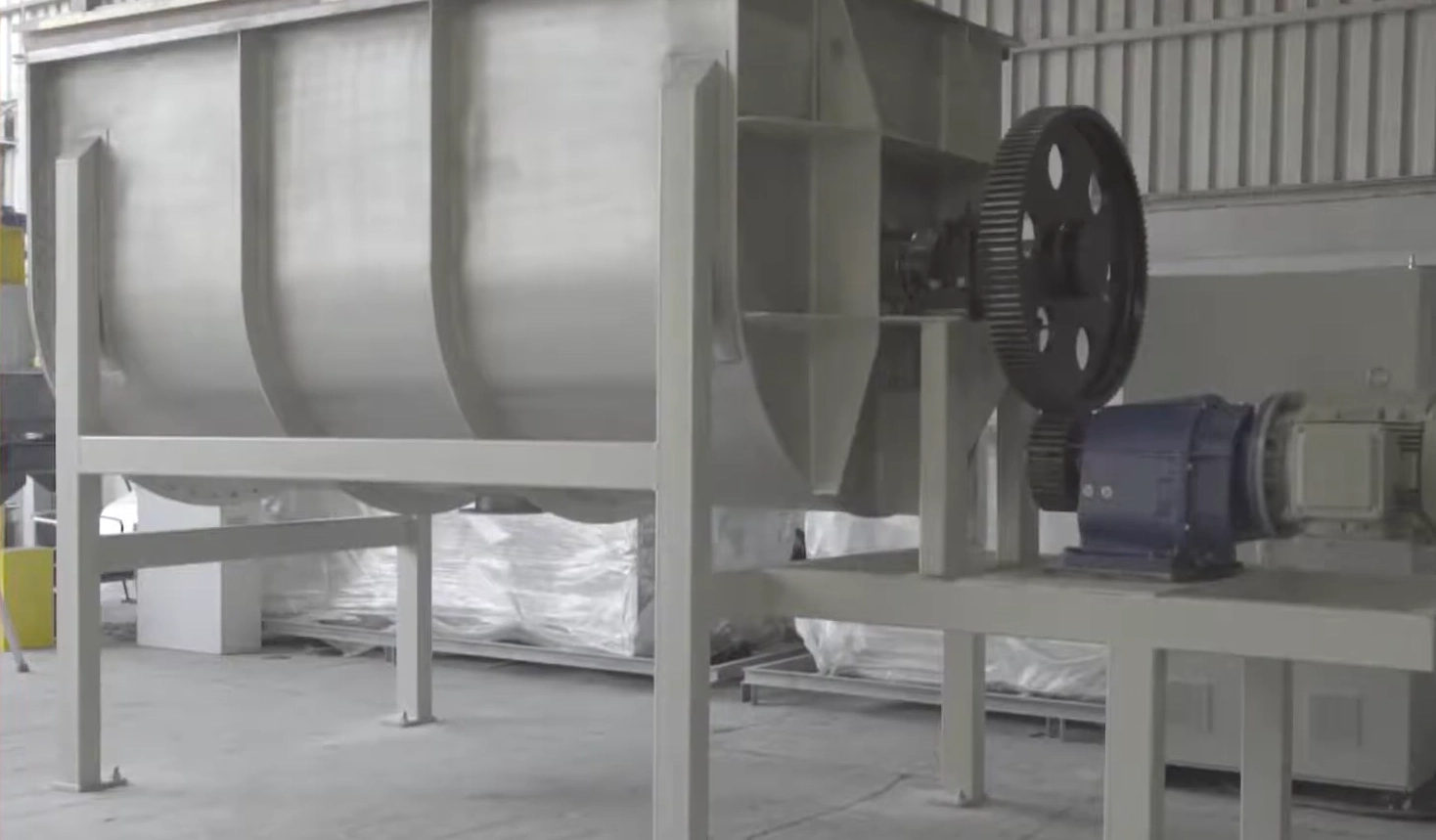
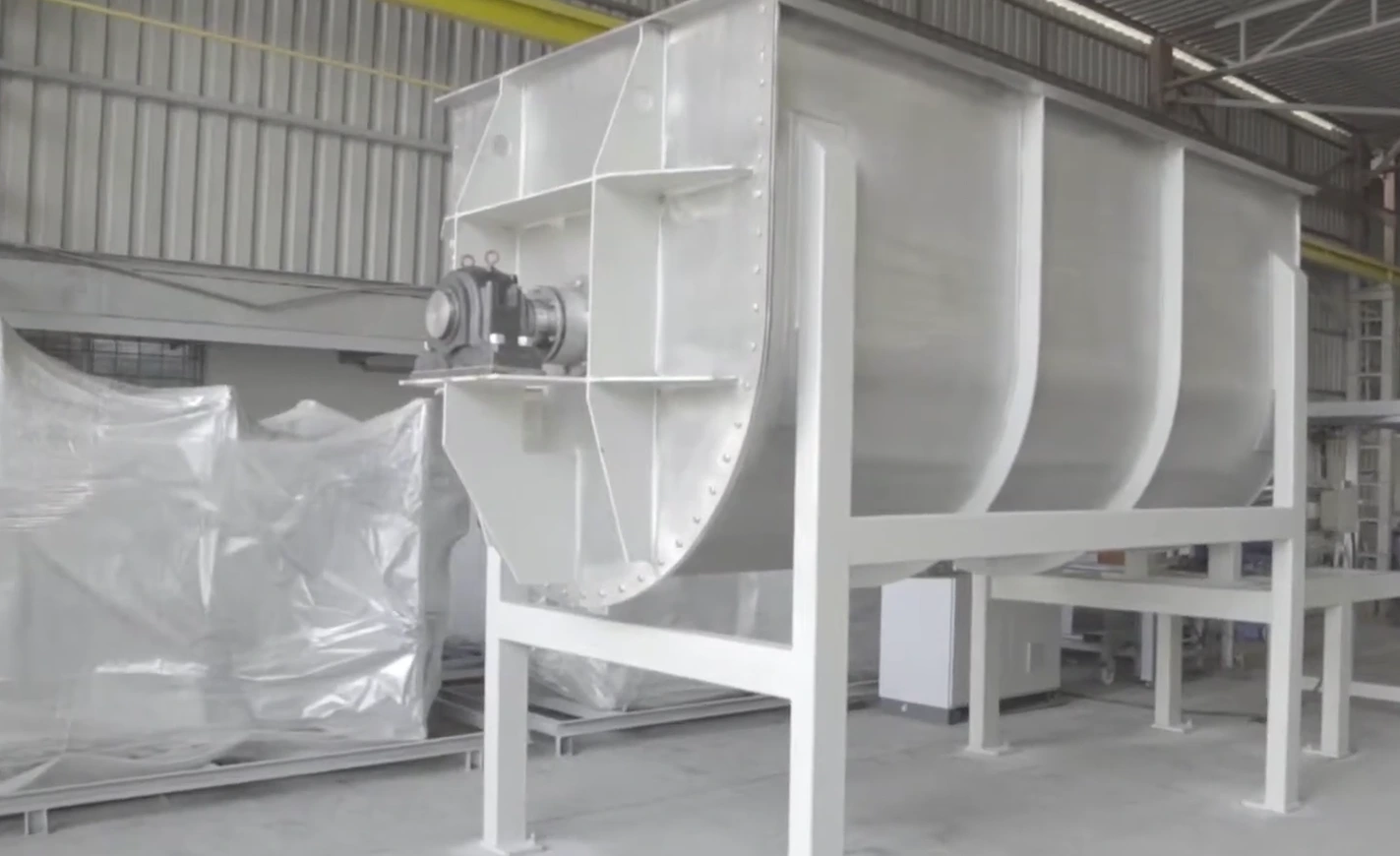
Cybernetik builds ribbon blenders from 100 to 10,000 liters with drives from 5 to 100 hp, sized against the product rather than the nominal volume. Inlets and outlets run from 150 to 300 NB, and construction is in SS304 or SS316 product contact with hygienic build.
Three features address the points raised in this guide. The agitator is a double ribbon with opposing outer and inner elements, which is what creates the counterflow that turns a batch over rather than simply stirring it. Discharge uses a plug valve designed to prevent dead pockets, with forward and reverse operation to help empty products that cling, and the discharge height is adjustable so the machine can be matched to a container, conveyor or packing machine below. Choppers, liquid addition and explosion resistant construction are available where the product needs them rather than fitted as standard.
Because Cybernetik also supplies the equipment around the blender, including bag tipping stations, silos, screw conveyors, sifters, metering valves and packing machines, a quote can cover charging and discharge rather than leaving them for the buyer to arrange. Projects run from design through factory testing, installation, commissioning and support with one engineering team responsible throughout, which is the practical reason plants tend to buy the blender and its surrounding equipment together.