
Key takeaways
Pneumatic conveying looks simple from the outside: powder goes in at one end of a pipe and comes out at the other. Inside, two very different things can be happening. In one system, particles fly through the pipe at high speed like dust in a storm. In another, the same powder creeps along in slow plugs. Which one a plant chooses affects product quality, pipe wear, energy use and cost for years.
Dilute phase pneumatic conveying moves material suspended in a fast-moving air stream, using a blower or vacuum pump, and suits free-flowing, non-abrasive powders at lower cost. Dense phase pneumatic conveying moves material slowly in plugs or a sliding bed using compressed air at higher pressure, usually from a blow tank, and suits abrasive, fragile or blended products because low velocity reduces breakage, wear and segregation.
This guide explains how each mode works, compares them side by side, shows which materials suit which mode and covers the main design and selection points.
What Pneumatic Conveying Is
Pneumatic conveying uses air, or sometimes an inert gas, to move bulk solids through an enclosed pipeline. Because the system is closed, it keeps dust in and contamination out, and pipes can be routed up, over and around existing equipment far more easily than mechanical conveyors.
Every system has the same basic parts: an air source, a way of feeding material into the line, the pipeline itself, and a way of separating the material from the air at the destination, usually a receiver with a filter. The difference between dilute and dense phase lies in how much air is used, how fast it moves and how the material behaves in the pipe.
For buyers looking at suppliers and complete systems in India, the guide to choosing a pneumatic conveying system manufacturer covers what to check beyond the conveying mode itself.
How Dilute Phase Conveying Works
In dilute phase, a large volume of air moves at high velocity through the pipe, and material is fed into it at a controlled rate. The particles are picked up and carried in suspension, spread thinly through the air. The air velocity must stay above the point at which particles begin to drop out of the stream and settle on the bottom of the pipe, otherwise the line can block.
Dilute phase systems can run under pressure, with a blower pushing air through the line, or under vacuum, with a pump drawing air from the destination end. They use relatively low pressures, simple air sources and standard pipe, which keeps equipment costs down.
In a pressure system, material is usually fed into the line through a rotary valve, which meters the powder while holding back the line pressure. How that seal works, and how to deal with air leakage, is explained in the guide to rotary airlock valves.
How Dense Phase Conveying Works
In dense phase, much less air is used and it moves far more slowly. Material travels as a moving bed, a series of dunes or discrete plugs separated by pockets of air, pushed along by the pressure difference across each plug. Because the material is not suspended, the system relies on pressure rather than speed to keep it moving.
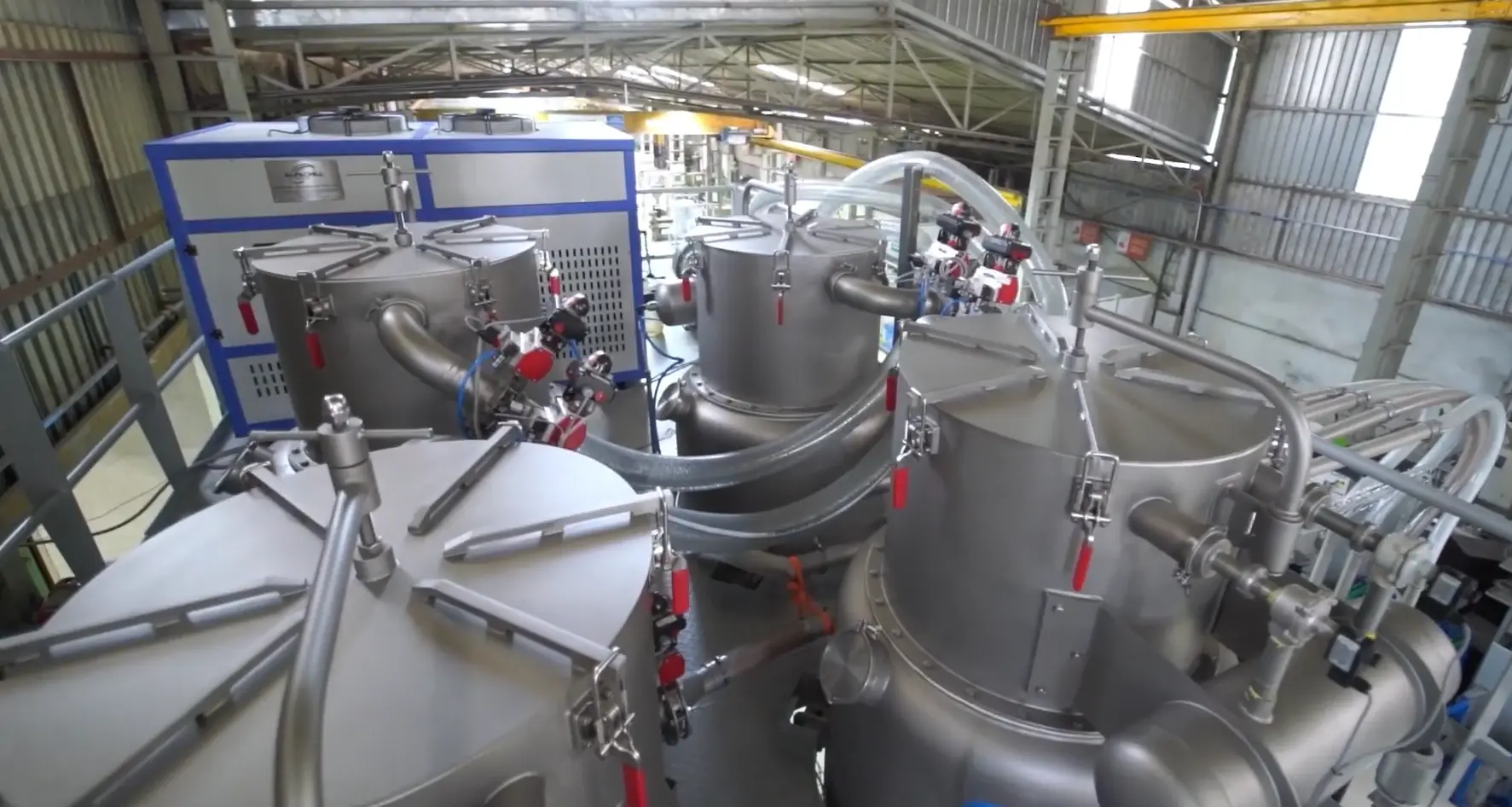
Dense phase systems usually use a blow tank: a pressure vessel that is filled with material, sealed, pressurized with compressed air and then discharged into the line. This repeats in cycles. Some systems use two blow tanks alternately for near-continuous flow, and air injection points along the line help keep longer or more difficult conveys moving.
The slow, controlled movement is the key benefit. Fragile particles break less, abrasive materials wear pipes and bends far less, and blended products tend to arrive in the same proportions they left in.
Dilute vs Dense Phase: Side by Side
| Factor | Dilute phase | Dense phase |
|---|---|---|
| How material travels | Suspended in a fast air stream | In slow-moving plugs, dunes or a sliding bed |
| Conveying velocity | High | Low |
| Air to material ratio | Lots of air per kg of material | Little air per kg of material |
| Operating pressure | Lower | Higher |
| Typical air source | Blower or vacuum pump | Compressed air |
| Feeding device | Rotary valve or venturi | Pressure vessel (blow tank) |
| Product degradation | Higher risk for fragile products | Lower, thanks to low velocity |
| Pipe and bend wear | Higher with abrasive materials | Lower |
| Segregation of blends | More likely | Less likely |
| Equipment cost | Usually lower | Usually higher |
| Best for | Free-flowing, non-abrasive, non-fragile powders over moderate distances | Abrasive, fragile or blended products, and long or high-rate lines |
The space between the two
Dilute and dense phase are not two neat boxes. Between them is a range sometimes called medium or strand phase, where material travels partly suspended and partly along the bottom of the pipe. Some materials move naturally in dense phase with little encouragement, while others can only be conveyed in dilute phase. Knowing which category a material falls into is one of the first things a conveying test establishes.
This matters because a system designed for one mode can behave unpredictably if conditions push it toward the other. A dilute phase line run too slowly, for example, may drift into an unstable flow that surges and blocks. Good design keeps the system clearly within its intended range across the full span of rates it will see.
Pressure and Vacuum Configurations
| Configuration | How it works | Typical use |
|---|---|---|
| Dilute phase pressure | A blower pushes air through the line; a rotary valve feeds material in | One source feeding one or several destinations |
| Dilute phase vacuum | A vacuum pump draws air and material to a receiver with a filter | Several pick-up points feeding one destination; dust-free unloading |
| Dense phase pressure | A blow tank is filled, pressurized and discharged in cycles | Abrasive, fragile or blended products, long distances |
| Dense phase vacuum | Low-velocity transfer under vacuum, often in short batches | Gentle transfer of powders into process vessels over short distances |
Vacuum systems have a useful safety feature: any leak draws air in rather than blowing powder out, which helps keep fine or hazardous powders contained. Pressure systems are better suited to longer distances and higher rates, because the available pressure difference is greater.
Which Materials Suit Which Mode
| Material | Usual mode | Reason |
|---|---|---|
| Flour, starch, sugar powder | Dilute phase | Free-flowing and not abrasive |
| Plastic pellets | Either | Dilute is common; dense reduces streamers and angel hair |
| Sand, cement, minerals | Dense phase | Low velocity reduces pipe and bend wear |
| Sugar crystals and coated granules | Dense phase | Gentle transfer reduces breakage and fines |
| Pre-mixed blends | Dense phase | Material travels together, reducing segregation |
| Fine pharmaceutical powders into vessels | Vacuum conveying | Dust-free and contained transfer |
These are general guides. Particle size distribution, moisture, temperature and how cohesive a material is all affect how it conveys. Reputable suppliers test difficult materials before committing to a design.
Design Factors That Matter
Distance and layout
Every meter of pipe and every bend adds resistance. Long lines and many bends push systems toward higher pressure, and often toward dense phase. Fewer, well-placed long-radius bends reduce wear and energy use in either mode.
Rate
The required throughput, together with the distance, sets the air volume, pressure and pipe size. Designing for peak rather than average demand avoids a system that struggles when production increases.
Material properties
Bulk density, particle size, abrasiveness, fragility and temperature all shape the design. A system that conveys sugar well may block with a fatty or sticky powder, so the material data must be accurate.
Filtration and dust
Receivers and filters separate material from the conveying air. Filter area must suit the air volume and the fineness of the powder, and filters must be cleaned regularly, usually by reverse air pulses, to keep pressure drop low.
Hazardous dusts
Many food and chemical powders are combustible. Systems handling them need earthing, suitable electrical equipment and explosion protection designed for the material and plant classification.
 “Pneumatic conveying is rarely a stand-alone purchase. It links bag or bulk bag unloading to storage silos, silos to mixers, and mixers to packing machines.“

See it in action
Key Components in More Detail
Maintenance and Reliability
Pneumatic systems have few moving parts in the line itself, which keeps maintenance simple, but the parts they do have need attention. Rotary valve clearances and seals wear over time, filters need checking and replacing, bends wear in abrasive service and blowers or compressors need regular servicing.
Monitoring line pressure is one of the most useful habits. A steady rise in pressure for the same rate often signals a partial blockage, filter blinding or a change in the material, giving time to act before the line stops. Many plants trend pressure and rate in the control system for exactly this reason.
Energy Use and Running Cost
Dilute phase uses large volumes of air at low pressure, while dense phase uses small volumes at higher pressure. Which one uses less energy depends on the material, distance and rate. Dense phase often uses less air overall, but compressed air is expensive to produce, so the comparison must be made for the specific duty.
Running costs also include wear. In abrasive applications, the money saved on equipment with a dilute phase system can be lost to frequent bend and pipe replacement. Product quality matters too: breakage that creates fines or off-spec material is a real cost even if it does not appear on the energy bill.
Common Problems and Fixes
| Problem | Likely cause and fix |
|---|---|
| Line blockages | Velocity too low in dilute phase or air supply interrupted; check air flow, feed rate and line routing |
| Excessive bend wear | High velocity with abrasive material; use wear-resistant bends or consider dense phase |
| Product breakage and fines | Velocity too high; reduce speed or move to dense phase |
| Blend arrives separated | Segregation in suspension; dense phase or a different transfer method |
| Rate below design | Air leakage at the feeder, filter blinding or worn components; inspect and service |
Safety Considerations
Pneumatic systems combine fine dust, moving air and, in dense phase, pressure vessels. Blow tanks and compressed air lines must be designed and inspected as pressure equipment, with relief devices and safe venting. Receivers and filters handling combustible dust need explosion protection suited to the material, such as venting, suppression or isolation. Earthing of pipes, hoses and equipment prevents static buildup, which is a real ignition risk with dry powders moving at speed.
How to Choose
Where Pneumatic Conveying Fits in a Powder Line
Pneumatic conveying is rarely a stand-alone purchase. It links bag or bulk bag unloading to storage silos, silos to mixers, and mixers to packing machines. The conveying mode, the feeders that put material into the line and the receivers that take it out all have to work with the equipment around them. Designing them together avoids mismatched rates, dust leaks at connections and filters that are too small for the air volume.
Plants planning a complete ingredient handling system, from unloading to mixing and packing, can find related equipment and complete lines on Cybernetik’s process solutions page.
Powder Conveying from Cybernetik
Cybernetik Technologies, headquartered in Pune and delivering turnkey automation since 1989, designs powder handling systems for food, pharmaceutical and chemical plants. Its powder charging system is a leak-proof vacuum conveying solution for powders up to 8 mm in size, with models from 500 to 3,000 kg/hr and customizable options.
For feeding and discharging conveying lines, Cybernetik’s rotary valve offers leak-proof, non-sparking construction for flow rates up to 6,000 kg/hr, with air or nitrogen purging.