
Key takeaways
Chemical drums are the format that most clearly exposes the hidden cost of manual end-of-line palletising. A 25 kg bag of grain is uncomfortable to lift repeatedly; a 120 kg chemical drum is a documented occupational hazard that generates injury claims, lost-time incidents, HSE enforcement notices and absenteeism costs that accumulate year over year on any plant still relying on manual handling at the end of the drum filling line. Robotic drum palletizing does not just automate an inconvenient task , it removes the human from a genuine harm zone and moves the injury liability from the annual safety report to the capital expenditure ledger, where it is one-off rather than recurring.
This guide covers the chemical industry requirements that specifically shape the robotic drum palletizer specification, the engineering of Cybernetik’s drum palletizing system for HDPE, fibre, PP and polymer drum variants, the transparent framework for evaluating robotic palletizer price against manual operation total cost, and the combination Bag & Drum Palletizer configuration that cuts chemical plant capital investment by allowing a single robotic arm to handle both formats. If your drum filling line still ends with manual palletising, this is the specification and ROI case that changes the procurement decision.
What Is a Robotic Drum Palletizer?
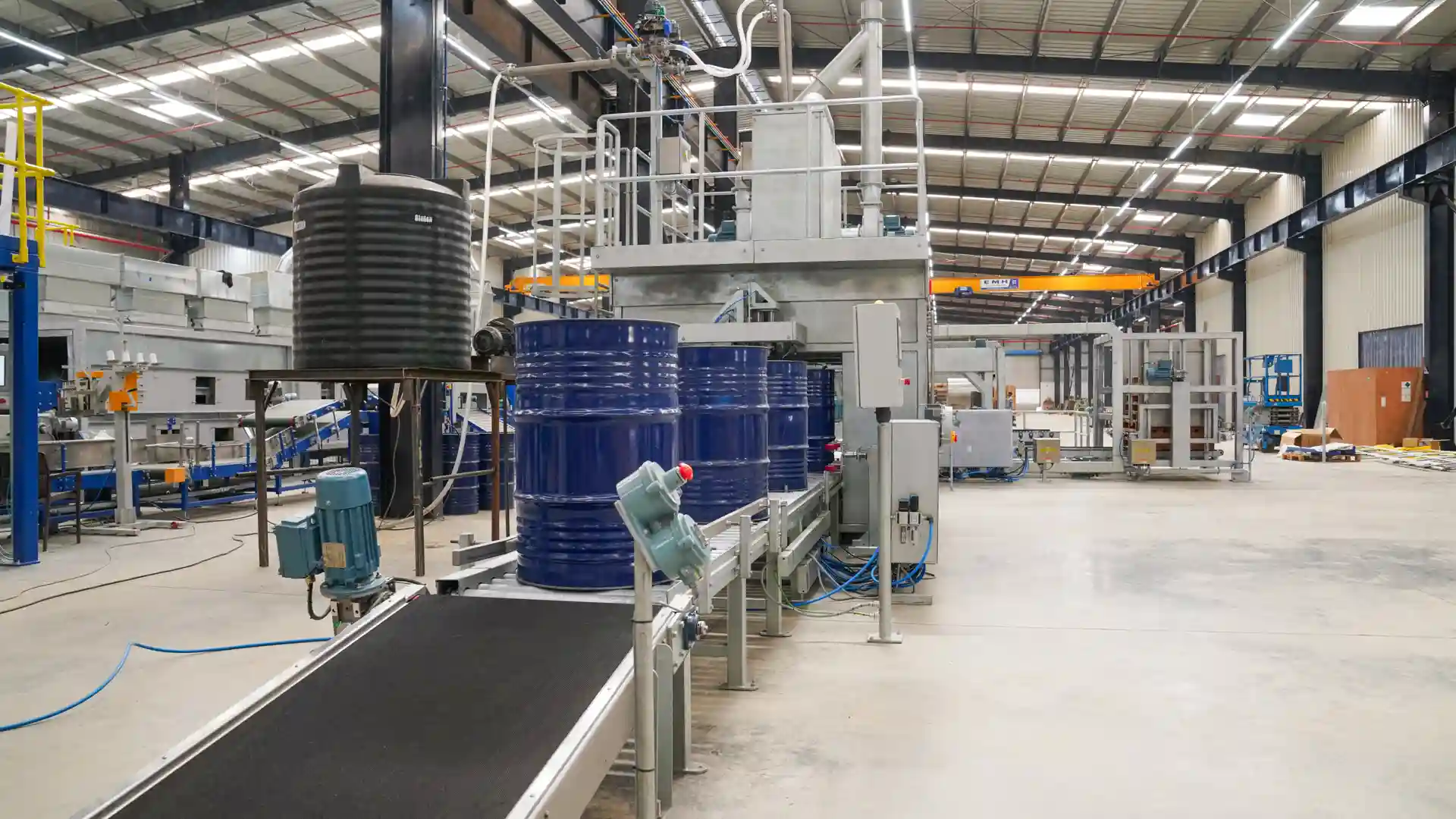
A robotic drum palletizer is an automated end-of-line machine that uses an articulated robotic arm to pick filled drums from a drum filling line or drum conveyor and stack them onto pallets in a recipe-defined matrix. The system handles the full palletising cycle , pallet infeed, drum positioning, pick-and-place stacking and completed pallet discharge , without operator involvement in the drum handling zone, which is the critical safety requirement for chemical, petrochemical and agrochemical drum palletising.
What makes a drum palletizer machine distinct from bag or box palletizers is the payload class and the grip engineering. A 120 kg HDPE drum filled with lubricating oil, a 200-litre fibre drum of bulk chemical, a screw-top drum of agrochemical concentrate , all require an arm with heavy-duty payload capability, a gripper engineered for the specific rim geometry of the drum type, and a motion path that handles the drum’s centre-of-gravity shift at extension without payload drop. A robotic drum palletizer built to these requirements removes the injury risk entirely; one that is undersized for the payload or mismatched to the drum geometry creates new risks of its own.
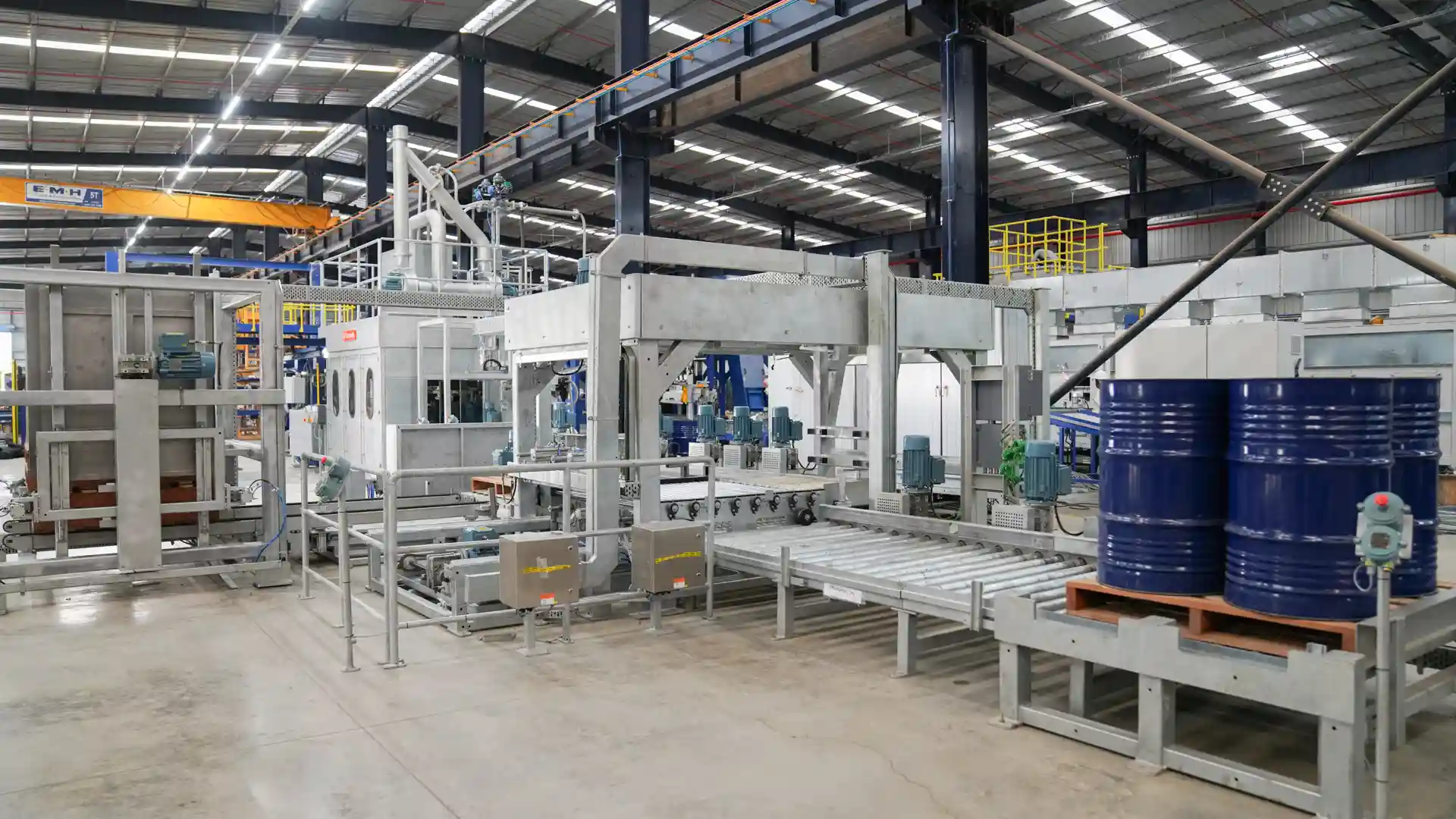
Cybernetik’s robotic drum palletizer handles up to 6 drums per minute at 120 kg payload , customisable per application , across drum types including reinforced-rib HDPE drums, rolled-edge drums, chime drums, rimmed-top drums and screw-top drums in HDPE, fibre, PP and other polymer materials. The system uses servo and pneumatic grippers selected per drum type, a dual reference system that positions both drum and pallet before every pick, an automatic pallet dispenser with 10-pallet magazine, stack height to 1,800 mm, 3.1 m reach, 7 × 7 m footprint and ISO 12100 enclosed safety guarding as standard.
Five Chemical Industry Requirements That Shape the Robotic Drum Palletizer Specification
1. Heavy Payload at Sustained Production Cadence
A 120 kg chemical drum is at the upper limit of safe manual handling under most national HSE guidelines , and most chemical drum filling lines run at 4 to 6 drums per minute, which no manual team can sustain across a full shift at that weight. Cybernetik’s robotic drum palletizer is rated at 120 kg payload and up to 6 drums per minute from production-deployed systems. Payload is customisable for applications involving drums above or below standard dimensions, and the arm’s reach of 3.1 m accommodates the floor layouts of most drum filling hall configurations.
2. Operator Separation from Chemical Drum Handling Zones
Chemical, petrochemical and agrochemical drums carry spill, vapour and contact hazards that manual palletising places directly at operators. Regulatory frameworks including COSHH in the UK, OSHA in the US and equivalent standards in India, the EU and other markets require risk assessment and, where reasonably practicable, substitution of manual handling with mechanical means. A robotic drum palletizer satisfies the substitution requirement entirely , the operator monitors from outside the ISO 12100 guarded enclosure, with no requirement to enter the drum handling zone during production.
3. Multi-Drum-Variant Handling Without Mechanical Reset
Chemical plants rarely run a single drum type on a single filling line. Lubricating oil, engine oil, fuel additive and specialty chemical drums may share the same end-of-line palletising station at different times in the production schedule, with different drum geometries, rim types and fill weights. Cybernetik’s robotic drum palletizer handles reinforced-rib, rolled-edge, chime, rimmed-top and screw-top drum variants through recipe-driven EOAT and matrix parameter selection on the HMI , no mechanical reset between drum types, no loss of production time on format change.
4. Single Robot Palletising Multiple Drum Lines Simultaneously
Chemical manufacturing often runs separate filling lines for different product grades that converge at the end-of-line palletising station. Cybernetik’s drum palletizer system is configured to handle drum variants arriving on multiple separate lines with a single robot, assigning each drum to the correct product-specific pallet in the correct matrix pattern. This eliminates the capital cost of a dedicated robotic drum palletizer per filling line , one robot, one control system, one safety enclosure.
5. Cost Reduction Through the Combined Bag and Drum Configuration
Many chemical plants fill both drums and bags , large-format drums for bulk liquid products and bags for powdered or granular chemical products. Cybernetik’s Bag & Drum Palletizer solution uses an automated tool changer to enable a single six-axis robotic arm to function as both a drum palletizer and a bag palletizer, switching between EOAT configurations in a single arm cycle. This halves the capital investment compared to two dedicated units, halves the guarding enclosure footprint and halves the PLC and HMI infrastructure required.
Three Robotic Drum Palletizer Configurations for Chemical Industries
Cybernetik builds robotic drum palletizing systems in three configurations that map to different chemical plant layouts, production volumes and capital profiles.
Dedicated Six-Axis Robotic Drum Palletizer
A dedicated six-axis articulated arm configured exclusively for drum palletising. Payload 120 kg, throughput up to 6 drums per minute, drum types including reinforced-rib HDPE, rolled-edge, chime, rimmed-top and screw-top in HDPE, fibre, PP and polymer materials. Servo and pneumatic gripper selection per drum type. Automatic pallet dispenser (10-pallet magazine), stack height 1,800 mm, footprint 7 × 7 m, power 35 kW, ISO 12100 full enclosure. Best for chemical plants with a single dominant product running a dedicated drum filling line at sustained throughput.
Bag and Drum Palletizer, Dual-Format Capital Optimisation
Cybernetik’s Bag & Drum Palletizer solution uses an automated tool changer that enables one six-axis robotic arm to palletise both drums (120 kg payload, drum-specific EOAT) and bags (50 kg payload, bag-specific EOAT) from the same base unit. The tool change takes a single arm cycle; production resumes without a setup pause. This configuration is the standard specification for chemical plants that fill both bulk liquid drums and powder or granule bags, eliminating duplicate capital investment and guarding infrastructure.
Multi-Line Drum Palletizer, Parallel Filling Lines
For chemical operations running two or more drum filling lines in parallel, Cybernetik configures multi-line drum palletizers where a single robotic arm handles drums arriving from separate filling line conveyors, assigns each to the correct product pallet and builds the correct matrix for each product grade simultaneously. Drum variants from different filling lines are identified through shared PLC communication with the filling line control, ensuring no cross-pallet mixing of product grades.
Robotic Drum Palletizer, Chemical Industry Specification Comparison
Verified technical specifications from Cybernetik’s production-deployed robotic drum palletizer configurations.
| Parameter | Dedicated Drum | Bag & Drum (Dual) | Multi-Line |
|---|---|---|---|
| Throughput | Up to 6 drums/min | Up to 6 drums/min or bags | Multi-line combined |
| Payload | 120 kg (customisable) | 120 kg drums / 50 kg bags | 120 kg per arm |
| Drum Types | 5 rim/top variants | 5 rim/top variants | 5 rim/top variants |
| Drum Materials | HDPE, Fibre, PP, Polymers | HDPE, Fibre, PP, Polymers | HDPE, Fibre, PP, Polymers |
| Max Stack Height | 1,800 mm | 1,800 mm | 1,800 mm |
| Footprint | 7 × 7 m | 7 × 7 m (combined) | Scaled to lines |
| Power | 35 kW | 35 kW | 35 kW per arm |
| Tool Changer | Optional | Standard | Optional |
| Safety | ISO 12100 full enclosure | ISO 12100 full enclosure | ISO 12100 full enclosure |
Chemical Industry Applications Within Cybernetik’s Robotic Drum Palletizer Scope
Drum types and materials handled
Chemical industry product categories palletised
End-of-line integration scope
 “A robotic drum palletizer does more than automate heavy lifting – it removes operators from hazardous handling zones while delivering safe, consistent, and high-throughput palletizing for chemical industries”

See it in action
The Cybernetik Robotic Drum Palletizer Advantage
Every specification and system feature below is drawn from Cybernetik’s production-deployed drum palletizer portfolio, verified from the live product page.
When the Robotic Drum Palletizer Business Case Is Clear
The case for a robotic drum palletizer in a chemical plant is clearest when two or more of the following appear in the annual safety and production audit.
The robotic palletizer price , when compared to the annual cost of manual drum handling, injury claims and lost productivity , shows payback inside three years without optimistic assumptions.
Where two or more of these apply, the robotic drum palletizer ROI calculation , comparing capital cost against cumulative injury claim avoidance, manual labour elimination and throughput-recovery savings , typically returns within twelve to thirty months depending on drum throughput volume and product hazard classification.