
Key takeaways
Chocolate is one of the most unforgiving products on a packaging line. Temperature-sensitive, prone to bloom, easily marked, and offered in dozens of formats , molded bars, enrobed pieces, pralines, truffles, bouchées, hollow figures , it demands a packaging architecture that respects fragility while still hitting commercial-scale throughput. A single 30-second jam at the wrong stage can warm a buffer of pieces past the working temperature, and an entire batch is downgraded or scrapped.
This guide explains what a chocolate packing machine actually does at each stage of a chocolate manufacturing line, the differences between primary, secondary and tertiary chocolate packaging automation, and how Cybernetik’s purpose-built chocolate packing solutions, including the Robotic High Speed Pick and Place System for Enrobed Chocolate at 480 parts per minute, the Chocolate Bar Case Packer, and the Robotic Carton Palletizer, work together as a single line. Whether you produce premium pralines in small batches or commercial chocolate bars at scale, the right packing architecture decides whether your enrober, cooler and shipping schedule all stay in sync.
What Is a Chocolate Packing Machine?
A chocolate packing machine is any piece of automated equipment that handles, wraps, cartons or palletizes chocolate products through one or more stages of the packaging process. The category spans three distinct stages: primary packing, where the naked chocolate is wrapped or pouched immediately after enrobing or cooling; secondary packing, where wrapped chocolates are loaded into display cartons or shipping cases; and tertiary packing, where loaded cases are palletized for dispatch.
Cybernetik builds chocolate packing machines for every one of these stages on a common engineering platform, meaning enrobing, cooling, primary wrapping, secondary cartoning and tertiary palletizing all run from a single PLC + SCADA architecture, with food-grade contact parts and FDA-compliant build for international markets. This integrated approach is what allows the line to maintain product temperature, prevent surface marking and run at rated throughput across an entire shift.
The Three Stages of Chocolate Packing Automation
Stage 1: Primary Chocolate Packing, Pick and Place, Flow Wrapping
Primary chocolate packing starts the moment a chocolate piece is naked on the cooling tunnel or enrober discharge. At this stage, the piece is still vulnerable: temperature-sensitive, glossy, and easily marked. Cybernetik’s Robotic High Speed Pick and Place System for Enrobed Chocolate is engineered specifically for this stage , combining two vision systems with four delta robots to read each piece’s position and orientation on a randomly distributed infeed conveyor, reject broken or out-of-shape units, and place accepted pieces into the longitudinal slot of a downstream flow wrapper at up to 480 parts per minute.
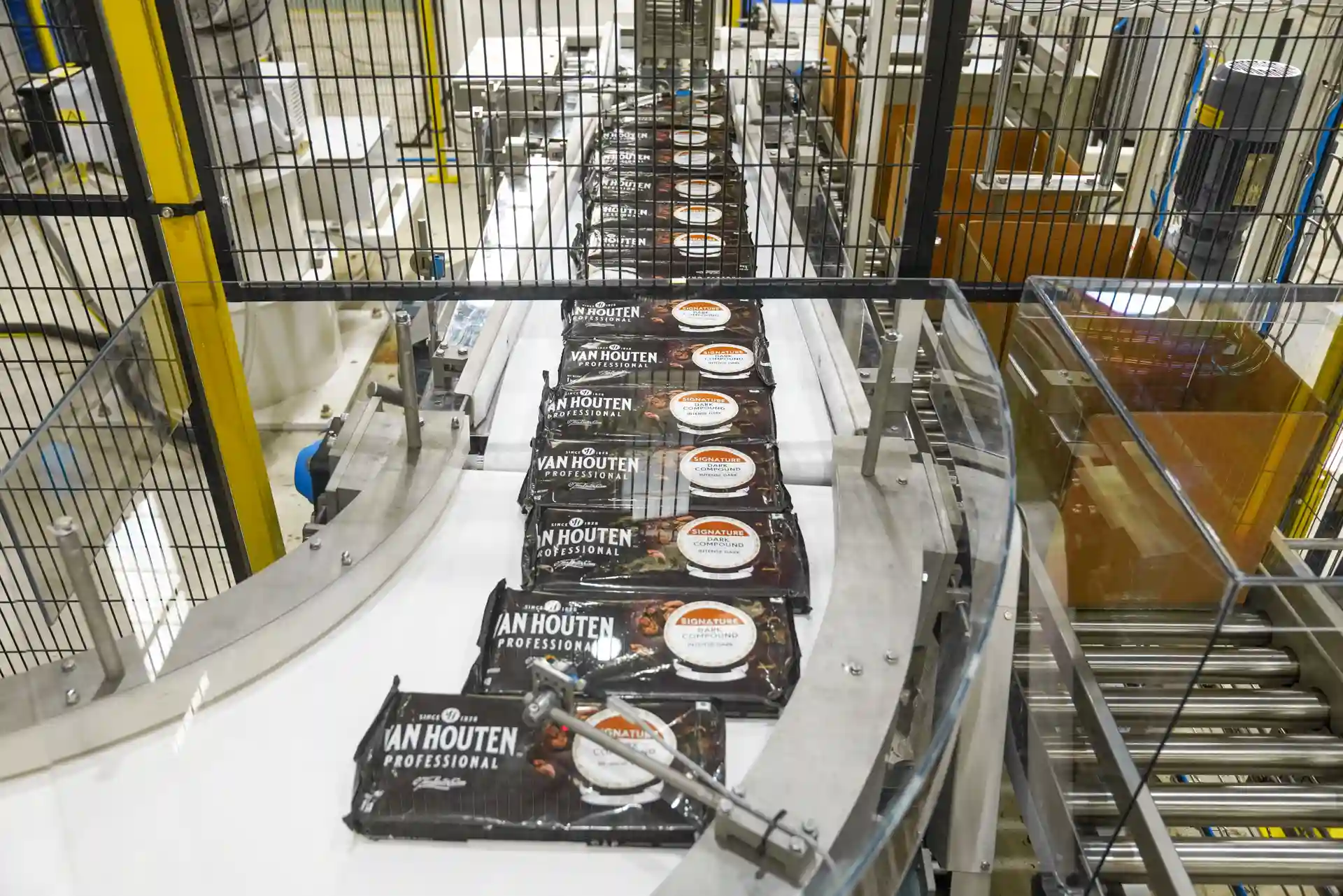
The flow wrapper itself then forms the pillow pack, fin-seal and cut. Cybernetik’s flow wrapper feeding system runs at up to 400 parts per minute in conveyorized configuration and integrates with the upstream pick-and-place line to deliver a continuous, perfectly oriented stream of wrapped chocolate pieces ready for secondary packing.
Stage 2: Secondary Chocolate Packing, Cartoning and Case Packing
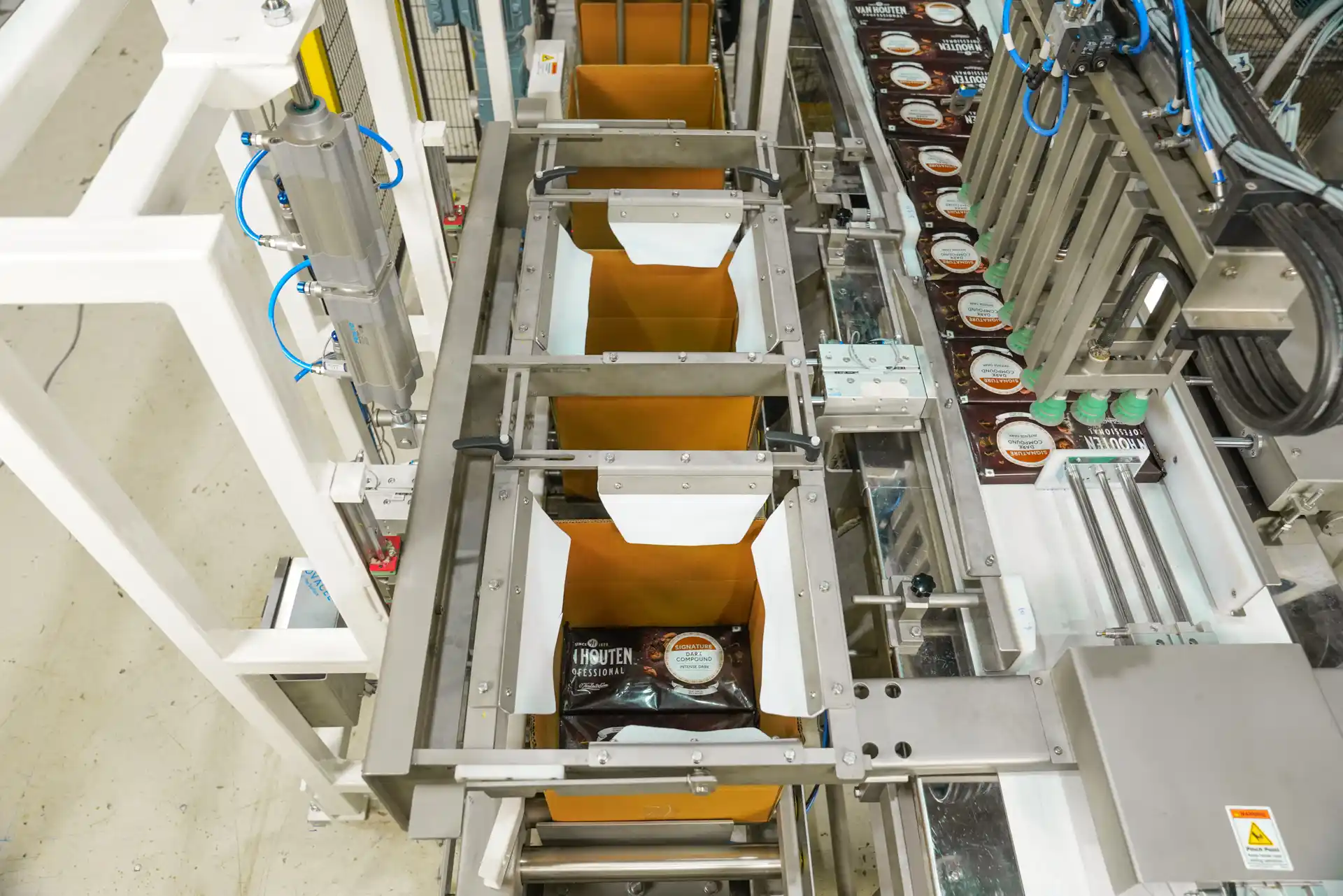
Once the chocolate is wrapped, it must be grouped, oriented and loaded into display cartons or shipping cases. This is the secondary chocolate packing stage. Cybernetik’s Chocolate Bar Case Packer handles chocolate bar variants with minimal modifications between SKUs, bars, slim bars, share-pack formats, picking wrapped bars from the upstream wrapper outfeed and loading them into pre-erected cases in a defined matrix formation.
For pralines, truffles and assorted-piece packs, secondary cartoning involves additional collation steps , grouping pieces into trays, inserting dividers, and loading them into display cartons that meet retail shelf-ready standards. Cybernetik’s carton box making machine erects the cases, the case packer loads them, the case sealer seals the bottom and top, and the loaded cases move to the palletizer.
Stage 3: Tertiary Chocolate Packing, Palletizing
The final stage is palletizing. Cybernetik’s Robotic Carton Palletizer is a high-performance, custom-built palletizing system engineered for efficient handling of sturdy and fragile packaging formats, including the temperature-sensitive chocolate cases that arrive from the secondary packing stage. Equipped with servo or pneumatic end-of-arm grippers and capable of palletizing up to three cartons simultaneously, the system supports customized pallet matrix formation for optimal space utilization on outbound shipping pallets.
Chocolate Formats and Their Packing Requirements
Different chocolate formats place different demands on the packing line. The table below maps the major formats to the primary packing method and the throughput band Cybernetik typically configures for them.
| Chocolate Format | Primary Packing | Throughput | Key Consideration |
|---|---|---|---|
| Molded chocolate bars | Flow wrapping after wrapper feeding | Up to 400 parts/min | Bar orientation, fin-seal integrity |
| Enrobed pieces | Robotic pick-and-place + flow wrap | Up to 480 parts/min | Random orientation, gentle handling |
| Pralines & truffles | Tray collation + carton loading | Up to 200 parts/min | Surface marking, temperature control |
| Hollow chocolate figures | Robotic pick-and-place + tray | Up to 120 parts/min | Fragility, irregular shape |
| Chocolate-coated snacks | Flow wrapping after wrapper feeding | Up to 400 parts/min | Coating integrity, crumb-prone |
| Wafer & layered bars | Flow wrap or carton sleeve | Up to 300 parts/min | Multi-layer pack alignment |
Cybernetik’s Chocolate Packing Machine Portfolio
Robotic High Speed Pick and Place System for Enrobed Chocolate
Built specifically for the enrober-to-wrap transition, this system uses two vision systems and four delta robots to handle randomly oriented enrobed pieces at up to 480 parts per minute. Main PLC + SCADA control allows recipe selection for different chocolate shapes, with FDA-compliant build for international markets. Vision rejects out-of-shape and broken pieces before the wrapping stage, eliminating film waste downstream.
Chocolate Bar Case Packer
Designed for high-throughput chocolate bar manufacturers, the Cybernetik Chocolate Bar Case Packer handles bar variants , standard bars, slim bars, share-pack formats , with minimal modifications between SKUs. Pre-wrapped bars from the upstream flow wrapper are picked and loaded into pre-erected shipping cases in customizable matrix formations, with built-in count verification.
Carton Erecting and Filling Solutions
Cybernetik’s carton box making machines erect flat blanks into 3D cases at 15–30+ cartons per minute, feeding the chocolate case packer with a continuous supply of ready-to-fill cases. Carton Weigh & Fill systems with vibratory feeders handle smaller chocolate formats (pralines, mini-bars) that need accurate weight-based filling into rigid cartons.
Robotic Carton Palletizer
The final-stage solution for chocolate lines, the Robotic Carton Palletizer handles cartons, rigid boxes and corrugated cases , capable of palletizing up to three cartons simultaneously with servo or pneumatic end-of-arm grippers. Automated pallet storage and dispensing ensures uninterrupted operation across shifts.
 “A modern chocolate packing line doesn’t just wrap and pack products – it protects appearance, maintains throughput, and preserves product integrity at every stage.”

Cybernetik packaging engineering team
See it in action
The Cybernetik Advantage: Why Chocolate Manufacturers Choose Cybernetik
Quality Challenges in Chocolate Packing and How Automation Solves Them
When Should You Invest in an Automated Chocolate Packing Line?
Where two or more of these are true simultaneously, the business case for a Cybernetik chocolate packing line is typically self-funding within 12 to 24 months on yield, labor and uptime savings alone.