
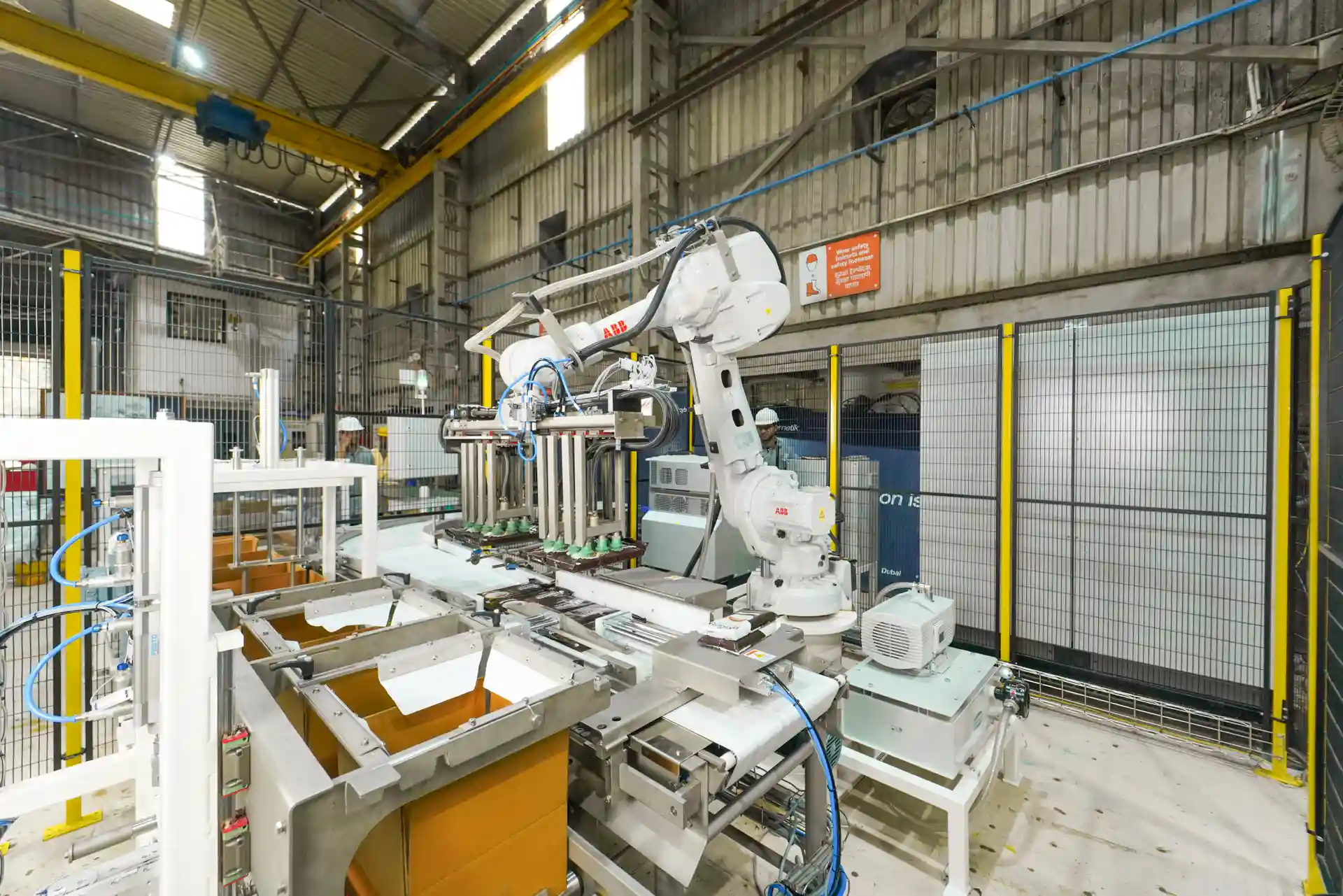
Key takeaways
An automated factory is only as automated as its most manual stage. A facility that has invested in robotic primary packaging, high-speed fillers, and automated conveyance , but still relies on operators to manually load and seal cases at the secondary packaging stage , has not completed its automation journey. That manual gap is both a throughput constraint and an OEE liability that compounds across every shift.
Case packaging systems close that gap. An integrated case packing system , from carton erector through robotic loading to palletizer , operates as a single, synchronised machine under one control architecture. It runs at the rated speed of the primary packaging line, switches between product formats on a recipe change, and detects quality failures before they become shipped defects.
This guide explains what a complete case packaging system includes, how the stages integrate, which configurations Cybernetik builds for different production profiles, and how to evaluate the right system for an automated manufacturing facility.
What Is a Case Packaging System?
A case packaging system is an integrated secondary packaging line that spans five sequential stages:
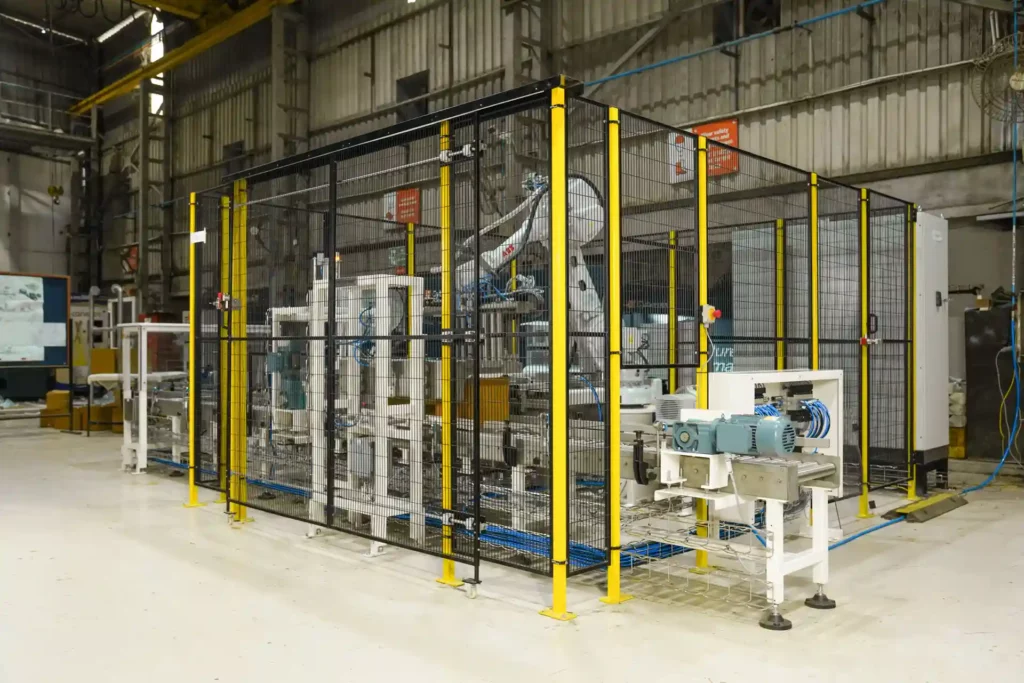
Integrated Secondary & Tertiary Bottle Packing System
Cybernetik’s Case Packaging System Configurations
Cybernetik builds case packaging systems for three primary product categories. Each configuration is engineered as a complete, integrated system , not a collection of separately specified machines.
Case Packing System for Pouches
Cybernetik’s Case Packer for Pouches is designed for flexible packaging lines producing filled pouches at up to 40 pouches/min. The staggered pouch lifting system and vibratory thickness conveyor are purpose-built subsystems that address the specific challenges of flexible pouch packaging , variable thickness, belt shifting, and density requirements , that generic case packers cannot resolve.
| Parameter | Value |
|---|---|
| Throughput | Up to 120 bottles/min or 5 cases/min |
| Payload | 200 kg |
| Bottle Variants | Up to 5 |
| QC | Missing bottle detection + vision inspection |
| Traceability | Track and trace standard |
Case Packing System for Shrink Packs
Cybernetik’s Case Packer for Shrink Packs is the highest-throughput case packaging system configuration , built for beverage canning and shrink multipack operations at up to 400 cans/min. Optional upstream carton erector and downstream taping/labelling complete the end-to-end automation sequence.
| Parameter | Value |
|---|---|
| Speed | Up to 400 cans/min |
| Payload | 200 kg |
| End-to-End Options | Case erector, top/bottom taping, labelling |
Dual-Mode Case Packing System , Shrink Packs and Bottles
Cybernetik’s Case Packer for Shrink Packs & Bottles provides a single-robot dual-mode system for factories running both individual bottles and shrink-wrapped multipacks , eliminating the capital cost and floor-space requirement of two separate case packaging systems.
| Parameter | Value |
|---|---|
| Speed (Shrink) | Up to 400 cans/min |
| Speed (Bottles) | Up to 120 bottles/min |
| QC Technology | 3D cloud point for missing bottle detection |
Downstream Integration, Completing the Case Packaging System
Case packaging is the penultimate stage of the end-of-line. The final stage , palletizing , must receive cases at the output rate of the case packer and stack them onto pallets without delay.
Cybernetik’s Box Palletizer range handles up to 1,200 boxes/hour (up to 1,800/hour for high-level configurations) and palletizes box variants arriving on separate conveyors onto distinct pallets within the same cycle. The Robotic Carton Palletizer simultaneously palletizes two cartons per cycle at 15 cartons/min with customisable matrix formation and an automated pallet dispenser for continuous operation.
Because both the case packer and palletizer operate under Cybernetik’s shared PLC/SCADA architecture, recipe changes at the case packer automatically update the palletizer’s stacking pattern , no separate operator intervention required at the palletizer HMI.
 “An automated factory is only as efficient as its end-of-line operations, where case packaging systems transform individual machines into a unified production flow.“

See it in action
Evaluating a Case Packaging System: Key Specification Parameters
| Parameter | What to Confirm |
|---|---|
| Throughput range | Peak units/min with 15–20% headroom; matches both primary line output and palletizer input |
| Product range | All active SKUs covered with one end-of-arm tool or auto tool changer |
| Carton format range | All active case sizes covered by recipe-driven erector and sealer |
| Integration architecture | Shared PLC/SCADA with upstream primary packaging and downstream palletizer |
| Quality control scope | Missing unit detection, vision inspection, track and trace , all integrated, not bolted on |
| Changeover method | Recipe-driven HMI , target under 10 min for all active format pairs |
| Safety | Single interlock chain across full case packaging system |
| Supplier scope | Full case packing system from one supplier , erector through palletizer |