
Key takeaways
An automatic palletizer sits at the end of every modern packaging line , and is usually the last stage to get automated. Filling is automated. Case packing is automated. Labelling is automated. Then at the outfeed, three operators stand in rotation stacking cases manually, because palletizing has always been done by hand. That pattern is ending, driven by a combination of rising labour costs, injury claims from repetitive heavy lifting, throughput ceilings that manual stacking imposes, and the arrival of robotic palletizer configurations that no longer require a factory floor redesign to install. Understanding exactly how an automatic palletizer machine works , and which applications give the fastest return , is the starting point for every plant that is still running its end-of-line by hand.
This guide walks through the five mechanical stages of automatic palletizer operation, the three configurations Cybernetik builds with verified specifications, the applications across food, beverage, chemicals, pharma and FMCG where automated palletizers are now standard, and the triggers that make the ROI case straightforward. If you are approaching your first automatic palletizing investment, this is the technical and commercial framework that turns the evaluation from a catalogue exercise into an engineering decision.
What Is an Automatic Palletizer Machine?
An automatic palletizer machine is a piece of end-of-line packaging automation that takes packed units , cases, bags, boxes, drums, pails , from an upstream conveyor and stacks them onto pallets in a defined, repeatable matrix pattern, without operator intervention between pallet loads. The machine combines robotic or servo-driven mechanical motion, recipe-controlled stacking logic, and integrated pallet handling into a continuous cycle that runs at the cadence of the upstream packaging line.
What separates an automatic palletizer from a conventional or manual operation is not just speed , it is consistency, safety, and integration. A well-specified automatic palletizer machine delivers the same pallet pattern on the ten-thousandth case as on the first, operates inside safety-compliant guarding that removes workers from the heavy-lift zone entirely, and communicates with upstream case packing equipment and downstream stretch-wrap systems through shared PLC logic so that no operator has to coordinate the handoffs between stages.
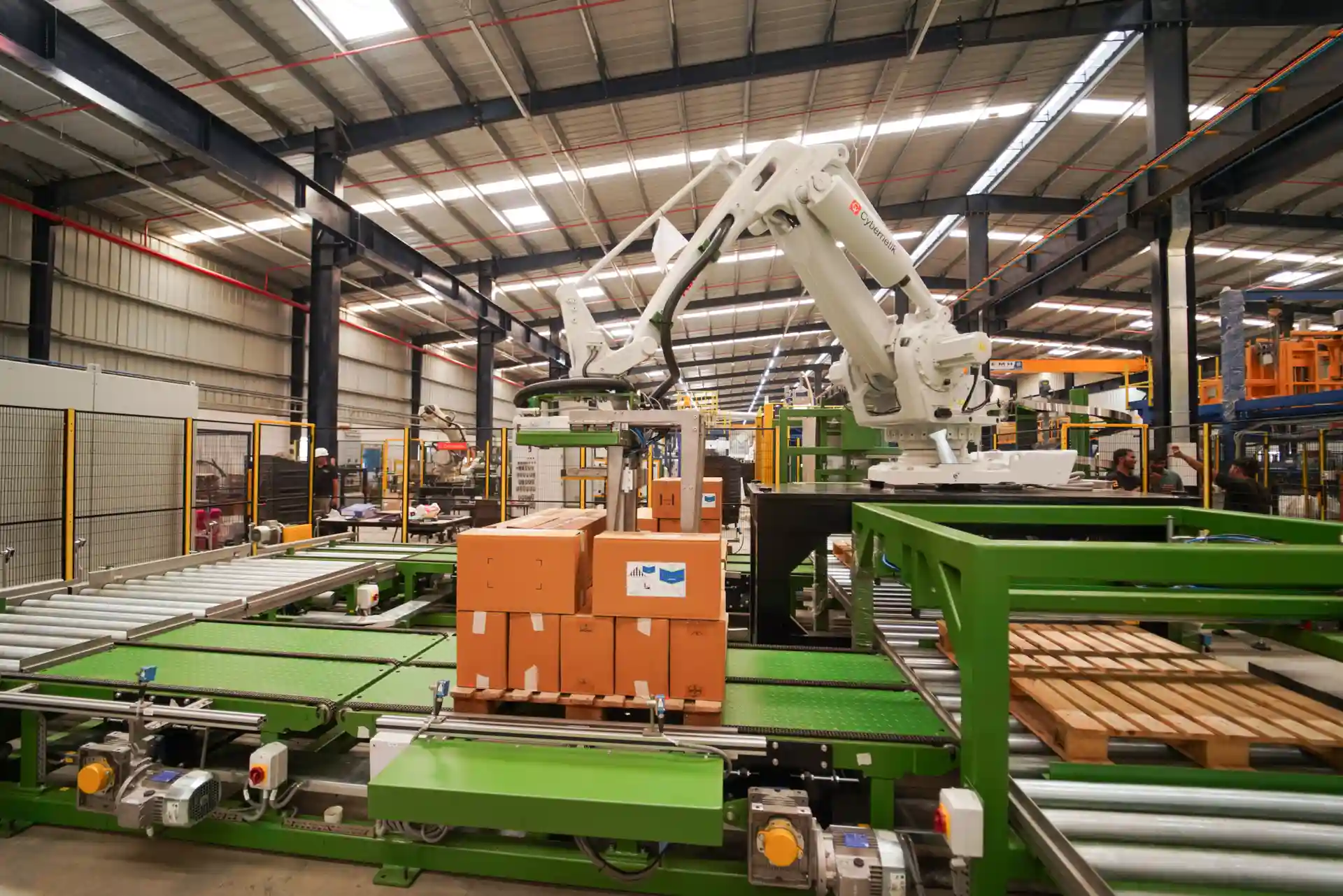
Cybernetik builds automatic palletizers across three configurations , six-axis robotic, gantry and cobot , on a common engineering platform. The six-axis automatic palletizing system handles boxes at up to 1,200 units per hour with 150 kg payload and simultaneous picking of up to three cases; the gantry processes 210 units per hour on just 10 kW of power with one operator for pallet changeover; and the cobot configuration deploys in operator-proximate environments without full enclosure guarding. All three are configurable for bags, boxes, drums and pails through end-of-arm tooling selection and recipe-driven matrix formation.
Five Stages of How an Automatic Palletizer Machine Works
Every automatic palletizer machine, regardless of configuration, executes the same five operational stages in sequence. Understanding each stage explains both the engineering and the common failure points that separate a well-specified machine from a poorly matched one.
Stage 1, Pallet Infeed and Automatic Positioning
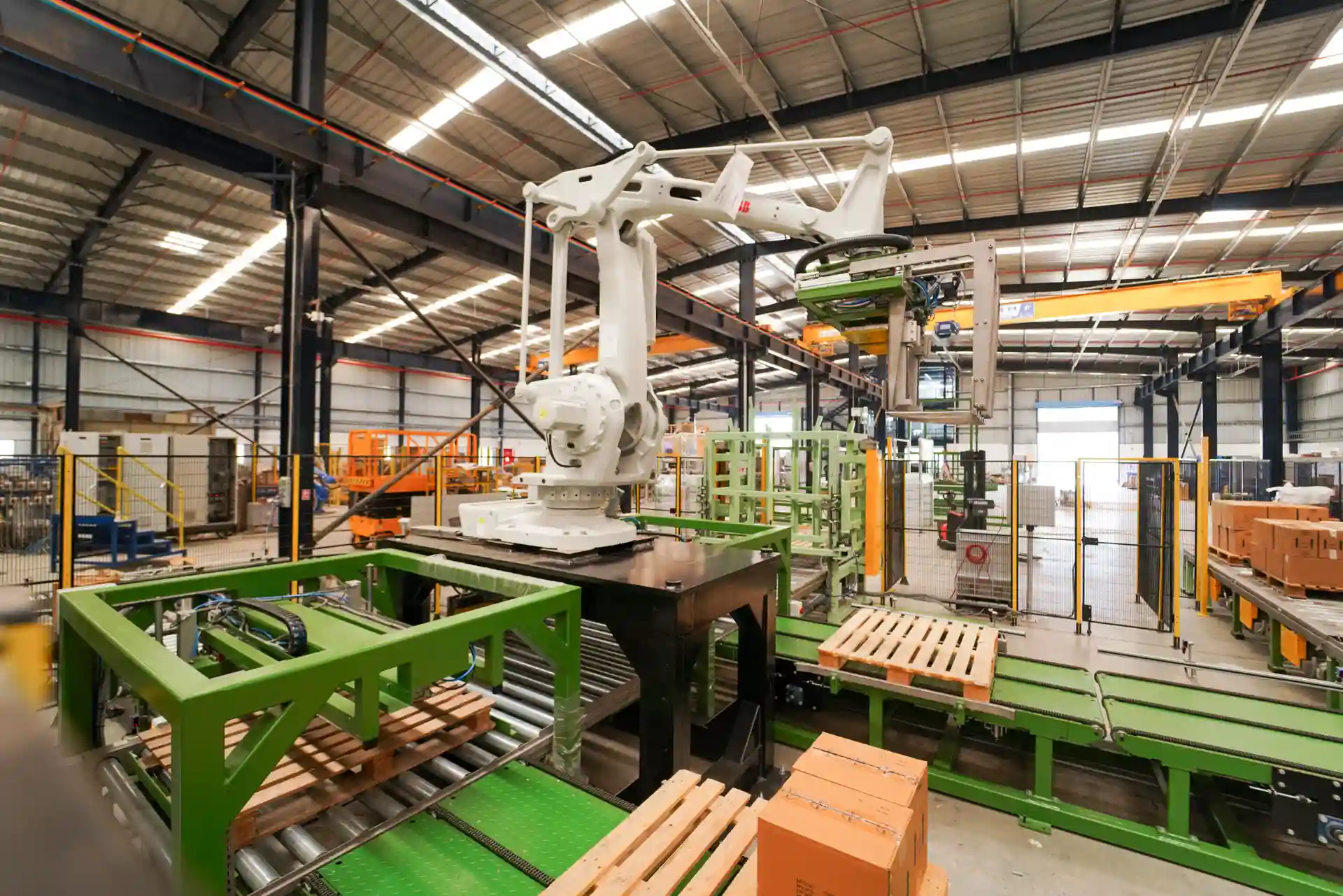
The palletizing cycle begins before the first case is picked. An automatic pallet dispenser draws a single empty pallet from a magazine. Cybernetik’s standard magazine holds up to 10 pallets of 150 mm each, and transfers it on a roller conveyor to the palletizing station. A dedicated reference system then positions the pallet precisely within the robot’s pick zone. Without accurate pallet positioning, the first case pick lands off-centre, and positioning error accumulates with every subsequent layer until the pallet is unstable. Cybernetik’s automatic pallet dispenser and reference system eliminate this as a variable entirely.
Stage 2, Case Infeed, Registration and Orientation
Packed cases arrive from the upstream case packer on a separate infeed conveyor. A second reference system registers each arriving case at the correct position and orientation before the robotic arm attempts a pick. For operations running multiple case dimensions on the same line, the automatic palletizer reads the incoming SKU from the shared PLC and pre-stages the correct matrix recipe before the case arrives at the pick station , so there is no dwell time between SKU identification and pick execution.
Stage 3, Robotic Pick-and-Place at Recipe-Defined Cadence
The robotic arm, six-axis articulated, gantry or cobot depending on configuration, picks the registered case with servo or pneumatic end-of-arm tooling and places it at the recipe-defined position on the pallet. On Cybernetik’s six-axis automatic palletizer, up to three cases are picked per arm cycle, keeping pace with upstream throughputs of 1,200 boxes per hour. On the gantry configuration, each cycle runs at 9 seconds with a rotary axis for case orientation on the pallet. The pick motion path is optimised per SKU recipe to minimise cycle time while keeping payload within the arm’s working reach envelope.
Stage 4, Layer-by-Layer Pallet Building to Stack Height
The automatic palletizer builds the pallet layer by layer, following the recipe-defined pattern: layer count, case rotation sequence, interlayer sheet insertion where required, and maximum stack height. Cybernetik’s six-axis model stacks to 1,800 mm; the gantry reaches 2,000 mm. The stacking pattern is designed for pallet stability under stretch-wrap and transport load; mismatched patterns cause edge-of-pallet overhang that fails during handling even if the stack was visually acceptable in the palletizer.
Stage 5, Completed Pallet Discharge and Cycle Reset
When the recipe-specified stack height or case count is reached, the completed pallet transfers on roller conveyor to the downstream stretch-wrap station or dispatch lane without operator intervention. Simultaneously, the automatic pallet dispenser releases the next empty pallet to the palletizing station and the infeed conveyor continues supplying cases , meaning the inter-pallet gap is the time for pallet transfer only, not for operator pallet-swap. This continuous-cycle design is what makes an automatic palletizer machine genuinely different from semi-automatic alternatives where the pallet-change pause is the throughput constraint.
Three Automatic Palletizer Machine Configurations
Cybernetik’s automatic palletizer portfolio covers three engineering configurations. Each executes the five stages above but differs in payload, throughput, footprint and cost profile.
Six-Axis Robotic Automatic Palletizer
Six-axis articulated arm automatic palletizer. Payload up to 150 kg (boxes/cartons) or 50 kg (bags). Throughput up to 1,200 boxes per hour or 600 bags per hour. Simultaneous picking of up to 3 units per arm cycle. Stack height up to 1,800 mm. Footprint approximately 3,600 × 7,880 mm. Power 28.7–35 kW. Automated pallet dispenser (10-pallet magazine). ISO 12100 full enclosure guarding. Best for high-throughput manufacturing lines in food, beverage, chemicals and pharma.
Gantry Automatic Palletizer
3-axis servo-actuated gantry automatic palletizing system. Throughput 210 units per hour at 9 seconds per cycle. Maximum pallet height 2,000 mm. Up to 10 SKU matrix formations via rotary axis end-of-arm tooling. Power 10 kW. One operator for semi-automatic pallet changeover. Compact footprint with light curtain safety, no full enclosure required. Suited to up to 1,500 units per day operations. Best for mid-volume food, FMCG, pharma and 3PL lines where low CAPEX and OPEX are the buying drivers.
Cobot Automatic Palletizer
Collaborative robot automatic palletizer. Inherent safety without full guarding enclosure. Operator-proximate deployment in environments where forklifts and workers share the floor zone and full enclosure would reduce operational flexibility. Lower payload and throughput than six-axis. Best for low-volume co-packing, artisan food production, pharmaceutical distribution and any application where frequent operator access to the palletising area is a layout requirement.
Automatic Palletizer Machine Technical Comparison
Verified technical specifications from Cybernetik’s production-deployed automatic palletizer configurations.
| Parameter | Six-Axis Robotic | Gantry | Cobot |
|---|---|---|---|
| Throughput , Boxes | Up to 1,200 boxes/hr | 210 units/hr (9 s/cycle) | Lower; application-specific |
| Throughput , Bags | Up to 600 bags/hr | Up to 210 bags/hr | Lower; application-specific |
| Payload | 150 kg (boxes) / 50 kg (bags) | Format-matched | Low (operator-safe class) |
| Max Stack Height | 1,800 mm | 2,000 mm | ~1,500 mm |
| Footprint | 3,600 × 7,880 mm (~28 m²) | Compact; no full enclosure | Minimal |
| Power Consumption | 28.7–35 kW | 10 kW | ~3–5 kW |
| Pallet Magazine | Up to 10 pallets | Semi-automatic changeover | Manual or semi |
| Safety Standard | ISO 12100 full enclosure | Light curtains + guards | Inherent cobot safety |
Applications: What Automatic Palletizers Handle
Packed unit types across the automatic palletizer portfolio
Packed unit types across the automatic palletizer portfolio
Upstream and downstream integration
 “An automatic palletizer doesn’t just stack products onto pallets; it transforms the final stage of packaging into a safer, faster, and more consistent operation that maximizes end-of-line efficiency.”

See it in action
The Cybernetik Automatic Palletizer Advantage
Every specification and feature below is drawn from Cybernetik’s production-deployed portfolio, verified against live product pages rather than catalogue projections.
When to Invest in an Automatic Palletizer Machine
The automatic palletizer business case moves from marginal to clear when two or more of the following appear simultaneously in an end-of-line audit.
Where two or more apply, the ROI on a Cybernetik automatic palletizer machine, measured against combined labour, injury, transport-damage and throughput-recovery savings, typically runs twelve to twenty-four months on the six-axis tier and twelve to eighteen months on the gantry tier for mid-volume operations.