
Key takeaways
Of all the formats an end-of-line machine must handle, bags are the hardest to palletise consistently. A rigid box arrives at the palletizer with predictable geometry, predictable weight distribution and predictable surface behaviour. A filled bag arrives with none of those guarantees. The same gusseted bag holds slightly different volumes at different fill temperatures, settles differently depending on product granularity, and deforms under grip force in ways that vary with bag material, seam placement and headspace. Manual bag palletising works at low volumes because experienced operators unconsciously compensate for all of that variability. Automatic bag palletizing works at scale because the machine is engineered to resolve it.
This guide explains the bag-specific engineering challenges that an automatic bag palletizer machine must address, the configurations Cybernetik builds for food, grain, FMCG and chemical bag palletising at up to 600 bags per hour, and the application range across the industries where bag palletising automation now pays back within a standard capex cycle. Whether you are palletising 25 kg flour sacks, 500 g coffee pouches or 5 kg detergent bags, the engineering below is what determines whether your end-of-line runs as fast as your bagger or chronically falls behind it.
What Is an Automatic Bag Palletizer Machine?
An automatic bag palletizer machine is end-of-line equipment that takes filled, sealed bags , gusseted bags, flat-bottom bags, sacks and bales , from an upstream filling or packing conveyor and stacks them onto pallets in a defined layer-by-layer matrix pattern without operator intervention between pallet loads. The automatic bag palletiser combines a robotic arm with bag-specific end-of-arm tooling, a recipe-driven stacking controller, an automatic pallet dispenser and infeed and outfeed conveyors into a single integrated palletising system.
What distinguishes a bag palletizer machine from a box or drum palletizer is the engineering tuning for flexible format handling. A bag gripper distributes clamping force across a wider contact area than a box gripper; motion paths are tuned for the settling dynamics of filled bags rather than the rigid geometry of corrugated cases; layer patterns are designed to interlock bag edges for stack stability in ways that differ fundamentally from the flat-layer stacking that works on uniform rigid containers. An automatic bag palletizer that was engineering-adapted from a box palletizer platform without this format-specific tuning produces unstable pallets at the production rates FMCG and food lines run.
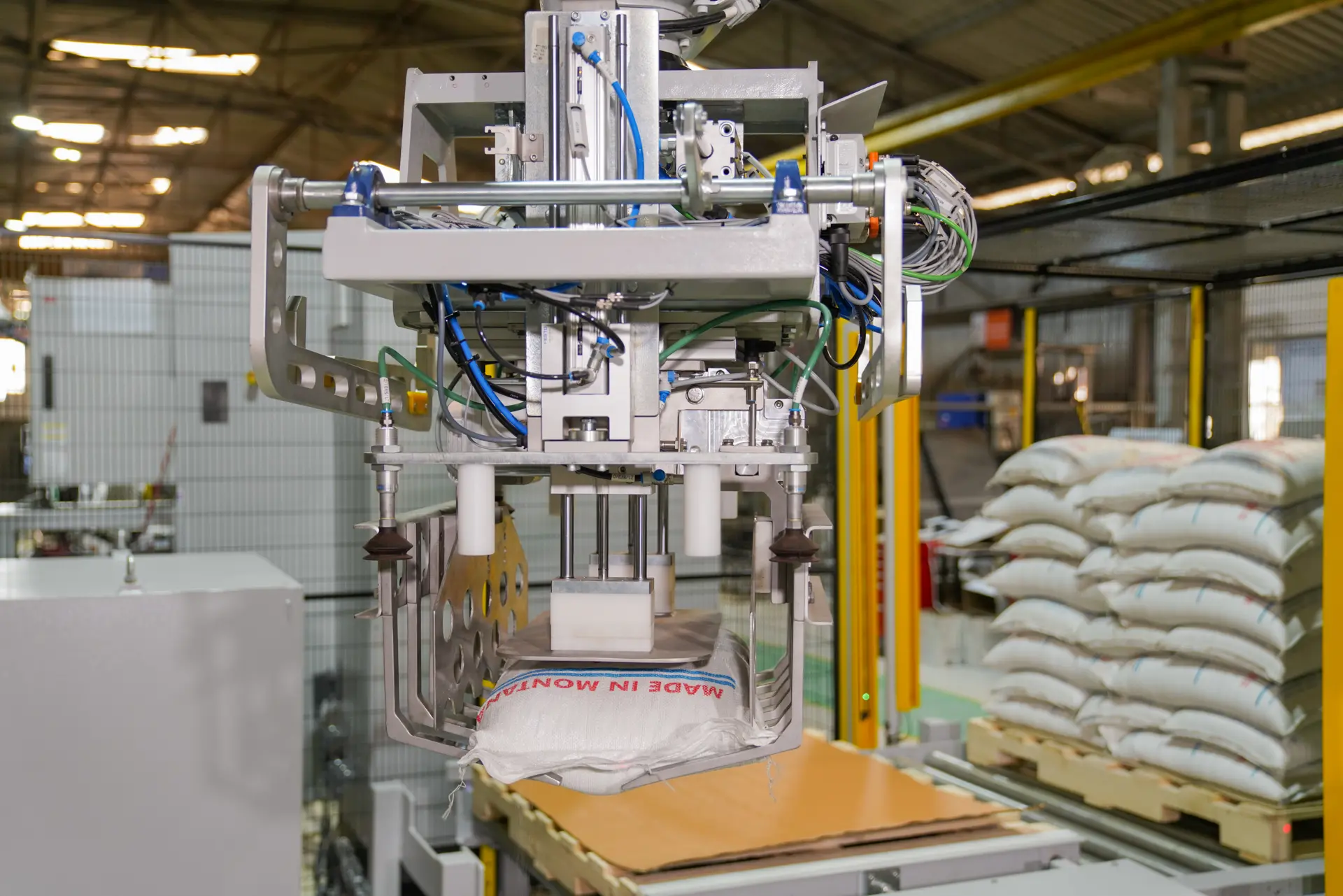
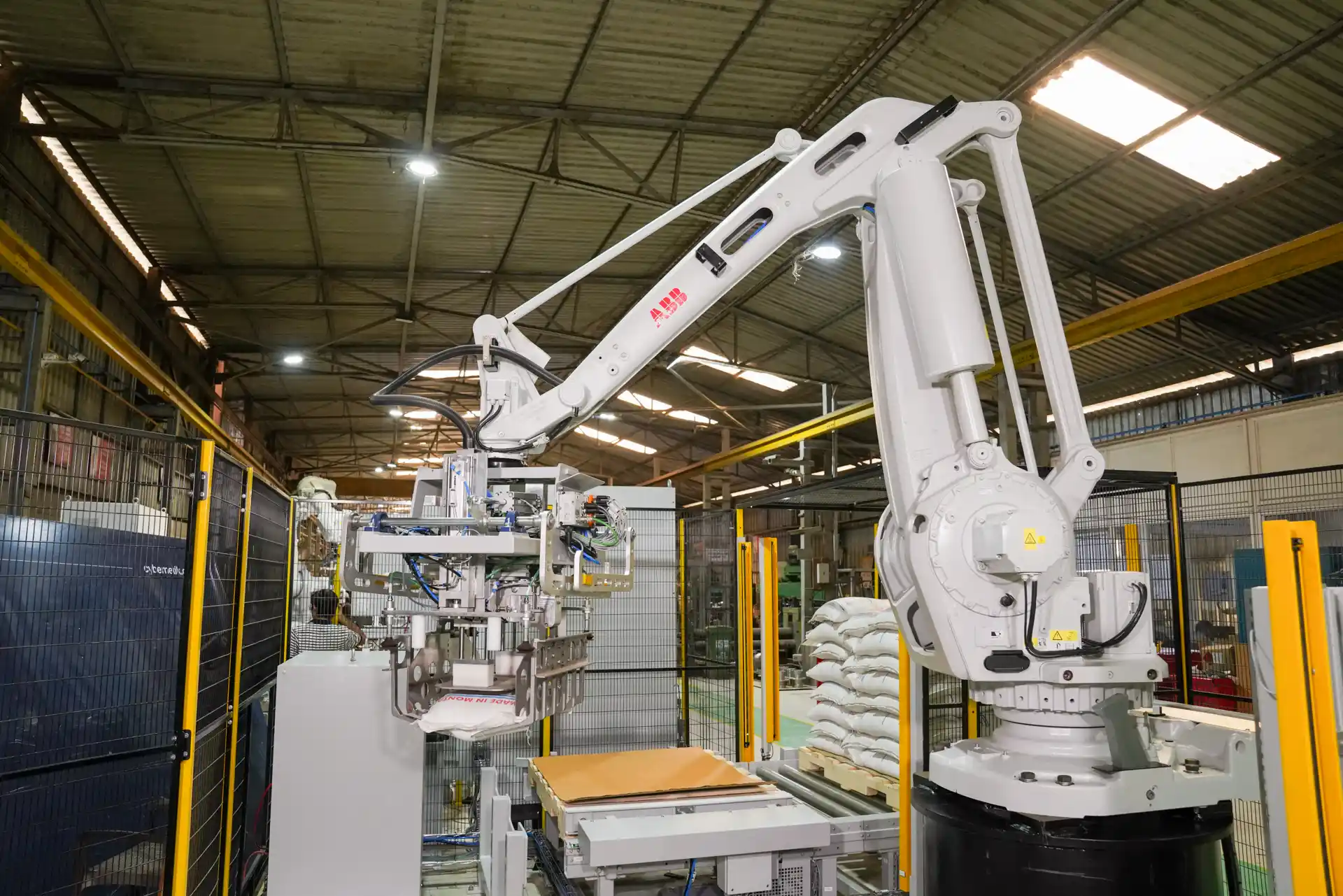
Cybernetik’s automatic bag palletizer is purpose-built for flexible format palletising. The six-axis robotic bag palletiser handles up to 600 bags per hour at 50 kg payload, with servo and pneumatic gripper options across gusseted bags, gusseted flat-bottom bags, sacks and bales in polyethylene and polypropylene materials. The system uses a common gripper architecture that handles both the bag and the pallet , saving arm cycles and reducing EOAT changeover complexity. Automatic pallet dispenser with up to 10-pallet magazine, stack height to 1,800 mm, 3.1 m reach and ISO 12100 safety are standard across the configuration.
Five Bag-Specific Engineering Challenges the Automatic Bag Palletizer Solves
1. Variable Bag Geometry Across Fill Levels and Product Types
A 25 kg grain sack and a 5 kg detergent bag do not have the same geometry even at the same fill weight. Granular product settles to a different distribution than powder; headspace varies with fill temperature; bag seam construction affects how the filled bag sits on a conveyor. Cybernetik’s automatic bag palletizer reads each bag’s infeed position via the registration system and adapts the pick approach per bag rather than per SKU recipe alone , resolving the positional variance that fixed-geometry mechanical palletisers cannot handle.
2. Surface-Sensitive Grip on PE and PP Bag Materials
Polyethylene and polypropylene bags mark under point-load grip force and split under excessive clamping. The automatic bag palletizer’s end-of-arm tooling must distribute grip force across the bag’s contact face rather than concentrating it at jaw edges. Cybernetik’s servo and pneumatic gripper options are configured per bag material and fill weight , distributing contact load for PE and PP bags across a wider surface area than rigid-container grippers, with grip force tuned to the minimum needed for lift security without surface marking.
3. Stable Layer Formation on Deformable Contents
Bags do not produce self-levelling layers the way rigid boxes do. A layer of filled bags settles under the weight of subsequent layers, and if the settle pattern is asymmetric, the pallet becomes progressively less stable with each layer added. Cybernetik’s automatic bag palletiser uses interlocking layer patterns, where bags in adjacent rows are offset to distribute settle load evenly, matched to the specific product, bag size and fill weight through HMI recipe selection. The result is a pallet that holds its geometry through stretch-wrap and in-transit vibration.
4. Multi-Bag-Type Operation Across FMCG and Food SKUs
A food or FMCG plant rarely runs a single bag format. Rice, flour, sugar, pulses, spices and detergent may all run through the same end-of-line palletising station at different times in the same shift. Cybernetik’s bag palletizer machine supports recipe-driven changeover across gusseted bags, gusseted flat-bottom bags, sacks and bales without mechanical reset between formats. The optional automated tool changer further enables one robot to handle bag formats requiring different EOAT geometry, switching between tools in a single arm cycle.
5. Food-Grade and GMP Hygienic Build for Direct Food Contact Zones
Bag palletising in food and FMCG operations often takes place in zones adjacent to open product or in hygienic areas where construction standards must match upstream filling equipment. Cybernetik’s automatic bag palletizer is available in food-grade build configurations with stainless steel contact parts, smooth-surface frame construction that does not trap product or moisture, and EOAT materials approved for incidental food contact , supporting GMP compliance in food manufacturing environments without infrastructure separation between the palletiser and the fill area.
Three Automatic Bag Palletizer Configurations for FMCG and Food
Cybernetik builds bag palletizers in three configurations that map to different throughput levels, footprint constraints and FMCG/food industry production environments.
Six-Axis Robotic Bag Palletizer , High Throughput, Full Flexibility
Six-axis articulated arm with payload up to 50 kg, throughput up to 600 bags per hour, servo and pneumatic gripper options, common gripper for bag and pallet handling, automated pallet dispenser with 10-pallet magazine, stack height up to 1,800 mm, reach up to 3.1 m, footprint 5 × 5.5 m, power 35 kW, ISO 12100 full enclosure. Optional automated tool changer for multi-format lines. Best for high-throughput food grain, FMCG, sugar, flour and chemical bag palletising. The standard specification for most industrial bag palletising applications above 300 bags per hour.
Gantry Bag Palletizer, Compact Low-CAPEX for Mid-Volume
3-axis servo-actuated gantry system, up to 210 bags per hour at 9 seconds per cycle, maximum pallet height 2,000 mm, up to 10 SKU matrix formations via rotary axis EOAT, 10 kW power, one operator for pallet changeover, compact footprint with light curtain safety. Handles bags, sacks and bales across food, agro and chemical applications at low capital and operational cost. Best for FMCG and food operations handling up to 1,500 bags per day where six-axis capex cannot be justified on current throughput. Also suited to lines that are scaling toward higher volume and need an interim solution.
Cobot Bag Palletizer, Flexible Low-Volume Deployment
Collaborative robot bag palletiser for low-throughput, operator-proximate applications. Inherent cobot safety eliminates the need for full guarding enclosure, making it suitable for small-scale food production, artisan FMCG lines and multi-product facilities where floor layout makes full enclosure impractical. Lower payload and throughput than six-axis but deployable without significant infrastructure investment. Best for specialty food, pharma bag and nutraceutical sachet palletising where throughput demand is low and flexibility of deployment matters more than peak throughput.
Automatic Bag Palletizer Machine and Configuration Comparison
Verified technical specifications from Cybernetik’s production-deployed bag palletizer configurations.
| Parameter | Six-Axis Robotic | Gantry | Cobot |
|---|---|---|---|
| Throughput | Up to 600 bags/hr | Up to 210 bags/hr (9 s/cycle) | Lower; application-specific |
| Payload | Up to 50 kg | Format-matched | Low (operator-safe class) |
| Bag Types | Gusseted, flat-bottom, sacks, bales | Bags, sacks, bales | Light bags and pouches |
| Bag Materials | PE, PP | PE, PP | PE, PP |
| Max Stack Height | 1,800 mm | 2,000 mm | ~1,500 mm |
| Footprint | 5 × 5.5 m | Compact; no full enclosure | Minimal |
| Power | 35 kW | 10 kW | ~3–5 kW |
| Pallet Dispenser | Auto , 10-pallet magazine | Semi-automatic changeover | Manual or semi |
| Safety | ISO 12100 full enclosure | Light curtains + guards | Inherent cobot safety |
What Cybernetik’s Automatic Bag Palletizer Handles
Bag types and materials within scope
FMCG and food product categories palletised
Pallet specifications and handling
 “An automatic bag palletizer doesn’t just automate palletizing – it combines precision gripping, recipe-driven stacking, and bag-specific engineering to deliver stable pallets for high-volume FMCG and food production.”

See it in action
The Cybernetik Automatic Bag Palletizer Advantage
Every specification and engineering feature below is drawn from Cybernetik’s production-deployed bag palletizer portfolio , verified from the live product page, not from catalogue projections.
When to Specify an Automatic Bag Palletizer Machine
The automatic bag palletizer business case is typically clear when two or more of the following appear simultaneously in an end-of-line audit of the bag filling or packing line.
Where two or more of the following describe your current end-of-line operation, the palletizing equipment specification has fallen behind the production volume it needs to serve.