
Key takeaways
The flat belt conveyor is the baseline against which every other conveying method is judged. It is the simplest configuration, the cheapest to build, the easiest to clean and the gentlest on product. When a material handling problem can be solved with a flat belt, it usually should be.
What causes trouble is not the concept but the sizing. Flat belts carry considerably less bulk material than their width suggests, because material sits in a shallow triangle rather than a trough, and the load is limited by how steeply the product will pile before it starts rolling off the edges. Plants that specify by belt width and hope for a capacity figure discover this after installation.
This article covers how flat belt conveyors are designed, the inputs that determine whether the calculation holds, where they belong in a plant and where they do not, and what makes them the default choice for unit handling. For the wider comparison across conveyor types, see the guide to conveyor belt machines.
How a Flat Belt Conveyor Is Configured
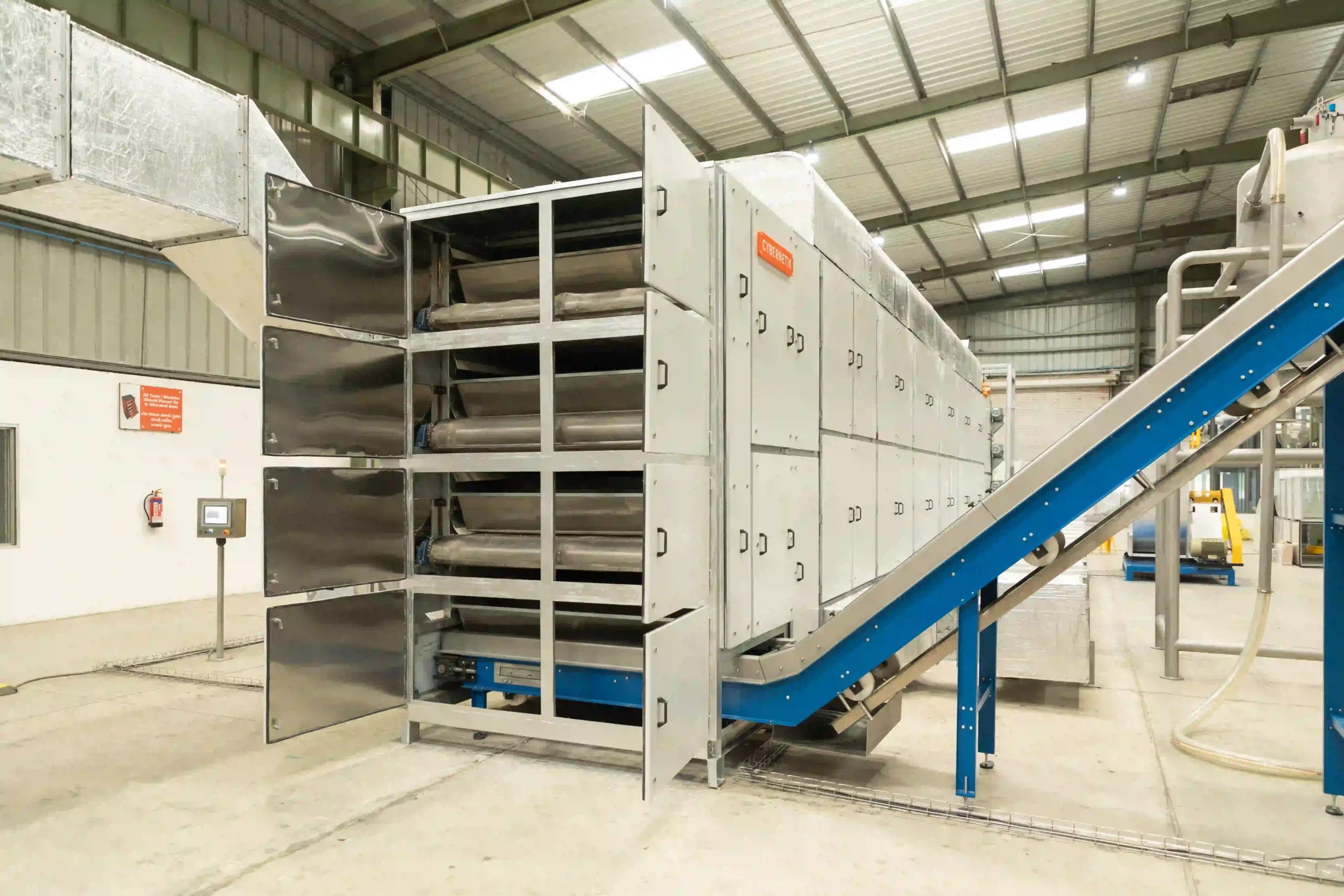
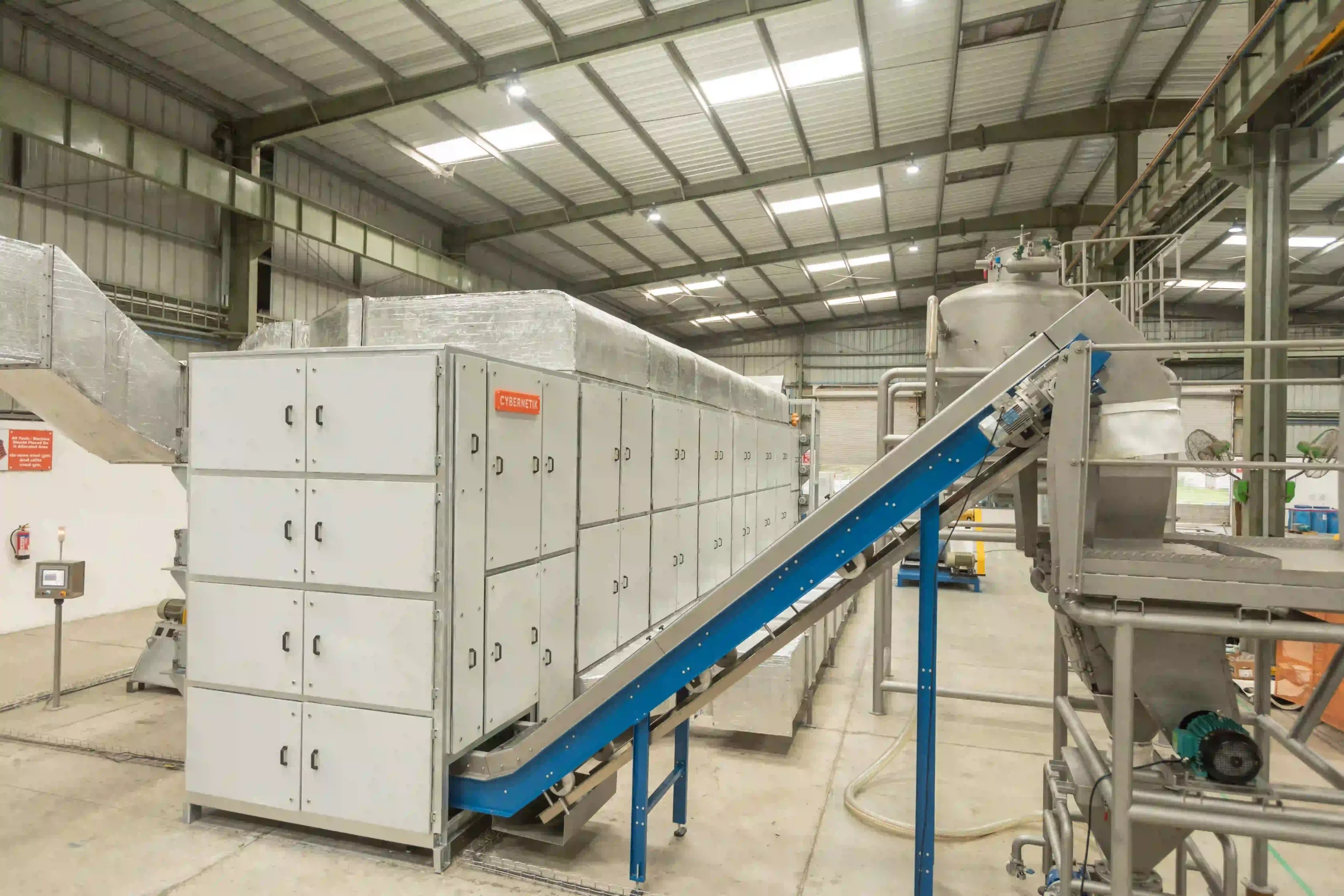
A flat belt conveyor runs a continuous belt over a driven head pulley and an idle tail pulley, supported between them either by a solid bed or by rollers. The carrying surface stays flat across its width, which is what distinguishes it from a troughed configuration and what defines both its advantages and its limits.
The support method is the first real decision. A slider bed, usually a stainless or UHMW polyethylene surface, supports the belt continuously. It handles light and unit loads without the belt sagging between supports, gives a flat surface for products that would otherwise tip, and is far easier to clean because there is nothing underneath the belt to trap debris. The cost is friction: sliding a belt across a solid surface takes roughly ten times the drive power that rolling it over idlers does.
A roller bed reverses that. Friction drops sharply, which matters on long runs and heavy loads, but rollers create gaps where the belt sags under concentrated loads and cavities that hold product in a washdown environment. Most food and pharmaceutical flat belt conveyors use slider beds for exactly this reason, and accept the power penalty.
Sizing the Conveyor
Capacity comes from area, not width
Throughput on a flat belt is the cross-sectional area of the load multiplied by belt speed and bulk density. That area is a triangle whose height depends on the surcharge angle, which is the slope material holds while moving and is typically several degrees shallower than its static angle of repose. Free flowing powders hold almost no slope at all, which is why a flat belt is a poor bulk conveyor for fine material and a good one for boxes.
The belt also cannot be loaded to its edges. Standard practice leaves a clear margin on each side, so effective carrying width is meaningfully less than nominal belt width. Any capacity figure quoted without stating the surcharge angle and edge allowance is an estimate rather than a calculation.
Belt width against lump size
For unsized bulk material, belt width should be at least three times the largest lump. Narrower than that and oversize pieces bridge across skirt plates and jam at transfer points. For packaged goods the constraint is different and simpler: the product footprint plus clearance for the tracking tolerance of the belt.
Speed
Flat belts are capable of high speed and rarely run at it in process plants. Speed is limited by whichever comes first: product damage at transfer points, dust generation from fine material, or the rate at which the downstream machine can accept product. In food handling, belts frequently run below half a metre per second, and capacity is achieved through width rather than pace.
Tension and drive
Drive is transmitted by friction at the head pulley, so the belt must carry enough tension for the pulley to grip. Rubber lagging on the pulley raises available friction, and a snub pulley increases the wrap angle, both of which reduce the tension needed. Take-up is usually a screw adjuster on short conveyors and a gravity arrangement on longer ones, and its job is to maintain that tension as the belt stretches in service rather than to correct tracking.
Design Inputs That Decide the Outcome
Seven pieces of information determine whether a flat belt conveyor performs as specified. Supplying them at enquiry stage is what separates a designed conveyor from a catalogue selection.
| Design input | Why it is needed | What happens if it is wrong |
|---|---|---|
| Bulk density | Converts load cross-section into mass flow and sets drive sizing | Drive undersized, belt slips under load, or motor oversized and wasteful |
| Maximum lump size | Fixes minimum belt width, usually at least three times the largest lump for unsized material | Material bridges at skirts and transfer points, and edge spillage becomes constant |
| Surcharge angle | Determines how much material the flat belt actually holds in its load triangle | Capacity calculated on paper is never achieved in practice |
| Required throughput | Combined with density and area, sets belt width and speed | Belt runs faster than the product tolerates, causing damage and dust |
| Conveyor length and lift | Drives effective tension and therefore motor power | Motor stalls on start-up under full load, or belt tension damages bearings |
| Support method | Slider bed friction is roughly an order of magnitude higher than roller friction | Power calculated on rollers but built as slider bed will be short of drive |
| Product characteristics | Fragility, stickiness, temperature and hygiene requirements govern belt material | Wrong belt compound fails early, or fails a food safety audit |
Tracking, Transfers and Hygiene
Three areas account for most of the operational complaints about flat belt conveyors, and all three are design decisions rather than maintenance failures.
Tracking is governed by symmetry. A belt drifts toward whichever side is tighter or more heavily loaded, so persistent wander usually points to frame misalignment, worn pulleys or off-centre loading. Crowned pulleys correct mild drift. In food applications a V-guide bonded to the underside of the belt running in a matching pulley groove is more positive and avoids the edge damage that guide rollers cause.
Transfer points cause most spillage. Product should be fed in the direction of belt travel, as close to belt speed as practical, and centred. Dropping product across the belt or at a large speed differential produces the spillage and product damage that then gets blamed on the conveyor.
Hygiene is decided when the frame is drawn. Open construction, sloped surfaces, no closed hollow sections and provision to lift or release the belt for cleaning are what allow a conveyor to pass an audit. A slider bed helps here too, since there is no roller bank underneath to collect debris.
Where Flat Belt Conveyors Fit
 “When a material handling requirement can be solved with a flat belt, the right design delivers a simple, economical, gentle, and highly maintainable conveying solution.”

See it in action
Benefits and the Limits of Them
The advantages of a flat belt are real and worth stating plainly. It is the lowest cost conveying configuration to build and to maintain. It handles product gently, with no scooping, tumbling or compression. It is the easiest belt type to clean, particularly on a slider bed. It accepts an enormous range of products without reconfiguration, and it can be enclosed, elevated, curved or fitted with side guides as the layout requires.
The limits follow from the same flat surface. For bulk material at volume, a trough belt conveyor carries substantially more in the same belt width and handles inclines up to around 30 degrees.
For steeper elevation, a flight cleated belt conveyor holds material in pockets and raises product up to 6 m, with a polyurethane extruded belt for hygiene and washability. Beyond roughly 15 to 20 degrees a flat belt simply returns product to the feed point, so the incline requirement should be settled before the belt type is chosen.
Flat Belt Conveyors from Cybernetik
Cybernetik engineers conveying equipment as part of complete process lines rather than as standalone units, which means belt type, support method, speed and transfer geometry are specified against the material and the machines on either side.
The conveying range covers flat and trough belt conveyors, flight cleated belts, vibratory conveyors, screw conveyors, bucket elevators and cooling and submerged conveyors, alongside the mixing, sifting, grinding, storage and packing equipment they connect. The full range sits under process automation solutions.
Cybernetik has operated for more than three decades, is headquartered in Pune with offices in the United States and the UAE, and has installed over 6,000 systems across 30 plus countries, including more than 400 custom automation solutions. With over 600 employees and divisions spanning Process Automation, Packaging Automation, CleanTech, Extraction, Labs and Defence, the engineering base behind a conveyor is considerably wider than the conveyor itself. Further background sits on the Cybernetik about page.