
Key takeaways
The growing demand for electric vehicles (EVs), renewable energy systems, and battery energy storage solutions is transforming the global manufacturing landscape. As industries continue to transition toward electrification, manufacturers must produce batteries that deliver higher performance, improved safety, longer service life, and consistent quality.
At the center of this transformation is the battery module assembly line. Battery modules act as the building blocks of battery packs, combining multiple battery cells into organized and precisely engineered units. Any variation during module assembly can affect the final battery’s performance, reliability, and safety.
Traditional manufacturing methods often struggle to meet the production requirements of modern battery facilities. Automated battery module assembly lines address these challenges by integrating robotics, vision systems, testing equipment, barcode tracking, and intelligent process control into a single manufacturing environment.
This guide explains how battery module assembly lines work, the equipment used throughout the manufacturing process, and the industries that rely on these advanced production systems.
What Is a Battery Module Assembly Line?
A battery module assembly line is an automated manufacturing system that assembles individual battery cells into battery modules before they are integrated into complete battery packs.
A battery module contains multiple cells that are electrically connected and mechanically secured within a protective structure. These modules are then combined to create battery packs used in electric vehicles, energy storage systems, industrial equipment, and other applications.
Modern assembly lines perform multiple manufacturing operations, including cell handling, testing, sorting, assembly, inspection, and quality verification. Rather than relying on manual processes, manufacturers use automated systems to maintain consistent production quality while increasing manufacturing capacity.
Why Battery Module Assembly Matters
Battery modules directly influence the performance of the final battery pack. Even minor manufacturing inconsistencies can create significant challenges, including uneven energy distribution, overheating, reduced battery life, and safety concerns.
A well-designed battery module assembly line helps manufacturers achieve several important objectives:
How Battery Module Assembly Lines Work
Although manufacturing requirements vary based on battery design and application, most automated assembly lines follow a similar production workflow.
Cell Unloading and Material Handling
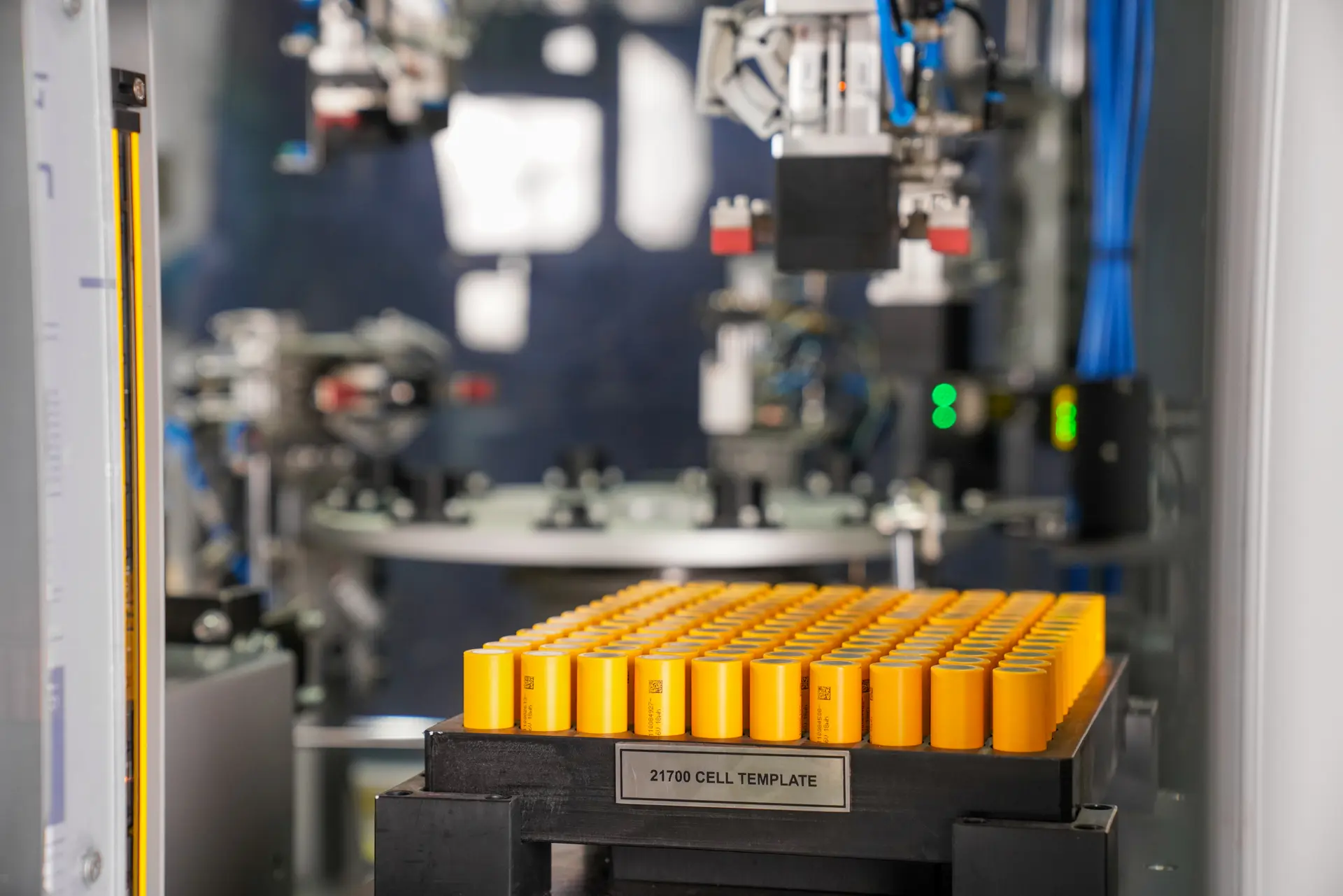
Automated cell feeding systems
The manufacturing process begins with unloading battery cells from storage containers and transferring them to the production line.
Automated conveyors and material handling systems transport cells between production stations while minimizing direct operator involvement. This reduces the risk of physical damage and improves production consistency.
Advanced manufacturing facilities often integrate robotic handling systems to improve cell positioning accuracy and optimize production flow.
Cell Testing and Quality Verification
Identifying defective cells before assembly
Battery cell testing is one of the most critical stages of the assembly process. Before cells are assembled into modules, manufacturers evaluate several performance parameters to ensure they meet quality standards.
Testing procedures typically include:
Only cells that meet predefined quality requirements move to the next production stage.
Cell Sorting and Classification

Matching cells with similar characteristics
Not all battery cells perform identically. Even cells produced within the same manufacturing batch may have slight performance variations.
Automated sorting systems classify cells according to characteristics such as:
- Voltage
- Capacity
- Internal resistance
Grouping cells with similar performance characteristics improves battery balancing and helps extend the operational life of the final battery module.
Cybernetik’s automated cell sorting systems are designed to support high-throughput manufacturing while maintaining precise classification accuracy.
Module Assembly and Robotic Integration
Precision assembly using robotics
After sorting, battery cells move to the assembly station, where robotic systems position them according to the required module configuration.
During this stage, several components are assembled, including:
- Cell holders
- Busbars
- Electrical connectors
- Insulation materials
- Structural supports
Robotic systems ensure that every component is positioned with exceptional accuracy. Automated assembly also improves repeatability, which is essential for large-scale battery manufacturing.
Welding and Final Validation
Creating reliable electrical connections
Battery modules require strong and consistent electrical connections between individual cells.
Manufacturers commonly use advanced welding technologies such as laser welding and resistance welding to create these connections.
After assembly is complete, the battery module undergoes final validation procedures, including electrical testing, visual inspection, and functional verification. Only fully validated modules proceed to battery pack assembly.
The same engineering platform produces materially different box packaging machines once industry requirements are applied. The divergence is most visible across three pivotal industries: beverage, pharma and confectionery.
Battery Module Assembly Process Overview
| Manufacturing Stage | Primary Objective | Automation Technology |
|---|---|---|
| Cell unloading | Material handling | Automated conveyors |
| Cell testing | Quality verification | OCV and ACIR testing |
| Cell sorting | Cell classification | Automated sorting systems |
| Module assembly | Component integration | Robotics |
| Welding | Electrical connection | Laser welding |
| Final inspection | Product validation | Vision inspection systems |
Equipment and Technologies Used in Battery Module Assembly Lines
Robotic Assembly Systems
Robotics has become an essential component of battery manufacturing. Robotic arms perform repetitive tasks with exceptional precision while reducing production variability.
Modern robotic systems support:
- Cell placement
- Pick-and-place operations
- Material handling
- Module assembly
Because robots can operate continuously, manufacturers can significantly increase production capacity while maintaining consistent assembly quality.
Vision Inspection Systems
Machine vision technology allows manufacturers to inspect every battery cell and module without interrupting production.
These systems analyze components in real time and identify issues such as:
- Misaligned cells
- Missing components
- Surface defects
- Barcode verification errors
AI-powered vision systems are becoming increasingly important as battery manufacturers adopt smart factory technologies.
Barcode and RFID Tracking Systems
Traceability has become a critical requirement in battery manufacturing.
Barcode and RFID technologies allow manufacturers to track individual components throughout production, creating a digital record for every battery module.
This information supports:
- Quality management
- Regulatory compliance
- Warranty tracking
- Production analysis
Complete traceability also allows manufacturers to quickly identify and isolate defective products if quality issues occur.
Data-Driven Manufacturing Platforms
Modern battery facilities increasingly rely on connected manufacturing systems that collect and analyze production data.
These platforms monitor:
- Equipment performance
- Production throughput
- Quality metrics
- Process efficiency
Real-time analytics help manufacturers identify bottlenecks, optimize production parameters, and improve overall operational performance
 “The performance of every battery pack begins at the module assembly stage, where precision, traceability, and process consistency directly influence safety, reliability, and service life.”

See it in action
Industry Applications of Battery Module Assembly Lines
Electric Vehicle Manufacturing
Electric vehicle manufacturers depend on battery module assembly lines to produce high-performance batteries that meet strict safety and quality requirements.
Automated production systems support battery manufacturing for passenger vehicles, commercial vehicles, buses, and two-wheelers.
Battery Energy Storage Systems (BESS)
Renewable energy projects increasingly rely on battery storage systems to improve grid stability and support energy management.
Battery module assembly lines help manufacturers produce reliable energy storage solutions for utility-scale projects, renewable energy facilities, and backup power applications.
Industrial and Commercial Applications
Battery modules are widely used in industrial equipment, warehouse automation systems, robotics, medical devices, and material handling applications.
As industrial electrification continues to expand, manufacturers require scalable production systems capable of supporting a wide range of battery technologies.
Battery Cell Formats and Their Applications
| Cell Type | Common Applications | Manufacturing Advantages |
|---|---|---|
| Cylindrical | Electric vehicles | Excellent thermal performance |
| Prismatic | Energy storage systems | Higher energy density |
| Pouch | Consumer electronics | Lightweight design |
| Blade | Next-generation EVs | Improved space utilization |
Why Choose Cybernetik for Battery Module Assembly Solutions?
Cybernetik develops advanced automation solutions for battery manufacturing by combining robotics, intelligent process control, integrated testing, and automated inspection technologies.
Key capabilities include:
Related solutions:
- Battery Pack Assembly Automation
- EV Battery Pack Assembly
- Battery Pack Assembly for Energy Storage Systems (BESS)
Future Trends in Battery Module Assembly
Several emerging technologies are expected to influence the future of battery manufacturing.
Artificial intelligence will continue to improve quality inspection and predictive maintenance. Digital twins will help manufacturers simulate production environments before implementing process changes.
Collaborative robotics will create more flexible production systems, while Industry 4.0 technologies will improve connectivity between equipment, software, and manufacturing operations.
As battery technologies continue to evolve, automation will remain one of the most important factors driving production efficiency, quality, and scalability.