
Key takeaways
When a plant head or procurement director searches for a palletizer machine price, they rarely get a useful number. Vendor websites list ranges so wide they span an order of magnitude; distributors quote figures stripped of integration, tooling, and commissioning. The result is a budget conversation that starts with bad data and ends with cost surprises after purchase order.
This guide gives a structured, honest breakdown of what drives palletizer machine prices , from machine type and throughput to payload, end-of-arm tooling, and total integration cost. It also explains what to look for when evaluating a palletizer machine for sale, and how to compare offers from different vendors on a like-for-like basis. All cost anchors reference Cybernetik’s current range of bag, box, drum, and pail palletizers.
Why Palletizer Machine Price Varies So Widely
A palletizer machine is not a commodity. Unlike a conveyor or a label printer, every palletizer configuration is engineered to a specific combination of product type, throughput rate, payload, plant layout, and downstream logistics requirement. Two machines quoted at the same headline price may differ dramatically in actual capability , and two machines with very different headline prices may deliver identical output for a specific application.
The five variables that explain most of the price variation are:
Palletizer Machine Types and Their Price Ranges
The following breakdown covers the main palletizer machine types available from Cybernetik, the typical application for each, and the factors that push price toward the higher end of each range. These are indicative ranges for guidance only; actual palletizer machine price depends on specific configuration, integration scope, and site requirements. Contact Cybernetik for an application-specific quotation.
1. Cobot Palletizer, Entry-Level Automation
The cobot palletizer and case printer is the most accessible palletizer machine for sale in Cybernetik’s range. Designed for shared human-robot workspaces, smaller footprints, and mid-volume lines, the cobot palletizer handles cartons of multiple sizes and integrates case printing directly in the cell. Price drivers: cobot model selected, case printer specification, conveyor length, and whether case printing is included.
2. Gantry Palletizer, Compact, Programmable, Cost-Effective
The gantry palletizer uses a linear overhead gantry instead of a robot arm, making it mechanically simpler and easier to program for single-SKU, uniform-format applications. Cybernetik’s gantry handles bag palletizing up to 210 bags per hour and box palletizing for uniform carton formats. Its smaller footprint relative to an equivalent robotic palletizer is a significant advantage in constrained layouts.
3. Six-Axis Robotic Bag Palletizer, Mid to High Range
The six-axis robotic bag palletizer handles bags, sacks, and bales of differing sizes and types with servo or pneumatic grippers. Up to 600 bags per hour, 50 kg payload, vertical stack height up to 1,800 mm, and a reach of up to 3.1 m. The automated pallet dispenser, common gripper option for bag and pallet, and automated tool changer for multi-format operation add capability , and cost.
4. Six-Axis Robotic Box / Carton Palletizer, Mid to High Range
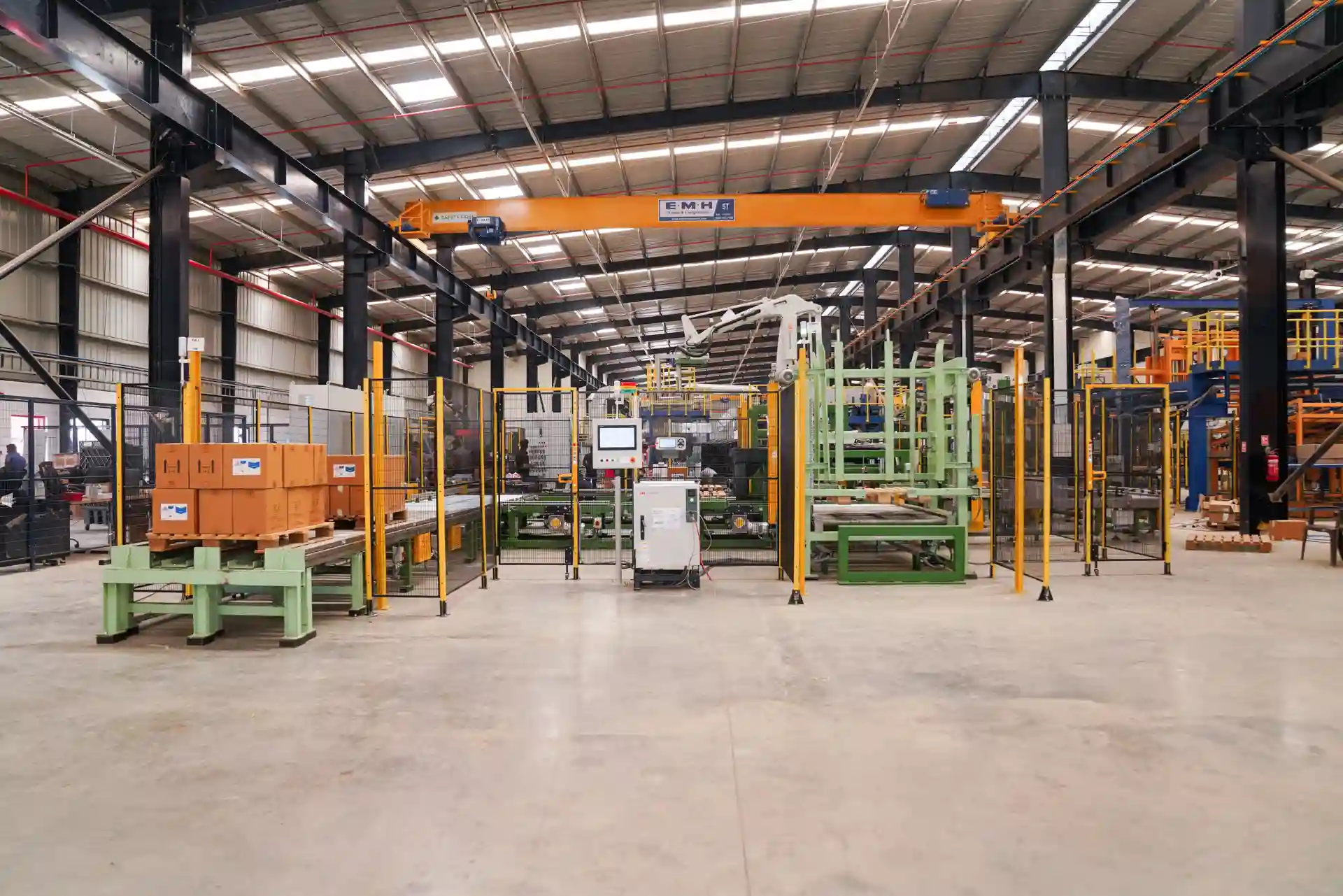
The robotic carton palletizer and box palletizer handle cartons, corrugated boxes, and rigid boxes up to 1,200 boxes per hour (up to 1,800 boxes per hour for high/low level variants), with 150 kg payload and simultaneous multi-unit palletizing of up to three boxes per cycle. The ability to palletize multiple box variants from different lines onto dedicated pallets in the same cycle is a major throughput and cost-efficiency advantage.
5. Bag & Drum Palletizer, Dual-Format Premium
The bag & drum palletizer uses an automated tool changer to switch a single robot between bag gripper and drum gripper tooling, effectively delivering two palletizer machines in one cell. Up to 120 kg payload, up to 12 drums per minute. This is the premium configuration in the bag/drum segment, priced higher than a dedicated bag or drum palletizer but significantly less than purchasing two separate systems.
6. Multiline Pail & Drum Palletizers, Specialist Range
The multiline pail palletizer and drum palletizer are specialist configurations for paints, coatings, and adhesives manufacturers. Up to 28 pails per minute, simultaneous multi-format handling across multiple lines. Pricing reflects the specialised tooling, multi-line infeed engineering, and the structural requirements for handling heavy, round, unstable formats at speed.
Palletizer Machine Price, Key Cost Drivers at a Glance
| Cost Driver | Low End | High End | Impact on Price |
|---|---|---|---|
| Machine Type | Cobot / Gantry | Six-Axis Robotic / High-Level | Very High |
| Throughput | Up to 210 bags/hr or 600 boxes/hr | 600 bags/hr or 1,800 boxes/hr | High |
| Payload | Up to 20 kg (cobot) | Up to 150 kg (six-axis) | High |
| End-of-Arm Tooling | Standard vacuum gripper | Servo adaptive / tool changer | Medium–High |
| Formats Handled | Single SKU, uniform format | Multi-SKU, multi-line, multi-format | Medium–High |
| Integration Scope | Standalone machine only | Full turnkey with conveyors, SCADA, fencing | Very High |
| Safety Specification | Basic guarding + interlocks | Light curtains, area scanners, CE/OSHA cert. | Medium |
| Environment Spec | Standard industrial | GMP / food-grade / explosion-proof | Medium |
| After-Sales Scope | Machine only, self-install | Installation, commissioning, training, SOP | Medium |
What to Look for When Evaluating a Palletizer Machine for Sale
When comparing a palletizer machine for sale from different vendors, the headline price is almost never the right comparison point. Here are the seven questions to ask before signing a purchase order:
1. Is the quoted price for the machine alone or for the integrated system?
A palletizer machine quoted without upstream infeed conveyors, downstream pallet discharge conveyor, safety fencing, SCADA integration, and commissioning can appear 30–50% cheaper than a fully integrated system. Ensure every quotation specifies exactly what is and is not included in scope.
2. What is the actual rated throughput at your product weight and format?
Throughput figures on a specification sheet are rated at optimal conditions with a reference product. Ask the vendor to model throughput at your actual product weight, bag or carton dimensions, and pallet pattern. A system rated at 600 boxes per hour for a standard 10 kg carton may deliver 400 per hour at your actual 18 kg, irregular-dimension carton.
3. Does the tooling cover your full SKU range without mechanical changeover?
Recipe-based changeover , selecting a new SKU on the HMI , is only possible if the end-of-arm tooling was specified to cover your full product range from the outset. Ask specifically whether your full SKU range is covered by the quoted gripper specification, or whether a separate gripper is required for each format. Cybernetik’s bag palletizer and box palletizer both support recipe-based changeover across format variants; the automated tool changer option extends this to fully different format types.
4. What is the pallet size and magazine capacity?
Standard pallets vary by geography and industry: 1200 x 1200 mm, 1200 x 1000 mm, and 1145 x 1145 mm are the common formats. Confirm the quoted system supports your pallet size and that the pallet magazine capacity (Cybernetik’s standard is up to 10 pallets of 150 mm each, customisable) matches your shift cadence without requiring a manual refill every 30 minutes.
5. What safety certification does the system carry?
A palletizer operating in Europe requires CE marking. North American operations require OSHA compliance. Food and pharmaceutical environments add GMP, HACCP, and in some cases FDA requirements. Confirm the certification scope is specified in the quotation, not assumed. Cybernetik conducts ISO 12100 risk assessments for every system and designs enclosures, interlocks, and emergency-stop architectures accordingly.
6. What does the after-sales package include?
A palletizer machine for sale at a lower headline price that excludes installation, commissioning, operator training, and SOP documentation transfers risk and cost to your team. Cybernetik’s standard delivery includes full turnkey installation, commissioning, operator training, SOP handover, and global after-sales support across 30+ countries.
7. Can the system integrate with your existing line architecture?
Verify that the palletizer’s PLC architecture can communicate with your upstream equipment , case packers, bagging systems, flow wrapper feeders , and your downstream stretch-wrapping or AGV systems. A single-integrator approach (where Cybernetik engineers the full line) eliminates inter-vendor communication protocol issues and gives a single point of responsibility for line performance.
 “A palletizer machine should be evaluated as a complete automation solution, where engineering, integration, and lifecycle performance matter as much as the initial price.

See it in action
Total Cost of Ownership: Beyond the Palletizer Machine Price
Purchase price is a one-time event. Total cost of ownership (TCO) is what actually determines whether the investment was sound. The TCO calculation for a palletizer machine includes five components:
Cybernetik Palletizer Machines for Sale: Full Range Overview
The table below summarises the full Cybernetik palletizer machine range, their specifications, and direct links for further information or to request a quote.
| Machine | Payload | Speed | Formats | Best For | Link |
|---|---|---|---|---|---|
| Box Palletizer | Up to 150 kg | Up to 1,800 boxes/hr | Cartons, corrugated, rigid boxes | Food, FMCG, pharma, chemicals | View & Quote |
| Bag Palletizer | Up to 50 kg | Up to 600 bags/hr | Gusseted bags, sacks, bales | Chemicals, agro, food powders | View & Quote |
| Drum Palletizer | Up to 120 kg | Up to 12 drums/min | Drums, IBCs | Adhesives, chemicals, liquids | View & Quote |
| Pail Palletizer | Up to 80 kg | Up to 28 pails/min | Pails, buckets | Paints, coatings, adhesives | View & Quote |
| Gantry Palletizer | Custom | Up to 210 bags/hr | Bags, uniform boxes | Single SKU, compact layout | View & Quote |
| Cobot Palletizer | Up to 20 kg | Compact cycle rates | Cartons + case printing | Mid-volume, small footprint | View & Quote |
| Bag & Drum Palletizer | Up to 120 kg | Dual format | Bags + drums (auto tool change) | Chemical, agro dual-format lines | View & Quote |
| Robotic Carton Palletizer | Up to 150 kg | Up to 15 cartons/min | Cartons, rigid, corrugated | High-speed multi-SKU carton lines | View & Quote |