
Key takeaways
The term ‘automatic palletizing system’ covers a remarkably wide range. At one end: a gantry auto palletizer processing 210 units per hour on 10 kW of power with a single operator for pallet changeover, installed in a packaging hall the size of a small warehouse. At the other: a six-axis robotic palletizing system handling 1,200 cases per hour with 150 kg payload, simultaneous picking of three cases, automated 10-pallet dispenser, full ISO 12100 enclosure and unified PLC integration with five upstream case packing lines. Both are automatic palletizing systems. They are not the same investment, not the same installation requirement, and not the same operational footprint.
The question that most buyers , and most supplier catalogues , sidestep is this: how does the automatic palletizing system specification actually change as you move up the scale from a small plant to a large manufacturing operation? This guide answers that question directly. It maps five specification dimensions across three plant sizes, explains what drives each dimension at each scale, and identifies the inflection points where the auto palletizer specification crosses from one tier to the next. Whether you are specifying a first automatic palletizing system for a growing SMB or replacing legacy equipment at an enterprise-scale facility, the framework below prevents the two most common specification errors: under-specifying at scale and over-specifying for current volume.
What Is an Automatic Palletizing System?
An automatic palletizing system is the complete end-of-line assembly that takes packed units from an upstream packaging conveyor and builds them onto pallets, automatically, without operator involvement between pallet loads. The ‘automatic’ distinction means every stage of the palletising cycle (product infeed, pick-and-place stacking, pallet supply and pallet discharge) runs under machine control. An auto palletizer that requires an operator to load pallets, or to change recipes, or to trigger the completed pallet transfer, is partially automatic at best.
The components of an automatic palletizing system are consistent regardless of scale: product infeed conveyor with registration, robotic or servo-driven palletising arm, end-of-arm tooling, automatic pallet supply, completed pallet outfeed, control PLC and HMI, and safety architecture. What changes with scale is the specification of each of these components, throughput tier, pallet magazine capacity, integration depth with upstream equipment and safety architecture complexity all increase as plant size increases.
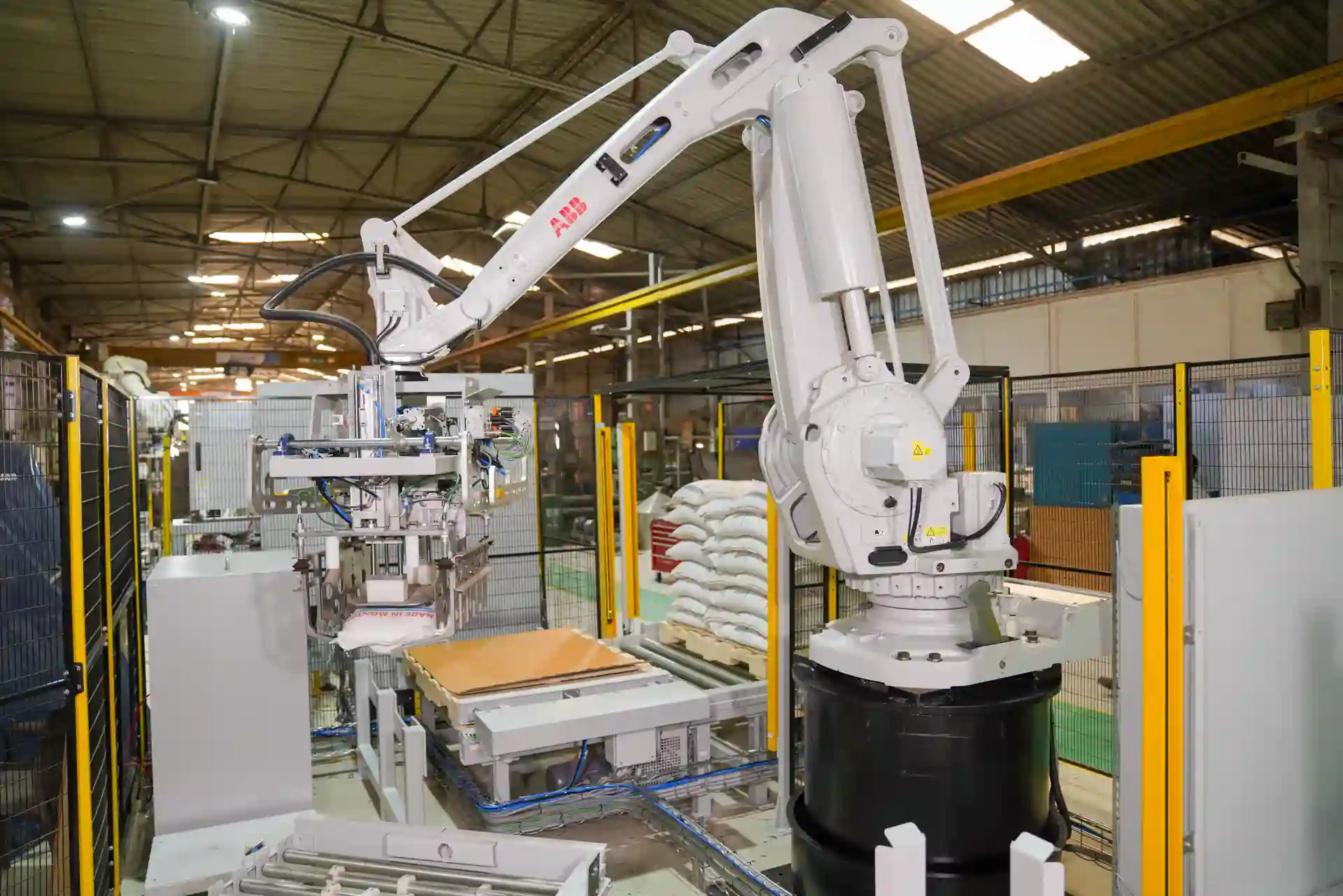
Cybernetik builds automatic palletizing systems from gantry configurations at 210 units per hour (the right specification for small and mid-size plants) up to six-axis robotic systems at 1,200 boxes per hour (the right specification for large manufacturing) and cobot configurations for very small operations and SMBs. All are genuine automatic palletizing systems, the differences between them are the specification responses to different scale requirements, not product quality differences.
Five Specification Dimensions That Change with Plant Scale
1. Throughput Tier, From 210 to 1,200+ Units per Hour
Throughput is the most visible scale-dependent specification. A small plant filling 200 cases per hour does not need a palletizer rated at 1,200, it needs a gantry auto palletizer at 210 units per hour with headroom above its own filler output. A large beverage plant running 1,000 bottles per hour through two parallel case packing lines needs a six-axis system rated above 1,000 to absorb both lines simultaneously. The specification error is always in the direction of the current filler’s rated output, not the catalogue’s peak figure.
2. Pallet Magazine Depth, From Semi-Automatic to 10-Pallet Auto Dispenser
At low throughput, a manual or semi-automatic pallet supply is tolerable , one pallet change per 20 minutes at 100 cases per hour costs relatively little throughput. At 1,200 cases per hour, a pallet change every 4 minutes with a 2-minute manual response time costs 40 cases per change, hundreds of cases per shift. Cybernetik’s automatic pallet dispenser with 10-pallet magazine is the standard specification at high throughput; the gantry’s semi-automatic pallet changeover is the right specification for small plant volumes where the 10-pallet magazine would be over-specified.
3. Upstream Integration Depth, From Infeed Interface to Full Shared PLC
At small plant scale, the automatic palletizing system can operate with a simple infeed conveyor connection to the upstream case packing machine, the operator selects the pallet recipe manually per batch. At large plant scale, this operator handoff introduces SKU errors and batch-transition delays that compound across the shift. Large plant automatic palletizing systems run on shared PLC with the upstream case packing line, SKU recipe pre-staging is automatic, batch transitions are seamless, and operator recipe intervention is eliminated entirely.
4. Safety Architecture, From Light Curtains to Full ISO 12100 Enclosure
Small plant auto palletizers operate in environments where floor space is constrained and operators work in close proximity to the palletising station. Light curtain safety (gantry) or inherent cobot safety allows the automatic palletizing system to operate without full enclosure, reducing both installation cost and floor footprint. Large plant palletizing environments typically separate the palletising station from the main production floor , full ISO 12100 enclosure becomes practical and required for the arm speeds and payload weights that high-throughput operation demands.
5. Downstream Coordination, From Manual Stretch-Wrap Trigger to Automated Dispatch Integration
At small plant scale, an operator can physically transfer the completed pallet to the stretch-wrap station and trigger the wrap cycle manually. At large plant scale, this manual transfer and trigger is a bottleneck that delays dispatch and costs throughput. Large plant automatic palletizing systems include roller conveyor outfeed with stretch-wrap PLC interface , completed pallet dimensions, weight and SKU pass to the stretch-wrap automatically, the wrap cycle starts on pallet arrival and the next empty pallet positions simultaneously at the palletising station.
Automatic Palletizing System Specifications Across Three Plant Scales
The table below maps Cybernetik’s automatic palletizing system configurations to three plant scale tiers, small, medium and large, across the five specification dimensions.
Small Plant Auto Palletizer, Gantry or Cobot Configuration
Gantry automatic palletizing system at 210 units per hour, 9-second cycle time, 2,000 mm stack height, up to 10 matrix formations via rotary EOAT, 10 kW power, light curtain safety, compact footprint, semi-automatic pallet changeover. Or cobot configuration for multi-line flexible deployment with integrated case printing and drop recovery. Capital-efficient for operations up to 1,500 units per day; operational from a single trained operative; repositionable as plant layout evolves.
Medium Plant Automatic Palletizing System, Standard Six-Axis Configuration
Six-axis automatic palletizing system at 400–800 boxes per hour, payload up to 150 kg, automated pallet dispenser, full ISO 12100 enclosure, HMI recipe library for all active SKUs, integration with upstream case packing machine via infeed PLC interface. The step-up from gantry that becomes economical when throughput exceeds 300 units per hour and the semi-automatic pallet changeover is visibly constraining shift output.
Large Plant Automatic Palletizing System, High-Throughput Integrated Configuration
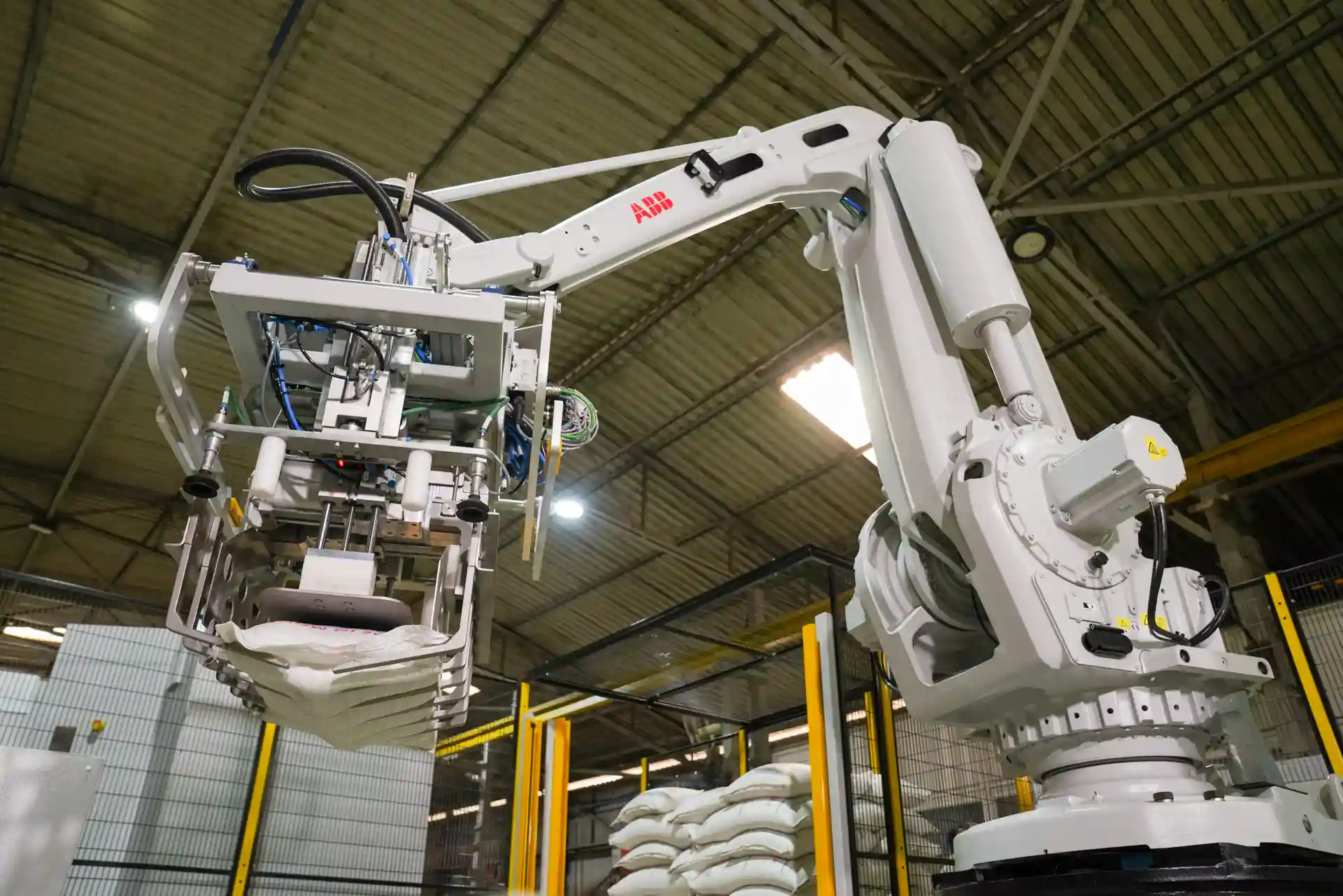
Six-axis automatic palletizing system at up to 1,200 boxes per hour with simultaneous three-case picking, 150 kg payload, 10-pallet automatic dispenser, full ISO 12100 enclosure, full shared PLC integration with upstream case packing line and downstream stretch-wrap, recipe pre-staging from upstream SKU signal, completed pallet data export to WMS. The specification for continuous high-throughput manufacturing where every element of manual coordination between stages has been replaced by automated control.
Automatic Palletizing System, Small, Medium and Large Plant Comparison
The table below maps five specification dimensions across three plant-scale tiers.
| Specification Dimension | Small Plant | Medium Plant | Large Plant |
|---|---|---|---|
| Throughput | Up to 210 units/hr (gantry) | 400–800 units/hr | Up to 1,200 units/hr |
| Pallet Supply | Semi-automatic changeover | Auto dispenser (10-pallet) | Auto dispenser (10-pallet) |
| Upstream Integration | Infeed interface only | Infeed PLC interface | Full shared PLC |
| Recipe Management | Operator-selected | HMI-selected | Automatic SKU pre-staging |
| Safety Architecture | Light curtains / cobot | ISO 12100 enclosure | ISO 12100 full enclosure |
| Downstream | Manual stretch-wrap trigger | Outfeed roller conveyor | Coordinated PLC stretch-wrap |
| Power | 10 kW (gantry) | 28.7 kW | 28.7–35 kW per arm |
| CAPEX Profile | Lower | Mid | Higher (lowest TCO/unit) |
Cybernetik’s Auto Palletizer Range Across Plant Scales
Small plant auto palletizer options
Medium plant automatic palletizing system options
Large plant high-throughput palletizing system options
 “The right palletizing system grows with your operation, balancing throughput, automation, and investment without compromising future performance.

See it in action
The Cybernetik Advantage Across the Automatic Palletizing System Scale Range
Cybernetik’s automatic palletizing system portfolio spans the full plant scale range with verified specifications at each tier.
Inflection Points That Signal an Upgrade Between Tiers
Moving from one automatic palletizing system tier to the next is triggered by specific operational indicators, not by elapsed time or instinct. Watch for the following inflection points.
At any of these inflection points, the Cybernetik automatic palletizing system at the next tier up typically delivers payback within twelve to twenty-four months on the throughput, changeover, integration and operator-coordination savings generated by moving to the right scale specification.