

Key takeaways
Most manufacturers need more engineering capability than they can justify employing. A company may launch two new products a year, redesign a line occasionally and then need controls expertise for a month. Hiring for all of that is expensive and leaves people idle between projects, so the work goes outside.
Product engineering services cover the design, development and industrialization work a manufacturer buys in rather than staffing internally, from concept and detailed design through prototyping, testing, documentation and support after launch. Choosing a partner well comes down to domain experience, a visible design process, clear intellectual property terms and whether the team understands how the thing will actually be made.
What These Services Cover
| Service area | What it covers |
|---|---|
| Concept and feasibility | Turning a requirement into options, with a view on cost and risk |
| Mechanical design | Detailed design, material selection, tolerances, drawings and analysis |
| Electrical and controls | Panels, wiring, sensors, PLC and HMI programming and safety circuits |
| Embedded and software | Firmware, interfaces and any connected functionality |
| Prototyping | Building and reworking samples to prove the design |
| Testing and validation | Functional, life, safety and compliance testing with documented results |
| Industrialization | Process design, tooling, fixtures, line layout and quality plans |
| Documentation | Drawings, bills of material, manuals and technical files |
| Sustaining engineering | Design changes, cost reduction and obsolescence handling after launch |
Few providers do all of this equally well. Some are strong in mechanical design and weaker in controls. Others are software led and subcontract the hardware. A team that has genuinely taken products from concept through to production usually shows it in the questions they ask early, which tend to be about manufacture and testing rather than about features.
Why Manufacturers Outsource Engineering
There are also cases where outsourcing is the wrong answer. Work that sits at the core of your competitive advantage, or that depends on knowledge your own people have built over years, is usually better kept inside. A sensible split is to keep the know-how that makes your product distinctive and buy in the engineering around it.
Engagement Models
| Engagement model | How it works | Suits | Watch for |
|---|---|---|---|
| Fixed scope project | An agreed deliverable for an agreed price | Well-defined work with stable requirements | Change requests if the scope shifts |
| Time and material | You pay for effort as it is used | Exploratory work where scope is unclear | Cost control needs active management |
| Dedicated team | A team works only on your projects, usually monthly | Ongoing pipelines of related work | Paying for capacity during quiet periods |
| Milestone based | Payment released at defined stages | Longer programs with clear checkpoints | Milestones must be defined precisely |
| Design and build | One partner designs and then manufactures | Machines and production lines | Less useful if you need design only |
The model matters as much as the partner. Fixed scope works when the requirement is genuinely settled and produces friction when it is not, since every change becomes a negotiation. Time and material suits early exploratory work but needs someone on your side actively steering it. For equipment and production lines, design and build is often the cleanest arrangement, because the team that designs it also has to make it work.
What to Check Before Choosing
| What to check | Why it matters |
|---|---|
| Domain experience | Engineering skill is transferable; knowing how powder, food or pharmaceutical products behave is not |
| Evidence of delivered work | Ask what they designed, what was built from it and whether it is running |
| Design process | Reviews, gates, checking and version control decide whether quality is repeatable |
| Tools and file formats | Native CAD compatibility matters when you later modify the design yourself |
| Testing capability | Whether they can test, or only design and send it elsewhere |
| Compliance knowledge | Familiarity with BIS, FSSAI, hazardous area and export requirements that apply to your product |
| Link to manufacturing | Designs from teams with no build experience are often expensive to make |
| Communication | Time zones, language, review cadence and a single point of contact |
The two rows that separate good partners from average ones are domain experience and the link to manufacturing. A competent engineer can design a mechanism anywhere. Knowing that a powder will bridge in that hopper, that the seal will not survive daily washdown, or that a tolerance is unrealistic on a production part comes from having been corrected by reality several times.
Intellectual Property and Confidentiality
This deserves settling in writing before work starts rather than when the first invoice arrives.
Agree who owns what the project produces. Most manufacturers expect to own the designs, drawings and test data created for them, while the provider keeps ownership of tools, libraries and methods it brought with it. Both positions are reasonable, and problems arise only when neither is written down.
How Pricing Usually Works
Engineering services are priced on effort, so the cost depends mainly on how much work the project takes and how much uncertainty it carries. Several things move that figure.
Scope clarity is the biggest. A well-defined requirement takes less engineering time than an open-ended brief, and it also makes quotes comparable between providers. Revision cycles matter too: every round of review and change adds effort, so projects with many stakeholders and no decision maker cost more than they should. The mix of people involved affects the rate, since senior design and analysis work is charged differently from drafting. And where testing, prototyping or travel are needed, those are usually separate.
Two practical ways to control cost are to write the requirement properly before asking for quotes, and to agree gates where the design is reviewed and frozen, rather than allowing changes to arrive continuously.
 “Clear requirements, structured design reviews, and controlled changes help prevent costly rework. Strong project planning keeps engineering efforts aligned with production goals, budgets, and timelines.”

See it in action
Running the Project Well
Most disappointing outcomes come from how a project was managed rather than from a lack of engineering skill.
One point of contact on each side
Someone on your side who can make decisions, and someone on theirs who owns delivery. Projects where feedback arrives from several people, sometimes contradicting each other, spend a lot of time on rework.
Design reviews at agreed points
Short, scheduled reviews with a clear decision at the end work better than continuous informal comment. Each review should end with the design either approved to move on or returned with specific changes.
Change control
Changes are normal. Changes without a record are not. Each one should carry a reason, an impact on cost and schedule, and a note of what it affects, including anything already tested.
Documentation as a deliverable
Agree at the start what the documentation set includes and in what formats. Chasing drawings, bills of material and test reports after the engineering team has moved on is slow and rarely complete.
The Handover Is Part of the Job
A project is not finished when the design works. It is finished when your organization can build, maintain and modify what was designed.
A complete handover usually includes native CAD files and source code, production drawings with tolerances, a bill of material with specifications and approved suppliers, test reports and compliance documents, assembly and maintenance instructions, a recommended spares list, and a short period of support while your team takes over. Where controls are involved, the program files and their documentation matter just as much as the mechanical drawings.
Where Engineering Meets the Factory
Design decisions determine manufacturing cost, and the most useful engineering partners think about the line while they are still drawing the product.
That includes how parts and materials move between stations, which is often treated as a separate problem and decided far too late. The principles behind it are set out in the guide to material handling automation systems, and bringing them into the design stage tends to remove work from every unit made afterward.
Measuring Whether It Is Working
Engineering projects are easier to judge while they run than at the end, provided a few things are being tracked. Useful signals are whether design reviews happen on the dates agreed, whether actions from the last review were closed before the next, how many changes are being raised and why, and whether deliverables arrive complete or need chasing.
It also helps to agree what done means for each stage in advance. For a design stage, that might be drawings issued, a design review closed and a costed bill of material. For a prototype stage, a working unit and a written test result. Stages that end with an opinion rather than a deliverable tend to be revisited later.
Building Internal Capability at the Same Time
Outsourcing engineering works best when your own team learns from it rather than simply receiving the output. That usually means someone internal joins design reviews, understands why the main decisions were made, and takes ownership of the documentation at handover.
Without that, the second project costs as much as the first, and modifying the design later means going back to the provider for every change. With it, each project leaves behind knowledge as well as drawings, and over time the split between what you keep in house and what you buy becomes a deliberate choice rather than a habit.
Risks and Red Flags
The Indian Context
India has a deep engineering services base, and manufacturers here can access design, analysis and controls expertise without going abroad. The practical question is not whether skills exist but whether a particular provider has worked in your domain and can connect design to production.
Two checks are worth making locally. First, whether the provider knows the standards that apply to your product, whether that is BIS certification, FSSAI requirements for food contact equipment, hazardous area classification for dust or solvent environments, or the export standards your customers ask for. Second, whether they have a route to manufacture, either in house or through partners they have worked with, because a design that cannot be built at a sensible cost is an expensive document.
Where Cybernetik Fits
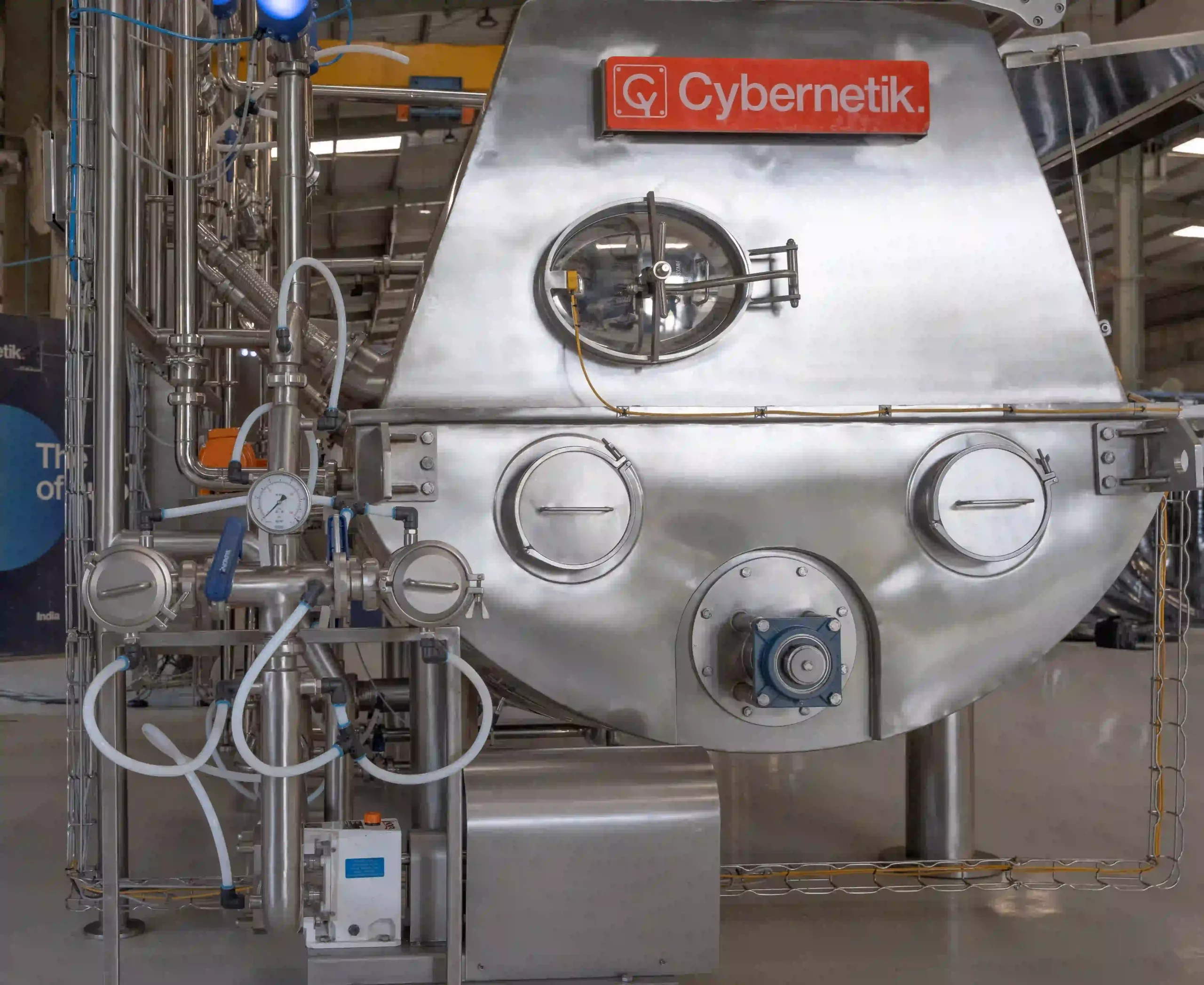
Cybernetik is not a general product engineering consultancy. Its engineering is applied to automation, which means the deliverable is normally a machine or a production line rather than a design package handed over for someone else to build.
That work is custom rather than catalog. The company has delivered more than 400 custom robotic automation solutions and over 6,000 systems across 30 plus countries, for food, pharmaceutical, chemical, automotive and battery manufacturers. Each project starts from a requirement, a product sample and a plant layout rather than from a standard model, and the engineering team designs around how the material actually behaves.
The engagement model is design and build. One team takes a project from concept and detailed design through manufacture, factory acceptance testing, installation, commissioning and ongoing support. For a manufacturer, the main advantage of that arrangement is accountability: the people who designed the line are the people who have to make it run at rate, so design decisions are made with the build in mind rather than passed on as someone else’s problem. Where a company needs design consultancy alone, without manufacture, a dedicated engineering services provider is the better fit.