
Key takeaways
Pour milk into coffee and it mixes itself. Stir two powders together and they will blend, but they will also try to separate again the moment you stop, pour them, shake them or drop them into a bin. That single difference explains most of what goes wrong in industrial powder blending.
A good blend is not the end of the job. It has to survive discharge, transfer and storage, and some blends start coming apart the moment they leave the mixer. Choosing a powder blender well means understanding why powders behave this way and designing the whole process, not just the mixing step, around it.
This article focuses on the powder side of the problem: why blends separate, how different powders behave, and the practical techniques that keep a blend uniform. The comparison of blender types themselves is covered in the guide to industrial blenders.
Why Powders Do Not Mix Themselves
Liquids mix by molecular motion, so given time they even out on their own. Powder particles do not move unless something moves them. Left alone, a powder stays exactly as it is, mixed or not.
That cuts both ways. A well-blended powder stays blended while it sits still. But the moment it moves, differences between particles, in size, density, shape and surface, start driving them apart. Mixing and segregation are happening at the same time whenever a powder is in motion, and a blender is really a machine for making mixing win.
How Blends Come Apart
Segregation is not one effect. It happens in several distinct ways, and each shows up at different points in a process.
| Segregation mechanism | What happens | Where it shows up |
|---|---|---|
| Sifting | Small particles fall through the gaps between larger ones as the bed moves | Filling hoppers, vibrating conveyors, transport |
| Air entrainment | Fine, light particles are carried by air and settle separately from coarse ones | Dropping powder into bins, pneumatic transfer, fast discharge |
| Trajectory | Larger or denser particles travel further when thrown or poured | Discharge chutes and the edges of piles |
| Rolling | Coarser particles roll down the slope of a pile while fines stay near the center | Forming a heap as a vessel fills |
Particle size difference is the biggest driver of most of these, far more than density, which surprises many people. A blend of ingredients with similar particle sizes is much easier to keep uniform than one mixing fine powder with coarse granules, even if the densities are close.
The practical point is that most segregation happens outside the blender, during filling, discharge and transfer. A blend can leave the mixer perfectly uniform and reach the next machine separated, and the blender gets blamed for a problem it did not cause.
Free-Flowing and Cohesive Powders Have Opposite Problems
| Free-flowing powders | Cohesive powders | |
|---|---|---|
| How they mix | Easily and quickly | Slowly, and they resist being moved |
| Main risk | Segregation, during and after blending | Lumps and agglomerates that survive mixing |
| What they need | Gentle mixing and careful handling afterward | Shear to break agglomerates, often choppers or high shear |
| Typical examples | Granules, crystalline sugar, coarse salt | Fine flours, starches, micronized powders |
Free-flowing powders are the tricky ones for segregation. Because their particles move freely, they mix fast and separate just as fast. They need gentle mixing and, more importantly, careful handling after the blend is made.
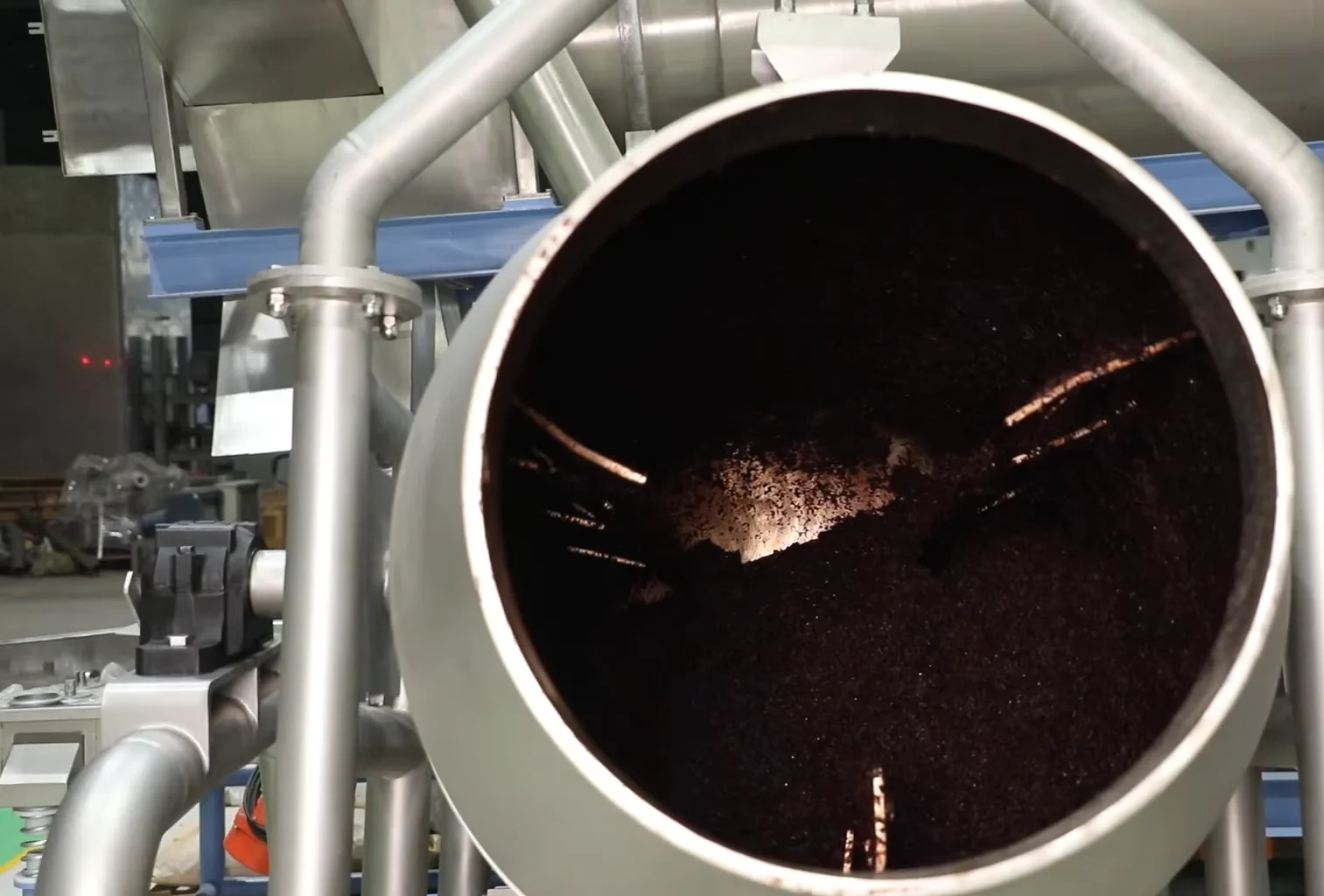
Cohesive powders are the opposite. Their particles stick together, so they resist segregation, but they also form agglomerates that simple mixing will not break up. A lump of one ingredient is a pocket of poor mixing, no matter how long the blender runs. These powders need shear, from choppers or a high shear mixer, and hard caked lumps are better dealt with before blending, as covered in the article on lump breakers.
Other Properties That Matter
Matching the Blender to the Powder
Once the powder’s behavior is understood, the choice of blender follows more naturally.
Tumble blenders, including bin and container blenders, suit free-flowing powders that need gentle handling. Ribbon blenders handle large batches of relatively simple dry blends. Paddle mixers mix quickly and gently and resist segregation well. Ploughshare mixers bring more intensity plus choppers, useful for cohesive powders and liquid addition. High shear mixers are for breaking agglomerates rather than general blending.
How paddle mixing in particular resists segregation, through a briefly weightless zone between two shafts, is explained in the piece on paddle mixers.
Small Ingredients Need Special Handling
Spreading a large ingredient evenly is easy. Spreading one that makes up a tiny fraction of the batch, such as a vitamin, an active ingredient, a colorant or a flavor, is where blends most often fail. Dropped into a large batch in one go, a small quantity tends to stay concentrated in one place far longer than the operator expects.
Pre-blending
A common fix is to mix the small ingredient first with a modest amount of one of the main ingredients, creating a pre-blend, and then add that to the full batch. The small ingredient starts out already spread through a larger volume, which makes it far easier to distribute evenly.
Geometric dilution
Widely used in pharmaceutical work, geometric dilution takes this further. The small ingredient is mixed with an equal amount of the bulk material, then that mixture is combined with an equal amount of bulk again, doubling each time until everything is included. It sounds slow, but it reliably spreads very small quantities through large batches.
Order of addition
The sequence ingredients go in matters. Adding a small ingredient between layers of the main ones, rather than on top where it can sit or stick to a wall, helps it distribute. Liquids generally go in after the dry ingredients are already spread, or they create wet lumps that never fully even out.
 “Blending in the transport container eliminates a critical transfer point, helping manufacturers reduce segregation risks while simplifying product handling and batch changeovers.”

See it in action
Blend Time: Too Short and Too Long
Under-blending is the obvious risk: stop too early and the ingredients are not yet evenly spread. Over-blending is less obvious and just as real.
With free-flowing powders, mixing for too long can actually make uniformity worse, because the blender keeps driving segregation once the blend has reached its best point. Friable particles break down and create fines. And in pharmaceutical blends, lubricants such as magnesium stearate are known to cause problems when blended too long, coating particles excessively and affecting how tablets form and dissolve.
The answer is to find the blend time that reaches the target uniformity for each product, confirm it by testing, and then stick to it rather than assuming longer is safer.
Sampling: Measuring the Blend, Not the Error
Checking blend uniformity means taking samples from different parts of the batch and testing them. It sounds straightforward, and it is easy to get wrong.
Sampling itself can disturb a powder. A sampling probe pushed into a bed can drag particles along with it, and fine and coarse particles may enter a sample unevenly. A poor sample can make a good blend look bad or a bad blend look good.
Good practice takes samples from defined locations spread through the batch, including top, middle and bottom and near the walls, uses sample sizes suited to what is being measured, and treats unexpected results with some suspicion before blaming the blender. When a blend seems to fail, it is worth asking whether the sampling was the problem.
Keeping the Blend Mixed
Since most segregation happens after blending, the most effective way to protect a blend is often to reduce how much it moves once it is made.
Blending in the container
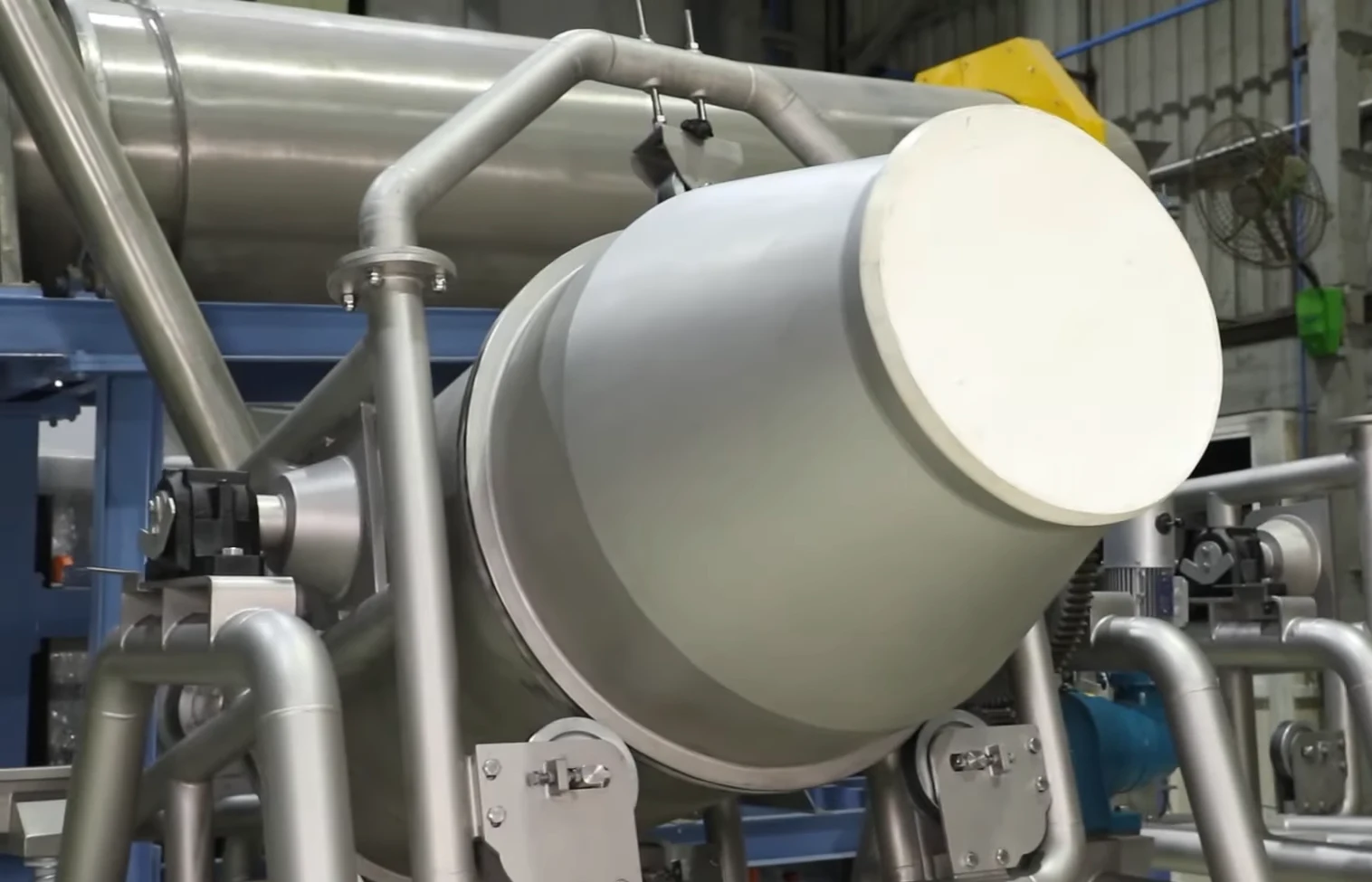
One of the most effective answers is to blend inside the container the material will travel in. With an intermediate bulk container blender, ingredients are loaded into an IBC, the whole container is tumbled to blend, and the same container then carries the blend to the next stage. There is no transfer from mixer to container, which removes one of the biggest segregation risks entirely.
It brings a second benefit in plants making several products. The blender never touches the product, only the container does, so there is no mixer to clean between batches. Cleaning moves to the containers, which are easier to wash and check.
Blending Equipment from Cybernetik
Cybernetik builds blending equipment across several designs and specifies it against the powder rather than from a single machine type.
| Cybernetik blending equipment | Specification |
|---|---|
| IBC blender | Tumbles containers up to 2,000 liters for 360-degree blending |
| Intermediate bulk carriers | 30, 100, 500, 1,000 and 2,000 liters, SS304 or SS316, no dead zones |
| Ribbon blender | 100 to 10,000 liters, 5 to 100 hp, double ribbon with plug valve discharge |
| Ploughshare mixer | 500 to 5,000 liters, with choppers, liquid injection and heating or cooling jacket |
| Continuous paddle mixer | Continuous-flow paddle mixing for steady production |
| Column lift high shear mixer | 500 liters at up to 3,000 rpm, for breaking agglomerates |
| Build standard | Hygienic, GMP built, with ATEX construction available |
The IBC blender and container range address the post-blending segregation problem described above directly, blending in the container that carries material onward. The ribbon, paddle and ploughshare mixers cover different powder behaviors and batch sizes, and the high shear mixer handles cohesive powders whose agglomerates need breaking.
For large batches of simpler dry blends, the ribbon blender runs from 100 to 10,000 liters, with a plug valve that prevents dead pockets and forward and reverse discharge that helps control how the blend leaves the mixer.
Cybernetik has been building automation for more than three decades. It is headquartered in Pune with facilities in Gujarat and Raigad and offices in the United States and UAE, and has installed over 6,000 systems in more than 30 countries, including over 400 custom automation solutions. More background is on the Cybernetik about page.