
Key takeaways
Walk through almost any process plant and you will find pneumatic butterfly valves everywhere: on silo outlets, dust collection ducts, water lines, conveying systems and the tops of hoppers. They are quick, simple, affordable and robust, and in a plant that already has compressed air they are often the default choice for any valve that opens and closes on command.
That popularity hides a fair amount of engineering. Choosing the actuator type, sizing it against the valve, arranging the control package and keeping the air supply in good shape all decide whether a valve works reliably for years or becomes a recurring maintenance job.
This article focuses on the pneumatic side: how the actuators work, the choices involved and where these valves fit best. The valve body itself, and how seat designs differ, is covered in the guide to motorised butterfly valves.
The Basic Idea
A butterfly valve closes a pipe with a disc that rotates a quarter turn on a central shaft. Turned edge-on to the flow, the disc lets material pass; turned across the pipe, it shuts it off. That quarter-turn motion is what makes butterfly valves easy to automate, because it needs only a short, simple movement.
A pneumatic actuator provides that movement using compressed air. Air pushes a piston, the actuator converts the piston’s straight-line motion into rotation, and the valve shaft turns. A small solenoid valve, switched by the plant control system, decides when air goes in and where it goes.
How Pneumatic Actuators Turn the Shaft
Two mechanisms dominate, and the difference between them matters more than it first appears.
| Rack and pinion | Scotch yoke | |
|---|---|---|
| How it turns the shaft | Pistons drive toothed racks that rotate a pinion gear on the output shaft | A piston drives a slotted yoke that swings the output shaft through its quarter turn |
| Torque across the stroke | Roughly constant from start to finish | Highest at the start and end of the stroke, lower in the middle |
| Match to a butterfly valve | Good for small and medium valves | Very good, since butterfly valves need most torque to unseat and to seat |
| Size and weight | Compact | Larger and heavier |
| Typical use | The most common choice for general service | Larger valves and higher torque duties |
The torque profile row is the interesting one. A butterfly valve does not need the same torque throughout its stroke. It needs the most at the very start, to break the disc free from the seat, and again at the very end, to press it back into the seat and seal. In between, it needs much less. A scotch yoke delivers high torque at exactly those two points, which is why it suits larger butterfly valves so well. A rack and pinion delivers steady torque throughout, which is simpler and entirely adequate for most smaller valves.
Double-Acting or Spring-Return
This is the most important choice in a pneumatic valve specification, because it decides what happens when something goes wrong.
| Double-acting | Spring-return | |
|---|---|---|
| How it moves | Air drives it both open and closed | Air drives it one way, springs drive it back |
| On loss of air | Stays roughly where it was | Springs drive it to a set safe position |
| Actuator size | Smaller for the same torque | Larger, because air has to overcome the springs as well as the valve |
| Solenoid type | Usually a 5/2 valve | Usually a 3/2 valve |
| Best suited to | Duties where holding position on air loss is acceptable | Duties that need a guaranteed fail-open or fail-closed position |
Spring-return actuators give pneumatic valves one of their biggest advantages over electric ones: a built-in safe position. If the air supply fails or the solenoid loses power, the springs drive the valve fully open or fully closed, whichever the process needs. A steam supply valve might be set to fail closed; a cooling water valve to fail open.
Double-acting actuators are smaller and cheaper for the same torque, and they suit duties where the valve simply holding its last position on air loss is acceptable. The choice should follow a clear view of what the process needs if air disappears, rather than whichever actuator happens to be cheaper.
The Control Package
The actuator is only part of a working valve. A small group of accessories turns it into something the control system can operate and trust.
Solenoid valve
The solenoid valve switches air to the actuator on a signal from the control system. Double-acting actuators usually use a 5/2 solenoid valve, which directs air to one side while venting the other. Spring-return actuators usually use a 3/2 valve, which either supplies air or vents it and lets the springs work. Many actuators have a standard mounting face so the solenoid can bolt directly on without extra tubing.
Limit switch box
A limit switch box sits on top of the actuator and tells the control system whether the valve is actually open or closed. That matters, because a valve commanded to close is not necessarily a valve that has closed. A stuck disc, a failed solenoid or a pressure drop can all leave the valve short of its intended position, and the next step in a sequence should not proceed until the valve confirms it got there.
Positioner
Most pneumatic butterfly valves simply open and close. Where a valve has to hold intermediate positions for throttling, a positioner is added. An electro-pneumatic positioner takes a control signal and adjusts the air to the actuator until the valve sits at the requested position, correcting as conditions change.
Speed control
Small flow control valves on the solenoid exhaust ports set how quickly the actuator moves. That sounds like a detail and can prevent real problems, covered below.
Sizing the Actuator
Actuator sizing is a torque calculation, and two points trip people up.
First, the torque available from a pneumatic actuator depends on the air pressure it receives. Plant supply pressure varies, dipping when demand elsewhere is high. An actuator sized against normal pressure can stall on a day when pressure drops, which is often exactly when several valves are moving at once. Size against the minimum pressure the valve can realistically see, not the nominal figure.
Second, spring-return actuators have two different torque outputs. Air has to overcome the springs as well as the valve when it opens, and the springs alone have to seat the valve when it closes. Both the air stroke and the spring stroke need enough torque for the valve, with a sensible margin. Valve torque also rises with the pressure difference across the disc and with sticky or abrasive media packing around the seat, so those conditions belong in the calculation too.
 “A pneumatic butterfly valve performs reliably only when clean, dry air, correct torque sizing, accurate feedback, and proper control are engineered as one system.”

See it in action
Air Quality Matters More Than It Seems
A pneumatic valve is only as reliable as the air feeding it, and air quality is one of the most common hidden causes of trouble.
Clean, dry, properly regulated air, with filtration close to the valves that need it, prevents most of these problems. It is far cheaper than chasing intermittent valve faults that turn out to be water in the air lines.
Closing Speed and Its Consequences
Pneumatic actuators are fast, often moving a valve in under a second. Usually that is exactly what is wanted. Sometimes it is a problem.
In liquid lines, slamming a valve shut stops a moving column of liquid almost instantly, and the resulting pressure spike, known as water hammer, can damage pipework, joints and instruments. In powder systems, a valve snapping shut under a moving stream can cause shock loads and compact material against the disc.
Slowing the actuator with exhaust flow controls solves this simply. Taking an extra second or two to close costs little and removes a surprising amount of stress from the system.
Pneumatic or Electric?
The two approaches suit different situations, and the deciding factor is often simply what the plant already has.
Pneumatic actuators are fast, inexpensive, tolerant of frequent cycling and able to fail safe with springs. They need a clean, dry compressed air supply. Electric actuators need only a power supply, position precisely without extra hardware and hold position on power loss, but they are slower and cost more per valve. A plant with good compressed air will usually find pneumatic the practical choice for on-off duty. A valve far from any air supply, or a plant without one, often favors electric.
Pneumatic Butterfly Valves in Powder Handling
Powder plants use pneumatic butterfly valves heavily, mostly as isolation valves. They close silo and hopper outlets, isolate sections of pneumatic conveying lines, and seal the connections on containers during docking and transfer. Compressed air is usually already present for conveying and dust collection, and fast, reliable open-close action fits sequencing well.
What they are not good at is controlling how much powder flows. Partly closing a butterfly valve on a cohesive powder encourages it to bridge across the smaller opening and stop, and the disc gives material a ledge to build on.
Where a measured flow rate is needed, a rotary or metering valve does the job properly. That difference between isolating and metering is set out in the guide to flow control valves.
Where Else They Are Used
How butterfly valves fit alongside ball, gate, globe and other valve types is covered in the article on industrial valves.
Keeping Them Running
Pneumatic butterfly valves are low-maintenance, and a few habits keep them that way. Drain moisture from air lines and check filters regularly. Watch for slow or incomplete valve movement, which often points to low pressure, a sticking solenoid or a worn seat rather than a failed actuator. Check that limit switches still read correctly, since a switch that has drifted can report a valve as closed when it is not. And replace seats before they wear to the point of leaking, since the seat is the main wear part in most butterfly valves.
Powder Valves from Cybernetik
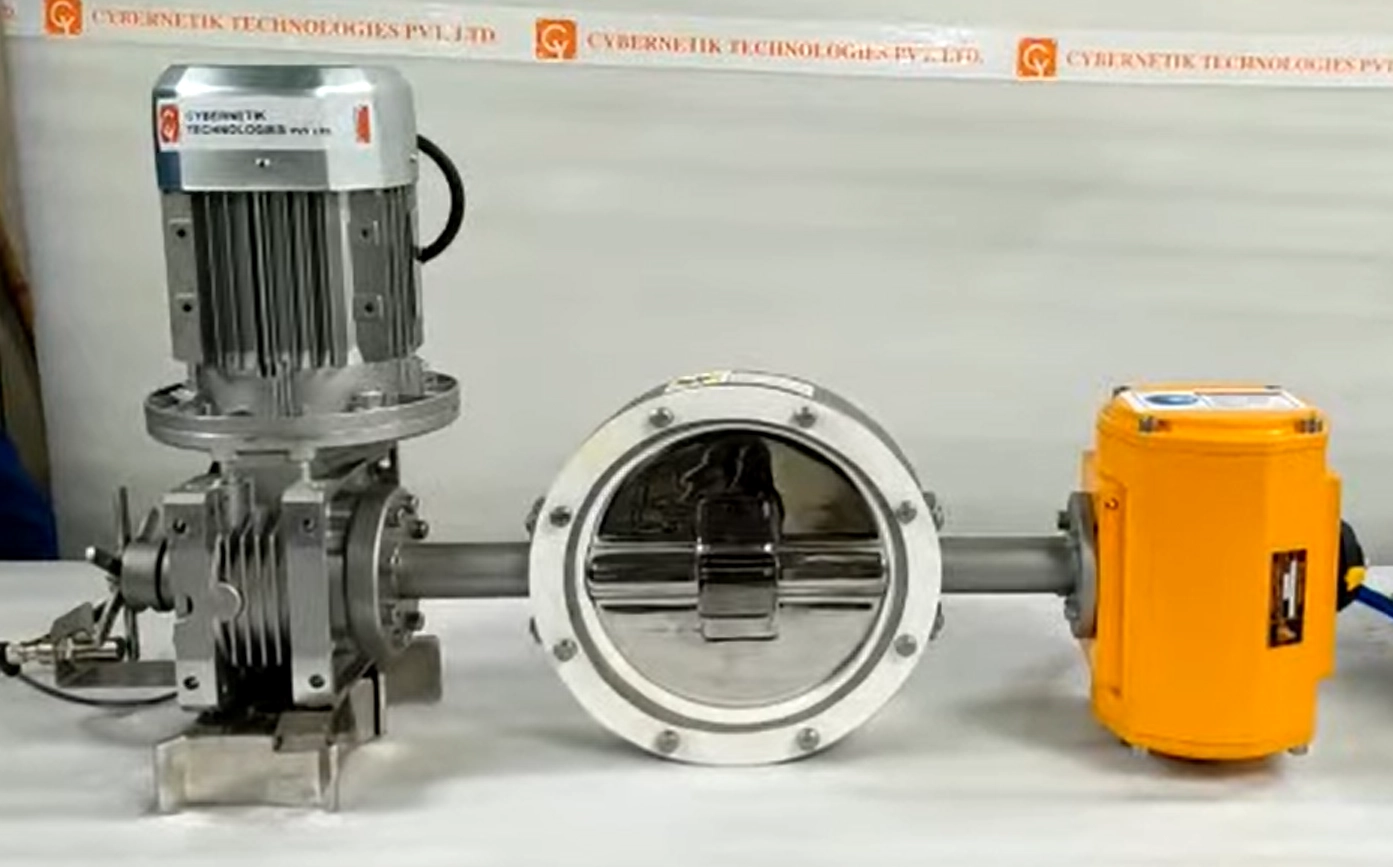
Cybernetik builds valves for powder and bulk solids handling as part of complete process lines, with actuation chosen for the duty. The CT valve can be supplied with pneumatic operation turning its rotor 90 or 180 degrees, and the combo valve uses separate actuators for coarse and fine flow, with pneumatic or electro-pneumatic options.
| Cybernetik powder valves | Specification |
|---|---|
| CT valve capacity | 1,000 to 6,000 kg/hr, customizable |
| CT valve actuation | Electric drive, with optional pneumatic operation turning the rotor 90 or 180 degrees |
| CT valve sealing | Zero leakage and vacuum compatible |
| Combo valve capacity | 1,000 to 6,000 kg/hr, customizable |
| Combo valve actuation | Separate actuators for coarse and fine flow, optional pneumatic or electro-pneumatic |
| Inlet and outlet | 100 to 300 NB |
| Construction | SS304 or SS316 contact parts, GMP built |
| Hazardous area | Explosion-resistant ATEX construction available |
Those valves handle the metering side of powder flow, where a butterfly valve would struggle, while pneumatic actuation gives the fast sequencing that batching and transfer need. For butterfly valve isolation on a specific line, it is worth discussing the details with Cybernetik’s engineers directly.
Cybernetik has been building automation for more than three decades. It is headquartered in Pune with facilities in Gujarat and Raigad and offices in the United States and UAE, and has installed over 6,000 systems in more than 30 countries, including over 400 custom automation solutions. More background is on the Cybernetik about page.