
Key takeaways
Flexible pouches are among the fastest-growing primary packaging formats in food, snack, and consumer goods manufacturing. They are lightweight, space-efficient, shelf-ready, and suitable for an enormous range of products , from wet sauces and dry snacks to pharmaceutical sachets and pet food. But their very flexibility creates a secondary packaging problem that rigid containers do not pose.
Pouches do not stand up on their own. They arrive at the case packing stage at variable thickness, shift on the belt, and resist the precise, repeatable matrix formation that corrugated case loading demands. Pack them too loosely and you waste case space and inflate shipping cost. Pack them incorrectly and lids do not close, cases fail in transit, and retailers reject pallets.
A purpose-built pouch case packing machine solves all of this. Engineered specifically for the characteristics of filled flexible pouches, variable thickness, compliant surfaces, and high packing density requirements, it transforms the most awkward secondary packaging challenge in food manufacturing into a reliable, high-speed, fully automated operation.
What Is a Pouch Case Packing Machine?
A pouch case packing machine is an automated secondary packaging system that receives finished filled pouches from a takeaway conveyor and loads them into corrugated cases or cartons in a defined, density-optimised matrix formation, ready for top sealing and downstream palletizing.
Unlike bottle or carton case packers, a food pouch packing machine must manage three challenges that rigid-product systems do not encounter:
Variable pouch thickness. A filled pouch deforms slightly at its edges. Without thickness normalisation before the pick zone, pouch matrices form unevenly, resulting in loose cases with insufficient density for stable transport.
Belt shifting. Pouches on a flat belt conveyor spread laterally and shift in orientation, particularly on high-speed takeaway conveyors downstream of vertical form-fill-seal (VFFS) machines. A system without active positioning will pick misaligned pouches, causing loading errors and case lid interference.
High density loading requirements. Pouches are typically lightweight per unit, so manufacturers need maximum pouches per case to keep per-unit shipping costs manageable. A pouch case packing machine must place pouches in the tightest achievable matrix without forcing lid closure failures.
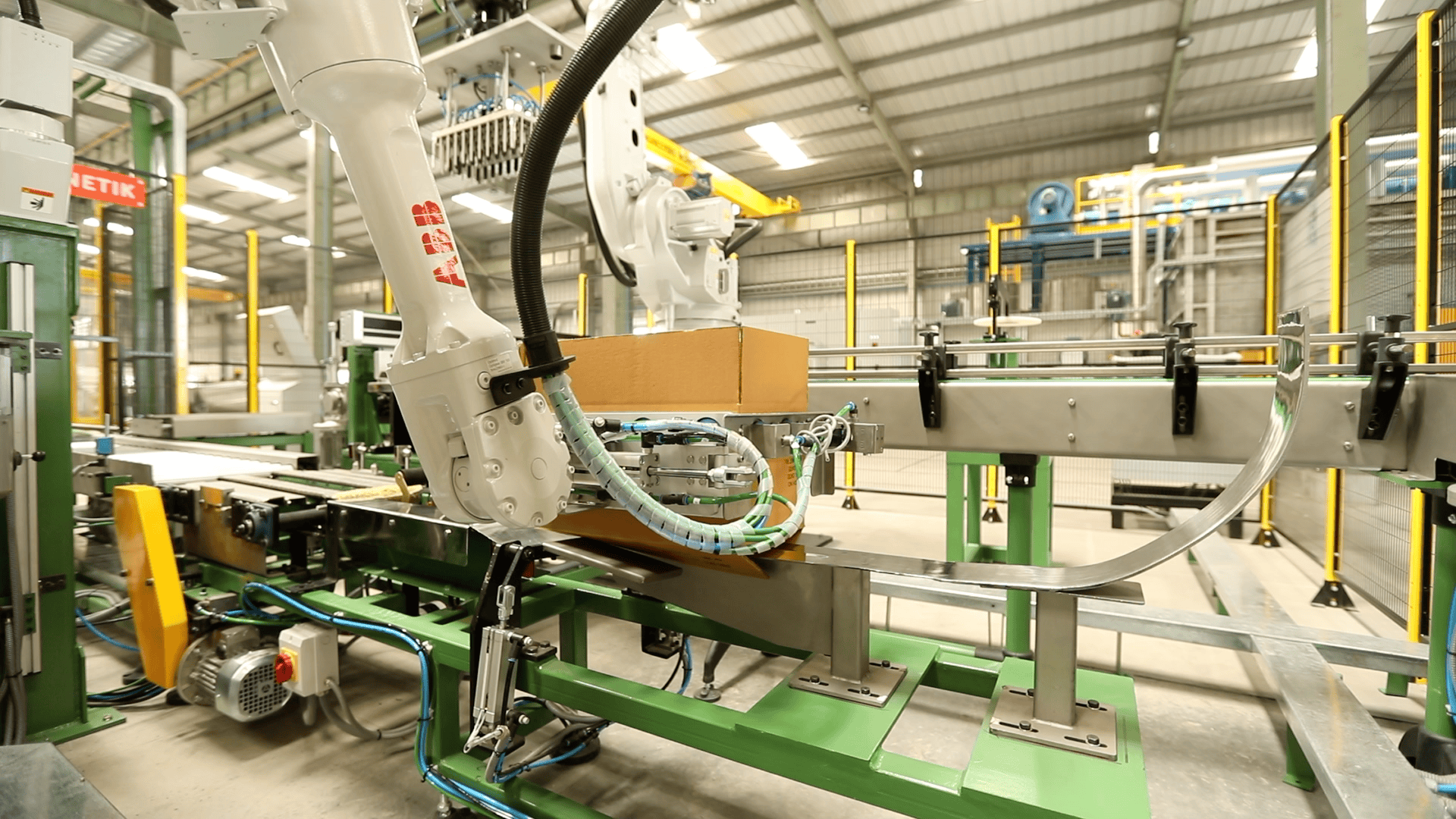
Cybernetik’s Case Packer for Pouches is engineered to address all three challenges with purpose-built subsystems operating in sequence.
Integrated Secondary & Tertiary Bottle Packing System
How Cybernetik’s Pouch Case Packing Machine Works
Step 1, Pouch Infeed and Thickness Normalisation Pouches arrive on the infeed conveyor from upstream primary packaging, VFFS machines, flow wrappers, or fill-and-seal lines. A vibratory conveyor uniformises the thickness of each pouch before it reaches the pick zone. This is not a guide rail or a mechanical stop, it is an active vibration system that settles the pouch fill content uniformly across the pouch footprint, producing consistent thickness at the pick point regardless of product type or fill weight.
Step 2, Staggered Pouch Lifting The staggered pouch lifting system raises two pouches simultaneously to slightly different heights. This height differential creates an overlap between adjacent pouches, the key mechanism behind Cybernetik’s maximum packaging density result. By overlapping pouches before loading, the system fits more pouches per case layer than any flat-placement system can achieve.
Step 3, Dual Robot Pick and Place Two pick-and-place robots, each fitted with grippers designed for the pouch geometry, pick one pouch at each height level simultaneously and load them into the case in a single coordinated cycle. Two robots working simultaneously at 40 pouches per minute, not one robot cycling twice as fast, is the architecture that delivers both speed and placement accuracy without compromising either.
Step 4, Optional Quality Control An optional cleated belt conveyor rejects broken or defective pouches before they enter the loading zone. An optional metal detector provides inline contaminant detection. An optional pouch pressing system applies controlled pressure to the loaded case before lid closure, confirming the pouch matrix is properly settled for a clean, reliable top-seal closure.
Step 5, Case Discharge The loaded, confirmed case is conveyed to the top-sealing and labelling station before passing downstream to the palletizer.
Technical Specifications, Cybernetik Case Packer for Pouches
| Parameter | Value |
|---|---|
| Capacity | 40 pouches/min (based on pouch size) |
| Payload | Up to 25 kg |
| Footprint | 10 × 10 × 3 m (customizable) |
| Certifications | CE (as required) |
| Quality Options | Broken pouch rejection, metal detector, pouch pressing system |
| Robot Configuration | 2 pick-and-place robots |
| Key Mechanism | Staggered pouch lifting + vibratory thickness conveyor |
 “The success of flexible packaging depends not only on how pouches are filled, but on how efficiently they are packed, protected, and prepared for shipment“

Why Pouch Case Packing Machines Are Essential for Food Flexible Packaging Lines
Food flexible packaging lines present a unique combination of throughput pressure, hygiene requirement, and product fragility that makes manual secondary packing both dangerous and unsustainable at scale.
Speed Mismatch Between Primary and Secondary Packaging
A modern VFFS machine or multi-lane flow wrapper can produce 80–200 pouches per minute depending on product and format. Manual secondary packing sustains 15–20 pouches per minute per operator. The mathematics are straightforward: a primary packaging machine running at four to ten times the speed of the manual secondary packing stage forces one of two outcomes , either the primary machine runs below rated capacity, or a buffer accumulation system absorbs the throughput gap at significant capital cost. A food pouch packing machine running at 40 pouches/min closes this gap without either compromise.
Hygiene and GMP Compliance at the Open-Case Stage
Open corrugated cases at the secondary packing stage present a contamination risk for food products. Manual handling at this stage introduces direct skin contact with food-contact packaging surfaces , a GMP exposure that many food retailers and export markets now audit explicitly. Cybernetik’s pouch case packing machine removes direct manual contact from the loading stage entirely, meeting GMP and CE compliance requirements for food-grade secondary packaging.
Packaging Density Determines Shipping Cost
For lightweight pouch products , snacks, sachets, seasonings , the shipping cost per unit is directly determined by how many pouches fit per case. Loosely packed cases mean more cases per pallet, more pallets per shipment, and higher freight cost per unit. Cybernetik’s staggered pouch lifting system is specifically engineered to maximise pouches per case layer , delivering the highest achievable packing density and the lowest possible per-unit shipping cost.
.
See it in action
Food Industries That Benefit Most From Pouch Case Packing Machines
Snack Foods and Confectionery High-volume, lightweight pouches with tight packaging density requirements are the core application. Automated loading at 40 pouches/min allows snack lines to run primary machines at full capacity without manual secondary packing becoming the constraint.
Sauces, Condiments, and Ready-to-Eat Meals Wet-fill pouches are among the heaviest and most fragile flexible formats. Payload capacity up to 25 kg and gentle dual-robot pick and place handle these formats without pouch rupture or seal stress , the critical failure modes for wet-fill secondary packing.
Spice, Seasoning, and Dry Food Sachets Small, lightweight sachets at high volumes require maximum density loading. The staggered lifting system’s overlap mechanism is most effective on small-format pouches , where the density gain per case layer is largest and the shipping cost impact is highest.
Pet Food Pet food pouches are typically medium-to-heavy format. The 25 kg payload and robust dual-robot architecture handle the weight range across the full pet food pouch format spectrum.
Pharmaceutical Sachets cGMP-compatible construction, minimal human contact at the loading stage, and optional metal detection make this system suitable for pharmaceutical sachet secondary packing under GMP compliance requirements.
Integrating the Pouch Case Packing Machine into a Complete Packaging Line
A food pouch packing machine does not operate in isolation. It is the secondary packaging stage in a connected line that begins with primary packaging and ends at the palletizer.
Upstream: Pouches arrive from Cybernetik’s Flow Wrapper Feeding systems or primary VFFS machines. The Robotic Flow Wrapper Feeding system , handling up to 100 parts/min per delta robot , feeds oriented, quality-checked pouches onto the takeaway conveyor, ensuring that only accepted pouches arrive at the case packer infeed.
At the case packing stage: Cybernetik’s Case Packers handle pouch loading under the same PLC architecture as the upstream flow wrapper, single recipe selection, single HMI, synchronised control.
Downstream: Sealed, labelled cases pass to Cybernetik’s Robotic Palletizers , handling up to 15 cartons/min at 150 kg payload , or to the Box Palletizer range for higher throughput end-of-line operations. The Robotic Carton Palletizer provides customised pallet matrix formation for corrugated cases, with simultaneous two-case palletizing for maximum throughput at the end-of-line stage