
Key takeaways
Every food and beverage line eventually arrives at the same problem. Primary packaging is complete , the pouch is sealed, the bottle is capped, the shrink pack is wrapped , and the product now has to move in bulk into a shipping case and out the door at the rate retail and distribution partners demand. That last metre of the production floor, from packed unit to sealed case, is where secondary packaging either holds the line or becomes the reason the line is losing output.
For most food and beverage manufacturers, manual case packing at that stage is the hidden ceiling on throughput. An operator loads 8 to 12 pouches per minute when things are going well. Add shift changes, fatigue, and the variety of SKUs that a modern FMCG or food production floor runs, and that ceiling drops further , while defect rates, product damage, and case-weight non-compliance creep up. A robotic case packer machine eliminates that ceiling. Robots do not change shifts, do not handle products with contamination risk, and do not make judgment errors when a mixed-SKU case needs a specific matrix.
This guide explains what a case packer machine does at the secondary packaging stage, how Cybernetik’s eight purpose-built case packer machine variants are designed for the specific handling requirements of food and beverage products , pouches, bottles, shrink packs, and chocolate bars , and what to look for when evaluating a case packer manufacturer for a new or upgraded line. Whether you are a snack producer, a beverage bottler, a dairy packer, or a confectionery manufacturer, the right case packer machine is what connects your production output to your distribution capacity.
What Is a Case Packer Machine and Where Does It Sit on the Line?
A case packer machine is the secondary packaging system that picks finished primary packs , pouches, bottles, shrink packs, trays, or bars , and loads them into outer cases or cartons in the required matrix formation for shipping and retail distribution. It sits between the primary packaging stage (filling, sealing, wrapping) and the end-of-line stage (palletizing, stretch wrapping, dispatch), and its job is to do that transition at the speed and accuracy the line needs, with the case integrity retailers require.
There are three decisions that define what a case packer machine must do on any given line:
- Format – what is being packed into the case (pouches, bottles, shrink packs, bars, or a mix of these).
- Speed – how many units or cases per minute the line needs to achieve at rated output.
- Flexibility – how many SKUs, sizes, and matrix configurations the same machine needs to handle without major retooling.
Choosing a case packer machine that is sized and configured correctly for all three means the secondary packaging stage never becomes the bottleneck. Choosing one that is undersized on any dimension means the primary packaging line, however fast, is effectively limited to the case packer’s throughput , a common and expensive problem in food and beverage plants that have upgraded their filling or wrapping stage without upgrading the secondary stage alongside it.
Cybernetik’s Case Packer Machine Line: Eight Variants for Food and Beverage Applications
Cybernetik builds eight case packer machine configurations on a common engineering platform, each built for a specific product format and production environment. All are CE-certified where applicable, GMP-built on food contact surfaces, and designed for upstream and downstream integration.
1. Case Packer for Pouches (Single and Multiple Robots)
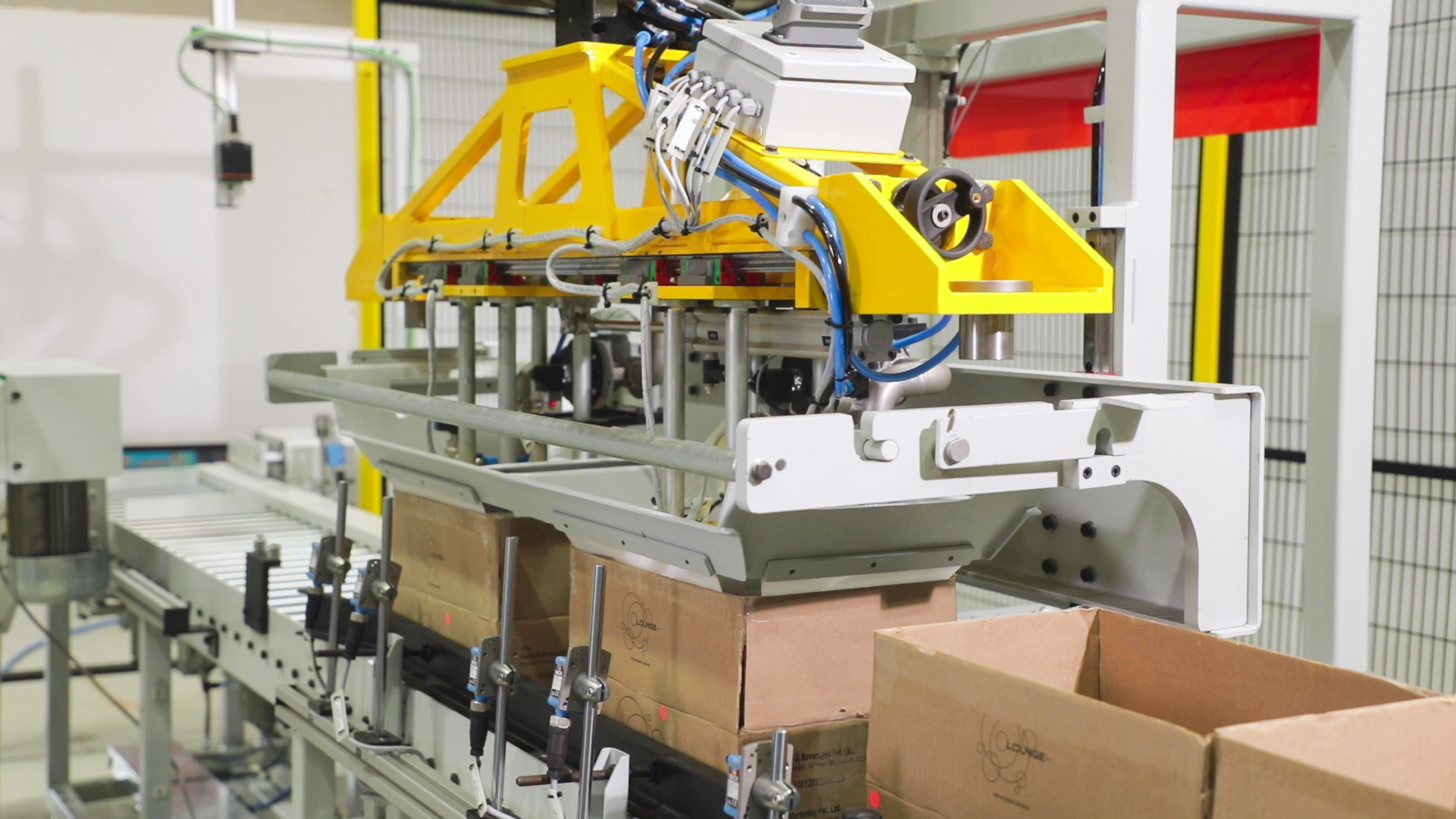
Cybernetik’s Case Packer for Pouches is automation for loading single or multiple pouches into cases, available in SCARA and Six-Axis robot configurations. The SCARA variant runs up to 12 pouches per minute with a 5 kg payload; the Six-Axis variant reaches up to 40 pouches per minute with a 200 kg payload. Pre-packaging features include in-line detection and rejection of broken pouches and metal-ingress pouches. Post-packaging features include a pneumatic ram for proper case lid closure, a carton vibrator to improve packing density, lid-edge folding, and a check weigher for in-line case-weight acceptance and rejection.
Applications: biscuits, chips, wafers, snacks, APIs, medicinal powders, granular drugs, fertilizers, pesticides, and herbicides.
2. Staggered Pouch Case Packer (Two Robots)
The Staggered Pouch Case Packer is designed specifically to maximize packaging density for pouches in cartons. A vibratory conveyor uniformizes the thickness of pouches for compact packaging. The staggered pouch lifting system raises two pouches to slightly different heights, and two pick-and-place robots load both pouches simultaneously into the case, creating a staggered overlap that fills the case volume efficiently. Optional features include a cleated belt conveyor for broken pouch rejection and a metal detector.
3. Multiple SKU Case Packer
The Multiple SKU Case Packer is a CE-certified, fully automated system designed for packing different pouch variants into cases using the same gripper. A single flexible gripper handles food, chemical, and other pouches , food-safe and customizable , with accurate placement and customizable stacking at up to 12 pouches per minute with a 5 kg payload. For food and beverage manufacturers running frequent SKU rotations, this is the configuration that removes the retooling cost from every changeover.
4. Horizontal Pouch Case Packer (SCARA)
Cybernetik’s Horizontal Pouch Case Packer is a CE-certified, fully automated system with a SCARA robot and a versatile vacuum gripper for secondary and tertiary robotic case packing of pouches into cartons, followed by palletizing in the same line. A carton referencing chute ensures accurate placement. Customizable matrix formations optimize space within each carton. The system begins with the operator initiating via a control interface and runs through to case packing and palletizing in a single integrated line.
5. Case Packer for Bottles
Cybernetik’s Case Packer for Bottles is a flexible system for packing bottles of multiple types at high speed , up to 120 bottles per minute (Six-Axis configuration) , in customizable matrix formations. An automatic tool changer for the pick-and-place robot enables rapid switching between bottle variants without manual retooling. Multiple bottle matrix formations are created at the matrix formation station. A vision system checks for defective bottles and cartons and rejects them before the case is sealed. The carton erector upstream unfolds and forms flexible cartons, bringing the bottle packer into a fully integrated secondary line.
Applications: juices, bottled beverages, sauces, condiments, dairy products, pharma bottles, nutraceuticals.
6. Case Packer for Shrink Packs
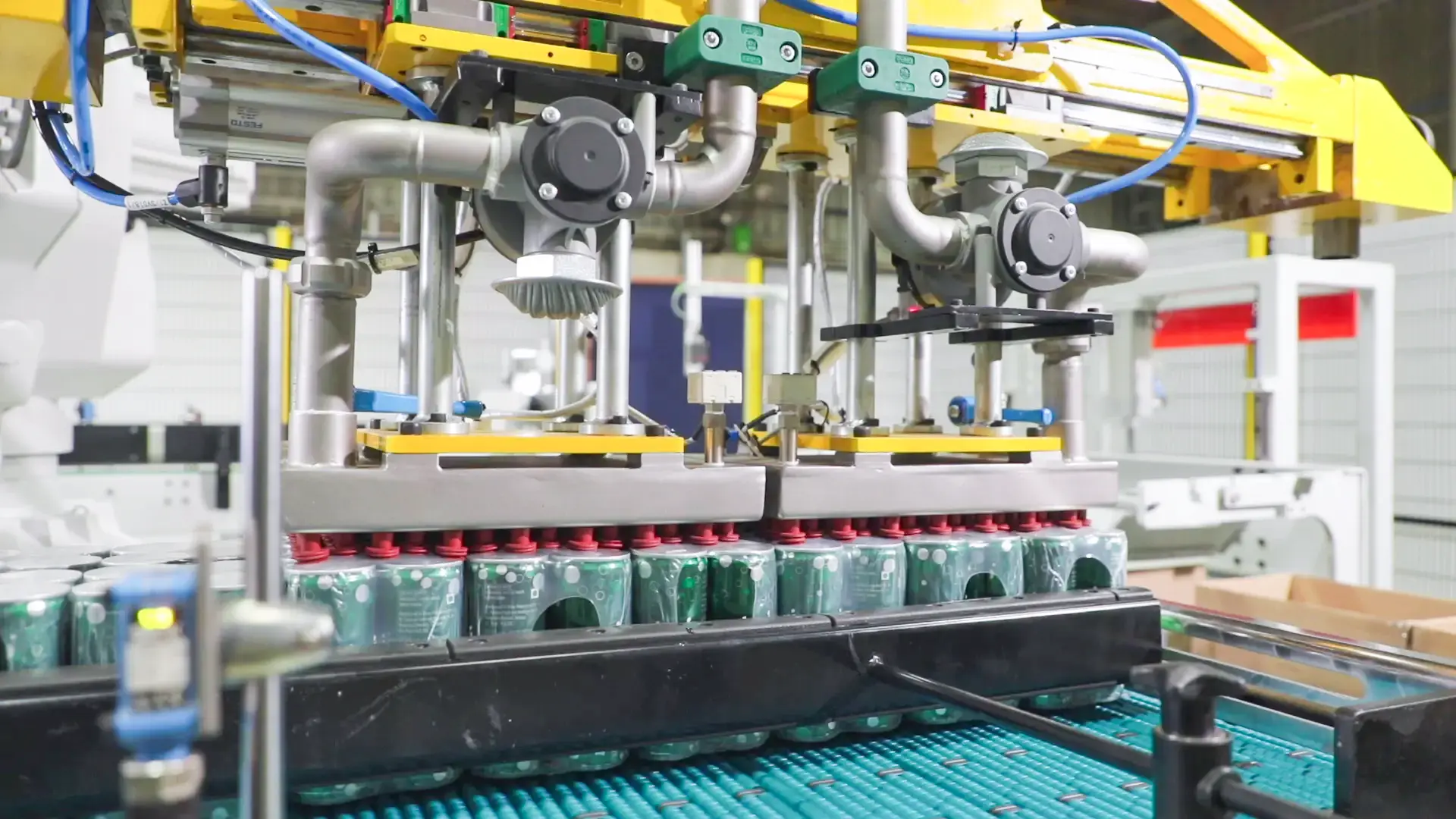
Cybernetik’s Case Packer for Shrink Packs is a customizable robotic carton packer system for multiple shrink pack variants using a single pick-and-place robot with dynamic gripper sizing. The robot simultaneously loads two shrink packs per cycle. Carton guide funnels ensure accurate placement and descend with the gripper during the final placing movement for last-mile accuracy. Rapid and simple changes to the infeed conveyor working width enable handling of shrink pack variants. An optional case erector can be added upstream; a case top and bottom taping system followed by a case palletizer downstream makes this an end-to-end automated setup.
Applications: carbonated drinks, energy and sports drinks, wellness beverages, juices, functional beverages, fruit-based drinks, coffee and tea based beverages, flavoured water.
7. Case Packer for Shrink Packs and Bottles (Combo)
The combo Case Packer for Shrink Pack and Bottles is a multipurpose robotic packaging solution with an automatic tool changer that enables rapid switching between shrink pack and bottle handling without stopping the line. As-required matrix formation is available for both formats. This is the configuration for beverage lines that run both returnable-bottle and shrink-pack SKUs on the same production floor, where flexibility and rapid changeover are non-negotiable.
8. Chocolate Bar Case Packer
The Chocolate Bar Case Packer is a Cybernetik solution that handles chocolate bar variants with minimal modifications between variants. Gentle pick-and-place handling protects the enrobed or moulded surfaces of chocolate bars that would be damaged by mechanical gripping. The same robotic platform that handles confectionery primary packaging feeds directly into this secondary case packing stage for a fully integrated chocolate line.
Credits: Name of the photographer
Why Food and Beverage Manufacturers Need Robotic Case Packer Machines
Food and beverage secondary packaging comes with a set of requirements that manual case packing cannot reliably meet at any meaningful production scale. Five of them drive the economics of the investment decision:
1. Hygiene and GMP Compliance
Food-contact and near-food-contact handling stages carry contamination risk every time a human hand is in the loop. A robotic case packer machine removes that touch point from the secondary packaging stage. Gripper surfaces are food-grade. Structural surfaces are stainless steel where contact is possible. The line runs without manual intervention inside the packing zone.
2. Case-Weight Compliance and Retail Audit
Retailers and distributors perform case-weight audits. Short cases , where count or weight falls below the stated spec , result in chargebacks and supplier penalties that erode margin on the entire shipment. Cybernetik case packer machines integrate check weighers at the outfeed; underweight cases are rejected in-line before they enter the shipping flow, not discovered at the customer’s warehouse.
3. Packing Density on Pouch Lines
Pouches are compressible. Hand-packed cases are inconsistently dense, which means excess dead volume in each case, higher carton cost per unit shipped, and pallet instability. Cybernetik’s staggered pouch lifting system on the robotic case packer for pouches creates deliberate overlap during loading, and the vibratory conveyor upstream uniformizes pouch thickness. The result is maximum packing density in every case, consistently.
4. SKU Proliferation and Format Changeover
The modern food and beverage production floor runs more SKUs than it did five years ago. A case packer machine that can handle multiple product variants and case configurations from a single HMI recipe , without mechanical retooling , is what keeps changeover time from cancelling the throughput gains from the robotic system. Cybernetik’s case packers are built with automatic tool changers, SCADA-based recipe storage, and versatile vacuum and mechanical grippers specifically to hold changeover time short across a high-SKU production mix.
5. Integration with End-of-Line Systems
A case packer machine does not stand alone. It feeds a palletizer. The palletizer feeds stretch wrapping. The output needs to be labelled. On beverage lines, the case erector is upstream. On food lines, the taping and sealing system is downstream. Cybernetik builds every case packer machine for upstream and downstream integration under a single control architecture , so the case packer, the upstream primary packaging stage, and the downstream palletizer share a PLC and interlock chain.
6. Case Packer for Shrink Packs
Cybernetik’s Case Packer for Shrink Packs is a customizable robotic carton packer system for multiple shrink pack variants using a single pick-and-place robot with dynamic gripper sizing. The robot simultaneously loads two shrink packs per cycle. Carton guide funnels ensure accurate placement and descend with the gripper during the final placing movement for last-mile accuracy. Rapid and simple changes to the infeed conveyor working width enable handling of shrink pack variants. An optional case erector can be added upstream; a case top and bottom taping system followed by a case palletizer downstream makes this an end-to-end automated setup.
Applications: carbonated drinks, energy and sports drinks, wellness beverages, juices, functional beverages, fruit-based drinks, coffee and tea based beverages, flavoured water.
 “The case packer is not the last step on the line. It is the step that decides whether every step before it was worth investing in”

Cybernetik packaging engineering team
See it in action
What Makes Cybernetik a Trusted Case Packer Manufacturer for F&B
Choosing a case packer manufacturer is a longer commitment than buying the machine. The case packer manufacturer who engineers, installs, and supports the line determines what your secondary packaging stage can do five years from now , in terms of flexibility, uptime, and the ability to handle new SKUs without a new capital purchase. Cybernetik has built its reputation as a case packer manufacturer across more than 30 countries and three decades by making six engineering commitments that compound into long-term production reliability:
F&B Applications: Which Case Packer Machine for Which Production Environment?
The food and beverage industry covers a wide range of packaging formats and throughput requirements. Below is a first-pass reference for matching the production environment to the right Cybernetik case packer machine variant.
Snack, Biscuit, and Chip Manufacturers
Pouch-format products arriving from horizontal or vertical form-fill-seal machines. High SKU velocity and frequent changeovers. The Case Packer for Pouches (single or multiple robots) and the Multiple SKU Case Packer are the primary configurations. The staggered pouch variant is the right answer when packing density is a commercial priority , smaller secondary packs with more pouches per case means lower logistics cost per unit shipped.
Beverage Bottlers and Juice Manufacturers
High-speed bottle case packing at up to 120 bottles per minute. Lines that run both bottled and shrink-pack SKUs benefit from the Combo Case Packer for Shrink Packs and Bottles with its automatic tool changer. Lines running carbonated or functional beverage shrink packs use the dedicated Case Packer for Shrink Packs with carton guide funnels for precise last-mile placement.
Dairy, Sauce, and Condiment Manufacturers
Bottle and pouch formats, often running multiple SKUs across the same line in the same shift. The Case Packer for Bottles with automatic tool changer and vision-based defect rejection handles the bottle format. Sauce and condiment pouches use the pouch case packer variants. Mixed format lines use the combo configuration.
Confectionery and Chocolate Manufacturers
Chocolate bars and confectionery formats from the enrober or moulding line through to secondary case packing. The Chocolate Bar Case Packer handles bar variants with minimal modifications between them. The same Cybernetik engineering platform that runs the Robotic Flow Wrapper Feeding upstream connects directly to the secondary case packing stage, enabling a fully integrated confectionery line from enrober to dispatch case.
Pharmaceutical, Nutraceutical, and Health Product Manufacturers
API pouches, medicinal powder pouches, and pharmaceutical bottle formats. GMP build and CE certification are mandatory. In-line metal detection and broken pouch rejection are standard requirements. The Case Packer for Pouches and the Horizontal Pouch Case Packer both meet the compliance requirements for pharmaceutical secondary packaging environments.
Full Cybernetik Case Packer Machine Lineup at a Glance
| Case Packer Machine Variant | Product Handled | Speed / Payload | Key Feature |
|---|---|---|---|
| Case Packer for Pouches (Single / Multiple Robots) | Snacks, biscuits, chips, wafers, APIs, agrochemicals | SCARA: up to 12 pouches/min, 5 kg payload Six-Axis: up to 40 pouches/min, 200 kg payload | Metal detection + broken pouch rejection; pneumatic press for case lid closure; carton vibrator for packing density; check weigher |
| Staggered Pouch Case Packer (Two Robots) | Snacks, FMCG pouches, food pouches | High-speed, dual-robot , customizable based on product | Staggered pouch lifting system maximizes density; vibratory conveyor uniformizes pouch thickness; simultaneous dual-robot packing |
| Multiple SKU Case Packer | Different pouch variants , food, chemical, agrochemical | CE-certified; up to 12 pouches/min, 5 kg payload | Single flexible gripper handles all SKUs; customizable stacking matrix; ideal for multi-SKU production floors |
| Horizontal Pouch Case Packer (SCARA) | Snacks, pharma, personal care pouches | CE-certified; SCARA robot, up to 6 kg payload | Carton referencing chute for precision placement; customizable matrix formations in carton; end-to-end: case packing + palletizing |
| Case Packer for Bottles | Juices, beverages, sauces, pharma bottles | Up to 120 bottles/min (Six-Axis); servo/pneumatic grippers | Automatic tool changer for bottle variants; vision system for defective bottle and carton rejection; matrix formation station |
| Case Packer for Shrink Packs | Carbonated drinks, energy drinks, juices, functional beverages | Single robot; simultaneous loading of 2 shrink packs | Dynamic gripper sizing; carton guide funnels descend with gripper for last-mile accuracy; rapid infeed conveyor width adjustment |
| Case Packer for Shrink Packs & Bottles (Combo) | Mixed lines , beverages in bottles and shrink packs | High-speed; automatic tool changer | Rapid changeover between shrink packs and bottles; as-required matrix formation for both formats; ergonomic setup |
| Chocolate Bar Case Packer | Chocolate bars , multiple variants | Customized based on variant mix | Handles bar variants with minimal modifications; gentle pick and place for coated surfaces |