
Key takeaways
India’s battery manufacturing story has two halves that are frequently reported as one. Pack assembly has localized quickly and now supports vehicle production at scale. Cell manufacturing has not, despite substantial policy support and a great many announcements.
Understanding that split matters, because it determines where investment is actually being deployed, what capability the country has today, and what a manufacturer entering the sector can realistically build now rather than in five years.
This article looks at where the industry stands, why the two halves diverged, and what it means for manufacturing capability.
The Gap Between Announcement and Commissioning
The Advanced Chemistry Cell Production Linked Incentive scheme was launched by the Ministry of Heavy Industries in October 2021 with an outlay of around ₹18,100 crore, targeting 50 GWh of domestic cell manufacturing capacity.
| Measure | Position | Source |
|---|---|---|
| ACC PLI outlay | Around ₹18,100 crore, targeting 50 GWh of domestic cell capacity | Ministry of Heavy Industries |
| Capacity commissioned | About 1.4 GWh as of October 2025, roughly 2.8 percent of target, entirely by Ola Electric | JMK Research and IEEFA |
| Incentives claimed | No beneficiary had claimed under PLI-ACC as of May 2026 | Ministry of Heavy Industries update |
| Announced capacity | Government statements referencing around 178 GWh across proposed projects | Industry reporting |
| Domestic value addition | 25 percent minimum, rising to 60 percent within five years | ACC PLI scheme terms |
| Investment obligation | ₹225 crore per GWh of committed capacity within two years | ACC PLI scheme terms |
The contrast in that table is the central fact of Indian battery manufacturing today. Analysis by JMK Research and IEEFA found that as of October 2025 only around 1.4 GWh had been commissioned within the stipulated timeline, roughly 2.8 percent of the 50 GWh target, and all of it by Ola Electric. A Ministry of Heavy Industries update reported that as of May 2026 no beneficiary had yet claimed incentives under the scheme.
Against that, government statements have referenced roughly 178 GWh across proposed projects, and more than ten companies beyond the PLI beneficiary list, including Tata Agratas with a 20 GWh plant in Gujarat, Amara Raja, Exide and Mahindra, have committed capacity of their own.
The distance between announced and commissioned is not evidence that the sector is failing. It is evidence that building cell manufacturing is genuinely hard, and it is worth understanding why.
Why Cell Manufacturing Has Been Slow
The IEEFA and JMK analysis identifies several structural bottlenecks rather than a single cause.
The underlying difficulty is inherent to the process. A cell plant needs dry rooms holding dew points far below anything conventional air conditioning achieves, solvent recovery infrastructure, formation capacity that ties up weeks of production, and a yield ramp measured in quarters. That is covered in the guide to battery cell manufacturing.
Pack Assembly Localized First
The other half of the story is more positive and receives less attention. Battery pack integration is now identified as one of India’s stronger EV supply chain capabilities alongside cell assembly, motor assemblies and structural components, with power electronics such as inverters and onboard chargers remaining the principal gap. Amara Raja’s Telangana facility, for instance, has pack assembly already operational while its first gigawatt-hour phase of cell production is still being brought up.
The reason for the difference is structural rather than accidental. Pack assembly requires precision handling, welding, testing and traceability. It does not require dry rooms at cell-plant specification, solvent recovery or formation capacity. The capital intensity is an order of magnitude lower, the ramp is faster, and the engineering skills involved, robotics, vision, welding, test and data systems, already existed in Indian manufacturing.
That has a practical consequence for anyone assessing the market. A manufacturer can build pack assembly capability in India now, with domestic engineering support, and source cells while domestic cell capacity develops. The reverse is not available.
The Two and Three Wheeler Market Shapes Everything
India’s EV market is not a smaller version of the Chinese or European market, and the difference runs through every manufacturing decision.
Volume is concentrated in two and three wheelers rather than passenger cars, and that changes the manufacturing problem in four ways.
Installed EV production capacity in India has now passed two million units a year, and the majority of those units are two and three wheelers. Manufacturing capability built for that market is a different specification from a European automotive pack line.
Chemistry and Format
Two technical trends are worth noting because they affect line design directly. Lithium iron phosphate has strong momentum in India for reasons that fit the market: lower cost, no cobalt, and thermal stability that matters in a hot climate with an installed base of two-wheelers charged in residential settings. Its lower energy density is more tolerable in a scooter than in a long-range car.
At the same time, Ola Electric’s Krishnagiri gigafactory is producing 4680-format cells in NMC chemistry, described as India’s first indigenous cell manufacturing at volume, with vertical integration from cells through packs to two-wheeler production on the same campus. That combination, large-format cylindrical cells with a nickel chemistry in a two-wheeler application, is a distinctly Indian configuration rather than an imported one.
The practical consequence for pack assembly is that a line cannot be built around one cell format. Lines handling multiple diameters and multiple form factors, cylindrical, prismatic, pouch and blade, are not a luxury in this market. The architectural implications are covered in the article on cell-to-pack versus module-based design.
The Regulatory Framework Has Matured
Following the two-wheeler battery fires of 2022, India’s safety and compliance regime tightened considerably, and it is now a structured rather than an emerging framework.
For manufacturing, the significant word in that list is traceability. Extended producer responsibility and pack-level safety standards both assume a manufacturer can identify what went into a specific pack and where it went. That is a data requirement placed on the assembly line rather than on the design office, and it has to be present from the first unit built because it cannot be reconstructed afterward.
 “As domestic cell manufacturing develops unevenly, flexible pack assembly becomes critical for manufacturers working across changing cell formats, chemistries, and vehicle platforms.”

See it in action
What This Means for Manufacturing
Five practical conclusions follow from the position described above.
Pack assembly is where domestic capability can be built now. The engineering exists, the capital requirement is manageable, and the market for the output is immediate.
Format flexibility is a requirement rather than an option. With domestic cell supply developing unevenly and chemistry choices still moving, a line locked to one cell format carries real commercial risk.
Verification has to be inline. Manufacturers assembling packs from imported cells own the field warranty without having controlled cell production, which makes incoming verification and joint-level testing the mechanism by which they manage that exposure.
Traceability is a compliance requirement, not an efficiency feature. Extended producer responsibility and pack safety standards both depend on records that only the assembly line can create.
And lines should be designed for a ramp. Given how far commissioned capacity sits below announced capacity across the sector, planning for phased volume growth is realistic rather than pessimistic.
Pack Assembly Automation from Cybernetik
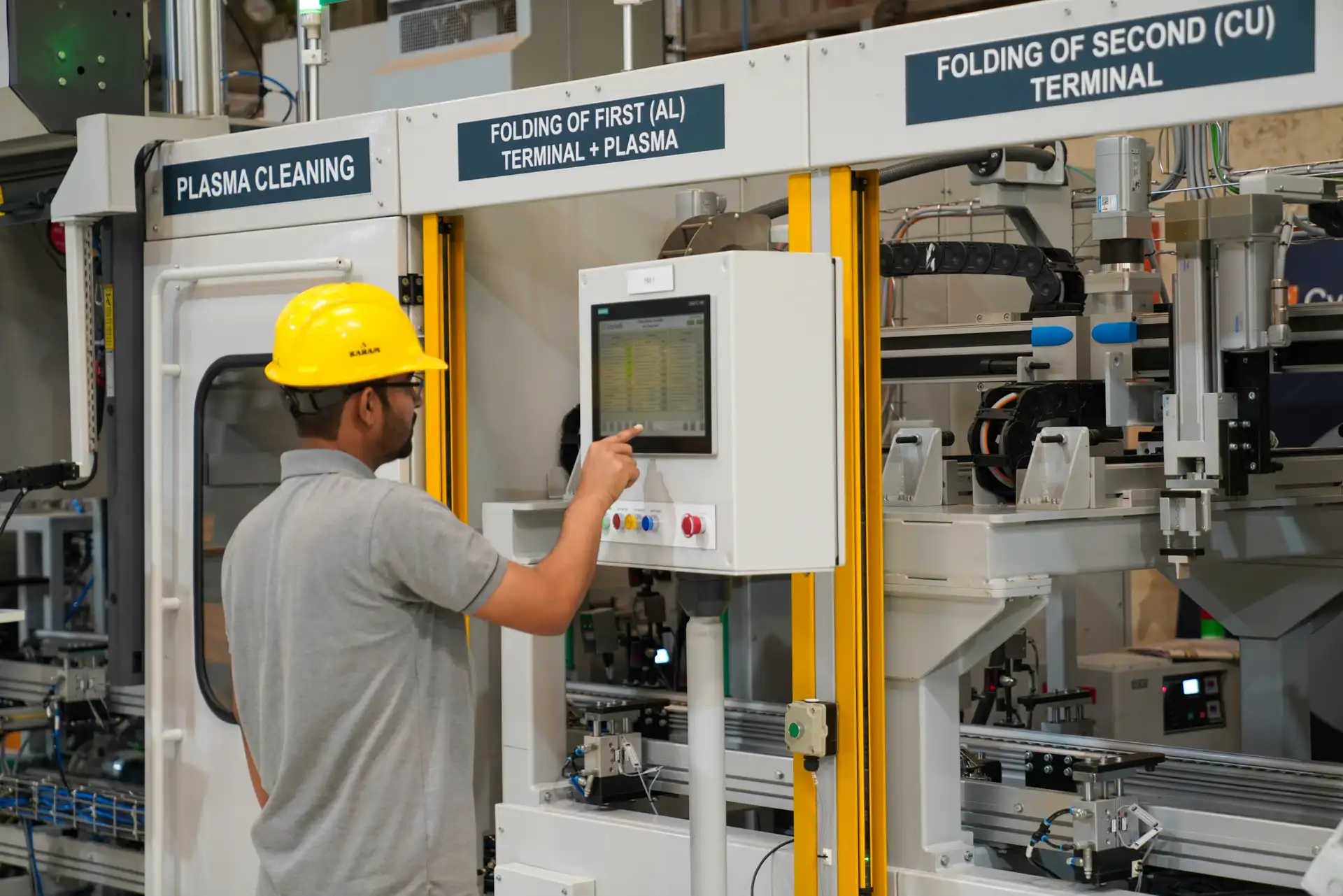
Cybernetik builds battery pack assembly automation rather than cell manufacturing equipment, which places it precisely in the half of the Indian battery industry that is scaling now.
| Cybernetik battery pack assembly capability | Specification |
|---|---|
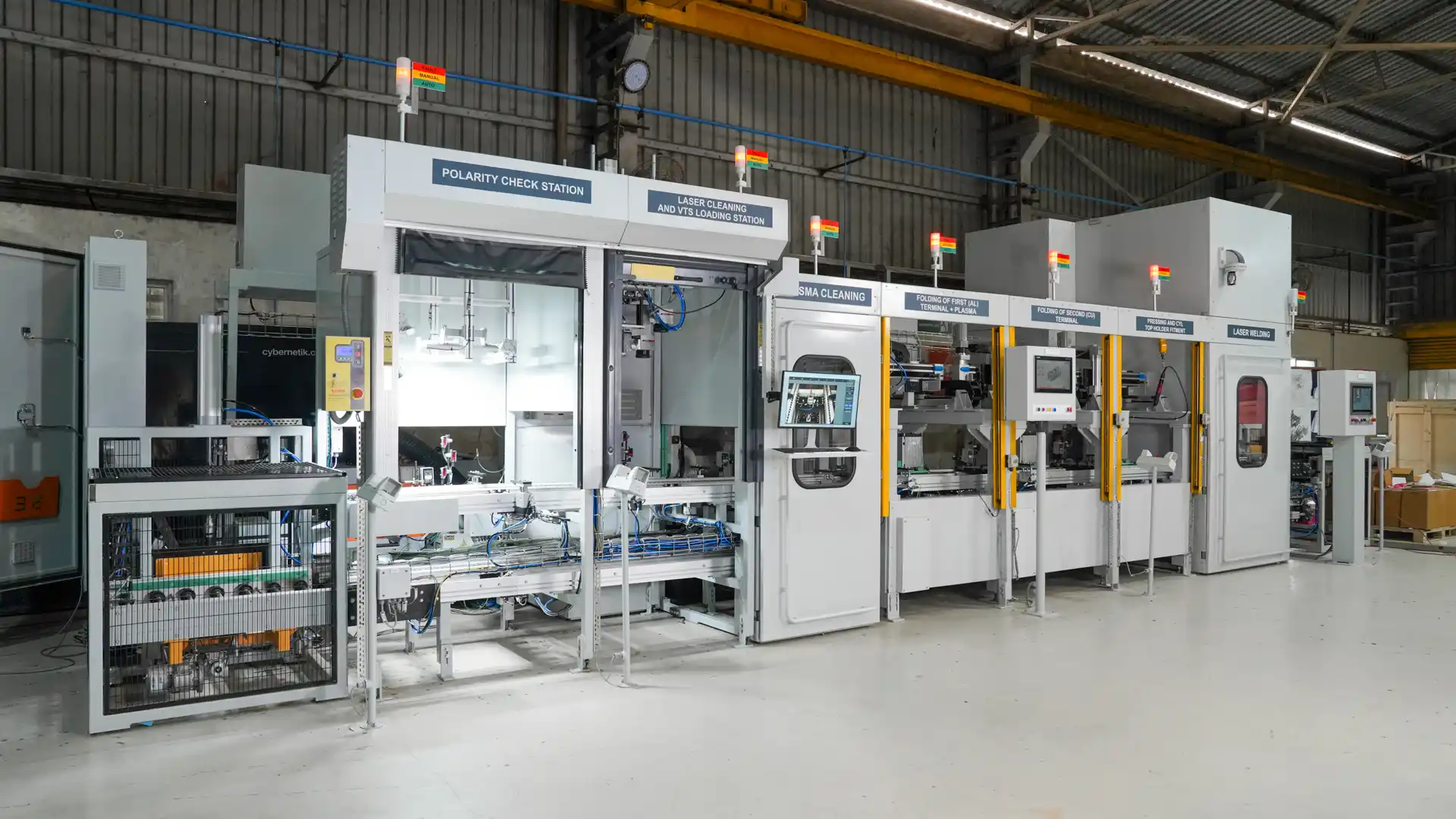
| Line structure | Three zones covering cell to module, pack assembly and end of line testing |
| Line rate | Up to 6,000 cells per hour |
| Cell formats | Cylindrical 18650, 21700 and 32140, plus prismatic, pouch and blade |
| Cell diameters | 32, 33, 35, 40, 42 and 46 mm |
| Incoming verification | OCV, IR and ACIR testing on every cell with robotic sorting |
| Surface preparation | Plasma cleaning with vision-confirmed insulation and polarity checking |
| Joining | Laser and resistance welding with inline weld integrity testing on every joint |
| End of line | BMS and TCU programming, air leakage testing, electrical testing and laser marking |
| Traceability | Barcode and RFID capture with MES connectivity and process logging |
| Module flexibility | Assembly lines adaptable to multiple module configurations |
That work has been delivered for manufacturers including Hero MotoCorp, TVS Motor, Livguard and Matter, which reflects where Indian volume actually sits. Cybernetik has operated for more than three decades, is headquartered in Pune with additional facilities in Gujarat and Raigad and international offices in the United States and UAE, and has installed over 6,000 systems across 30 plus countries, including more than 400 custom robotic automation solutions. Further background is on the Cybernetik about page.