
Key takeaways
A containerized battery energy storage system is a power plant that ships on a truck. Everything needed to store and return several megawatt hours of electricity, cells, racks, controls, cooling, fire protection and electrical distribution, is built and commissioned inside a standard enclosure in a factory, then delivered to site as one unit and connected.
That packaging decision is what makes the manufacturing interesting. A containerized system is not a battery pack that happens to be large. It is a building services project executed on a production line, where battery assembly, thermal engineering, fire safety and electrical integration all have to converge inside a steel box before it leaves the door.
This article covers what sits inside a containerized system, how it is assembled from cell up to container, what the fit out stages actually demand, and how the finished unit is tested and certified. For the underlying cell and module work that feeds it, see the guide to lithium battery pack assembly.
The Assembly Hierarchy: Cell to Container
Containerized systems are built in four nested levels. Keeping them straight matters, because each level has its own test gate and its own failure modes.
Cell level
Individual cells arrive from the manufacturer, most commonly large format prismatic or pouch cells for stationary duty. Lithium iron phosphate chemistry dominates this application because cycle life, thermal stability and cost matter more than the energy density that vehicles need. Every cell is tested and graded before it is allowed into a module.
Module level
Cells are grouped, joined electrically, fixed mechanically and instrumented with voltage and temperature sensing. The module is the smallest unit that can be tested as a working sub-assembly, and it is the unit that gets replaced in the field if something fails. Module design therefore has to balance electrical performance against whether a technician can physically extract one from a rack years later.
Rack level
Modules are stacked into racks and connected in series to form a DC block at system voltage, with a rack level control unit, disconnect and protection. This is where series matching becomes critical. A rack performs at the level of its weakest module, and a container performs at the level of its weakest rack, so grading discipline applied at cell level propagates all the way up.
Container level
Racks are installed into the enclosure alongside thermal management, fire safety, electrical distribution and system controls. Current twenty foot units commonly reach around five megawatt hours, with larger enclosures and higher densities in production. The container is then commissioned as a complete system before shipping.
The Manufacturing Sequence

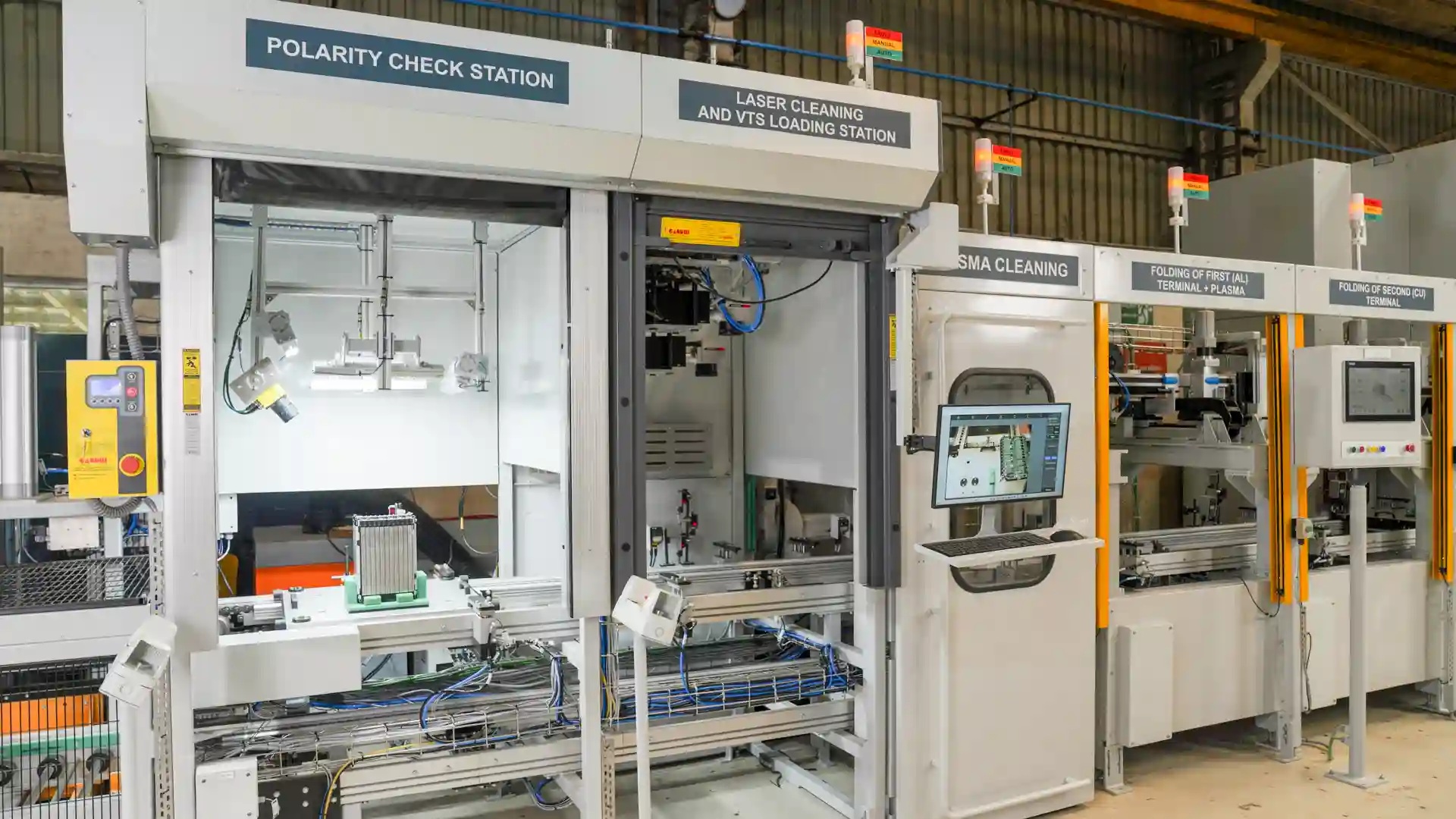
On an automated line, module production for stationary storage runs through a defined sequence before anything reaches the container floor.
Container Fit-Out
Once racks are built, the container becomes an integration exercise. Six subsystems have to coexist inside a fixed volume, each with its own trade discipline and its own verification requirement.
| Subsystem | What it does | What it demands of manufacturing |
|---|---|---|
| Battery racks | Series strings of modules forming the DC blocks that store energy | Consistent module electrical characteristics, or the weakest string caps the whole container |
| Battery management | Layered monitoring at module, rack and system level, balancing cells and enforcing safety limits | Correct sense wire routing and pairing of every board to its physical position and pack identifier |
| Thermal management | Liquid cooling loops or forced air holding cells inside their temperature window | Leak tight coolant circuits and even thermal interface application, since temperature spread drives uneven ageing |
| Fire detection and suppression | Gas and smoke detection, suppression agent, and deflagration venting sized to the enclosure | Correct placement and commissioning verification, tested as an integrated system rather than as parts |
| Power conversion and electrical | Inverters, switchgear, protection, auxiliary supplies and cabling | Torque controlled terminations and insulation resistance verification across every connection |
| Enclosure | Weather rated, seismically rated housing with defined ingress protection | Sealing integrity and structural verification that survives ocean transport and site handling |
Thermal management deserves particular attention because the industry has largely moved from forced air to liquid cooling for containerized systems. The reason is uniformity rather than raw cooling capacity. Air cooled enclosures develop temperature gradients between racks, and cells that consistently run a few degrees warmer age faster than their neighbours. Since the system degrades at the rate of its worst performing string, holding a tight temperature spread across the whole container is worth more than lowering the average.
Testing and Certification
Containerized systems carry a heavier certification burden than most manufactured products because they combine stored energy, high voltage and an occupied site.
 “Containerized battery performance depends on more than storage capacity – it requires uniform temperature control, integrated fire protection, and verified electrical safety across the entire system”

See it in action
Why Stationary Differs from Automotive
The stages look similar to vehicle pack production, and the underlying battery pack assembly automation shares much of its equipment. The priorities do not.
Vehicle packs optimise for energy density, compact packaging and high takt rates, inside a geometry fixed by the vehicle. Containerized systems optimise for cycle life measured in thousands of cycles, serviceability over a twenty year asset life, and scalability. Volumes are lower and unit sizes far larger, so lines are built for modular scalability from pilot output to multi megawatt hour capacity rather than for fixed high volume takt. And because the finished unit is a site asset that inspectors and insurers examine, traceability and certification documentation carry weight they simply do not carry in automotive.
Cybernetik’s BESS Assembly Automation
Cybernetik builds turnkey BESS battery pack assembly lines for stationary storage manufacturers, covering the full sequence from cell sorting through module preparation, casing, stacking and container integration.
The company has operated for more than three decades, is headquartered in Pune with offices in the United States and the UAE, and has installed over 6,000 systems across 30 plus countries, including more than 400 custom robotic automation solutions. That experience spans both electric mobility and stationary storage, which matters because the two share equipment and diverge on priorities. More background sits on the Cybernetik about page.
What the systems cover
Typical applications include renewable energy storage paired with solar and wind, commercial and industrial backup power for data centres, factories and hospitals, telecom and remote off grid power, and utility scale grid balancing and peak shaving.