
Key takeaways
The phrase “end-of-line automation” is commonly used to describe palletizing. It is the stage most manufacturers automate first, because robotic palletizing has an obvious ROI , it eliminates heavy manual lifting at the most visible point in the factory.
But palletizing is the final stage, not the complete picture. Between the high-speed filler and the palletizer sits a secondary packaging stage where bottles are grouped, cased, and sealed , and in most facilities, this stage remains partially or fully manual. The result is a factory with automated primary packaging and automated palletizing separated by a manual island that caps line speed at what operators can load by hand.
A bottle case packing machine is the component that completes end-of-line automation. It receives bottles from the capping and labelling line, forms them into a matrix, loads them into erected corrugated cases, confirms case integrity, and hands sealed cases to the palletizer , at the speed the filling line demands, with the quality control the retail and pharmaceutical markets require.
The End-of-Line Automation Gap
End-of-line automation is most effective when every stage from primary packaging to pallet dispatch operates under connected control. In practice, most facilities automate the ends of this sequence first (filling, then palletizing) and leave the middle stage, secondary case packing, for later investment.
The consequences of this gap are consistent across industries:
Throughput cap. Operators manually loading bottles into cases cannot match the filling line’s output speed. The filler throttles down to what the secondary packing station can absorb, typically 20 – 40% below rated capacity.
Quality inconsistency. Manually loaded cases vary in bottle count, orientation, and matrix density. Cases with missing bottles, misoriented bottles, or loose packing fail at the retailer’s distribution centre, generating chargebacks and returns that trace back to the secondary packing stage.
Changeover cost. When the line switches from 500 ml bottles to 1-litre bottles, the manual secondary packing stage requires physical guide rail adjustment, replacement of any fixture tooling, and re-verification of case closure. This takes 30 – 45 minutes , and on high-SKU lines, this time loss is the largest single drain on weekly productive capacity.
A bottle case packing machine eliminates all three problems simultaneously.
How a Bottle Case Packing Machine Completes End-of-Line Automation
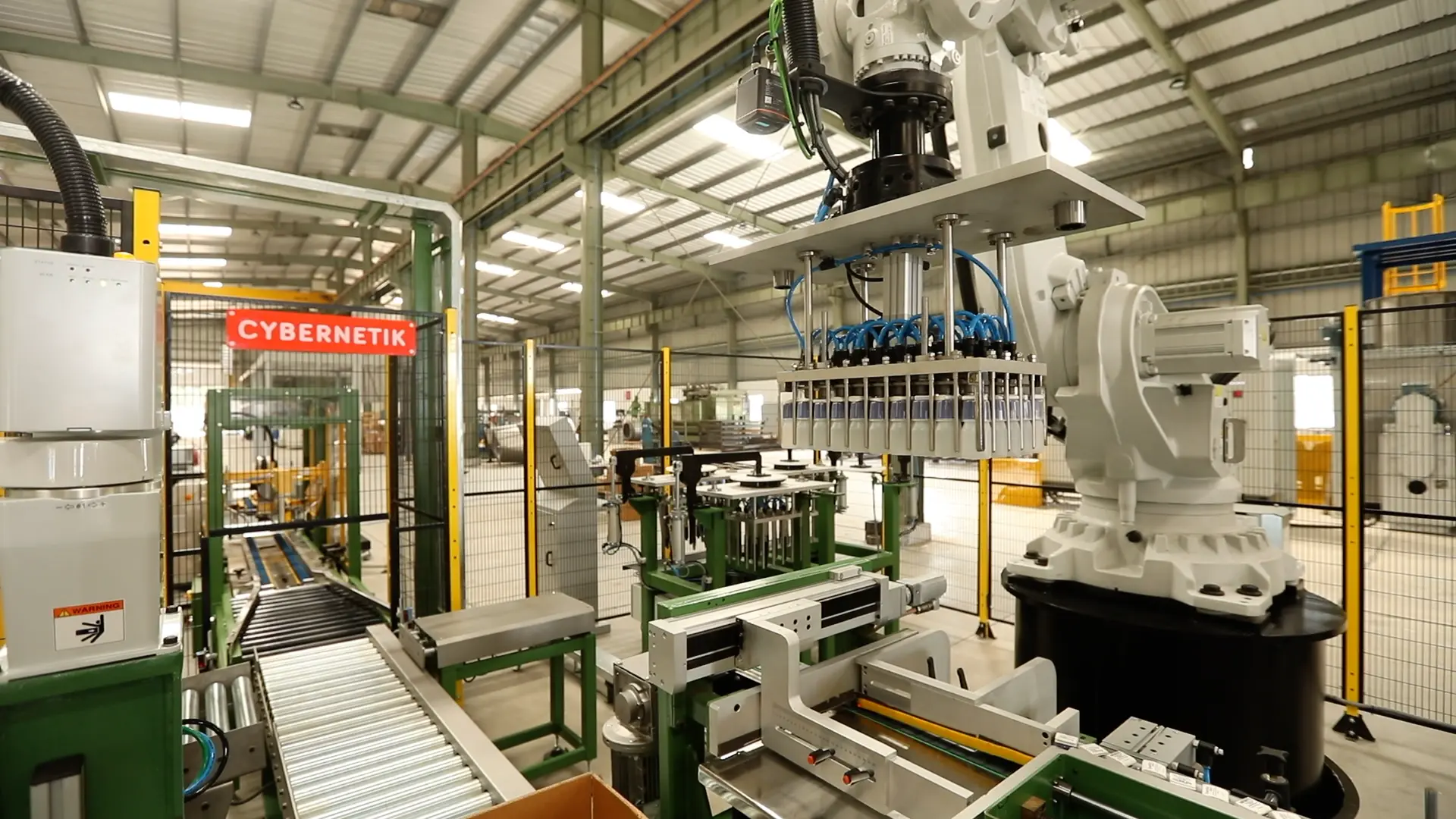
Cybernetik’s Case Packer for Bottles is the end-of-line secondary packaging stage in a connected automation sequence. Its integration with upstream and downstream systems is what makes it a true end-of-line component rather than a standalone machine.
How It Connects Upstream
Bottles arrive at the case packing machine from the capping and labelling line takeaway conveyor. The case packer’s infeed is synchronised to the labelling line speed , no buffer accumulator required between the two stages when both operate under connected PLC control.
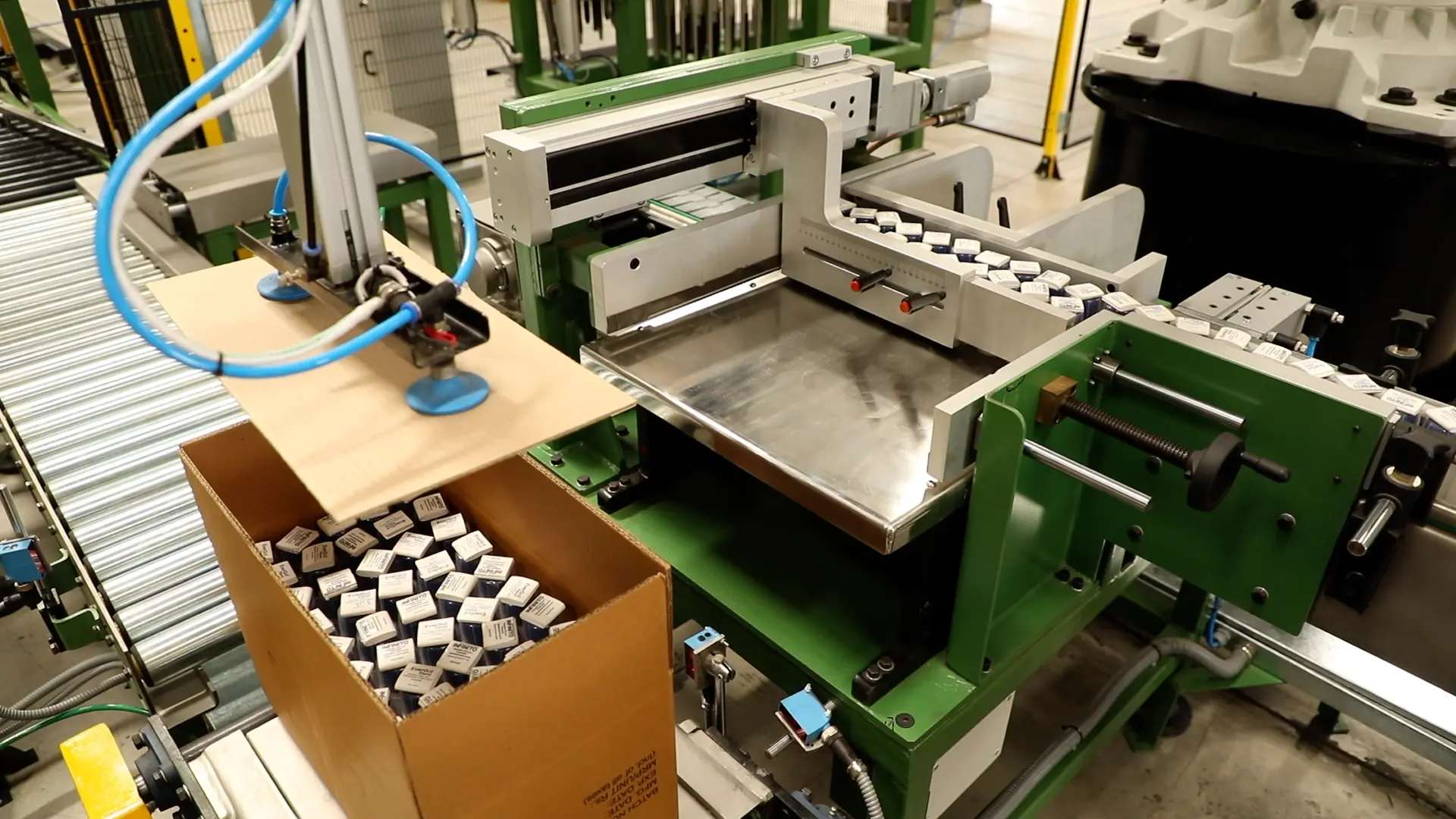
The carton erector at the start of the case packing machine sequence forms cases at the same rate the loading station requires. It draws flat blanks from the magazine, squares, folds, and base-seals them before conveying each formed case to the loading station , synchronised to the robot’s loading cycle.
How It Operates
The matrix formation station accumulates bottles into the required row-and-column pattern for the active recipe. The Six Axis robot , fitted with servo or pneumatic grippers designed for the active bottle geometry , lifts the complete matrix and places it into the open case in a single pick cycle.
Vision inspection confirms bottle and carton condition. Missing bottle detection , optionally using 3D cloud point technology , confirms every cell in the matrix is occupied. Defective or short-count cases are rejected before the sealing station.
The sealed, labelled case exits the case packing machine at the same rate the palletizer expects to receive it , no accumulation gap, no speed mismatch.
How It Connects Downstream
Sealed cases convey directly to Cybernetik’s Box Palletizer or Robotic Palletizers. Because both the case packing machine and the palletizer operate under a shared PLC/SCADA architecture, the palletizer’s stacking pattern is already updated when the recipe changes at the case packer , one HMI command governs both stages.
Technical Specifications, Cybernetik Bottle Case Packing Machine Range
Case Packer for Bottles
| Parameter | Value |
|---|---|
| Throughput | Up to 120 bottles/min or 5 cases/min |
| Payload | 200 kg |
| Bottle Types | Up to 5 |
| QC | Vision inspection + missing bottle detection |
| Traceability | Track and trace standard |
| Footprint | 17 × 7 × 3 m (customizable) |
| Tool Changer | Automatic |
Case Packer for Shrink Packs
| Parameter | Value |
|---|---|
| Speed | Up to 400 cans/min |
| Payload | 200 kg |
| Footprint | 8 × 5 m |
| End-to-End Options | Carton erector, top/bottom taping, labelling |
Case Packer for Shrink Packs & Bottles (Dual-Mode)
| Parameter | Value |
|---|---|
| Speed (Shrink) | Up to 400 cans/min |
| Speed (Bottles) | Up to 120 bottles/min |
| QC Technology | 3D cloud point (missing bottle detection) |
| Payload | 200 kg |
End-of-Line Quality Control: Why It Matters at the Case Packing Stage
Quality control in end-of-line packaging is often associated with palletizer-stage weight checks or post-line inspection. The most cost-effective quality intervention point is earlier , at the case packing machine, before the case is sealed.
1. Missing bottle detection
Missing bottle detection before sealing means a short-count case is diverted at the loading station, not discovered at the retailer’s distribution centre. The cost difference between these two outcomes is an order of magnitude , a rejected case at the factory gate vs. a chargeback, compliance filing, and relationship risk at the retail account.
2. Vision inspection for defective bottles and cartons
Vision inspection for defective bottles and cartons means production-related defects , damaged caps, label misalignment, carton misformation , are caught before they contribute to a sealed case and proceed to shipment.
3. 3D cloud point technology
3D cloud point technology, available on Cybernetik’s dual-mode case packing system, provides the most accurate missing bottle detection for high-density matrices where standard 2D camera systems produce false negatives due to cap reflectivity or label colour interference.
Track and trace provides the case-level audit trail that food safety audits, pharmaceutical compliance, and retail vendor programmes now require as a standard condition of supply , not an optional data management feature.
Downstream: Completing the End-of-Line Automation Sequence
Box Palletizer, Up to 1,800 Boxes/Hour
Cybernetik’s Box Palletizer receives sealed cases from the bottle case packing machine and stacks them onto pallets in a recipe-defined matrix. Configurations range from cobot and gantry systems (up to 600 boxes/hour) to high-level robotic systems (up to 1,800 boxes/hour). A single robot handles multiple box variants from separate lines onto distinct pallets , maximising flexibility without additional capital investment.
Box Palletizer, Up to 1,800 Boxes/Hour
The Robotic Carton Palletizer is the natural downstream complement for bottle case packing machine output. Simultaneous two-case palletizing at 15 cartons/min, customisable matrix formation, and an automated pallet dispenser provide continuous, operator-free palletizing at the end of the case packing sequence.
Cobot Palletizer & Case Printer
For lower-throughput bottle lines where labelling and palletizing must be combined in minimal floor space, Cybernetik’s Cobot Palletizer & Case Printer picks, labels, and palletizes cases in a single cobot cycle , with a drop recovery system that maintains a complete matrix on every pallet.
 “True end-of-line automation begins when bottle case packing operates at the same speed, precision, and intelligence as the rest of the production line.”

.