
Key takeaways
A high-speed filling line is one of the most capital-intensive assets on a manufacturing floor. It runs at 120, 300, or 600 bottles per minute. The downstream secondary packaging stage , the point where those bottles must be grouped, cased, and sealed , is expected to match that speed without interruption. When it cannot, the consequence is immediate and visible: a growing accumulation of bottles between the filler and the case packer, a line that throttles back to what operators can manually sustain, and an expensive machine running at a fraction of its capacity.
A purpose-built bottle case packer resolves this at the mechanical level. Robotic pick and place, automatic matrix formation, integrated carton erection, and vision quality control combine to produce a system that runs at the filling line’s rated speed , not at operator speed , across every shift, with every bottle format the line runs.
What Is a Bottle Case Packer?
A bottle case packer is an automated secondary packaging machine that receives bottles from a labelling or capping takeaway conveyor, groups them into a defined row-and-column matrix, and loads that matrix into an erected corrugated case , ready for top sealing, labelling, and palletizing.
The term automatic bottle packing machine describes the same equipment. In high-speed packaging contexts, the distinction between a standard case packer and a high-speed bottle case packer lies in four specific capabilities:
Cybernetik’s Case Packer for Bottles delivers all four in a single integrated system.
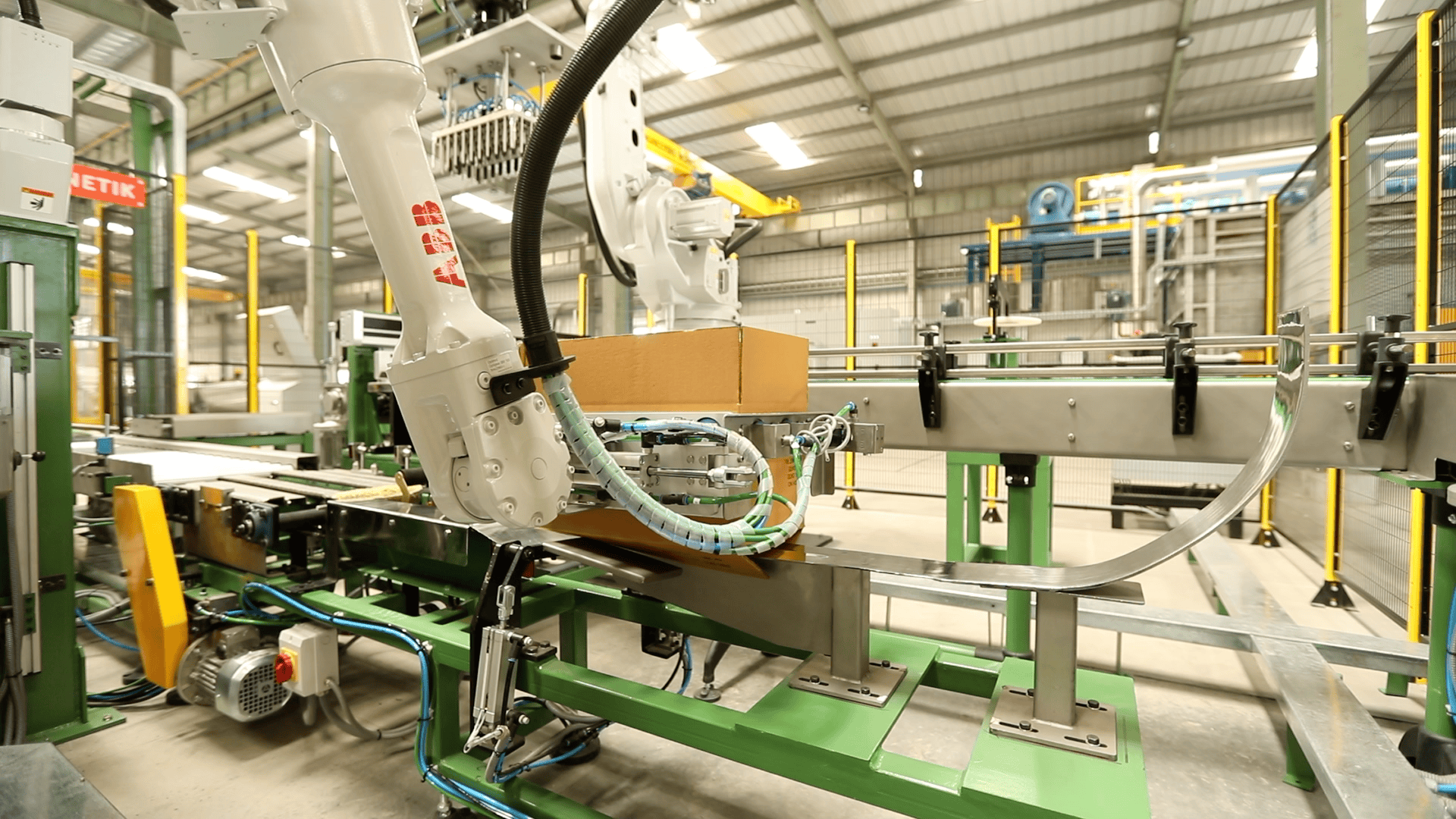
Integrated Secondary & Tertiary Bottle Packing System
How a Robotic Bottle Case Packer Works
Step 1 , Carton Erection Operation begins at the carton erector. Flat corrugated blanks are drawn from the magazine, squared, and base-sealed before being conveyed to the loading station. The erector is synchronised to the case packer’s loading rate , it never starves the loading station, and it never overproduces ahead of it.
Step 2 , Matrix Formation Bottles arriving from the takeaway conveyor enter the matrix formation station. The station accumulates bottles into the required row-and-column pattern , a 4×6, 3×8, or any other as-required matrix , before signalling the robot to pick.
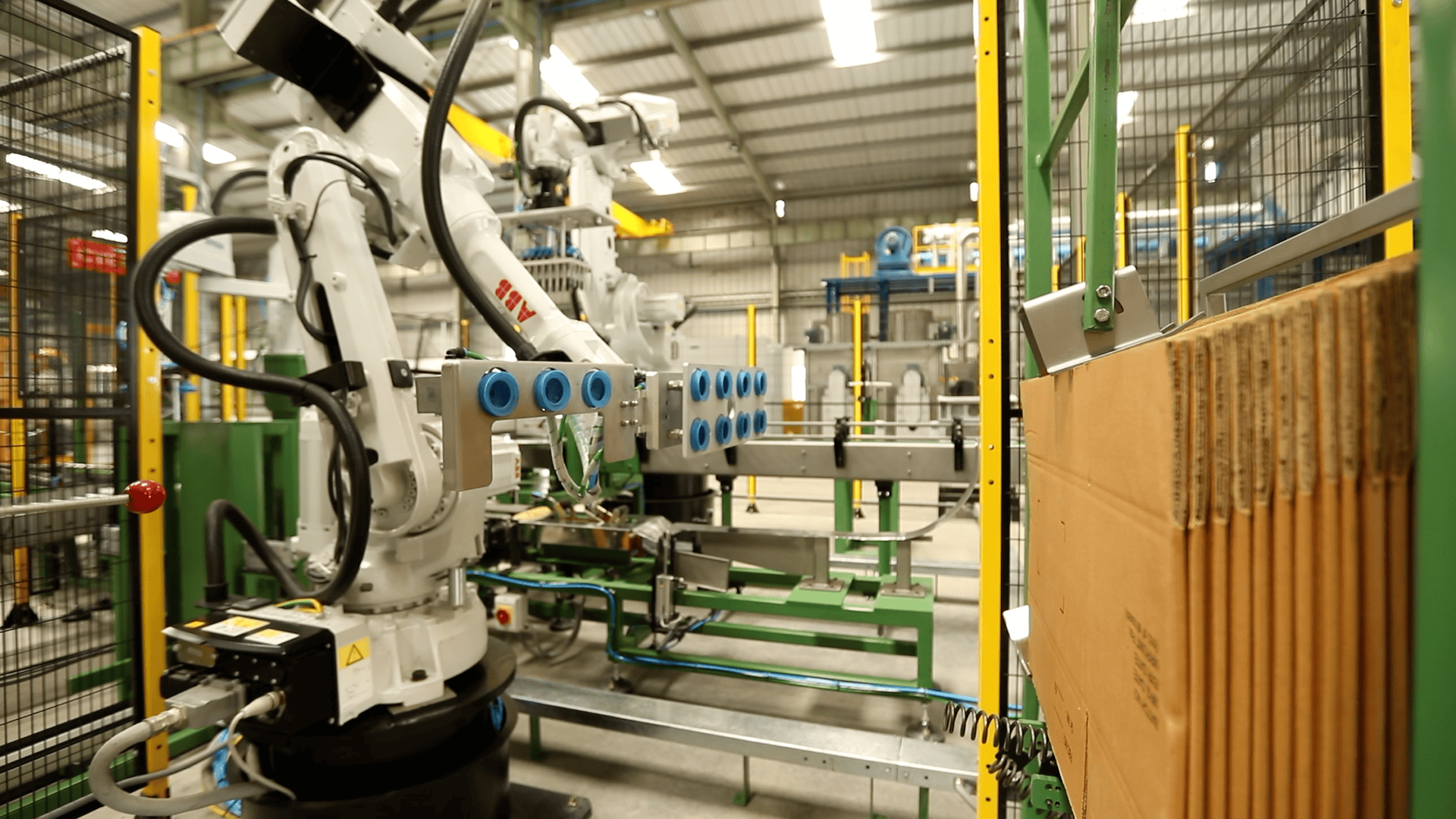
Step 3 , Robotic Pick and Place The Six Axis robot, fitted with servo or pneumatic grippers custom-designed for the active bottle geometry, lifts the complete matrix in a single pick cycle and places it into the open case below. Guide funnels descend during the final placement phase to ensure precise last-mile positioning regardless of minor conveyor positional variation.
Step 4 , Vision Inspection A vision system checks for defective bottles (damaged caps, labels, or bodies) and incorrectly formed cartons after loading. Defective units and misformed cases are rejected before sealing , not detected at the distribution centre after shipment.
Step 5 , Missing Bottle Detection A dedicated detection system confirms every cell in the matrix is occupied. Cases with missing bottles are diverted before the sealing station , ensuring every sealed case contains the correct count.
Step 6 , Track and Trace A track and trace system records case contents, batch data, and production parameters for every sealed case , providing the audit trail required by food retailers, pharmaceutical accounts, and export market compliance requirements.
Cybernetik’s Bottle Case Packer Configurations
Six Axis Case Packer for Bottles
The Six Axis configuration is Cybernetik’s primary automatic bottle packing machine for high-speed, multi-SKU lines.
Technical Specifications:
| Parameter | Value |
|---|---|
| Throughput | Up to 120 bottles/min or 5 cases/min |
| Payload | 200 kg |
| Bottle Types Handled | 5 |
| Footprint | 17 × 7 × 3 m (customizable) |
| Tool Changer | Automatic, no manual intervention |
| QC | Missing bottle detection + vision inspection |
| Traceability | Track and trace system standard |
Key differentiators:
 “The efficiency of a bottling line is determined not only by how fast bottles are filled, but by how efficiently they are packed, inspected, and prepared for shipment.“

Industries Where High-Speed Bottle Case Packers Deliver Highest ROI
Beverages The beverage sector’s combination of high throughput, multiple bottle formats, and increasingly strict retail traceability requirements makes robotic bottle case packers the standard equipment choice for any new or upgraded bottling line.
Food Sauces and Condiments Glass and PET bottles in multiple sizes on the same line demand multi-format flexibility. The automatic tool changer and five-variant handling capability directly addresses the format diversity on most sauce and condiment lines.
Personal Care and Home Care HDPE bottles for shampoo, conditioner, liquid soap, and cleaning products require high-payload robotic handling that manual operators cannot sustain safely at production speed. The 200 kg payload Six Axis configuration handles the heaviest personal care bottle formats without ergonomic risk.
Pharmaceutical and Nutraceuticals cGMP-compatible construction, missing bottle detection, and track and trace are mandatory requirements. The bottle case packer’s integrated inspection system and case-level data capture meet these requirements as standard system features.
Chemical Products Cans and bottles for chemical and agrochemical products require robust high-payload handling. The Six Axis 200 kg payload configuration handles the heaviest chemical bottle formats and provides the audit trail required for hazardous goods shipping documentation.
.
See it in action
Connecting the Bottle Case Packer to the Full End-of-Line
A bottle case packer is most effective as part of a complete, integrated end-of-line system. Cybernetik designs the full sequence under one engineering engagement:
Upstream: Bottles arrive from labelling and capping lines. The case packer’s infeed conveyor receives them at rated speed with no additional buffer station required.
At the case packer: Carton erection, matrix formation, robotic loading, vision inspection, and missing bottle detection complete the loading and quality stages under shared PLC/SCADA control.
Downstream: Sealed cases are conveyed to Cybernetik’s Robotic Palletizers , up to 15 cartons/min at 150 kg payload , or to the Box Palletizer for lines requiring up to 1,200–1,800 boxes/hour. The Robotic Carton Palletizer handles simultaneous two-case palletizing at 15 cartons/min with customisable pallet matrix formation.
Because the case packer and palletizer share a PLC/SCADA architecture, a recipe change at the case packer automatically updates the palletizer’s pallet pattern, one HMI command updates the entire end-of-line.
Specification Checklist for a High-Speed Bottle Case Packer
| Specification | What to Confirm |
|---|---|
| Throughput (bottles/min) | Matches peak filler output with 15–20% headroom |
| Bottle format range | All active variants covered by single tool set or auto tool changer |
| Payload (kg) | Covers heaviest bottle matrix including case weight |
| Carton format range | All active case sizes covered by recipe-driven erector |
| Missing bottle detection | Standard, before sealing , not optional |
| Track and trace | Integrated, case-level , not a third-party add-on |
| Changeover time | Under 10 min via HMI for all active format pairs |
| PLC architecture | Shared with downstream palletizer |