
Key takeaways
Most manufacturers focus their automation investment on the part of the packaging line that moves fastest, the filler, the wrapper, the case packer. The stage that forms the cases those machines depend on is treated as an afterthought. An operator opens flat blanks, squares them by hand, and tapes the base. At four to eight cases per minute, the manual case forming stage silently limits the entire secondary packaging line.
An automatic case erector solves this at the source. By mechanically unfolding, squaring, and base-sealing corrugated blanks at the speed of the downstream case packer, it removes the last manual bottleneck before the loading station and delivers the consistent, correctly formed cases that robotic case packers need to run at rated capacity.
This guide explains how automatic case erectors work, where they fit on the packaging line, what specifications matter when selecting a case erector machine, and how Cybernetik integrates carton forming into complete secondary packaging systems.
What Is an Automatic Case Erector
An automatic case erector, also called a carton forming machine or automatic carton erector, is a machine that takes flat-packed corrugated blanks from a magazine, unfolds them into an open-top case, squares the corners, and seals the base with adhesive or tape. The formed case is then conveyed downstream to the loading station of a robotic case packer.
Without automation at this stage, every case on the line passes through human hands before it receives product. At low volumes, this is manageable. At 40 to 120 bottles or pouches per minute, the rated speeds of modern robotic case packers, manual case forming becomes the binding constraint on line throughput, not the case packer itself.
The automatic case erector removes this constraint by synchronising case supply to packing demand. As long as the blank magazine is stocked, the loading station never waits for a formed case.
Where the Case Erector Machine Fits on the Packaging Line
Understanding placement is key to specifying the right system. On a complete secondary packaging line, the sequence runs as follows:
Primary packaging → Takeaway conveyor → Case packer infeed → Case loading station → Case taping/sealing → Palletizer
The automatic case erector sits upstream of the case loading station. It feeds the loading station a continuous supply of formed, bottom-sealed cases at the exact pitch and rate the case packer robot requires. Downstream of loading, a top-taping or top-sealing station closes the filled case before it passes to the labeller and palletizer.
Cybernetik integrates robotic case erectors as standard upstream components of its bottle, pouch, and shrink pack case packing systems, so the forming, loading, sealing, and palletizing stages operate under a single PLC architecture with a single recipe selection at the HMI.
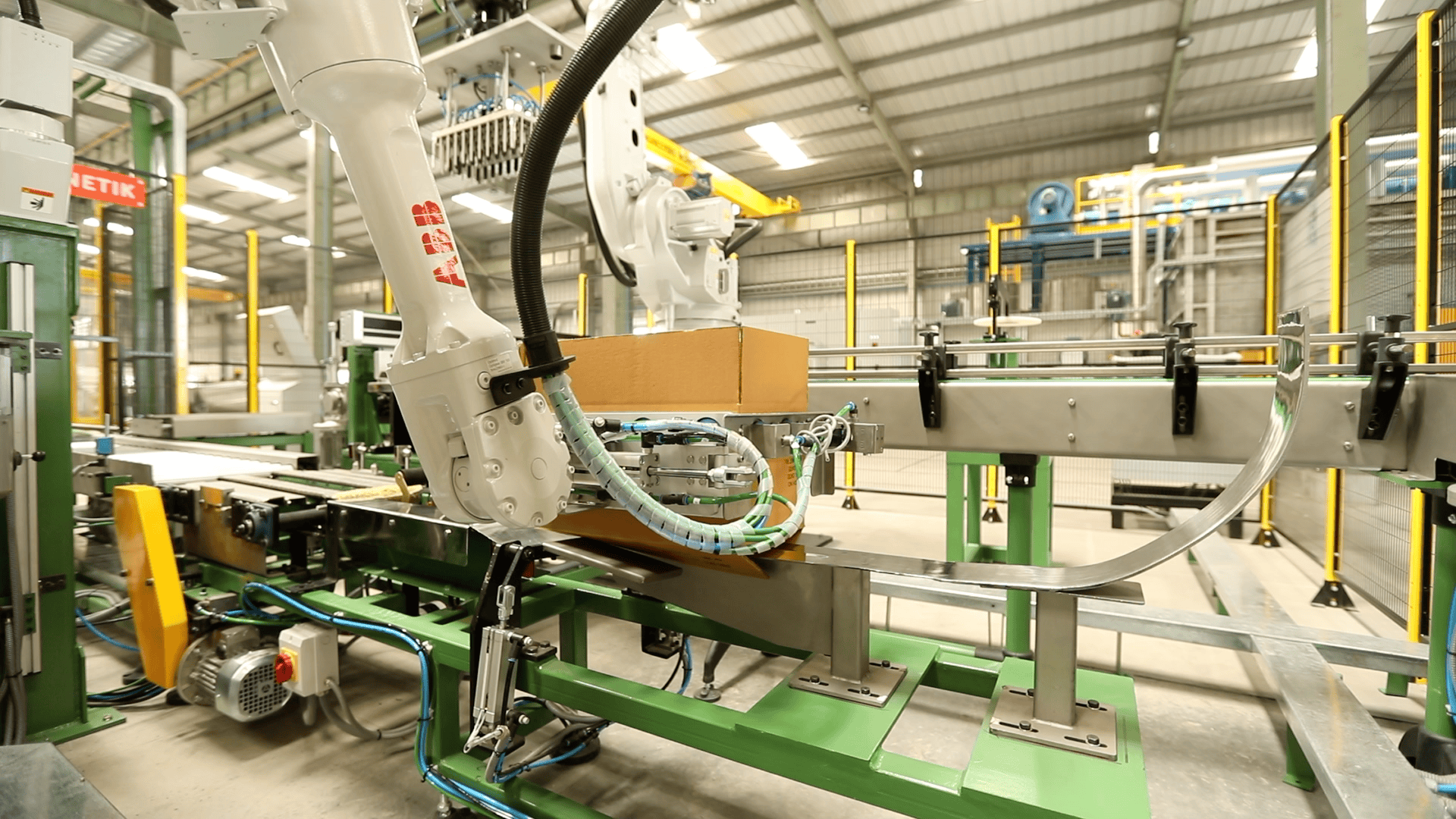
Integrated Secondary & Tertiary Bottle Packing System
How an Automatic Case Erector Works: Step by Step
Step 1 -Blank Infeed Flat corrugated blanks are stacked in a magazine hopper. The erector draws one blank at a time using vacuum cups or mechanical grippers, ensuring consistent, jam-free infeed even at high cycle rates.
Step 2 – Squaring and Opening The blank is folded along its pre-scored lines, squared at the corners, and held in the open-case position. Corner-squaring accuracy at this stage directly determines base-seal quality , a poorly squared case produces a weak bottom that can fail under product load.
Step 3 – Base Sealing The case base flaps are folded and sealed with either hot-melt adhesive or pressure-sensitive tape, depending on the carton specification. Adhesive sealing is faster and more consistent; tape sealing is preferred for applications where the case must be opened cleanly at the distribution centre or retail stage.
Step 4 – Case Discharge The formed, sealed case is conveyed to the loading station, positioned below the carton guide funnels of the case packer, and held by reference stops ready for the robot to place the product matrix.
Automatic Case Erector as Part of Cybernetik’s Integrated Case Packing Systems
Cybernetik does not sell standalone case erectors in isolation. Instead, carton erectors are engineered as integrated upstream modules within complete, turnkey case packing systems. This approach ensures that the forming speed, case dimensions, blank format, and control architecture are matched precisely to the downstream case packer, not specified independently and integrated later.
Case Packer for Bottles, Integrated Carton Erector
The Case Packer for Bottles begins its operational sequence at the carton erector. The erector unfolds and forms flexible corrugated cartons before conveying them to the matrix loading station, where the pick-and-place robot with servo/pneumatic grippers lifts the complete bottle matrix into the open case.
The integrated erector handles multiple carton formats corresponding to the five bottle types the system supports. Format changes between carton sizes are managed via recipe selection at the HMI, no mechanical reconfiguration of the erector required.
System specifications (including carton erector):
Throughput: Up to 120 bottles/min or 5 cases/min
- Payload: 200 kg
- Bottle types handled: 5
- Footprint: 17 × 7 × 3 m (customizable)
Case Packer for Shrink Packs, Optional Upstream Case Erector
Cybernetik’s Case Packer for Shrink Packs includes an optional automatic case erector upstream of the loading station. When integrated, the erector forms and positions cases below the carton guide funnels before the robot picks and places two shrink packs simultaneously into each case.
The integrated taping system seals the case top and bottom in transit immediately after loading, followed by labelling with batch and product data, completing a fully automated carton forming, loading, sealing, and labelling sequence in a single line.
System specifications (with optional case erector)
Speed: Up to 400 cans/min (shrink pack); up to 120 bottles/min
- Payload: 200 k
- Footprint: 8 × 5 m
- Electric: 415V / 3ph / 50 Hz
- Pneumatic: 100 CFM @ 6 bar
Case Packer for Shrink Packs & Bottles, Versatile Multi-Format Erection
For lines running both shrink packs and bottles on the same system, Cybernetik’s Case Packer for Shrink Packs & Bottles provides an automatic tool changer that switches the robot between shrink pack and bottle handling, with the carton erector and guide funnels adjusted to match the active format.
Missing bottle detection uses 3D cloud point technology, a more accurate inspection method than standard 2D vision for complex, high-density bottle matrices, ensuring every case is confirmed complete before sealing.
System specifications:
- Speed: Up to 400 cans/min (shrink packs); up to 120 bottles/min
- Payload: 200 kg
- Footprint: 8 × 5 m
 “The performance of a robotic case packer depends on one critical input: a continuous supply of accurately formed cases”

Cybernetik packaging engineering team
.
See it in action
Robotic Case Erector in Complete Turnkey Lines
On full turnkey packaging lines, particularly in chocolate, confectionery, and snack manufacturing, the robotic case erector is one stage in a multi-machine system that Cybernetik engineers and commissions as a single integrated solution.
A typical turnkey configuration for confectionery includes:
primary pick-and-place and flow wrapping → pouch filling → carton filling → carton erector → carton sealer → robotic palletizer.
Each stage communicates with the next via the main PLC and SCADA layer, with recipe selection managing format changes across the entire line from a single HMI.
This is the architecture described in Cybernetik’s chocolate manufacturing case study, a complete SS304 FDA-approved construction with food-grade bearings, motors, and cleanable belts, where the robotic case erector and sealer sit between carton filling and palletizing in an uninterrupted automated sequence.
Industries That Benefit Most From Automatic Case Erectors
Food and Confectionery – High-volume lines with multiple carton formats and strict hygiene requirements make manual case forming impractical. Automatic case erectors on confectionery lines run continuously across full shifts without contamination risk or base-seal variation.
Beverages – Bottle lines running multiple SKUs need carton erectors that handle format changes as quickly as the case packer switches between bottle variants. Recipe-driven erectors and automatic tool changers on the case packer work in concert to make multi-SKU bottle lines genuinely flexible.
Personal Care and Household Products – Soap bars, detergent bottles, and aerosol cans packaged in corrugated cases require consistent, strong base seals to withstand warehouse stacking and transit vibration. Automatic adhesive sealing provides the seal consistency that manual tape application cannot sustain at production speed.
Pharmaceutical and Nutraceuticals – cGMP compliance requirements for contamination-free open-case handling, combined with track and trace obligations, make automated case erection mandatory on most modern pharma secondary packaging lines.
Chemical and Agrochemical – Heavy cases containing cans, pails, or multi-pack bottles place severe demands on base seal integrity. Robotic case erectors with controlled adhesive application ensure base seals that hold under the full dynamic load of stacked pallets, something manual tape application cannot guarantee consistently.
Chemical and Agrochemical – Heavy cases containing cans, pails, or multi-pack bottles place severe demands on base seal integrity. Robotic case erectors with controlled adhesive application ensure base seals that hold under the full dynamic load of stacked pallets, something manual tape application cannot guarantee consistently.