
Key takeaways
Most conveyor problems are not dramatic. A belt that keeps drifting to one side, a splice that opens after a year, product that falls through a gap, a washdown that never quite gets the belt clean. Many of these trace back to one early decision: whether the conveyor should have a flat belt or a modular one.
A flat belt conveyor uses a continuous belt, usually PVC, PU or rubber, driven by friction from a pulley, and suits smooth, quiet conveying of cartons, bags and small or light products on straight runs. A modular belt conveyor uses interlocking plastic modules driven by sprockets, so it tracks itself, handles curves, lets air and water through and can be repaired module by module, which suits washdown, cooling and harsh duty.
This guide explains how each design works, compares them side by side and sets out how to choose between them for your product and plant.
How a Flat Belt Conveyor Works
A flat belt conveyor runs a continuous loop of belt over a drive pulley at one end and a tail pulley at the other. The belt is supported either by a flat slider bed, which gives a stable surface for small items, or by rollers, which reduce friction over long distances. The drive pulley turns the belt by friction, so tension has to be set correctly to avoid slipping.
Because the belt is continuous, its surface is smooth and unbroken. Small packs, thin items and products that need a level surface ride well, and the belt runs quietly. Belts come in many materials and surface finishes, from smooth food-grade PU to grip surfaces for inclines.
The design, applications and benefits of flat belt conveyors are covered in detail in the guide to flat belt conveyors.
How a Modular Belt Conveyor Works
A modular belt is built from rigid plastic modules, commonly polypropylene, polyethylene or acetal, linked by hinge rods into a continuous belt of any length and width. Instead of friction, sprockets on the drive shaft engage the underside of the belt directly. This positive drive means the belt cannot slip and does not drift sideways, so tracking adjustment is rarely needed.
Modules come in many styles: flat top, open grid, raised rib, friction top and versions with flights or side guards. Radius modules let the belt turn corners without a transfer. If a section is damaged, the affected modules can be removed and replaced without changing the whole belt.
Features and typical uses of modular belts are explained further in the article on modular belt conveyors.
Flat Belt vs Modular Belt: Side by Side
| Factor | Flat belt conveyor | Modular belt conveyor |
|---|---|---|
| Belt construction | Continuous belt of PVC, PU or rubber, usually fabric reinforced | Interlocking plastic modules joined by hinge rods |
| How it is driven | Friction between belt and drive pulley | Sprockets engage the belt directly (positive drive) |
| Belt tracking | Needs adjustment to keep the belt centered | Self-tracking, because sprockets guide the belt |
| Surface | Smooth and continuous | Flat, open, ribbed or with flights, depending on module |
| Small or light items | Very good: no gaps for items to catch | Can be harder with very small items, depending on pitch |
| Curves | Needs special curved belt designs | Radius modules allow curves in one belt |
| Drainage and airflow | Closed surface | Open-area modules let water and air pass through |
| Damage and repair | Cuts and splice failures may need a new belt or splice | Damaged modules replaced individually |
| Noise | Generally quiet | Usually noisier, especially at speed |
| Typical cost | Lower for straightforward runs | Higher, but often lower lifetime cost in harsh duty |
The two designs overlap more than this table suggests. Many lines use both: modular belts through washdown and cooling sections, and flat belts for inspection, weighing and packing, where a smooth surface matters most.
In practice, the best way to compare is to start from the product and the plant, not the conveyor. Size, weight, temperature, moisture, cleaning routine and line layout narrow the choice quickly, and the sections below explain how each of these affects the decision.
Design Points That Make the Difference
Tracking and tension
Flat belts rely on correct tension and well-aligned pulleys to stay centered. Uneven loading, worn pulleys or a frame out of square can make them drift, which wears belt edges and can cause spills. Crowned pulleys and tracking guides help. Modular belts avoid this problem because the sprockets hold the belt in place, but they need correct catenary sag on the return side to engage the sprockets properly.
Transfers
Every transfer from one conveyor to another is a chance for products to tip, jam or fall. Flat belts can be run over small-diameter nose bars to give tight transfers for small items. Modular belts have a minimum transfer gap set by the module pitch and sprocket size, which can be an issue for very small products. Some modular designs use finger plates or small-pitch modules to close the gap.
Curves
Flat belts can only turn corners with purpose-built curved belt conveyors. Modular radius belts run around curves as part of one continuous belt, which reduces transfers and saves floor space in tight layouts.
Inclines
Both designs can climb. Flat belts use grip surfaces or welded cleats; modular belts use flights and side guards. The right choice depends on the angle, the product and how easily the belt must be cleaned.
Belt Materials Explained
| Material | Common in | Strengths and limits |
|---|---|---|
| PVC | Flat belts for packaging and general handling | Economical and versatile; less resistant to fats and high temperatures than PU |
| PU (polyurethane) | Flat belts for food contact | Resists oils and fats, cleans well; costs more than PVC |
| Rubber | Flat belts for heavy or abrasive duty | Tough and grippy; not usually chosen for direct food contact |
| Polypropylene (PP) | Modular belts, washdown areas | Good chemical and heat resistance; can become brittle at low temperatures |
| Polyethylene (PE) | Modular belts, cold and frozen products | Stays tough at low temperatures; lower heat resistance |
| Acetal | Modular belts with heavier loads | Strong and low friction; check chemical compatibility |
The belt material must suit the product, the temperature range and the cleaning chemicals. A belt that performs well with dry cartons may crack in a freezer or swell when exposed to oils, so share these details with the supplier early.
Load, Speed and Noise
Flat belts handle light to moderate loads well and can run smoothly at a wide range of speeds, which suits packing and inspection lines. Very heavy loads may need roller support and stronger belt carcasses. Because the surface is continuous and the drive is by friction, flat belts also run quietly, which helps in packing halls where people work for long shifts.
Modular belts carry heavier loads and impacts without damage, and the positive drive keeps speed steady under changing loads. The trade-off is noise: modules engaging sprockets and running over wear strips make more sound, particularly at higher speeds. Low-noise module designs and correct sprocket selection reduce it.
Energy use differs less than many buyers expect. What matters most is belt weight, length, load and the friction of the support underneath. A well-designed conveyor of either type, with the right support and drive, uses modest power compared with the process equipment it serves.
Hygiene and Washdown
In food plants, cleaning often decides the choice. Flat belts present a smooth surface that wipes clean easily, and food-grade PU or PVC belts resist fats and oils. Their weak points are the edges, splices and the underside of the belt, where residue can build up. Lift-up or quick-release frames make cleaning these areas much easier.
Modular belts withstand hot water and strong cleaning chemicals, and open-area modules let water drain through. Hinges and rods have many surfaces to clean, so designs with open hinges and easily removed rods are preferred where hygiene is critical. In wet, heavy washdown areas, modular belts are usually the more practical choice.
The frame matters as much as the belt. Open stainless steel frames, sloped surfaces that shed water, minimal ledges and tool-free belt removal all shorten cleaning time. Ask to see how the belt is lifted or removed for cleaning, and time it, because that task will be repeated every shift.
Cooling and Drying in Transit
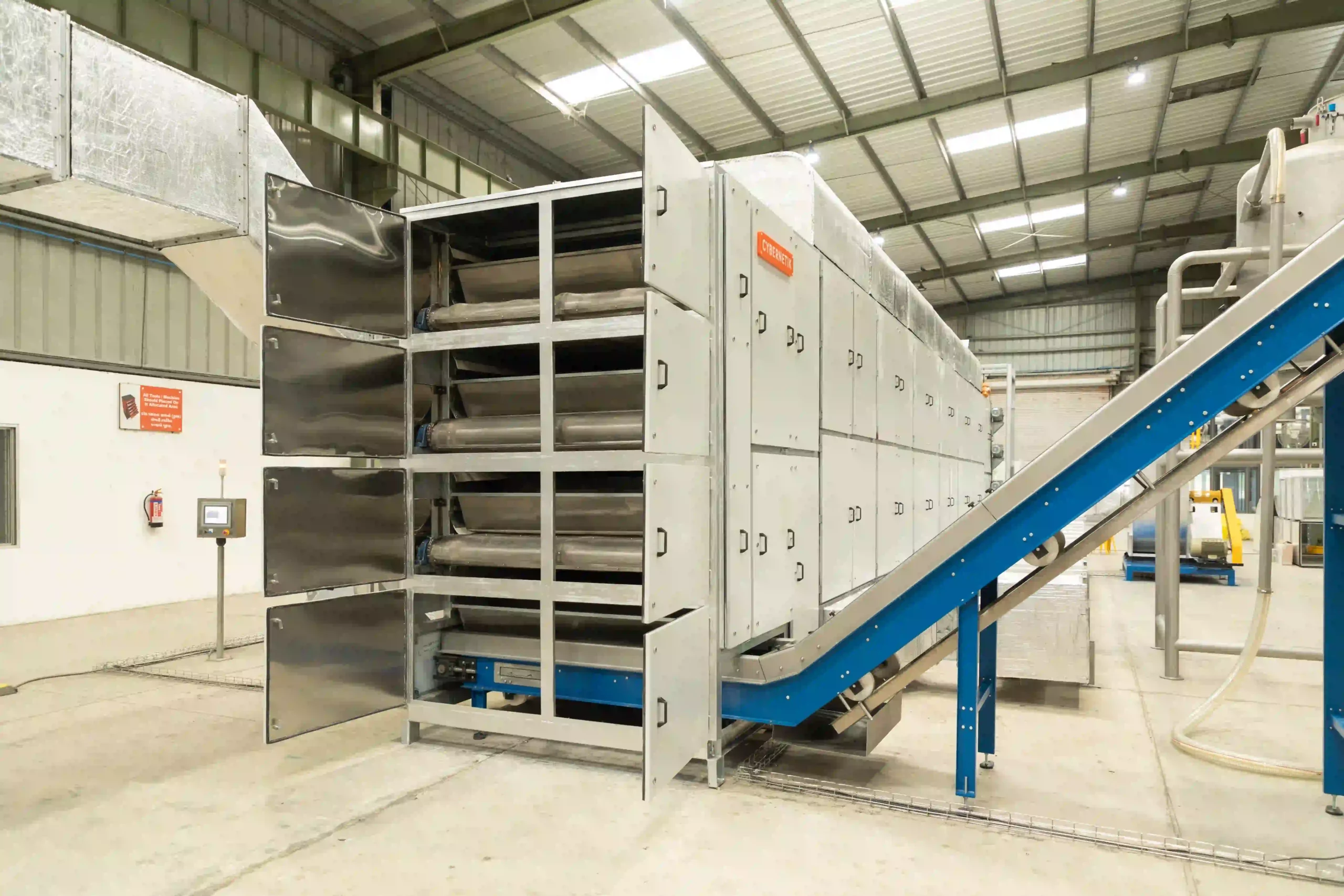
When products must cool or dry while they move, airflow through the belt matters. Open-area modular belts let air pass from below, cooling products evenly. Cybernetik’s convective cooling conveyor is one example, using blowers to circulate ambient air over freshly prepared snacks at up to 1,000 kg/hr, with filters to trap food particles and a detachable CIP system for hygiene.
Which One for Which Application?
| Application | Usual choice | Reason |
|---|---|---|
| Cartons, bags and boxes on straight runs | Flat belt | Smooth, quiet and economical |
| Small packs, labels or light products | Flat belt | Continuous surface with no gaps |
| Inspection and metal detection | Flat belt | Smooth, plastic belts suit detector heads and visual checks |
| Washdown areas in meat, poultry and seafood | Modular belt | Open design, high temperature cleaning, easy drainage |
| Cooling or drying products in transit | Modular belt | Air flows through an open belt |
| Conveying through curves | Modular belt | Radius belts avoid transfer points |
| Inclines with flights | Either | Cleated flat belts or modular belts with flights both work |
| Heavy, sharp or abrasive items | Modular belt | Tough modules and easy section replacement |
 “Every conveyor performs differently under real plant conditions, where product size, temperature, cleaning and layout shape the right choice.”

See it in action
Maintenance and Lifetime Cost
Flat belts are usually cheaper to buy and simple to maintain, but a deep cut or failed splice can mean replacing or re-splicing the belt, which takes the conveyor out of service. Regular checks of tension, tracking and pulley condition keep them running.
Modular belts cost more at the start but are easy to repair: damaged modules are swapped in minutes. Sprockets and wear strips need periodic inspection, and the belt stretches slightly over time as hinges wear, which is taken up by adjusting the return side. In harsh, wet or high-impact duty, modular belts often have the lower lifetime cost.
Whichever belt you choose, keep a small stock of the parts most likely to fail: a spare belt or splice kit for flat belts, and a supply of modules, rods and sprockets for modular belts. A few spares on the shelf can turn a day of lost production into an hour.
Choosing Between Them
| Question | Points toward |
|---|---|
| Is the product very small, thin or light? | Flat belt |
| Does the conveyor need to turn corners? | Modular belt |
| Will it be washed down hot and often? | Modular belt |
| Must air or water pass through the belt? | Modular belt |
| Is quiet running important? | Flat belt |
| Is the lowest purchase price the priority on a simple straight run? | Flat belt |
| Do cuts and impacts damage belts often? | Modular belt |
If the answers point both ways, consider splitting the line. Using each belt type where it performs best is common and often more effective than forcing one design to do everything.
Common Mistakes When Choosing a Belt
Questions to Answer Before You Order
A conveyor supplier can recommend the right belt only if they know how it will be used. Before asking for a quote, gather the product’s size, weight, temperature and surface, the throughput, the conveyor length and layout, including any curves or inclines, and the cleaning method and chemicals. Note whether the conveyor passes through metal detectors, checkweighers or cooling sections, and whether it must connect to existing equipment at fixed heights.
For a wider view of conveyor types beyond these two, including cleated, trough and screw designs, see the guide to conveyor belt machines.
Belt Conveyors from Cybernetik
Cybernetik Technologies, headquartered in Pune and delivering turnkey automation since 1989, builds conveyors as part of complete process and packaging lines. Its belt conveyor range transfers products at up to 6,000 kg/hr and comes in flat, modular, curved, cleated and washdown or sanitary versions.