
Key takeaways
A case packer is the machine that takes individually packaged product and loads it into a shipping case. It sits between primary packaging and palletizing, and it is usually the stage where a plant discovers whether its packaging line is actually a line or just a sequence of machines.
The reason is that case packing depends entirely on what arrives at it. A filler can run at rate regardless of how product leaves it, but a case packer has to receive product in a known orientation, in a known count, at a known rate. Everything difficult about case packing traces back to that dependency.
This guide covers what a case packer does, the loading methods that define the main types, what the machine delivers over manual packing, and where each configuration is used.
Where the Case Packer Sits
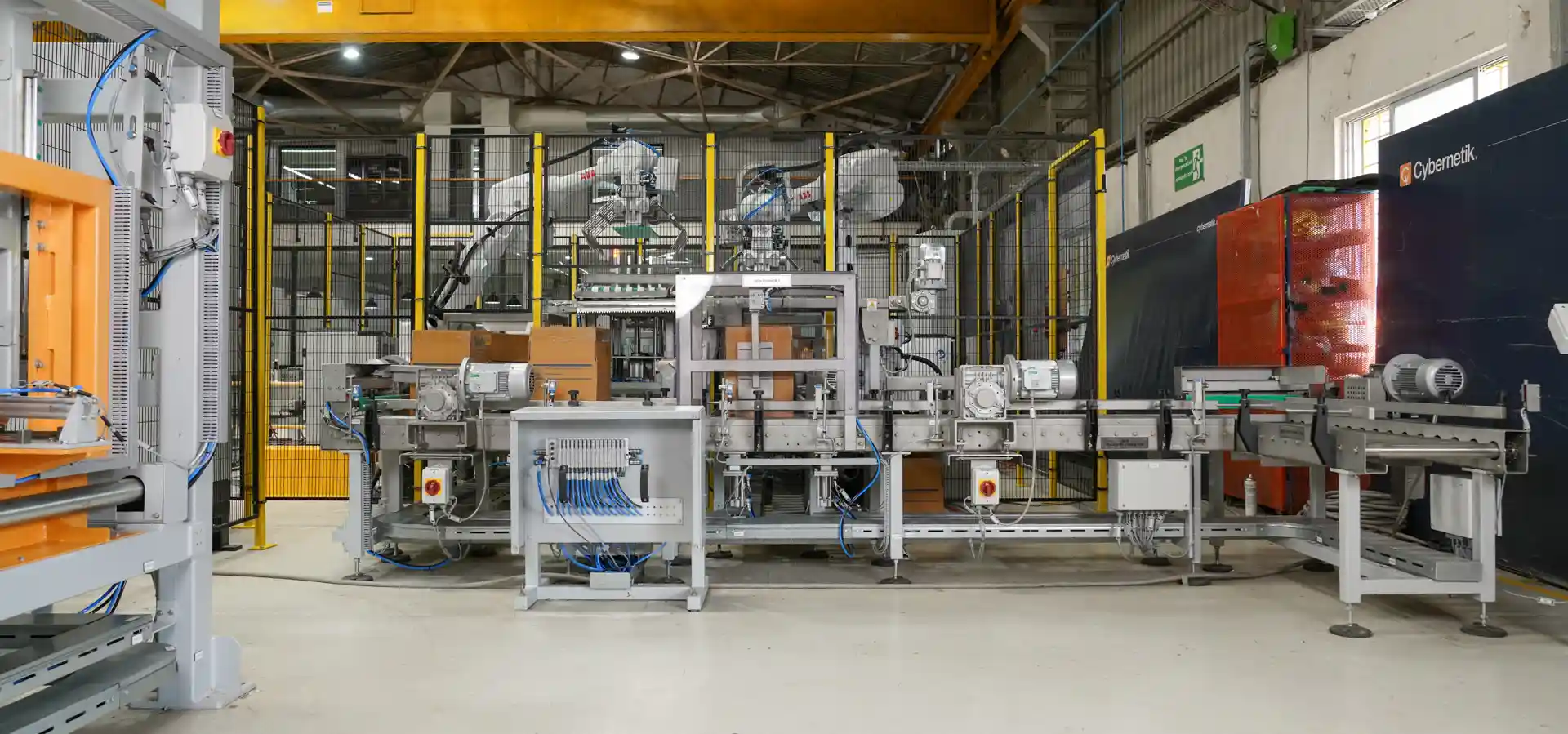
A case packing station is rarely one machine. It is a small cell with four functions that usually appear together.
Buying a case packer without specifying the erector and the collation ahead of it is the most common way these projects underdeliver. The packer arrives capable of a rate the cell around it cannot supply.
The Types, Defined by How Product Enters the Case
Case packers are classified by loading method, because that decision determines what products the machine can handle, how fast it runs and how much space it occupies.
Top-load
The case is presented open at the top and product is lowered or dropped in from above. This is the most versatile arrangement, handling pouches, jars, bottles, trays and mixed formats, and it is the natural configuration for robotic packing since a robot approaches from above anyway. It requires headroom over the line, and it depends on collation being accurate, because the pattern is set before the product moves.
Side-load or end-load
The case lies on its side and the collated product is pushed in horizontally. This suits folding cartons and upright packs that need to stand on end in the case, and it produces very tight nested patterns. The trade is an extra stage, since the case has to be tipped upright after packing.
Wrap-around
Rather than filling a pre-formed case, a flat blank is folded around the collated product and sealed. Board consumption is lower and the finished pack is tighter, which matters at high volume where corrugated cost is a real line item. The blank is specific to the pattern, so this configuration suits long runs of a single format rather than variable production.
Drop packer
Product falls into the case through a chute under gravity. Mechanically the simplest and cheapest option, and fast for robust items such as bagged snacks or hardware. Unsuitable for anything fragile, anything that must arrive in a specific orientation, or anything that will settle unevenly.
Robotic
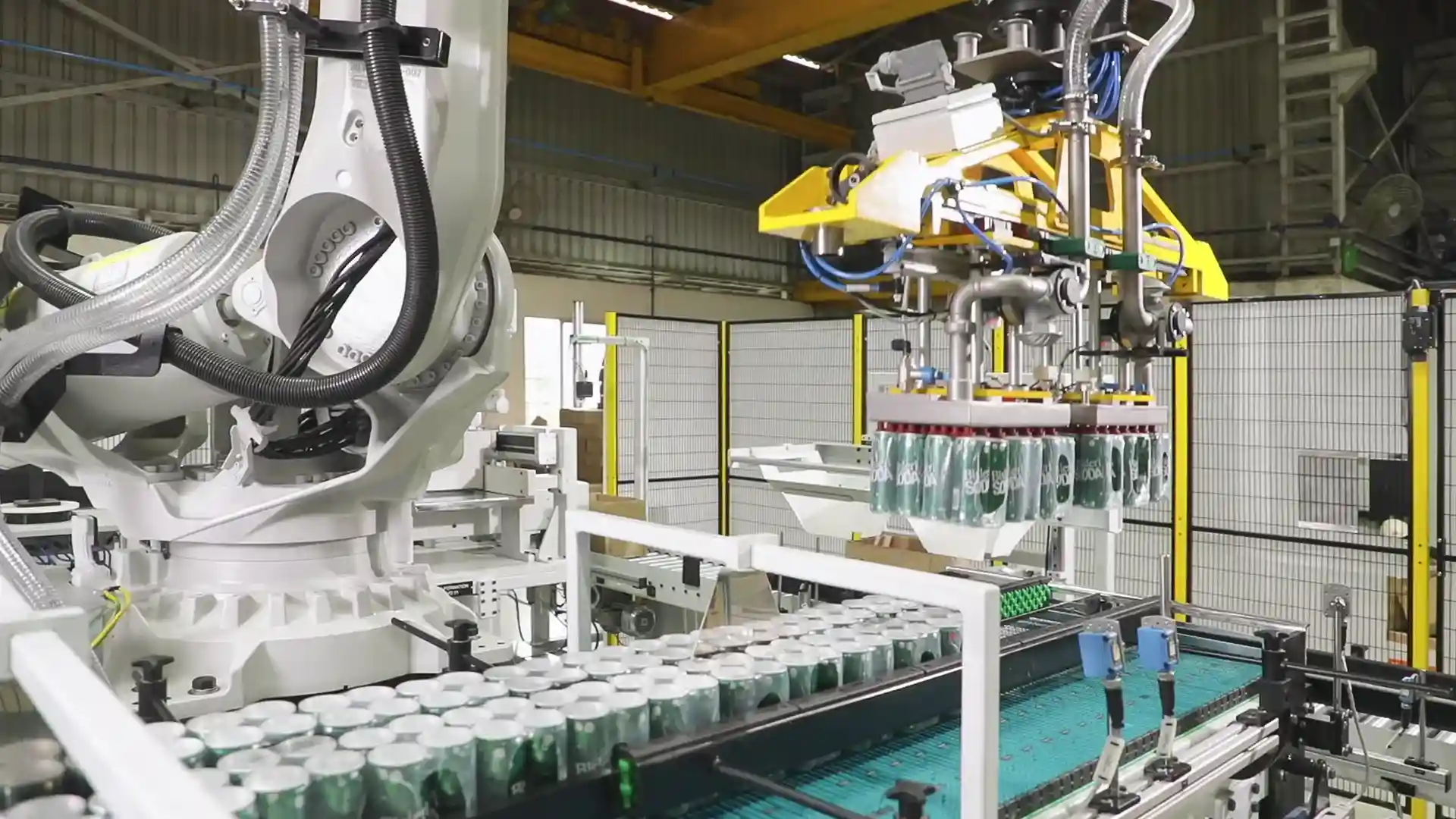
A SCARA or six-axis robot picks product and places it into the case, usually guided by vision. This handles product arriving in random orientation, which removes the need for mechanical aligning equipment upstream, and it changes format by recipe rather than by retooling. It is the configuration that suits plants running many SKUs, and it handles fragile product more gently than any mechanical alternative.
| Case packer type | How product enters the case | Suits | Trade-off |
|---|---|---|---|
| Top-load | Product is lowered or dropped into an open case from above | Pouches, jars, bottles, trays, mixed and multi-format production | Needs headroom above the line; collation must be accurate |
| Side-load or end-load | The case lies on its side and product is pushed in horizontally | Folding cartons, upright packs, tightly nested patterns | Case must be reoriented after packing, adding a stage |
| Wrap-around | A flat blank is folded around the collated product | High-volume single-format runs of cans, bottles and cartons | Uses less board and packs tighter, but the blank is format-specific |
| Drop packer | Product free-falls into the case through a chute | Robust products such as bagged snacks and hardware | Simplest and cheapest, but unsuitable for fragile items |
| Robotic | A SCARA or six-axis arm picks and places product, often vision-guided | Multi-format plants, fragile product, random infeed orientation | Higher capital cost and integration effort |
What a Case Packer Delivers
Industrial Applications
 “Modern case packing combines robotics, intelligent controls, and flexible changeovers to handle multiple product formats with consistent accuracy, reduced manual intervention, and greater production efficiency.”

See it in action
What Determines Whether It Works
Three things decide whether an installed case packer performs to specification, and none of them is the packer.
Product presentation is first. The machine has to receive product in the orientation and spacing it expects. Where the upstream machine discharges in random orientation, either mechanical aligning equipment or a vision-guided robot has to bridge the gap, and choosing which belongs in the original scope.
Collation accuracy is second. If the pattern presented to the packer is short by one unit or misaligned, the case is wrong regardless of how well the packer performs. Collation is the stage most often under-specified relative to its importance.
Case quality is third and least anticipated. Corrugated blanks vary between suppliers and with humidity, and a case erector set up for one board specification will misfeed on another. Plants that buy board on price from rotating suppliers experience this as a machine fault, and it is not one.
Case Packing from Cybernetik
Cybernetik builds case packing as part of complete secondary packaging lines, with erecting, collation, packing, sealing, coding and palletizing engineered together under one control architecture rather than procured as separate machines.
| Cybernetik case packing equipment | Rated performance |
|---|---|
| SCARA pouch case packer | Up to 40 pouches per minute |
| Six-axis bottle case packer | Up to 120 bottles per minute, 200 kg payload |
| Chocolate bar case packer | Confectionery format applications, flow wrapper fed |
| Carton weigh and fill system | Vibratory feeder dosing granular product directly into cartons |
| Automatic carton box making machine | 15 to 30+ cartons per minute, magazine-fed with vacuum pickup |
| Semi-automatic case erector | Entry option for phased automation roadmaps |
| Inline case sealer | Tape, hot-melt or combined sealing |
| Coding | Inline date, batch and barcode coding integrated with the line PLC |
| Robotic carton palletizer | Up to three cartons handled simultaneously |
| Line control | Unified PLC and SCADA architecture across all stages |
Because every stage runs under a unified PLC and SCADA architecture, a format change propagates across the cell simultaneously rather than requiring each machine to be reconfigured in turn. That is what keeps changeover within a format family down to minutes rather than the better part of a shift.