
Key takeaways
Ask a plant what bagging equipment they run and the answer is usually one machine. Ask what stops the bagging line and the answer is almost never that machine. It is the bag magazine that jammed, the stitching head that skipped, the check weigher rejecting on a bag weight change, or the dust collector that tripped.
Bagging is a line, not a machine, and understanding it that way is what separates a project that raises output from one that installs a faster filler in front of an unchanged constraint.
This guide walks the full sequence, from product arriving above the filler through to a wrapped pallet, and covers the closing methods, bag materials and support systems that determine whether the line runs.
The Stages of a Bagging Line
A complete industrial bagging line has seven stages, and only one of them is the filler.
Upstream of the Filler
Product supply and surge capacity
A filler can only be as consistent as its supply. Without a surge hopper above it, the bagging line inherits every fluctuation from upstream processing, and fill weights drift with head pressure. Level control on that hopper is a small item that prevents a category of accuracy problems nobody traces back to it.
Feed system
Gravity for free-flowing granules, vibratory pans for granular product where coarse and fine stages can be separated, and fine screw feeding for powders that will not flow reliably under their own weight. Staged coarse and fine feeding is what allows tight tolerance without sacrificing rate.
Bag supply
The bag magazine and placer are the most common source of stoppages on an automatic line, and the cause is usually bag variation rather than machine fault. Bags that differ in dimension, stiffness or coating between deliveries defeat a placer set up for the previous batch. Where a plant buys bags on price from rotating suppliers, this shows up as a machine problem and is not one.
Filling, Then Conditioning
Filling itself divides into open-mouth, valve, bulk bag and small bag formats, each with its own machine family. What matters at line level is what happens immediately after the fill.
Product entering a bag carries air with it. Powders in particular can occupy far more volume immediately after filling than they will an hour later. A bag closed in that state looks full, then settles in transit and arrives looking short-filled even though the weight is correct. De-aeration during filling and vibratory settling on the spout prevent this. It is a presentation issue rather than a compliance one, and it generates a surprising number of customer complaints.
Flattening follows settling. A flattener presses the bag into a consistent profile so that bags stack squarely on a pallet. Without it, pallet patterns become unstable, which produces transit damage on loads that were otherwise packed correctly.
Closing Methods
The closing stage is frequently the rate limit on an open-mouth line, and it is decided by the bag as much as by the product.
| Closing method | How it works | Bag types | Trade-off |
|---|---|---|---|
| Stitching | A sewing head closes the bag mouth with thread, often over a crepe tape strip | Multiwall paper, woven polypropylene | Fast and low cost, but not airtight unless taped |
| Heat sealing | Heated jaws fuse the inner liner or film layer | PE-lined, laminated woven, poly bags | True moisture barrier, but the seal area must be free of product |
| Pinch-top gluing | Hot melt adhesive closes a pinch-style bag top | Pinch bottom open mouth bags | Sift-proof and premium in appearance, requires a specific bag |
| Fold-over taping | The bag mouth is folded and taped | Paper and woven bags | Quick and cheap, minimal barrier properties |
| Self-closing valve | The valve closes as the filling spout withdraws | Valve bags | No closing equipment at all, but format is fixed |
Two practical points. If moisture protection matters, stitching alone will not deliver it regardless of thread or tape, so the bag has to carry a heat-sealable liner. And where a line runs more than one bag style, the closing station is usually the hardest part to make format-flexible, so it belongs in the changeover discussion early.
Bag Materials
Bag choice constrains the closing method, and both constrain the machine. It is worth settling material, format and closure together rather than sequentially, because a decision made on bag cost can force an equipment change costing far more than the saving.
 “Effective dust control begins with equipment design, not as an afterthought. Integrating extraction, enclosed filling, and suitable handling systems helps manufacturers improve housekeeping, protect product integrity, and support safer operations.”

See it in action
Verification and End of Line
A check weigher after closing confirms every bag rather than sampling, and an automatic reject removes failures before they reach a pallet. Metal detection is standard in food and feed and increasingly expected elsewhere. Positioning matters: verification should sit after closing so that a bag failing inspection has already consumed all the value it is going to, and before palletizing so a bad bag never enters a load.
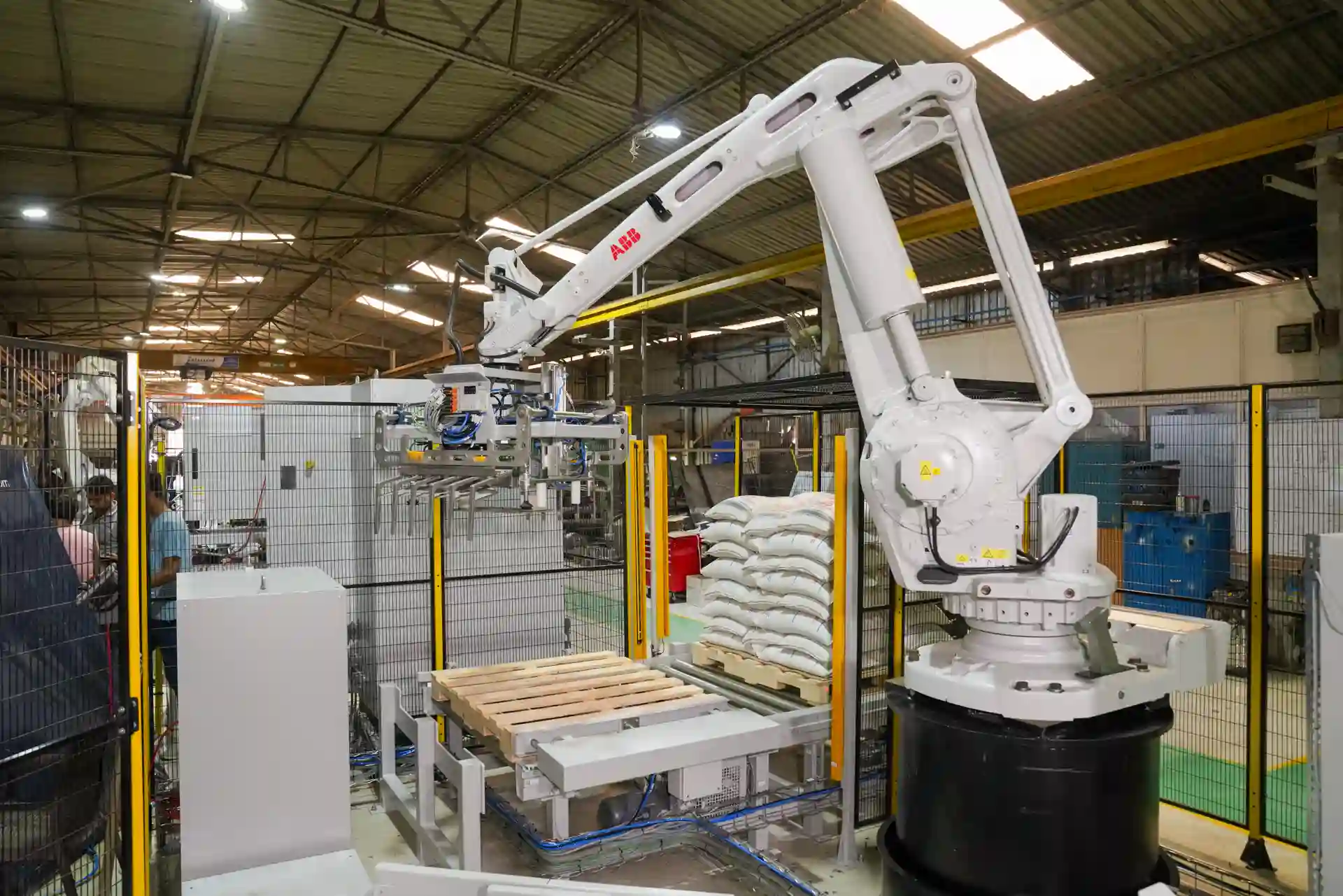
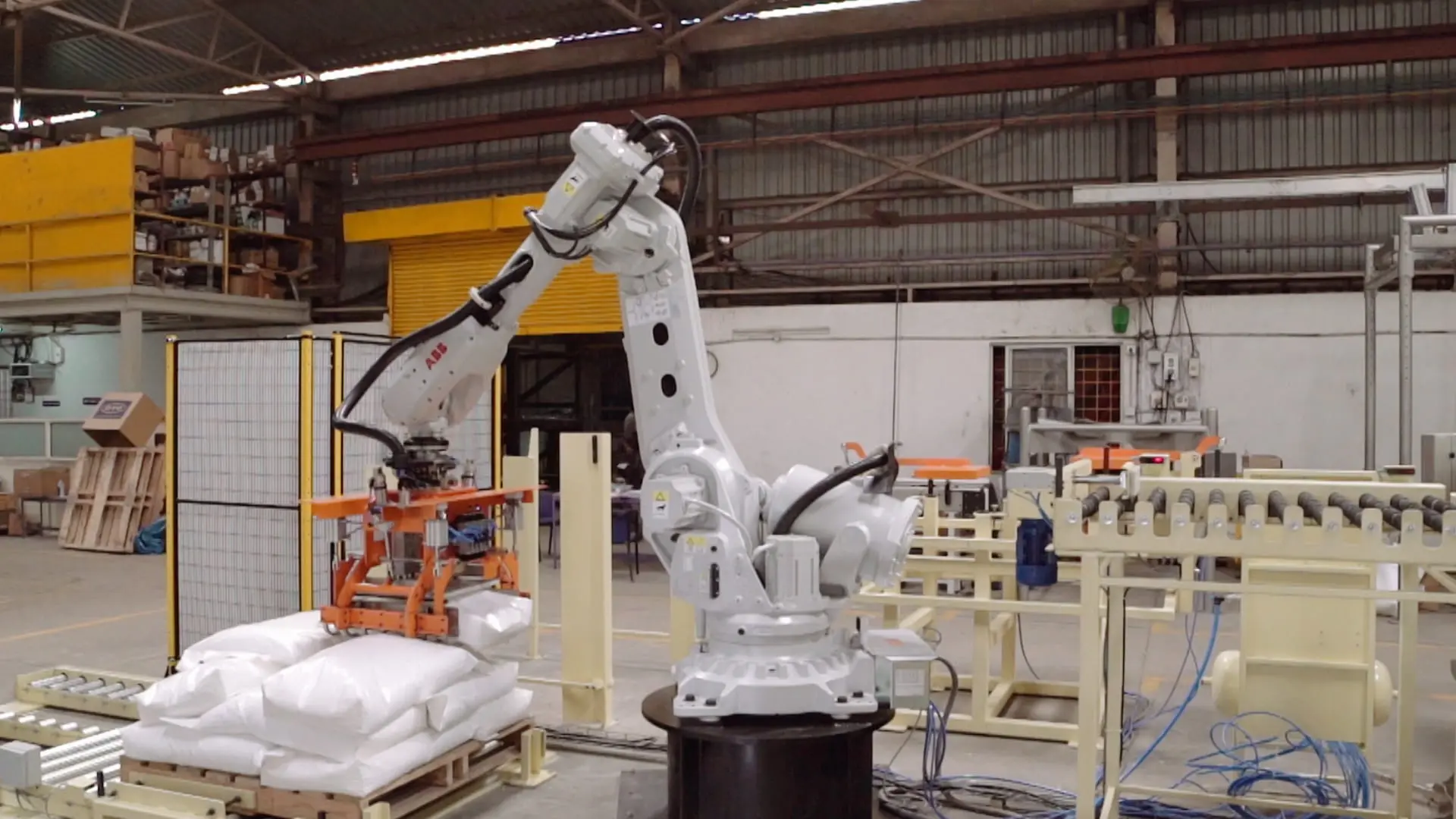
A bag turner orients bags for the palletizing pattern, and palletizing may be conventional, robotic or collaborative. Robotic palletizing handles multiple patterns through recipe change rather than mechanical adjustment, which suits plants running several bag sizes on one line.
The Support Systems That Get Overlooked
Bagging Systems from Cybernetik
Cybernetik designs and manufactures bagging equipment as complete lines rather than individual machines, covering small bags, open-mouth bags, valve bags and bulk bags, with the conditioning, closing, verification and palletizing stages engineered alongside the filler.
| Cybernetik bagging equipment | Specification |
|---|---|
| Open-mouth bag filler, semi-automatic | 25 kg and 50 kg bags, up to 4,500 kg/hr, customizable |
| Open-mouth accuracy | Up to 0.1 percent weight tolerance with separate coarse and fine feeders |
| Automation range | Entry model, electro-pneumatic automatic, Robopack 1 and Robopack 2 robotic |
| Auger valve bag packer | Up to 3,000 kg/hr at 0.1 percent tolerance |
| Impeller valve bag packer | Up to 6,000 kg/hr at 0.5 percent tolerance |
| Valve bag range | 10 to 50 kg, with impeller, screw or air loading |
| Feeding options | Gravity, vibratory coarse and fine, and fine screw feeding to 0.1 percent tolerance |
| Bag handling | Pneumatic clamp and lifter, lifter elevation adjustment, vibratory settling motor, bag flattener and bag turner |
| Closing | In-built stitching and sealing |
| Dust control | Dust-free operation with de-aeration during filling; taper sleeve and vacuum spillage cover on valve bagging |
| Downstream | Robotic carton palletizer handling up to three units simultaneously, and cobot palletizing |
| Line control | Unified PLC and SCADA architecture across stages |
The open-mouth range is built as a progression: an entry model for lower production rates with quick return on investment, an electro-pneumatic automatic system for mid-level requirements and for clean or hazardous applications, Robopack 1 for multiple bag variants with minimal changeover, and the flagship Robopack 2 for high throughput with minimal manual intervention. Robopack 2 is fully modular plug and play and needs no robot training to operate.
Materials handled include powders, granules and pellets across food, chemical, fertilizer, pharmaceutical and construction industries, with achievable capacity varying by powder properties.