
Key takeaways
A bag filling machine is bought to solve a throughput problem and is chosen, more often than not, by the bag. The format your customers expect, the weight they order in, and the way the bags will be handled after they leave your dock narrow the equipment field before any supplier is contacted.
That order matters because the five families of bag filling equipment are not interchangeable. A machine built for 50 lb open-mouth sacks shares almost nothing with one built for valve bags or bulk totes, and specifying capacity before format usually surfaces at quotation stage.
This guide works through the bag formats, the machine families that serve each, how weighing method affects speed and accuracy, and which combinations suit which industries.
Start From the Bag
Four bag formats cover almost all industrial dry product packaging in North America, and each exists because it solves a particular distribution problem.
The format is usually set by the market rather than the plant. Where it is genuinely open, valve bags remove a closing station and cut dust, open-mouth bags give the most flexibility on print and closure, and bulk bags eliminate handling labor at the cost of requiring bulk handling at both ends.
The Five Machine Families
Small bag and pouch fillers
Product is metered by auger, multihead weigher or volumetric cup into a formed or pre-made pouch and sealed immediately. Rates are high and the equipment compact. Accuracy comes from the weigher rather than the filling head, so weighing technology dominates the specification here.
Open-mouth bag fillers
An empty bag is presented to a spout, clamped, filled to weight, released and closed by stitching or heat sealing. The largest and most varied family, spanning semi-automatic machines where an operator hangs each bag through to robotic systems that place, fill, settle and close unattended. Rate is governed as much by the closing method as by the fill.
Valve bag packers
A spout enters the bag valve and product is forced in by auger, impeller or air, then the bag self-seals as it comes off. Auger packers give the tightest accuracy, impeller packers give higher rate at slightly looser tolerance, and air packers handle the very finest powders. The absence of a closing station is a real advantage in both capital cost and floor space.
Bulk bag and FIBC fillers
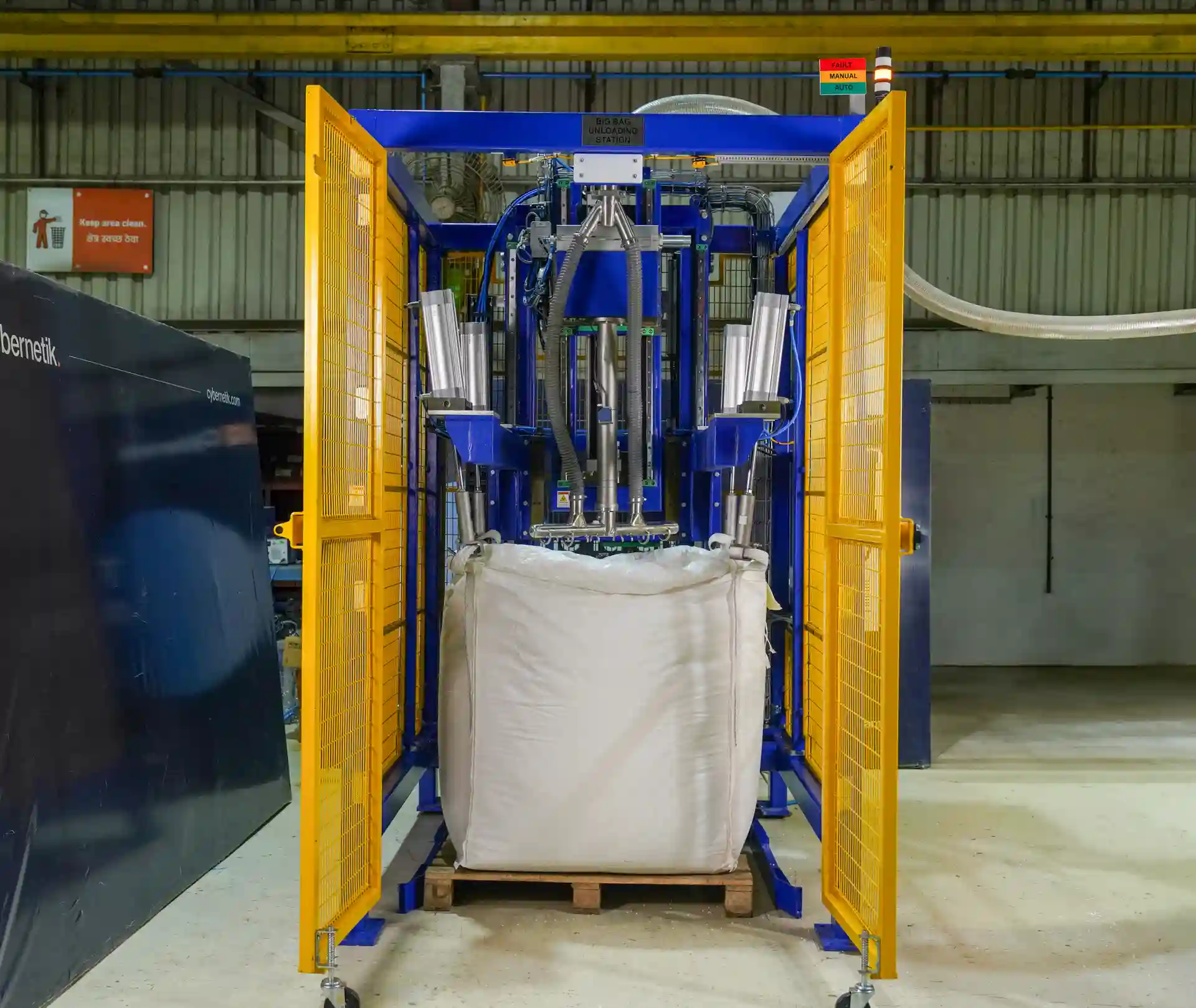
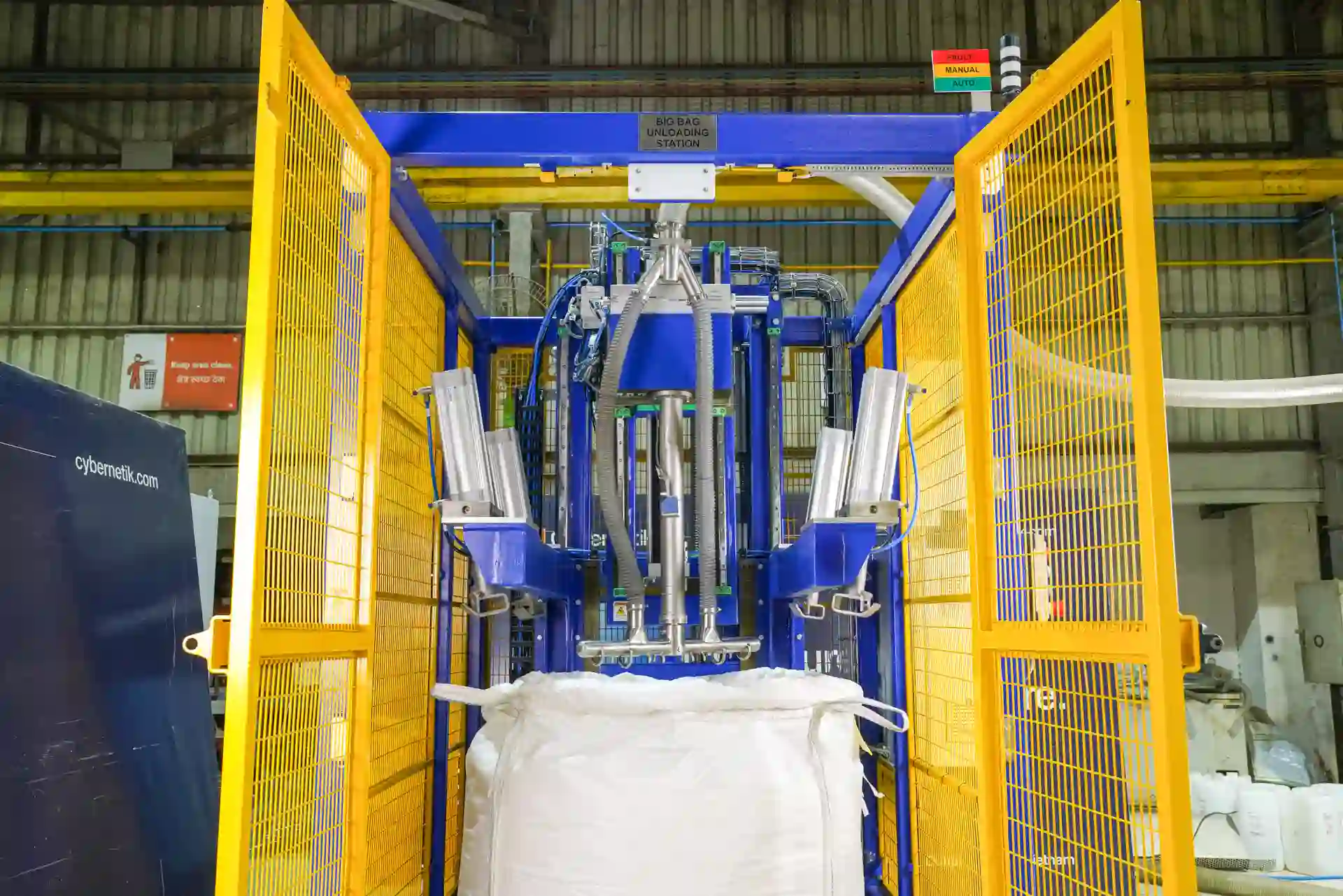
The empty tote is hung from loop hooks on a frame, inflated so it fills squarely, and filled through a spout with an inflatable seal for dust containment. Weight is measured by load cells on the frame, and a densification deck vibrates the bag during filling so the product settles and the finished bag stands stable on a pallet. Skipping densification produces bags that lean and topple in transit.
Form fill seal
Bags are formed from roll stock, filled and sealed in one continuous machine. Bag cost per unit is the lowest of any format, and the machine is fast, but it commits the plant to one bag style. Best suited to high volume single-format production.
Gross Weigh or Net Weigh
This is the specification detail that most affects both speed and accuracy, and it is frequently absent from an initial inquiry.
A gross weigh machine places the bag on a scale and fills until bag and product together reach target. Simpler, cheaper, fewer moving parts. The limits are that the bag must be stationary and settled before the reading is trusted, which caps speed, and that variation in empty bag weight goes straight into the fill.
A net weigh machine weighs product in a hopper first, then discharges the measured charge into the bag. Bag weight variation becomes irrelevant, and because the next charge is being weighed while the current bag discharges, throughput is considerably higher. The trade is more capital, more height and a more complex machine.
The practical rule: gross weigh suits lower rates and simpler installations, net weigh suits high throughput or tight tolerance. If bag weights vary noticeably between suppliers or between deliveries, net weigh stops being optional.
Applications by Industry
| Industry | Typical products | Common format | Machine family |
|---|---|---|---|
| Food and ingredients | Flour, sugar, starch, spices, dairy powders | 25 to 50 lb open-mouth | Open-mouth with net weigh, GMP construction |
| Pet food and animal feed | Kibble, pellets, meal | 40 to 50 lb open-mouth | Open-mouth, gravity or vibratory feed |
| Chemicals | Resins, additives, masterbatch | 25 kg open-mouth or valve | Valve packer or open-mouth with dust control |
| Fertilizer and agriculture | Granules, blends, seed | 50 lb bags and bulk bags | Open-mouth plus FIBC filling |
| Building materials | Cement, mortar, mineral fillers | Valve bags | Impeller or air packer |
| Pharmaceutical and nutraceutical | Excipients, actives, blends | Small bags and contained transfer | Small bag filler with containment |
Two patterns stand out. Food and pharmaceutical duty pushes toward net weigh and GMP construction, because accuracy and cleanability are both enforced externally. Building materials push toward valve bagging, because dust dominates and the closing station disappears.
Selection Tips
 “Accurate filling is only one part of successful bagging. De-aeration, vibratory settling, bag closure, and pallet stability all contribute to protecting product quality and ensuring reliable downstream handling.“

See it in action
Bag Filling Machines from Cybernetik
Cybernetik designs and manufactures bag filling machines for small bags, valve bags, open-mouth bags and bulk bags, combining process automation and robotics rather than relying on either alone.
| Cybernetik bag filling equipment | Specification |
|---|---|
| Open-mouth bag filler, semi-automatic | 25 kg and 50 kg bags, up to 4,500 kg/hr, customizable |
| Open-mouth accuracy | Up to 0.1 percent weight tolerance with separate coarse and fine feeders |
| Open-mouth automation levels | Entry model, electro-pneumatic automatic, Robopack 1 and Robopack 2 robotic |
| Auger valve bag packer | Up to 3,000 kg/hr at 0.1 percent tolerance |
| Impeller valve bag packer | Up to 6,000 kg/hr at 0.5 percent tolerance |
| Valve bag range | 10 to 50 kg, with impeller, screw or air loading |
| Valve bag dust control | Taper sleeve on filler port, spillage cover with vacuum, slide gate assembly and load cell frame |
| Fine screw feeding | Powders and granules to 0.1 percent tolerance |
| Bag handling | Pneumatic clamp and lifter, elevation adjustment, vibratory settling, bag flattener and turner |
| Closing | In-built stitching and sealing |
| Build standard | Dust-free operation with de-aeration during filling, hygienic GMP construction |
The open-mouth range is built as a progression rather than a single machine. An entry model suits lower production rates with quick return on investment. An electro-pneumatic automatic system covers mid-level requirements and applications where reducing manual presence matters for cleanliness or safety. Robopack 1 handles multiple bag variants with minimal changeover. The flagship Robopack 2 is a high-speed fully automatic system, fully modular plug and play, requiring no robot training to operate.
Materials handled include powders, granules and pellets across food, chemical, fertilizer, pharmaceutical and construction industries, with capacity varying by powder properties.