
Key takeaways
A lithium battery pack is not really one product. It is a few hundred individual cells asked to behave like a single unit for the next eight to ten years, through vibration, temperature swings, fast charging and deep discharge. Whether they manage that is settled almost entirely on the assembly line.
Cell chemistry gets most of the attention in battery engineering conversations, and it deserves some of it. But the difference between a pack that holds its rated capacity through the warranty period and one that degrades unevenly usually traces back to assembly decisions. How tightly cells were matched before they were grouped. Whether every weld was verified or every fiftieth weld was sampled. Whether the insulation layer landed in the same position on cell number 4,000 as it did on cell number four.
This guide walks through the lithium battery pack assembly process stage by stage, explains what changes when the cell format changes, and points at the stages where production lines most often lose yield. If you are scoping a new line or trying to work out why an existing one is underperforming, the battery pack assembly automation side of the problem is usually where the answers are.
From Cell to Module to Pack
Lithium battery pack assembly is conventionally described in three levels, and it helps to keep them separate because the failure modes at each level are different.
At cell level, finished cells arrive from the cell manufacturer in trays, cartons or bandoliers. Nothing is built yet. Everything here is about verification: confirming that what arrived is electrically what the datasheet claims.
At module level, cells are grouped, joined electrically, fixed mechanically and instrumented with voltage and temperature sensing. A module is the smallest unit that can be tested as a functioning sub-assembly.
At pack level, modules go into an enclosure alongside the battery management system, thermal management hardware, high voltage wiring, contactors and fusing. What leaves the line is a sealed, certified, serial numbered unit.
Cell to pack architectures compress this by removing the module stage entirely. Fewer parts, less mass, better volumetric efficiency. The trade off is that there is no intermediate assembly to catch a marginal cell before it becomes structurally embedded in the pack, which raises the precision bar on everything upstream.
The Lithium Battery Pack Assembly Process, Stage by Stage
1. Cell intake, scanning and traceability
Cells are unloaded from incoming trays and every barcode is read the moment the cell enters the line. That scan is written to a database along with the position the cell will occupy. This record is the traceability spine of the entire pack, and it is worth being strict about it. If a field failure comes back eighteen months later, this is the data that tells you which cell batch, which module position and which weld station were involved. Batch scanning saves a few seconds per tray and costs you the ability to defend a warranty claim.
2. Electrical testing and sorting
Open circuit voltage, internal resistance and alternating current internal resistance are measured on every cell, and cells are sorted into narrow parameter bands. The logic is simple: a module is limited by its weakest cell. Put a slightly higher resistance cell in a group and it will run warmer, age faster and drag the whole group down with it. Tight sorting bands are what produce packs that age uniformly. On a fully automated line, EV battery pack assembly systems divert cells onto parallel conveyors by test result using SCARA robots, at rates reaching 6,000 cells per hour.
3. Surface preparation and insulation
Cell terminals are plasma cleaned to strip oxide and handling contamination. This is not cosmetic. A clean terminal gives a consistent weld nugget and a reliable test contact, and skipping it shows up later as scattered weld strength results that nobody can explain. On cylindrical cells, an insulation ring or gasket is then applied to the positive terminal so the busbar cannot short against the can rim. A vision system confirms placement on every cell, because misapplied insulation is one of the more common root causes of latent short circuits that only appear under vibration.
4. Module assembly and welding
Cells are oriented, polarity is verified by vision, and cells are loaded into holders in the required series and parallel configuration. Busbars are placed and joined to the terminals. Laser welding is the usual choice for speed and repeatability. Wire bonding is chosen where a fusible link is wanted, so that a single failing cell disconnects itself rather than feeding a fault. Either way the joint is the highest risk feature in the pack, which is why post weld resistance measurement and weld seam inspection belong inline rather than in a sampling plan.
5. BMS mounting and electrical integration
The battery management system board, sense wiring or flexible printed circuit, temperature sensors and high voltage interconnects are installed. The BMS is then flashed and paired to the pack identifier. From this point the pack has an electronic identity that every subsequent test result is written against.
6. Enclosure, sealing and thermal interface
Modules are placed into the housing and thermal interface material is dispensed to a controlled bead weight and path so heat transfer to the cold plate is even across the pack. Gaskets are seated, the top cover is fastened to a controlled torque sequence, and the seal is verified by air leak or pressure decay test against the target ingress protection rating.
7. End of line testing and marking
The finished pack goes through insulation resistance and dielectric withstand testing, a charge and discharge cycle to confirm capacity, a BMS communication check, and a final leak test. The pack identifier is laser marked and the complete test record is written back against it. A pack ships only when its own data says it should.
Where Lithium Pack Assembly Lines Actually Lose Yield
Most lines do not fail dramatically. They drift, and the drift shows up as a first pass yield number that slid from 98 percent to 92 percent over two quarters without anyone being able to name the reason. Four causes account for most of it.
 “Modern lithium battery pack assembly combines robotics, automated testing, vision inspection, and traceability to turn thousands of individual cells into one reliable, validated energy system.”

See it in action
How Cell Format Changes the Line
The seven stages above hold across chemistries and formats, but the equipment that executes them changes considerably depending on what shape the cell is. This is the single biggest driver of line design, and it is worth settling before anything else is specified.
| Cell format | Handling on the line | Typical joining method | What it means for the line |
|---|---|---|---|
| Cylindrical (18650, 21700, 32140) | High cell count, fast pick and place, tray or bandolier feeding | Laser welding or wire bonding to busbars | Throughput and sorting accuracy dominate. Thousands of joints per pack means inline weld verification is non negotiable. |
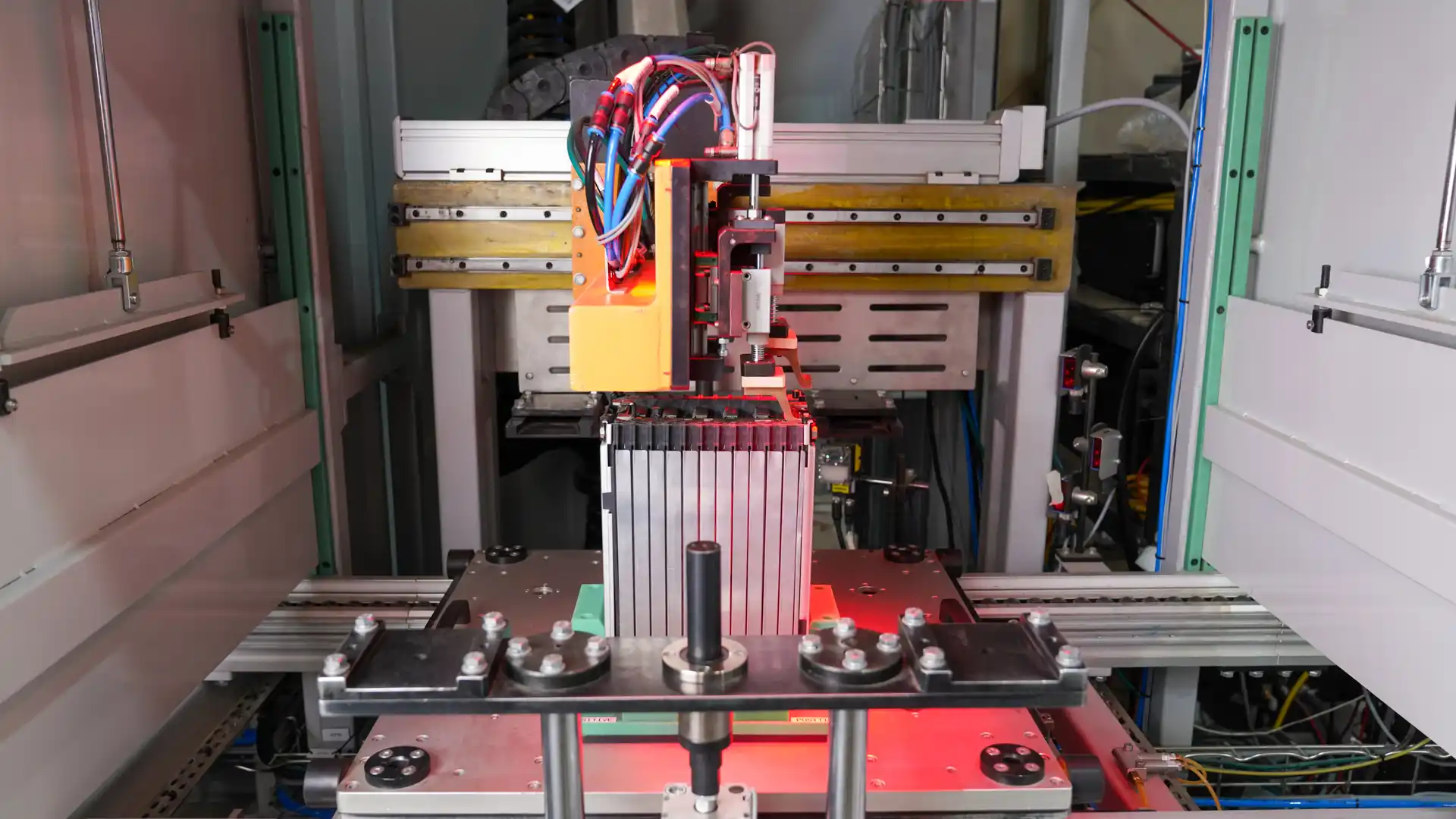
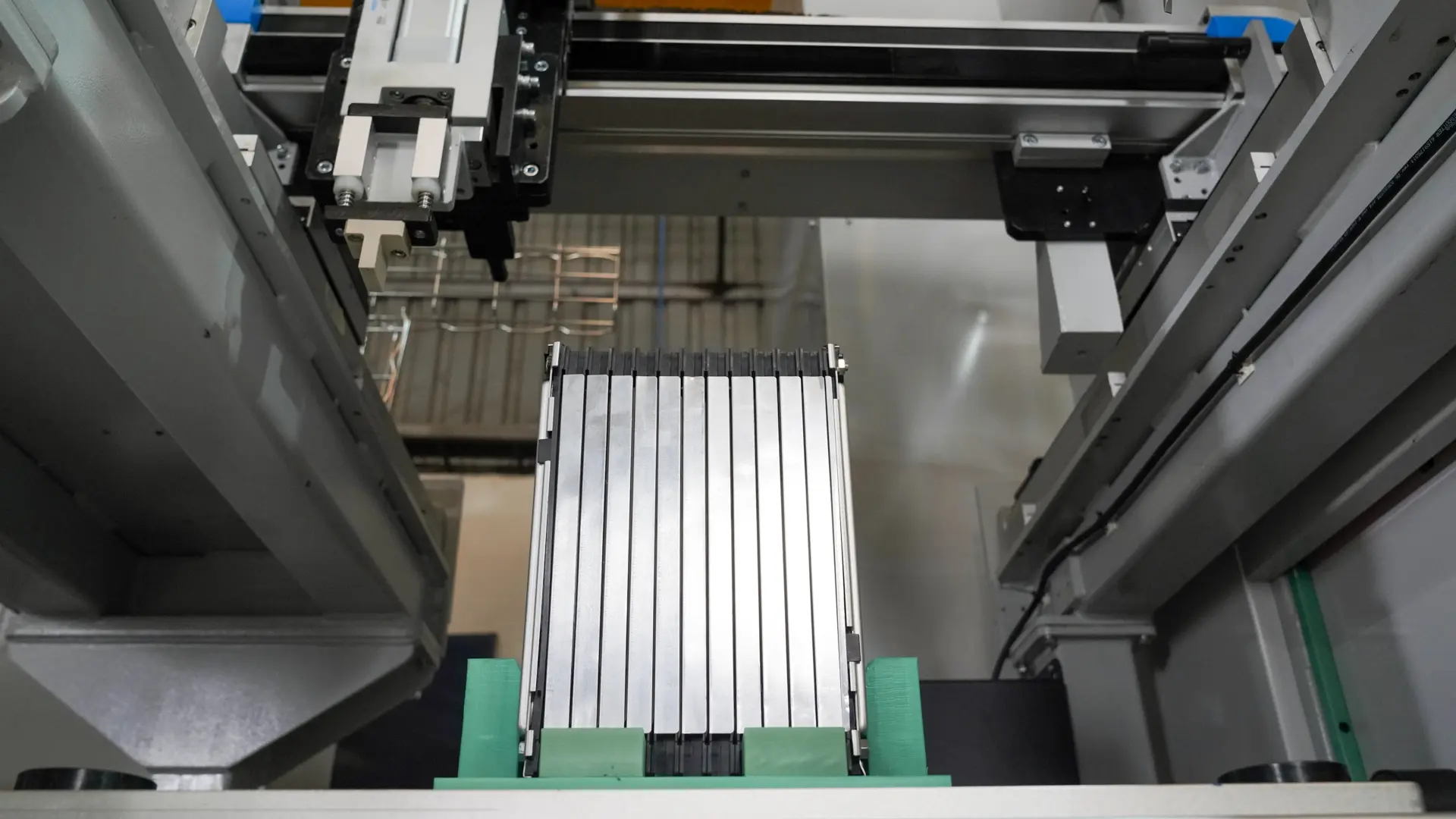
| Prismatic | Lower cell count, heavier cells, stacking and compression fixtures | Laser welding to busbars, bolted terminals on large formats | Stack pressure control and terminal alignment matter more than raw speed. |
| Pouch | Delicate tabs, no rigid casing, needs supported handling | Ultrasonic welding or laser welding of tabs | Handling forces and swelling allowance drive fixture design. |
| Blade and large format | Long cells handled by gantry or six axis robots | Laser welding, structural bonding | Adhesive dispensing accuracy and structural bonding cure control become line critical steps. |
Stationary storage adds another variable. Grid, telecom and commercial backup applications lean toward large format prismatic and pouch cells assembled into modular racks rather than vehicle shaped packs, so BESS battery pack assembly lines are built around scalability from pilot volumes to multi megawatt hour capacity rather than around fixed high volume takt.
What Cybernetik Builds Into Lithium Pack Assembly Lines
Cybernetik designs and installs turnkey lithium battery pack assembly automation for both electric vehicle and stationary storage manufacturers. The engineering emphasis is on the stages listed above where yield is won or lost.