
Key takeaways
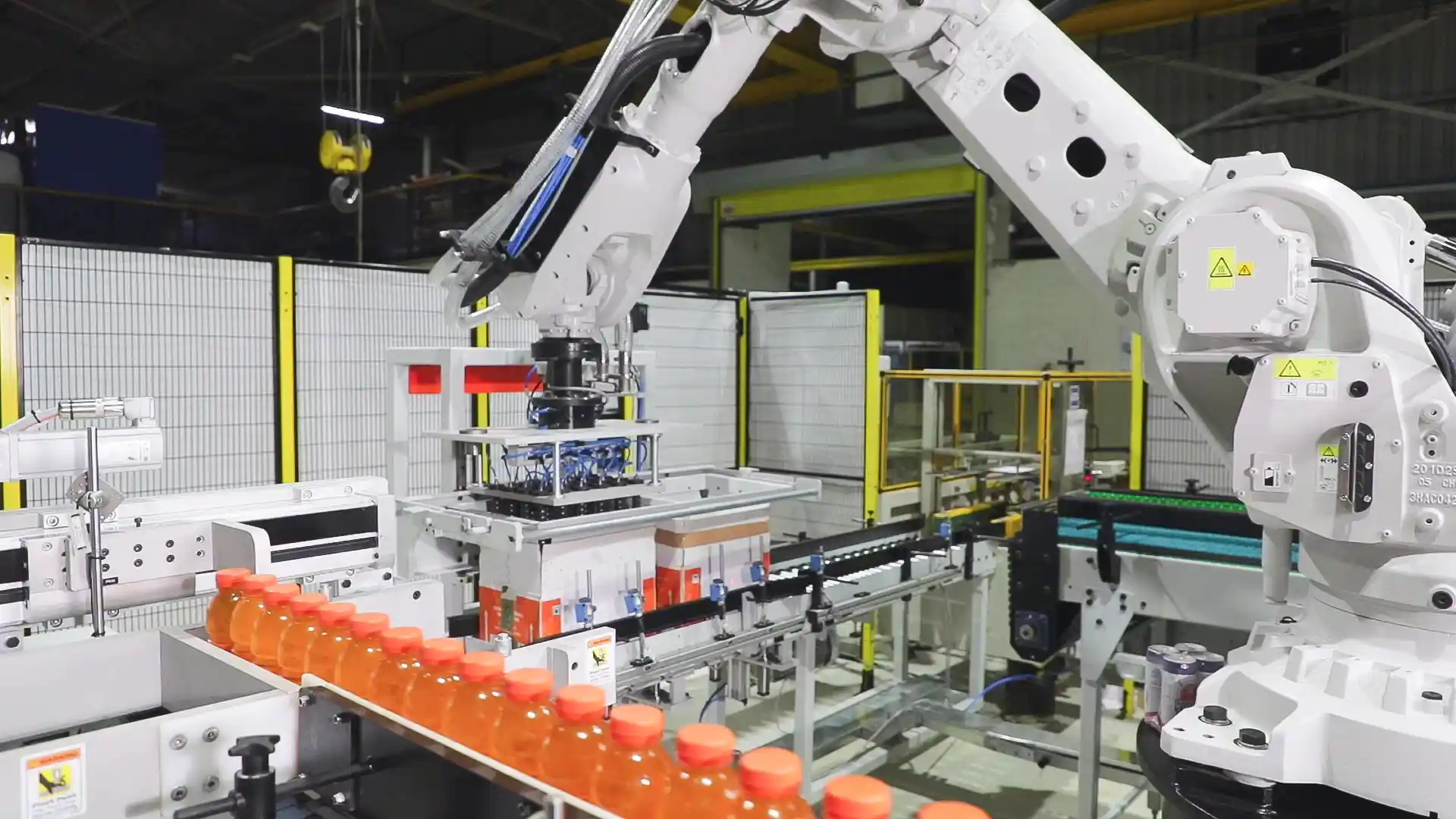
On a bottling line, the moment of truth for automation is not at the filler or the labeller. Both stages have been automated for decades, with well-understood mechanical engineering and predictable cycle times. The moment of truth is the case packer , where bottle geometry variability, multi-SKU recipe demands, surface sensitivity and high-throughput cadence all converge on a single piece of equipment. Mechanical case packers fail this test in increasingly many plants. Robotic bottle case packers pass it , when they are engineered correctly for the specific intersection of robotics and bottle handling.
This guide examines what makes a robotic bottle case packer different from either a generic robotic case packer or a generic bottle case packer, the engineering decisions that determine whether the platform handles your bottle mix well or merely adequately, and how Cybernetik configures six-axis robotic bottle case packing for beverage, dairy, pharma and personal care manufacturers running 60 to 120 bottles per minute. If your bottling line is at the point where mechanical case packing is the documented constraint, the equipment specification below is the resolution.
What Is a Robotic Bottle Case Packer?
A robotic bottle case packer is the intersection of two engineering categories: robotic case packing (software-defined motion paths via articulated robotic arms) and bottle case packing (purpose-tuned handling of variable bottle geometries, surface-sensitive materials and label-face orientation requirements). Neither category alone is sufficient. A generic robotic case packer applied to bottles will scuff PET surfaces, mark glass and misorient labels; a generic bottle case packer running fixed mechanical sequences will fail on multi-SKU lines and on label-face presentation. The robotic bottle case packer combines both engineering disciplines.
What this means in practice is that every parameter on the robotic bottle case packer is tuned twice , once for robotic motion characteristics and once for bottle-specific handling. The arm topology, the end-of-arm tooling, the deceleration curve, the vision system exposure, the pickup pattern, the matrix loading sequence: each is set per bottle SKU recipe with both the robotics and the bottle properties co-considered. The result is a platform that picks heavy glass bottles without marking, picks light PET bottles without dropping, picks pharma bottles with tamper-evident seal preservation , all from the same machine through recipe selection.
Cybernetik’s robotic bottle case packer is built on a six-axis articulated robotic platform with payload capability up to 200 kg and throughput up to 120 bottles per minute. The configuration supports vision-guided multi-bottle array pickup, custom end-of-arm tooling per bottle SKU, recipe-driven changeover under five minutes, and integration with upstream labellers and downstream palletizers through a unified PLC + SCADA architecture. GMP and FDA-compliant builds support pharmaceutical and food applications including international regulated market export.
Five Capabilities Robotics Brings to Bottle Case Packing That Mechanical Cannot Match
1. Per-Bottle Vision-Adaptive Pickup
Mechanical bottle case packers assume bottles arrive at fixed pitch and orientation. Real upstream lines do not deliver this consistently. The robotic bottle case packer reads each bottle’s position and label-face orientation in real time and adapts the arm motion per pick , eliminating the jams and orientation errors that plague mechanical equivalents.
2. Software-Defined Bottle SKU Changeover
On a mechanical bottle case packer, switching from a 500 ml PET bottle to a 1 L glass bottle requires physical reset of pushers, guides and pickup heads. On a robotic bottle case packer, the operator selects the new SKU on the HMI and the platform reconfigures motion paths, gripper parameters and case matrix in software , under five minutes within a format family.
3. Heavy-Payload Multi-Bottle Array Picking
Six-axis robotics with 200 kg payload supports multi-bottle pickup cycles that mechanical pushers cannot match at high throughput. Picking six or eight heavy glass bottles per cycle keeps cadence at 120 bottles per minute that single-bottle picking could never sustain.
4. Surface-Sensitive Gripper Tuning per Bottle
End-of-arm tooling on the robotic bottle case packer is selected and configured per bottle SKU , vacuum cups for smooth PET, soft-clamp jaws for embossed glass, finger grippers for irregular HDPE. Mechanical case packers apply the same pickup mechanism to every bottle, with predictable surface-marking consequences when bottle types vary.
5. GMP and FDA Compliance Built In
The robotic bottle case packer supports stainless steel contact parts, pharma-grade grippers, tamper-evident sealing integration and audit-grade traceability through line PLC integration. Mechanical bottle case packers can be retrofitted for some of these requirements but rarely all of them simultaneously.
Robotic Bottle Case Packer Configurations from Cybernetik
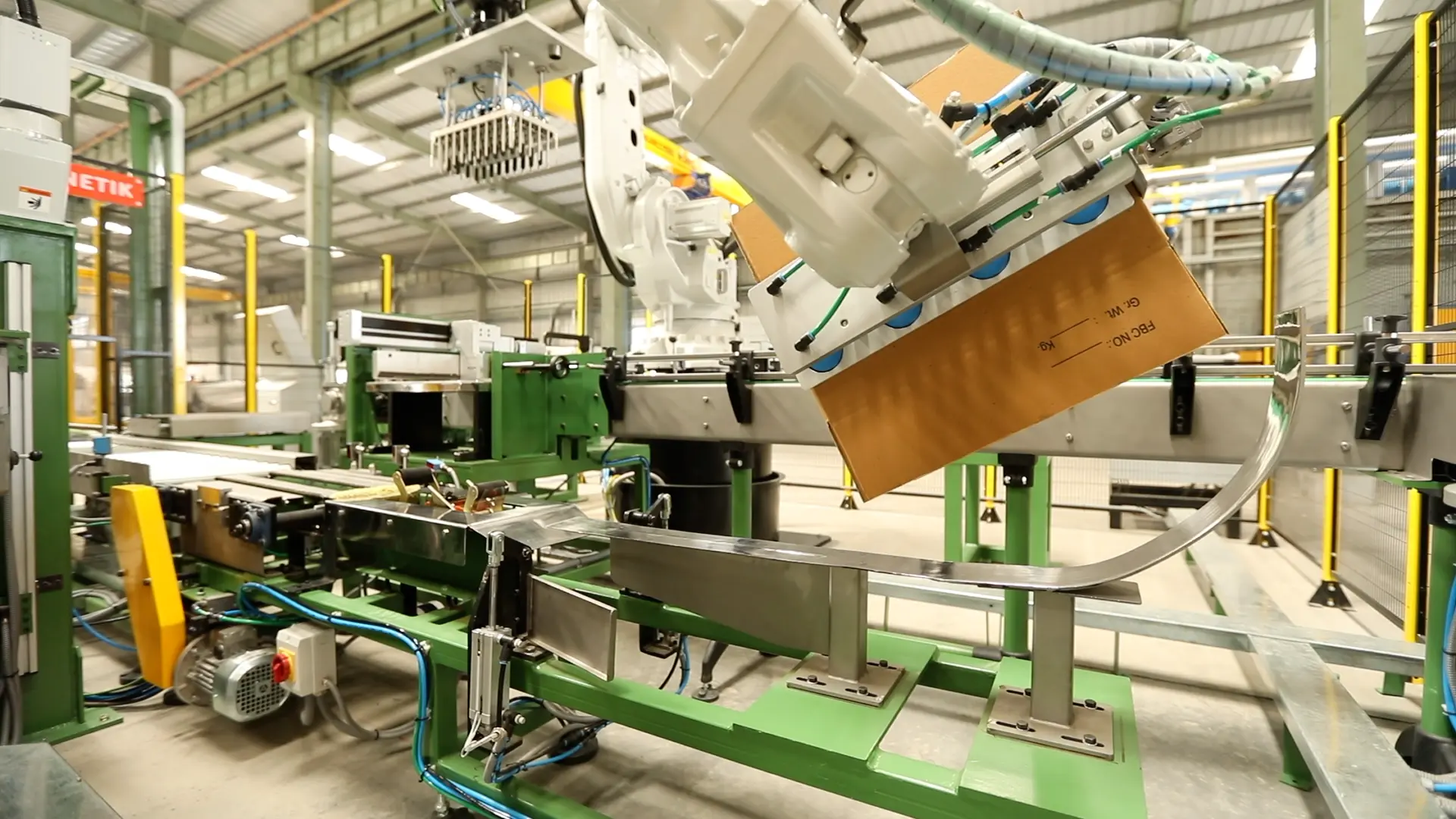
Even within the robotic bottle case packer category, the right configuration depends on bottle weight, throughput target, SKU mix and the regulatory environment.
Six-Axis Heavy-Payload Robotic Bottle Case Packer
Six-axis articulated robotic arm with payload up to 200 kg and throughput up to 120 bottles per minute. The strongest configuration for heavy glass bottles, large HDPE chemical jars, multi-bottle array picks and complex orientations. Best for high-volume beverage, dairy, chemical and personal care bottling at scale.
Six-Axis Mid-Payload Pharma Configuration
Same six-axis topology with reduced payload and pharma-grade EOAT for bottled syrups, oral liquids, suspensions and vials. GMP build, tamper-evident sealing integration and FDA-compliant construction for regulated pharmaceutical bottle packaging in international markets.
Six-Axis Multi-SKU Co-Packer Configuration
Six-axis platform with broad EOAT library and extensive recipe storage on the HMI, supporting co-packers and contract manufacturers running 20+ bottle SKUs across multiple brand customers. Quick-change tooling and recipe-driven configuration handle the SKU diversity that defines co-packing economics.
Side-by-Side Comparison
The table below compares the three robotic bottle case packer configurations across the parameters that drive specification.
| Specification | Heavy-Payload | Pharma Mid-Payload | Co-Packer Multi-SKU |
|---|---|---|---|
| Throughput | Up to 120 bottles/min | Up to 80 bottles/min | Up to 100 bottles/min |
| Payload | Up to 200 kg | Up to 50 kg | Up to 100 kg |
| Bottle Focus | Heavy glass, HDPE | Pharma syrups, oral | Mixed beverage/personal care |
| Vision System | Standard | Standard + integrity | Standard + SKU verification |
| GMP Build | Available | Standard | Available |
| FDA Compliance | Optional | Standard | Optional |
Bottle Types and Applications the Robotic Bottle Case Packer Handles
Bottle materials and formats supported
Robotic motion and pickup capabilities
Secondary packaging formats loaded
 “From PET and glass to HDPE and pharmaceutical bottles, robotic case packing delivers the accuracy, hygiene, and scalability required for modern bottling operations.“

See it in action
Why Bottling Lines Specify Cybernetik’s Robotic Bottle Case Packer
Industries Where the Robotic Bottle Case Packer Pays Back Fastest
When the Robotic Bottle Case Packer Becomes the Right Specification
Where two or more of the following describe your current bottling line, specifying a Cybernetik robotic bottle case packer is typically the rational next investment.
Where these conditions cluster, the Cybernetik robotic bottle case packer typically delivers payback in twelve to twenty-four months on changeover savings, surface-marking reduction, hygiene compliance and shift-long throughput stability.