
Key takeaways
A chocolate bar travels less than thirty seconds from the cooling tunnel discharge to its primary wrapper. In those thirty seconds, the bar must be picked from a randomly oriented conveyor, oriented label-up, fed into the flow wrapper at perfect pitch, wrapped, fin-sealed, cut and discharged – without a single piece of operator contact and without exceeding the working temperature window above which surface bloom begins. The chocolate bar packaging machine that performs this sequence is one of the most time-pressured pieces of equipment in any food plant.
This guide walks through what a complete chocolate bar packaging line involves at the machine level, the engineering choices that protect bar surface quality and brand presentation, and how Cybernetik’s chocolate bar packing machine portfolio – flow wrapper feeding at up to 400 parts per minute, dedicated Chocolate Bar Case Packer, and Robotic Carton Palletizer – comes together as a single line. Whether you produce standard bars, share-pack formats or premium gifting variants, the architecture below determines whether your throughput matches the cooling tunnel or chronically lags behind it.
What Is a Chocolate Bar Packaging Machine?
A chocolate bar packaging machine is any piece of equipment that handles the wrapping, cartoning or palletizing of chocolate bars through one or more stages of the packaging line. The category typically spans three integrated functions: primary wrapping (flow wrapping with upstream feeding), secondary case packing (the Chocolate Bar Case Packer), and tertiary palletizing (robotic carton palletizing). A complete chocolate bar packing machine line orchestrates all three under unified control.
What distinguishes chocolate bar packaging from generic confectionery packaging is the combination of speed pressure and surface sensitivity. Bars must be wrapped fast enough to keep up with cooling tunnel discharge – typically 300 to 400 bars per minute on a modern line – while preserving the surface gloss and label-face appearance that constitute the bar’s shelf presence. The wrapping window is also a hygiene window: the longer the bar spends naked on the conveyor, the higher the contamination risk and the more time for temperature drift.
Cybernetik’s chocolate bar packaging portfolio is purpose-built for this combination of pressure and care. The flow wrapper feeding system runs at up to 400 parts per minute in conveyorized configuration; the dedicated Chocolate Bar Case Packer handles bar variants – standard bars, slim bars, share-pack formats – with minimal modifications between SKUs; and the Robotic Carton Palletizer handles up to three cartons simultaneously at the line outfeed. All stages share an FDA-compliant build and a unified PLC + SCADA architecture.
Five Stages from Cooling Tunnel to Palletized Case
1. Bar Feeding into the Flow Wrapper
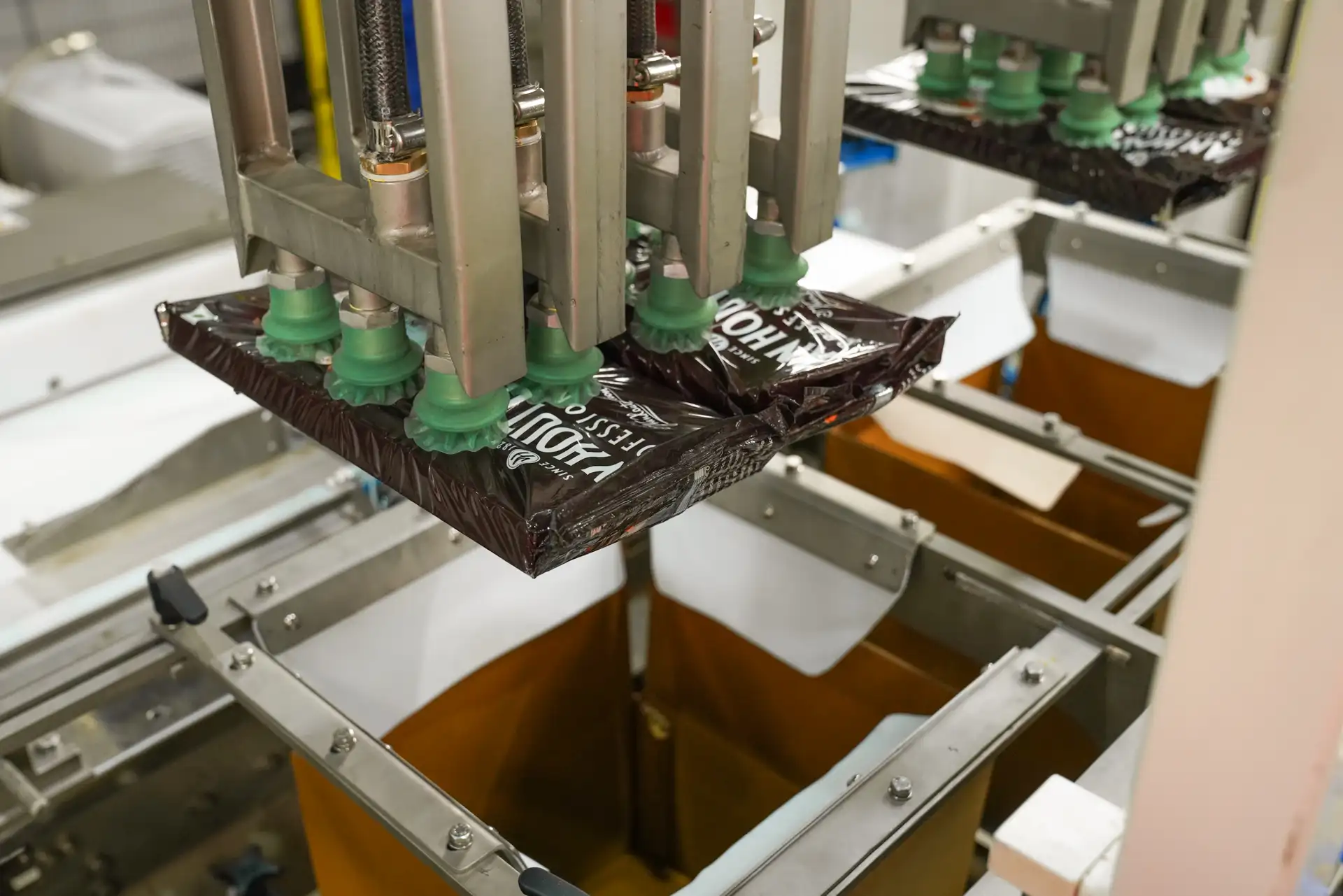
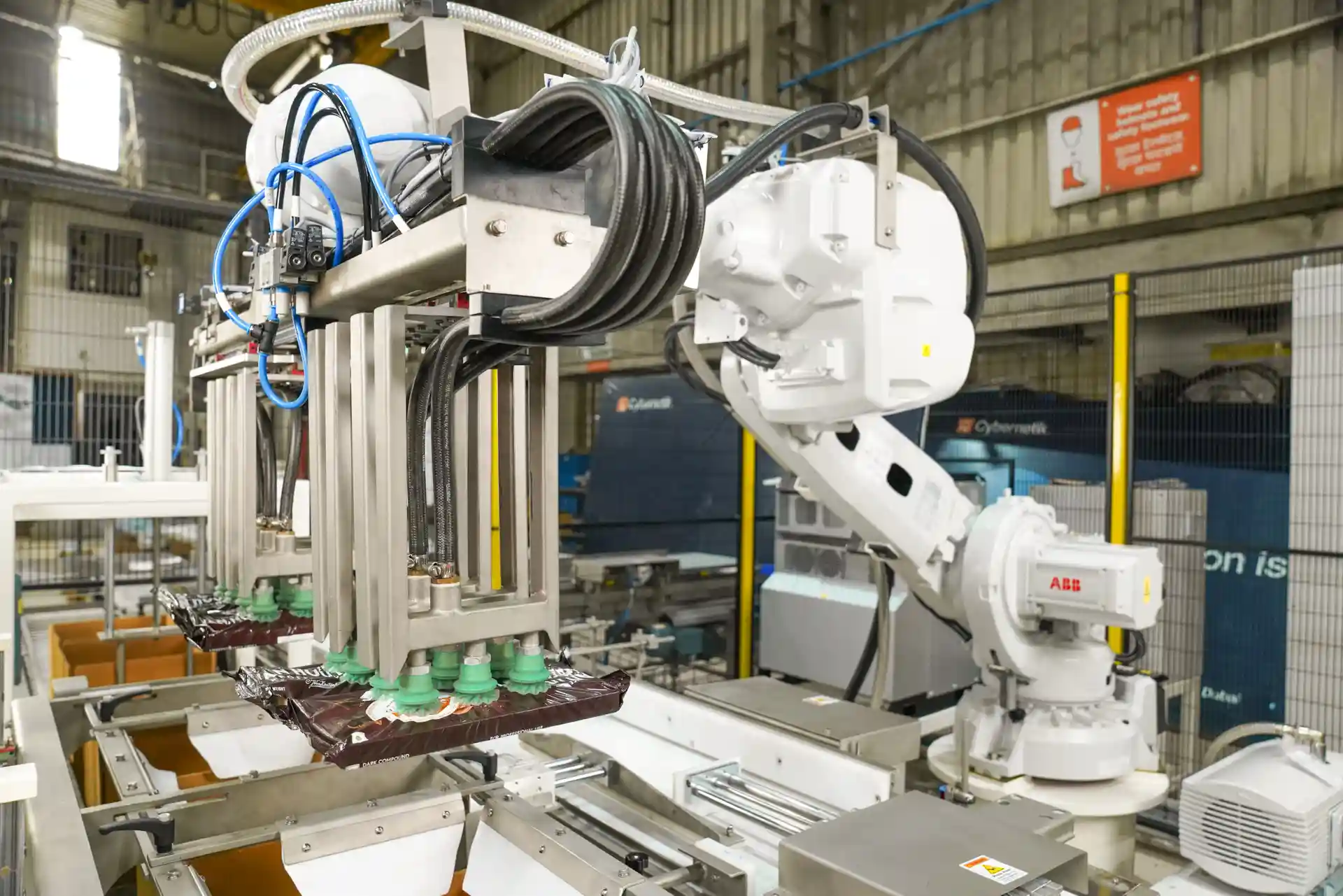
Chocolate bars exit the cooling tunnel randomly oriented across the conveyor width. Cybernetik’s flow wrapper feeding system reads each bar’s position via vision and uses pick-and-place or conveyorized indexing to deliver bars to the flow wrapper at perfect pitch, label-up and at the right cadence. Conveyorized configuration runs up to 400 parts per minute; robotic configuration runs up to 100 parts per minute per arm.
2. Primary Flow Wrapping and Fin-Seal
The flow wrapper forms a continuous film tube around the bar, applies a longitudinal fin-seal, makes the cross-seal cut, and discharges the wrapped bar onto the secondary conveyor. The bar is now protected from temperature, light and contamination – and from operator contact – through its remaining journey.
3. Secondary Cartoning via the Chocolate Bar Case Packer
Wrapped bars enter the Chocolate Bar Case Packer, which collates them into the case matrix specified by the SKU recipe – display carton, RSC shipping case or shelf-ready tray and loads the group into the pre-erected case. Multi-bar pickup, count verification and label-orientation control are all built into the cycle.
4. Case Sealing and Coding
Loaded cases pass through the case sealer, which folds top flaps and seals with hot-melt, tape or combined methods depending on application. Batch, date and barcode coding is applied inline, with the data integrated into the line PLC for audit traceability.
5. Robotic Carton Palletizing
Sealed cases are picked by the Robotic Carton Palletizer – capable of palletizing up to three cartons simultaneously with servo or pneumatic end-of-arm grippers and stacked into the recipe-defined pallet matrix. The palletizer ties into automated pallet storage and dispensing for uninterrupted shift operation.
Chocolate Bar Formats and How They Affect Packaging Machine Choice
Different chocolate bar formats place different demands on the packaging line. The right chocolate bar packaging machine configuration follows the bar format and the throughput target.
Standard Bar Packaging (45–100 g)
The classic chocolate bar – single-serve, individual flow wrap, then cartoned into countertop display boxes for retail. Cybernetik configures the flow wrapper feeding at up to 400 parts per minute and the Chocolate Bar Case Packer with display-carton recipes for shelf-ready retail presentation.
Premium and Gifting Bar Packaging
Premium bars and gift formats often use thicker, embossed or shaped wrappers and travel to retail in divider cartons rather than standard display cases. Cybernetik tunes the EOAT and motion path to handle premium bar surface finishes without marking, and supports divider-carton recipes on the Chocolate Bar Case Packer.
Share-Pack and Multi-Bar Format Packaging
Share packs (bag of mini-bars), multi-bar sleeves and value packs require grouping wrapped bars into secondary flexible packaging before cartoning. Cybernetik’s line architecture supports both primary flow wrap followed by secondary bagging, and direct multi-pack cartoning depending on the format.
Side-by-Side Comparison
The table below compares packaging machine considerations across the three main chocolate bar format families.
| Specification | Standard Bars | Premium / Gifting | Share-Pack / Multi-Bar |
|---|---|---|---|
| Typical Throughput | Up to 400 bars/min | Up to 200 bars/min | Up to 300 bars/min into multipacks |
| Primary Pack | Flow wrap | Premium flow wrap or sleeve | Flow wrap then bagging |
| Secondary Pack | Display carton | Divider carton | Multi-bar carton |
| Surface Sensitivity | Standard | High (embossed wrap) | Standard (wrapped first) |
| Vision QC | Orientation + fin-seal | Orientation + surface check | Count + label-face |
| Carton Sealing | Tape or hot-melt | Hot-melt or glue | Hot-melt |
| Best Industry Niche | Mainstream retail | Premium and seasonal | Family and value packs |
Chocolate Bar Packaging Machine Portfolio from Cybernetik
Primary packaging equipment
Secondary packaging equipment
Tertiary packaging equipment
 “From cooling tunnel discharge to palletized case, intelligent automation protects every chocolate bar while maximizing productivity and packaging consistency.”

See it in action
Why Chocolate Manufacturers Choose Cybernetik’s Chocolate Bar Packaging Machine Line
Where the Cybernetik Chocolate Bar Packaging Machine Line Delivers Most Value
When to Specify a Modern Chocolate Bar Packaging Machine Line
Two or more of the following symptoms together typically justify investment in an integrated chocolate bar packaging machine line.
Where these conditions appear together, the Cybernetik chocolate bar packaging machine investment typically delivers payback in twelve to twenty-four months on yield, labour, surface-quality and shift-output gains.