
Key takeaways
When evaluating palletizing equipment for a new or upgraded packaging line, one question consistently drives the decision: should you use a low level palletizer or a high level palletizer? The answer depends on your factory’s conveyor infrastructure, ceiling height, throughput requirements, available floor space, and capital budget. Getting it wrong means either under-investing in a system that caps your line speed, or over-investing in infrastructure your throughput doesn’t justify.
This guide explains exactly what separates a low level palletizer from a high level palletizer , mechanically, operationally, and commercially , and maps each configuration to the factory scenarios where it delivers the best return. It also covers how Cybernetik’s palletizer range addresses both architectures, and which of Cybernetik’s configurations map to low-level and high-level operating principles in practice.
What Is a Low Level Palletizer?
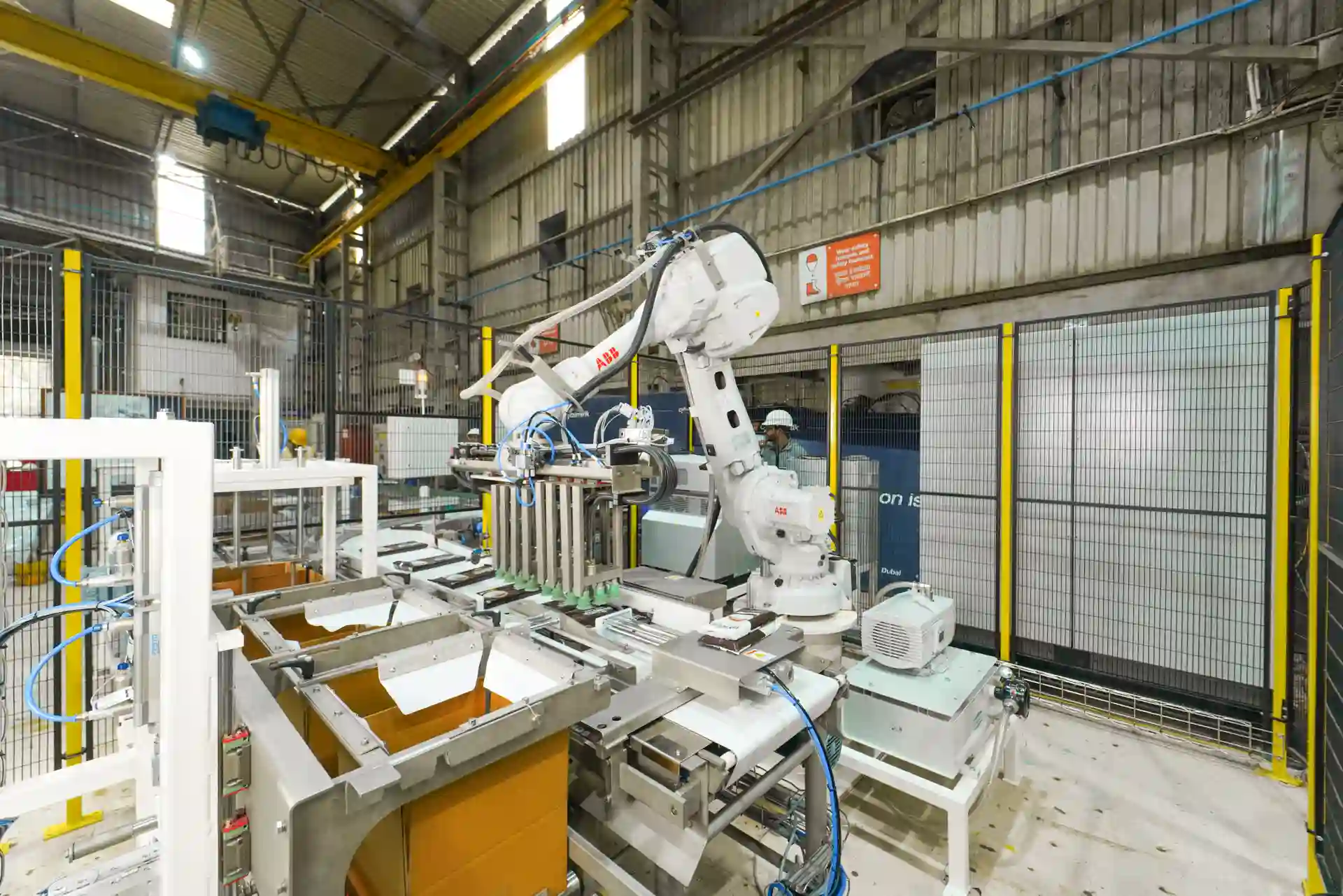
A low level palletizer, sometimes called a floor-level or low infeed palletizer, receives product from floor-level or waist-height conveyors, typically at infeed heights of 30 to 36 inches (approximately 75 to 90 cm) from the floor. The product arrives at roughly the same elevation as standard line conveyors, so no vertical lift infrastructure is needed to bring the product up to the machine.
In a low level system, product is collected into a row, then a layer, and the full layer is lifted vertically, either by a hoist raising the pallet platform, or by the layer-forming head traveling upward, to place each successive layer on the growing pallet stack. This vertical travel per layer is the defining mechanical characteristic of the low level design, and it is also the main reason low level palletizers generally operate at lower cycle speeds than high level alternatives.
Advantages of a Low Level Palletizer
Limitations of a Low Level Palletizer
What Is a High Level Palletizer?
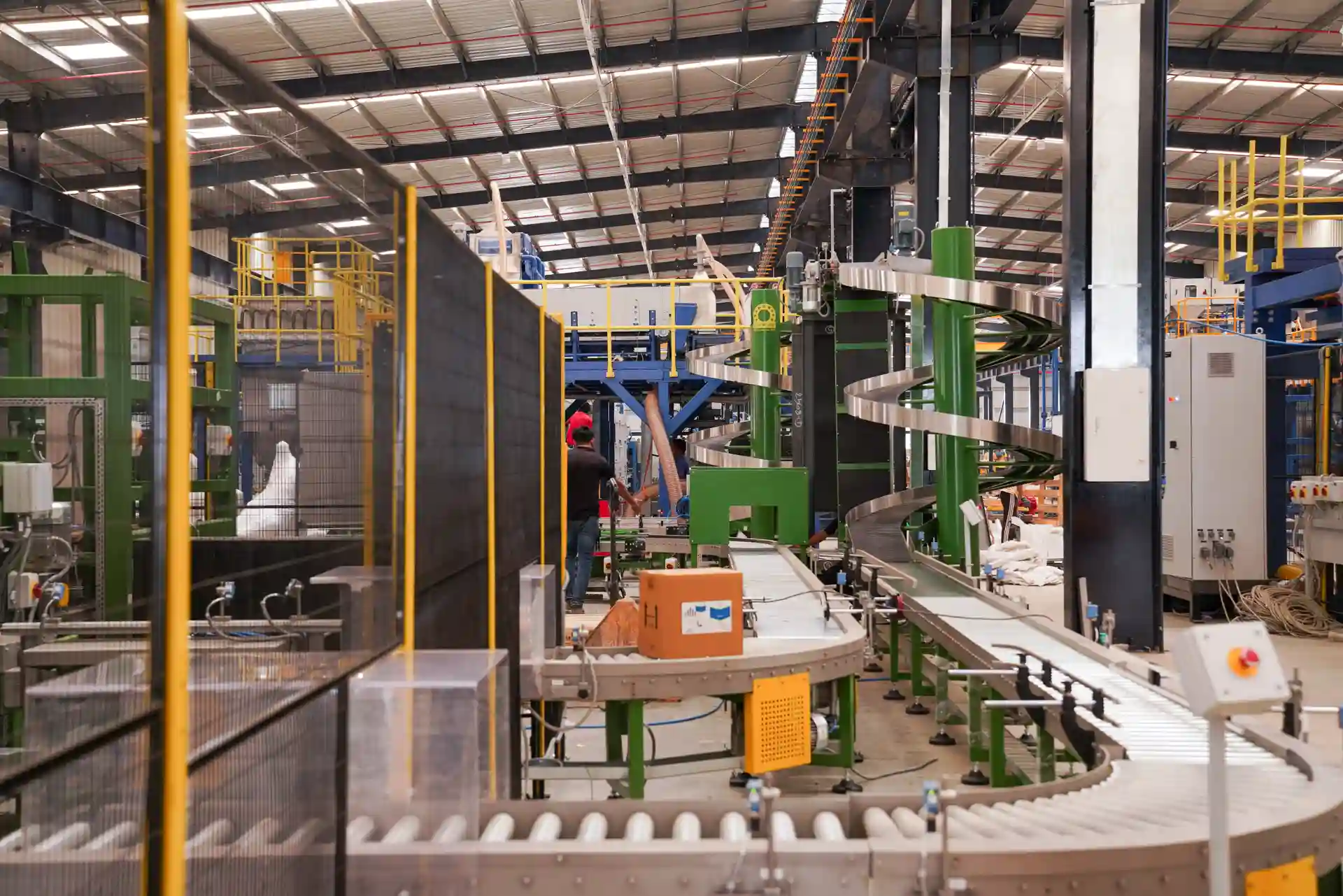
A high level palletizer receives product from an elevated infeed conveyor, typically at heights of 100 to 144 inches (approximately 2.5 to 3.6 metres) above floor level. Product travels up to the palletizer via a spiral conveyor or vertical lift, is formed into a complete layer on a bed at elevation, and is then lowered layer by layer onto the pallet below , the pallet descends as each layer is added rather than the layer-forming head ascending.
Because the layer is formed at a consistent elevated height and lowered onto the pallet, rather than lifted upward per cycle, high level systems achieve fundamentally faster cycle rates. The pallet platform descends incrementally with each completed layer, and there is no upward travel penalty per cycle. High level systems can form up to 10 layers per minute in high-speed configurations , more than double the top speed of most low level alternatives.
Advantages of a High Level Palletizer
Limitations of a High Level Palletizer
Low Level vs High Level Palletizer: Side-by-Side Comparison
Use this table to map each configuration to your factory’s specific constraints and requirements.
| Factor | Low Level Palletizer | High Level Palletizer |
|---|---|---|
| Infeed Height | 30–36 inches (floor/waist level) | 100–144 inches (overhead elevation) |
| Layer Speed | 1–3 layers per minute | 5–10 layers per minute |
| Cases/Min (typical) | Up to ~20–25 cases/min | 30–60+ cases per minute |
| Ceiling Height Needed | 4–6 metres (standard factory height) | 5–7+ metres (tall ceiling required) |
| Infrastructure Cost | Low , uses existing floor conveyors | High , spiral lift / elevated conveyor needed |
| Machine Capital Cost | Lower | Higher |
| Floor Space | Larger footprint at floor level | Smaller floor footprint; uses vertical space |
| Maintenance Access | All at floor level , simple | Elevated platform , requires stairs/access |
| Fragile Product | Moderate , lifting action per layer | Better , lowering action is gentler |
| Best For | Lower speeds, floor-level lines, low ceilings, lower CAPEX | High speeds, overhead lines, tall ceilings, high throughput |
| Typical Applications | Chemicals, agro, building materials, SME food factories | High-speed food & beverage, FMCG, pharma, beverage bottling |
 “Choosing between a low level and high level palletizer is about matching technology to your production environment, ensuring the best balance of efficiency, scalability, and investment.”

See it in action
How to Choose Between a Low Level and High Level Palletizer
The decision framework comes down to seven questions. Work through them in order and the right configuration becomes clear:
1. What is your current conveyor infeed height?
If your packaging line conveyors run at floor or waist height (30–36 inches), a low level palletizer connects directly with no additional infrastructure. If your plant already uses elevated overhead conveyors at 8–12 feet, a high level palletizer is the natural fit and a low level system would require a costly decline conveyor to bring product back down.
2. What is your ceiling height?
High level palletizers require at least 5 to 7 metres of clear ceiling height above the installation zone. If your factory has lower ceilings, common in older warehouses, converted facilities, or lean-build manufacturing halls, a low level palletizer is the only viable mechanical option without structural modifications.
3. What is your throughput requirement?
Low level palletizers cap at around 20 to 25 cases per minute in most configurations. If your line runs at 30 cases per minute or above, typical for beverage, snack food, and FMCG operations, a high level palletizer is the correct choice. Attempting to run a high-throughput line through a low level system results in product accumulation upstream and line stoppages.
4. What is your capital budget and total cost of ownership target?
If minimizing upfront CAPEX is the primary constraint, common for smaller manufacturers, greenfield lines in cost-sensitive markets, or operations replacing manual stacking incrementally , a low level palletizer offers substantially lower machine cost and near-zero installation infrastructure cost. High level systems carry a premium on both machine price and installation, but the throughput advantage typically generates a faster ROI at high production volumes.
5. How sensitive is your product to mechanical handling?
For fragile formats, glass containers, delicate cartons, pharmaceutical packs, the layer-lowering mechanism of a high level palletizer is gentler than the layer-lifting approach of a low level system. If product damage rates are a key quality metric, this consideration can tip a borderline decision toward the high level configuration.
6. How much floor space is available at end of line?
Low level palletizers have a larger ground footprint because all their mechanical components , the infeed, row-former, layer table, and hoist , sit at floor level. High level systems move the layer-forming platform overhead, freeing floor space for forklift access, pallet storage, or adjacent line expansion. If floor congestion at end of line is already a problem, high level systems address it structurally.
7. Do you need future throughput scalability?
High level palletizers are generally easier to configure for higher throughput as production volumes grow, because the speed ceiling is higher and the layer-forming mechanism is less constrained by the vertical travel distance. If your production plan calls for throughput growth over a 5 to 10-year horizon, a high level palletizer offers more headroom than a low level alternative.