
Key takeaways
There is no universal answer to the question of which case packer is best. The best case packer is the one that is best for your specific line , your throughput, your product range, your quality obligations, your floor space, and your total cost of ownership horizon.
Manufacturers who evaluate case packers only on upfront capital cost consistently make the wrong decision and discover it 18 months after commissioning, when the machine they bought is either starving the line, generating quality failures, or taking 40 minutes to change over between SKUs.
This guide provides the complete evaluation framework , the seven factors that determine whether a case packer is genuinely the best choice for a packaging line.
The Seven Factors That Define the Best Case Packer
Factor 1, Throughput Match
The best case packer is one that runs at the rated speed of your primary packaging line , not below it, and not so far above it that you are paying for unused capacity.
How to calculate: Primary packaging speed (units/min) ÷ Units per case = Cases per minute required. Add 15–20% headroom for growth.
| Product Type | Configuration | Sustained Speed |
|---|---|---|
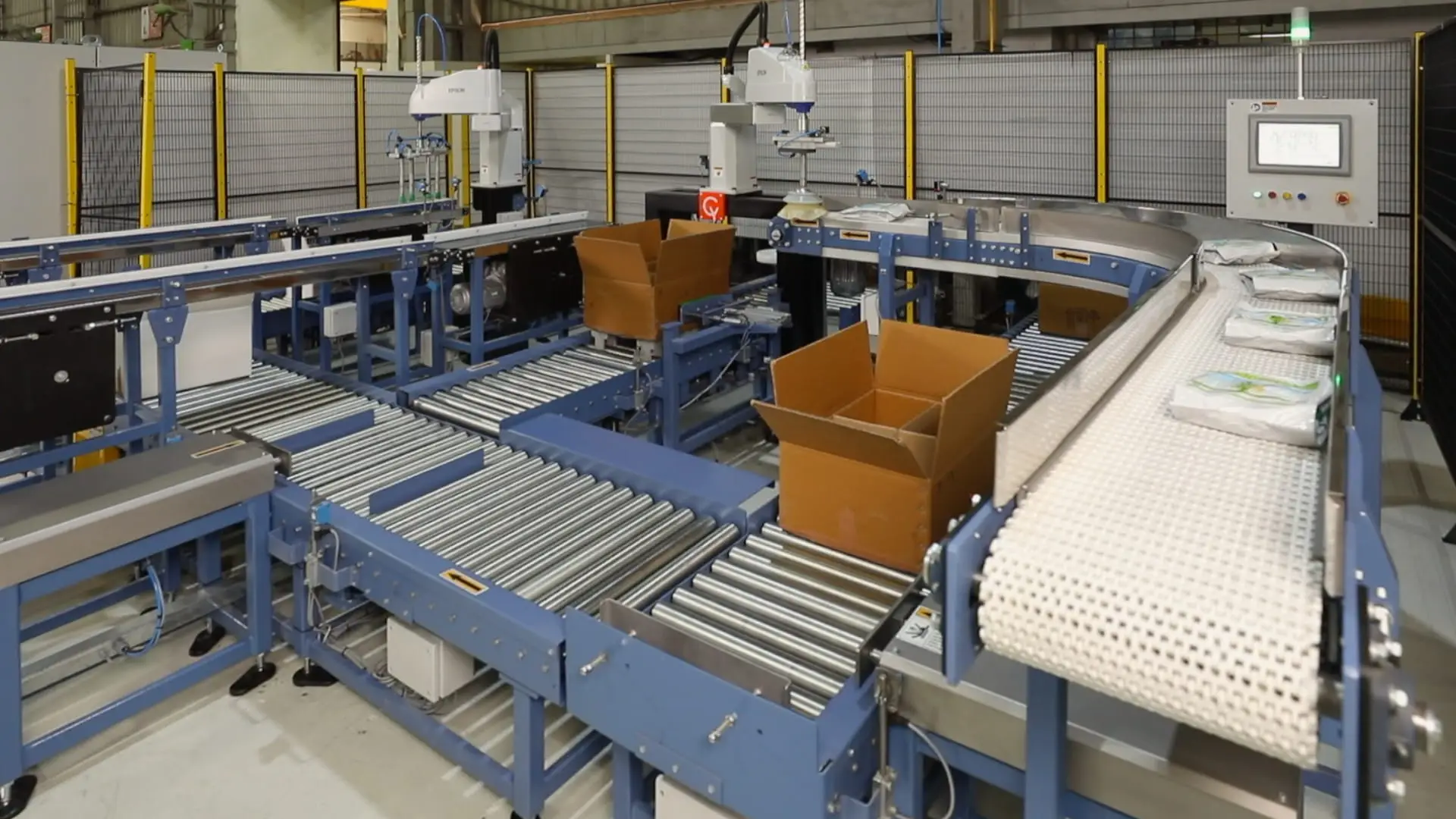
| Pouches | Case Packer for Pouches (SCARA dual-robot) | 40 pouches/min |
| Bottles | Case Packer for Bottles (Six Axis, 200 kg) | Up to 120 bottles/min |
| Shrink packs | Case Packer for Shrink Packs | Up to 400 cans/min |
| Dual-mode | Shrink Packs & Bottles | Up to 400/120 (mode dependent) |
Factor 2, Product and SKU Range
The best case packer handles every product variant your line runs today , and every variant you are likely to add in the next three years , without a separate machine for each.
Cybernetik’s Automatic Tool Changer on the Six Axis configuration switches between up to 5 product variants without manual intervention. The Versatile Vacuum Gripper handles multiple pouch and carton types with a single end-of-arm tool.
Factor 3, Changeover Time and Method
For a multi-SKU line, changeover time is a direct determinant of weekly productive capacity. A line with four format changes per week at 35 minutes manual changeover recovers 120+ hours annually by switching to recipe-driven automatic changeover , equivalent to more than three full production shifts per year.
Cybernetik target: under 10 minutes total changeover time for any active format pair, updating case packer AND downstream palletizer simultaneously from a single HMI.
Credits:
Factor 4, Quality Control Integration
Missing unit detection , confirms every cell in the matrix is occupied before the case is sealed
All are available on Cybernetik’s fully automatic configurations as standard or integrated optional features. None are available on semi-automatic case packers.
Factor 5, Integration Architecture
The best case packer integrates cleanly with your upstream primary packaging equipment and your downstream palletizer under a shared PLC/SCADA architecture. A case packer from the same supplier as your palletizer enables a single recipe change to update both machines simultaneously.
Factor 6, Total Cost of Ownership, Not Just Case Packer Cost
The purchase price of a case packer is typically 30–50% of the total cost of ownership over 5 years. The remaining 50–70% includes:
Factor 7, Compliance and Hygiene Standards
For food, pharmaceutical, and personal care applications, the best case packer meets GMP/cGMP compliance requirements with minimal human contact at the open-case loading stage, CE certification, and cleanable design.
 “Choosing the best case packer is less about equipment specifications and more about how effectively the machine supports your production strategy.”

Cybernetik packaging engineering team
See it in action
Matching the Best Case Packer to Your Product Type
| Product | Best Configuration | Key Differentiator |
|---|---|---|
| Flexible pouches | Case Packer for Pouches | Staggered lifting system + vibratory thickness conveyor – unavailable elsewhere |
| Multiple bottle sizes | Case Packer for Bottles | 5 variants, auto tool changer, missing bottle detection standard |
| Shrink multipacks | Case Packer for Shrink Packs | 400 cans/min with simultaneous dual-pack loading |
| Bottles AND shrink packs | Case Packer for Shrink Packs & Bottles | One robot, two formats – eliminates capital cost of second machine |
Case Packer Cost: The Total Cost of Ownership Model
| Cost Category | Manual/Semi-Automatic | Automatic Robotic |
|---|---|---|
| Capital cost | Lower | Higher |
| Annual labor (loading operators) | High (2 ops × 3 shifts × 250 days) | Minimal (monitoring only) |
| Annual changeover time cost | High (30–45 min × changes/week × 52) | Low (under 10 min × changes/week × 52) |
| Annual quality failure cost | Higher (missing units, defective cases) | Lower (automated detection) |
| 5-year total | Often 2–3× capital cost higher | Often 30–40% lower than semi-automatic |