
Key takeaways
Every product that leaves a manufacturing facility and arrives on a retail shelf or at a customer’s warehouse has passed through a secondary packaging stage. For the vast majority of manufactured goods , bottles, pouches, jars, cans, cartons , that stage is case packing: the process of grouping finished primary packs into a corrugated case, sealing it, labelling it, and handing it to the palletizer for dispatch.
Case packing is not a glamorous topic in manufacturing. It sits between the primary packaging line (which gets the investment) and the palletizer (which gets the attention). But it is the stage that determines whether a high-speed filler actually runs at its rated capacity, whether cases arrive at the retailer with the correct product count, and whether a multi-SKU packaging line can switch formats in 10 minutes or 45.
This guide explains what case packing is, how the case packaging process works step by step, what types of case packing machines exist, and why automated case packing is increasingly the standard across modern manufacturing.
What Is Case Packing?
Case packing , also called case packaging , is the secondary packaging process of loading finished primary packs into corrugated cases or cartons in a defined, structured matrix, then sealing and labelling those cases for downstream palletizing and dispatch.
It is called secondary packaging because it comes after primary packaging (the stage that puts the product into its immediate container , a bottle, pouch, or wrapper) and before tertiary packaging (palletizing , stacking cases onto pallets for storage and transport).
Case packing encompasses everything from erecting the corrugated case to confirming the product count before sealing. In an automated facility, it is the stage that connects the primary packaging machine to the palletizer. In a manual or semi-automated facility, it is usually the stage that limits how fast the entire line can run.
What Case Packing Is Not
Case packing is distinct from, though closely related to, several adjacent processes:
Understanding this distinction matters when specifying a case packing system, because the machine that erects, loads, and seals a corrugated shipping case is fundamentally different from the machine that wraps a multipack in shrink film.
The Case Packing Process: Step by Step
Whether performed manually or by an automated case packing machine, the case packaging process follows the same five-stage sequence.
Step 1, Case Erection
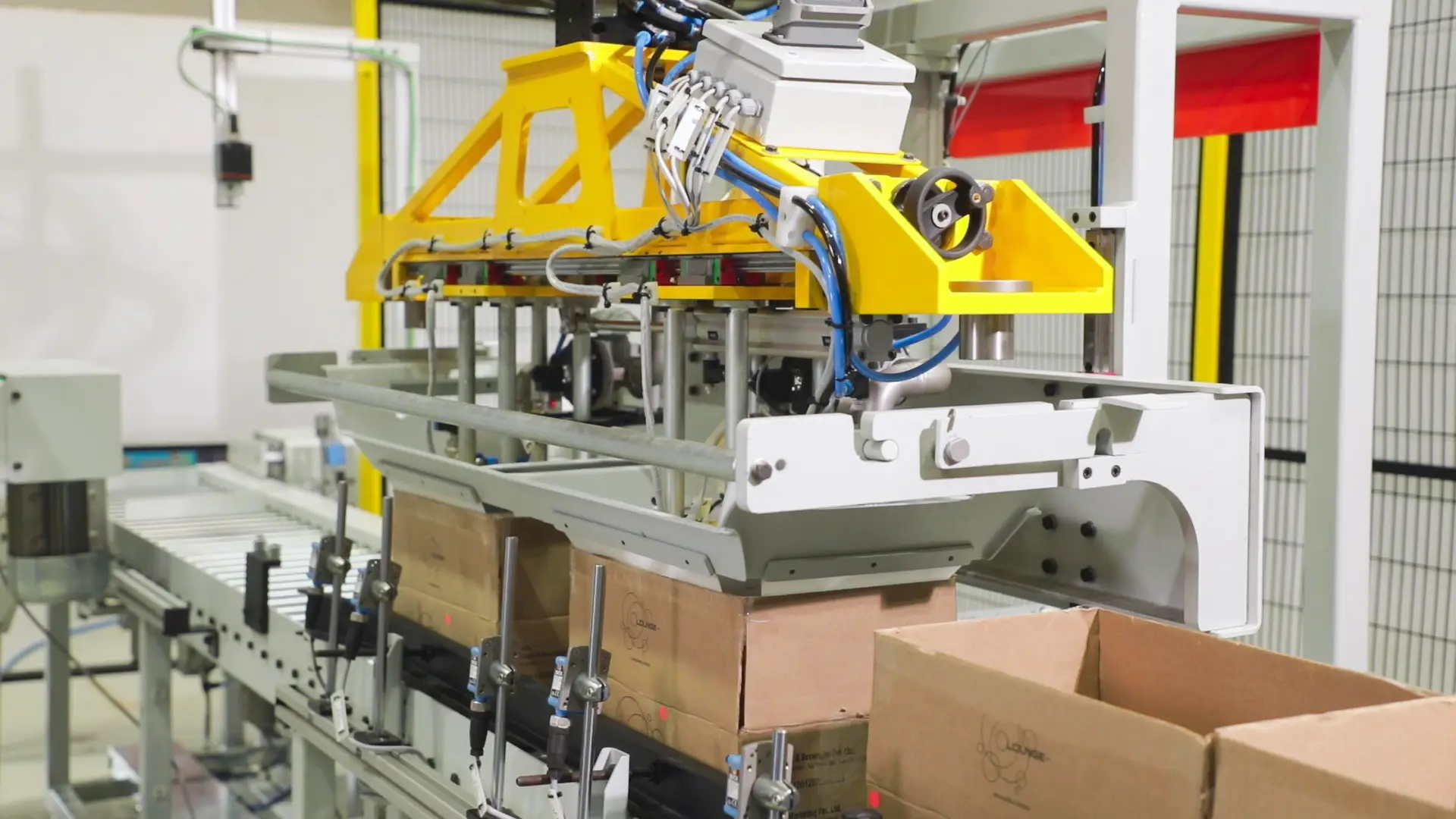
A flat corrugated blank is drawn from a magazine, unfolded, squared at the corners, and base-sealed, either with hot-melt adhesive or pressure-sensitive tape. The result is an open-top corrugated case, correctly formed and base-sealed, ready to receive product.
In manual operations, an operator performs this step by hand. In automated case packing systems, a case erector machine performs this step at the same rate the loading station requires, synchronised to the downstream robot’s loading cycle so the loading station never waits.
Step 2, Product Infeed and Matrix Formation
Finished primary packs, bottles, pouches, jars, shrink pack , arrive from the upstream primary packaging line on a takeaway conveyor. They are accumulated into the required row-and-column matrix (for example, a 4×6 pattern of 24 bottles, or a staggered overlap pattern of pouches) before the loading cycle begins.
The matrix formation stage is where automated case packing delivers the most precision advantage over manual loading. A matrix formation station accumulates exactly the right number of units in exactly the right arrangement before every robot pick cycle, without the count errors, orientation mistakes, or missing units that manual accumulation produces at speed.
Step 3, Robotic Case Loading
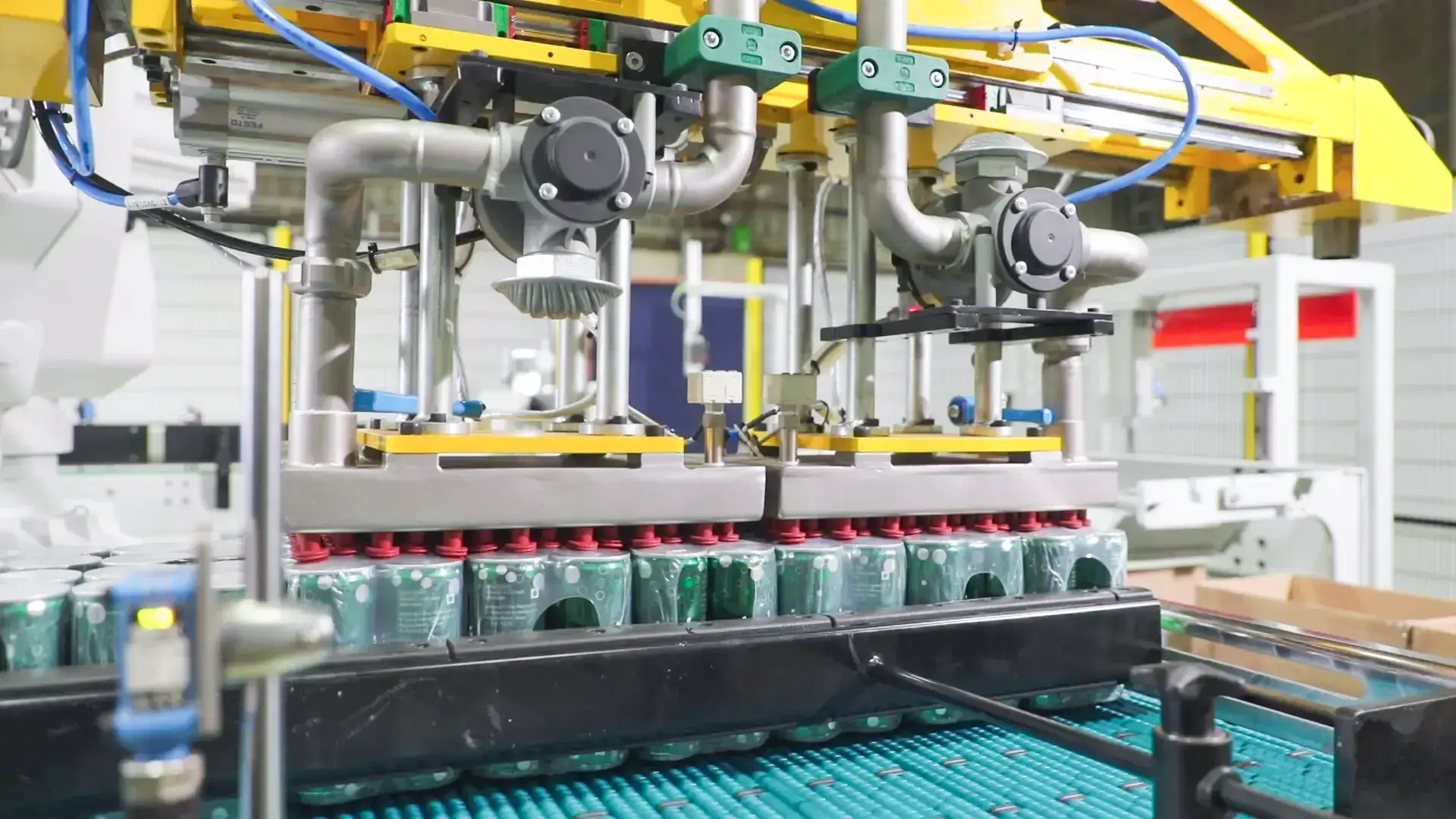
The pick-and-place robot lifts the complete matrix and places it into the open case in a single coordinated cycle. The robot is fitted with end-of-arm grippers , servo or pneumatic, custom-designed for the product geometry , that handle the matrix without damaging the primary packaging.
On a Six Axis robotic case packing machine, the robot’s reach and payload (up to 200 kg) enable it to pick large bottle matrices, heavy pouch stacks, or bulky shrink packs with the same precision. On a SCARA robot configuration, higher cycle rates at lower payload (up to 6 kg) suit lighter products like small pouches, sachets, or confectionery.
Step 4. Quality Control: Missing Unit Detection and Vision Inspection
Before the case is sealed, two quality control stages confirm its integrity:
Vision inspection checks that all bottles, pouches, or cartons are correctly oriented and undamaged. Defective units , broken caps, torn pouches, misformed cartons , are detected and the case is rejected before sealing.
Missing unit detection confirms every cell in the matrix is occupied. A case with a missing bottle, pouch, or jar is rejected and diverted before the sealing station , not discovered at the retailer’s distribution centre after shipment.
On high-density bottle matrices, 3D cloud point technology provides more accurate missing unit detection than standard 2D camera systems , particularly where bottle cap geometry or reflective labels cause false negatives in 2D inspection.
Step 5, Case Sealing, Labelling, and Discharge
The confirmed, fully loaded case proceeds to the top-sealing station. Adhesive or tape seals the top flaps. A label application system applies batch, date, product, and barcode data to the sealed case. A track and trace system records case-level data before the case leaves the packing zone.
The sealed, labelled case is conveyed to the downstream palletizer for stacking and pallet formation.
Credits:
Manual vs. Automated Case Packing: What the Data Shows
Understanding the gap between manual and automated case packing requires looking at the numbers across four dimensions.
| Metric | Manual Case Packing | Automated Case Packing |
|---|---|---|
| Loading speed | 15–20 units/min per operator | 40–120 units/min (sustained) |
| Format changeover | 30–45 min mechanical adjustment | Under 10 min via HMI recipe |
| Missing unit detection | Visual inspection – unreliable at speed | Automated detection before sealing – 100% coverage |
| OEE contribution | Typically 40–60% (manual lines) | Typically 75–85% (automated lines) |
| Contamination risk | High – open case stage with direct hand contact | Low – minimal human contact with open packaging |
| Labor requirement | 2–4 operators per line per shift | 0–1 operator per line per shift (monitoring) |
The OEE gap between manual and automated case packing, typically 15- 20 percentage points, is not primarily a speed gap. It is an availability gap (manual lines stop for breaks, fatigue, and jam clearance) combined with a quality gap (missing units and orientation errors that generate rejects and returns downstream).
Types of Case Packing Machines
Case packing machines are classified by the robot architecture and the product type they are designed to handle.
Six Axis Robotic Case Packers
Six Axis robots offer the highest payload (up to 200 kg), greatest reach, and maximum multi-product flexibility. They handle bottles, jars, shrink packs, and heavy containers , and their automatic tool changer enables switching between product variants without manual tooling intervention.
Cybernetik’s Six Axis configurations include:
- Case Packer for Bottles , up to 120 bottles/min, 5 variants, 200 kg payload
- Case Packer for Shrink Packs , up to 400 cans/min with end-to-end automation
- Case Packer for Shrink Packs & Bottles , dual-mode, 3D cloud point QC
SCARA Robotic Case Packers
SCARA robots are optimised for high cycle rates with lighter products (up to 6 kg). They are well-suited to pouch, sachet, and small carton case packing , where speed is the primary requirement and payload is not the constraint.
Cybernetik’s SCARA configuration:
- Case Packer for Pouches , up to 40 pouches/min, dual-robot, staggered lifting system, vibratory thickness conveyor
 “Automated box packaging is more than moving products into cases; it is the system that connects production output to efficient, reliable distribution”

Cybernetik packaging engineering team
See it in action
How Case Packing Connects to the Full Packaging Line
Case packing is most effective as one integrated stage in a connected end-of-line sequence.
Upstream connections: Products arrive from primary packaging , Cybernetik’s Robotic Flow Wrapper Feeding system for confectionery and food products, or filling and labelling lines for beverages and personal care. When primary packaging and case packing share a PLC architecture, the case packer’s infeed is synchronised to primary packaging output without a buffer accumulator.
Downstream connections: Sealed cases from the case packer feed Cybernetik’s palletizer range:
- Box Palletizer , up to 1,800 boxes/hour, multi-line multi-variant capability
- Robotic Carton Palletizer , 15 cartons/min, simultaneous two-case palletizing
- Robotic Palletizers , full range including Six Axis, cobot, high-level, and gantry configurations
- Cobot Palletizer & Case Printer , combined label printing and palletizing in one cobot cycle
When case packing and palletizing share a PLC/SCADA layer, a format change at the case packer propagates automatically to the palletizer , one HMI command updates the full end-of-line.
The Cybernetik Approach to Case Packing
Cybernetik has delivered case packing and end-of-line automation systems across 30+ countries from four manufacturing facilities. The engineering principles that distinguish Cybernetik’s case packing machines: