
Key takeaways
The decision between semi-automatic and automatic case packaging equipment is one of the most consequential capital decisions in secondary packaging, and one of the most frequently misframed.
The typical framing is a capital cost comparison: semi-automatic is cheaper upfront, automatic costs more. This is accurate but incomplete. The complete comparison includes throughput capacity, labor cost over the asset life, changeover time on multi-SKU lines, quality control capability, and the cost of quality failures that reach the market.
When the full picture is evaluated, the break-even point for most medium-to-high-volume manufacturers is 12–24 months , after which an automatic case packer consistently outperforms a semi-automatic on total cost of ownership.
What Is a Semi-Automatic Case Packer?
A semi-automatic case packer is a machine that automates one or more stages of the case packing process while retaining a manual operation at the loading stage. Common semi-automatic configurations include:
In all semi-automatic configurations, the throughput ceiling is determined by the operator’s sustained loading speed , typically 15–30 units per minute per operator.
What Is an Automatic Case Packer?
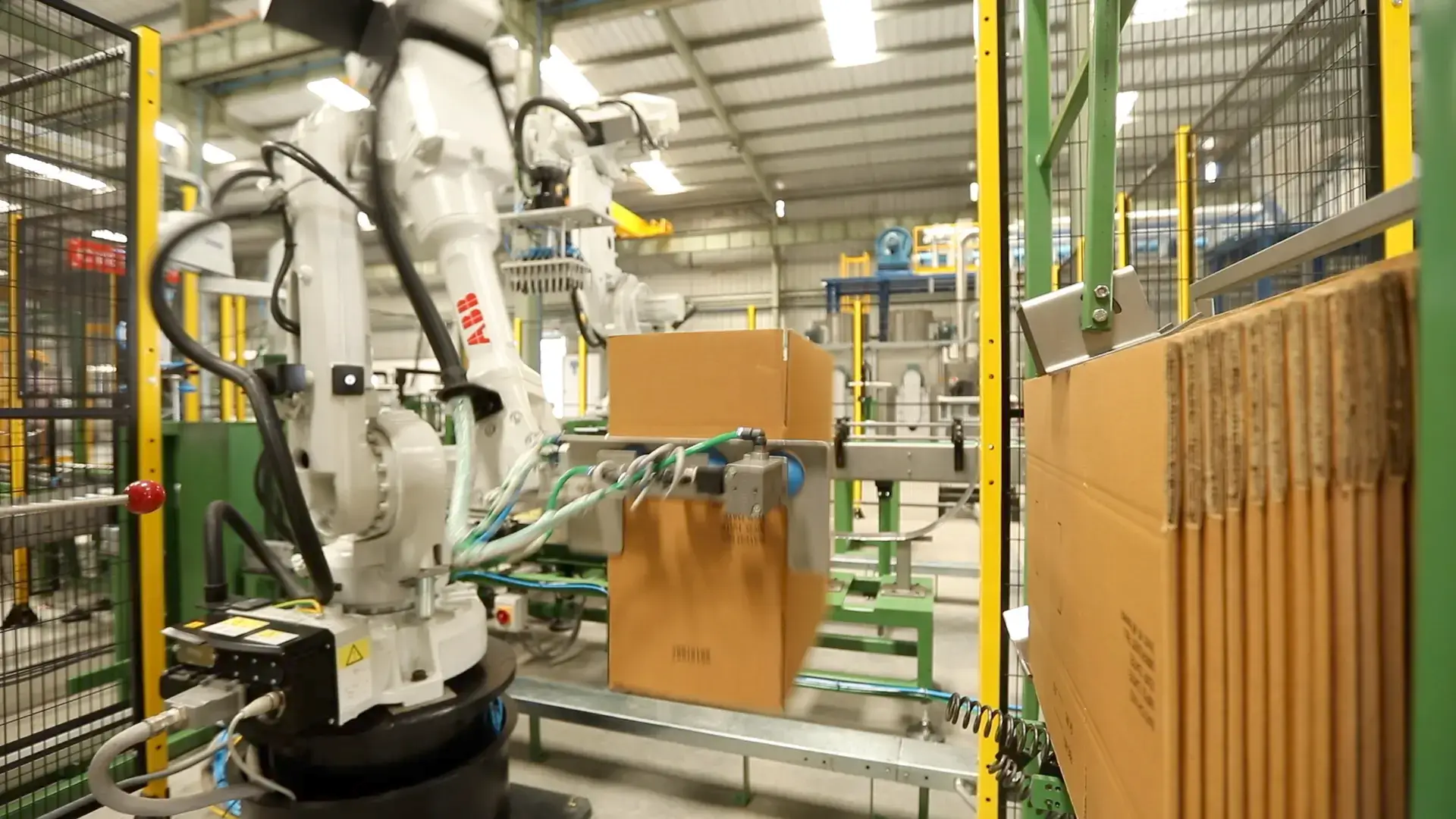
An automatic case packer is a fully robotic secondary packaging system that performs all stages , case erection, product matrix formation, robotic pick-and-place loading, quality inspection, and case sealing , without direct operator involvement in any loading cycle.
Cybernetik’s Case Packers are built on two robotic architectures:
Credits:
Head-to-Head Comparison
| Factor | Semi-Automatic | Automatic (Robotic) |
|---|---|---|
| Loading speed | 15–30 units/min (operator limited) | 40–120 units/min (machine rated) |
| Sustained throughput | Degrades with operator fatigue | Constant across full shift |
| Format changeover | 20–45 min mechanical adjustment | Under 10 min via HMI recipe |
| Missing unit detection | Visual – unreliable at speed | Automated before sealing – 100% coverage |
| Vision QC | Not available | Standard or optional |
| Track and trace | Not available | Standard on most configurations |
| Labor per line per shift | 1–2 operators at loading station | 0–1 operator (monitoring only) |
| GMP / hygiene | Direct manual contact with open cases | Minimal human contact – GMP-compatible |
| Upfront capital cost | Lower | Higher |
| Total cost over 3 years | Higher (labor + rejects + failures) | Lower (savings compound annually) |
| Typical payback period | N/A | 12–24 months from commissioning |
| OEE contribution | Typically 45–65% | Typically 75–85% |
When a Semi-Automatic Case Packer Makes Sense
When an Automatic Case Packer Is the Right Investment
 “The decision between semi-automatic and automatic case packing is not simply about capital cost; it is about throughput, labor efficiency, quality control, and the long-term economics of production.”

Cybernetik packaging engineering team
See it in action
The Hidden Costs of Semi-Automatic Case Packaging Equipment
Sustained Labor Cost
A semi-automatic case packer requires 1–2 operators at the loading station per shift. At three shifts per day, five days per week, this represents 15–30 operator-shifts per week dedicated to case loading, a labor cost that compounds annually.
Quality Failure Cost
Manual loading at speed produces missing units, orientation errors, and over-packed cases. The downstream cost of a single short-count case reaching a retailer, chargeback, compliance filing, relationship risk often exceeds the cost of several hours of production.
Changeover Opportunity Cost
On a line with 4 format changes per week at 35 minutes manual changeover each, the annual lost production time is 120+ hours , the equivalent of more than three full production shifts lost to case packer changeovers.
Cybernetik’s Automatic Case Packing Equipment: Configurations
| Product Type | Configuration | Speed | Key Advantage over Semi-Auto |
|---|---|---|---|
| Pouches | Case Packer for Pouches (SCARA dual-robot) | 40 pouches/min | Staggered lifting + max density – unavailable on semi-auto |
| Bottles | Case Packer for Bottles (Six Axis, 200 kg) | 120 bottles/min | 5 variants, auto tool changer, missing bottle detection |
| Shrink Packs | Case Packer for Shrink Packs | 400 cans/min | No semi-auto can approach this throughput |
| Dual-Mode | Shrink Packs & Bottles | 400/120 units/min | One robot replaces two separate semi-auto machines |