
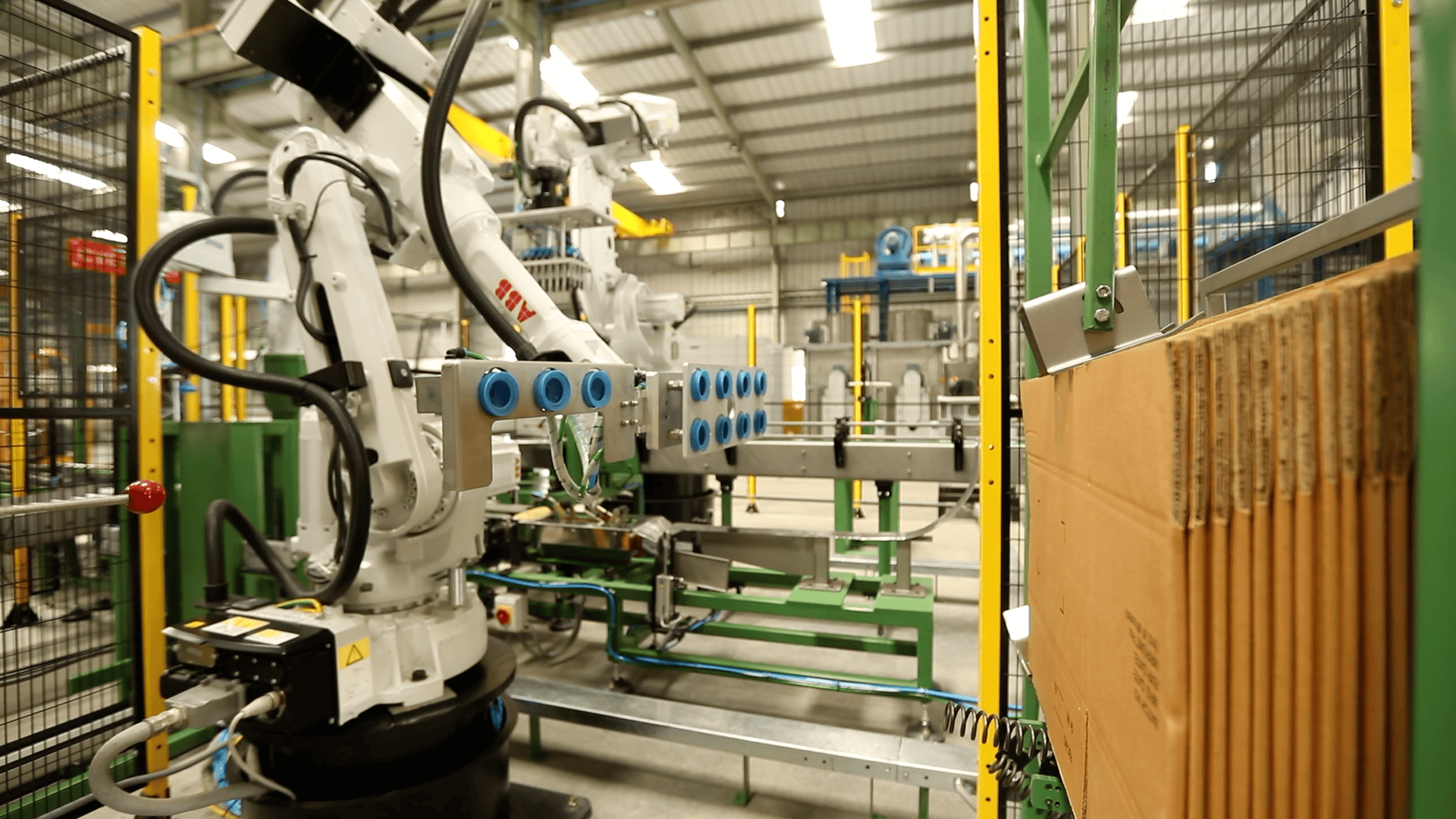
Not every packaging line needs a full-scale, high-throughput case packer running 120 bottles per minute. For a growing FMCG brand, a contract packer handling 15 SKUs, or a pharmaceutical company moving into automated secondary packaging for the first time, the right answer is a small case packer , one that delivers the reliability and quality control of a full robotic system at a throughput, footprint, and capital cost matched to where the business actually is today.
The challenge is that small case packer selection involves the same set of engineering decisions as any case packer: robot type, gripper design, product format compatibility, SKU range, quality control integration, CE certification, and downstream connection to taping, printing, and palletizing systems. Getting those decisions wrong at the specification stage means a machine that caps your throughput, limits your SKU range, or requires expensive retooling every time a format changes.
This guide walks through every decision a production manager or plant head needs to make when choosing a small case packer , covering throughput sizing, robot configuration, SKU flexibility, quality control requirements, and what to look for in a case packing machine manufacturer with the capability to support the installation long term. Cybernetik’s SCARA and Six-Axis case packer configurations are used throughout as the reference point for specifications and features, sourced directly from packaging.cybernetik.com.
A small case packer is a secondary packaging system , typically a SCARA or compact Six-Axis robotic configuration , that loads finished primary packs into outer shipping cases at low to medium throughput. It performs the same function as a large industrial case packer:
picking pouches, bottles, or shrink packs from the infeed, forming the required matrix inside the outer case, closing or sealing the case, and passing it downstream to a palletizer.
The key difference is scale. A small case packer is sized for production environments where:
Industries most commonly investing in small case packers include FMCG snacks and food brands scaling from regional to national distribution, contract packagers running multi-client, multi-SKU operations, pharmaceutical and nutraceutical companies moving pharma pouch lines into automated secondary packaging, and agrochemical producers automating pesticide and fertilizer pouch loading into outer cases.
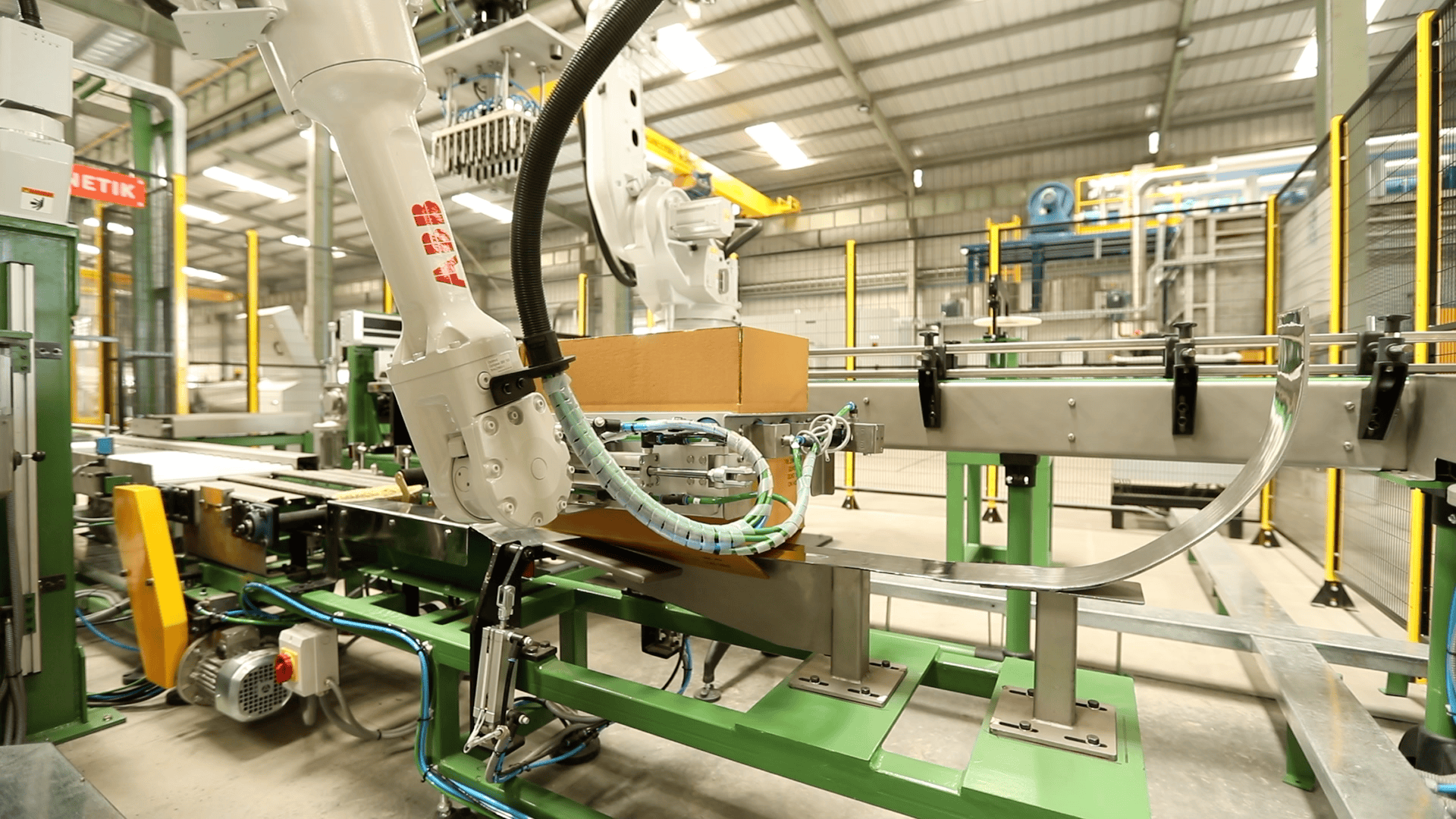
Integrated Secondary & Tertiary Bottle Packing System
1. Robot Type: SCARA vs Six-Axis
SCARA robots are the standard for small case packer applications. They are fast at horizontal pick-and-place movements, compact in footprint, and well-suited to low-payload applications where the product is a pouch or a small jar. Cybernetik’s SCARA case packer configuration handles up to 12 pouches per minute with a 5 kg payload , the right spec for low-to-medium volume pouch lines.
Six-Axis robots offer more payload and more range of motion , up to 40 pouches per minute with a 200 kg payload, and up to 120 bottles per minute. If your current throughput sits below 12 per minute but you expect to scale beyond that within two to three years, specifying a Six-Axis configuration from the start avoids a full machine replacement at growth stage. Cybernetik builds both configurations on the same engineering platform, so the downstream integration architecture stays consistent as you scale.
2. Product Format and Gripper Design
The gripper is what makes or breaks a small case packer for any given product. Pouches need vacuum grippers or mechanical fingers sized to the pouch surface and fill density. Bottles need servo or pneumatic grippers matched to bottle neck or body diameter. Jars need a different contact geometry than flat-bottom pouches. Cybernetik customizes gripper design for each installation, and the Multiple SKU Case Packer uses a single flexible gripper that handles multiple pouch formats without retooling , the most important feature on any high-SKU small case packer line.
3. Throughput Sizing with Growth Headroom
The most common small case packer specification error is buying to today’s throughput without headroom. If your line currently runs at 8 pouches per minute and your SCARA case packer is rated to 12, you have some room. If you add a second shift or a second SKU and need 15, you are already at the ceiling. The industry standard is to build 20 to 30 percent throughput headroom into the specification. For a small case packer, that typically means choosing the next robot tier up , or specifying a modular system that allows a second robot to be added to the same frame without full re-engineering.
4. SKU Flexibility and Changeover Time
On a small case packer, the throughput advantage of automation is partially offset by changeover time if the machine requires mechanical retooling between SKUs. Cybernetik’s SCARA Multiple SKU Case Packer solves this with SCADA-based recipe storage , one HMI selection switches the robot’s pick trajectory, the matrix formation, and the case-closing parameters. Changeover is measured in minutes, not hours. For contract packers and multi-SKU FMCG lines, this is the single most important feature to verify at the specification stage.
5. Quality Control Integration
Even on a small case packer, quality control must be built in, not added later. The minimum viable QC set for a food or pharma small case packer includes broken pouch rejection before loading, a check weigher at the outfeed for underweight and overweight case rejection, and a pneumatic ram for proper case lid closure. Optional additions , metal detection, carton vibration for packing density, lid-edges folding , are available across Cybernetik’s configurations and should be budgeted for even if not activated on day one.
6. CE Certification and Compliance
If the line produces food, pharmaceutical, or chemical products, CE certification on the case packer is non-negotiable for export markets and for most retail supply chain audits. Cybernetik’s SCARA single-robot Case Packer for Pouches and Multiple SKU Case Packer are both CE-certified. GMP-built food-grade contact surfaces are standard across all food and pharmaceutical configurations.
The machine is only part of the decision. The case packing machine manufacturer you choose determines what your line can do five years from now , in terms of supported SKUs, available upgrades, spare parts availability, and engineering support when something breaks at 2 AM on a Monday. Five criteria separate a reliable case packing machine manufacturer from a vendor who disappears after installation:
Cybernetik builds four configurations suitable for small-to-medium throughput secondary packaging operations:
The business case for a small case packer is self-funding within 12 to 24 months in most food and FMCG environments when two or more of the following are true:
A bag case packer loads flexible packaging , pouches, sachets, stick packs, gusseted bags , into shipping cases using gentle vacuum or finger-grip pickup and density-optimized loading patterns. A carton packer loads rigid products , bottles, jars, cans, flow-wrapped bars , into shipping cases using higher-force pickup and geometry-determined matrix layouts. The fundamental difference is product rigidity, which cascades into every design decision.
Cybernetik’s SCARA single-robot case packer handles up to 12 pouches per minute with a 5 kg payload, suitable for low-to-medium volume lines. The Six-Axis configuration handles up to 40 pouches per minute with a 200 kg payload and up to 120 bottles per minute, covering medium-to-high throughput. Both are customizable based on product and line requirements.
Cybernetik builds hybrid case packing lines with quick-change end-of-arm tooling and dual-recipe HMIs that switch between bag and carton modes in roughly 15 to 30 minutes. This works well for mid-volume mixed lines, including co-packers and contract manufacturers. For high-volume dedicated production, specialized machines for each format typically deliver better economics.
CE certification is standard across multiple Cybernetik case packer variants including the SCARA single-robot configuration and the Multiple SKU Case Packer. GMP-built food-grade contact surfaces are standard across all food and pharmaceutical configurations.
Cybernetik case packers are designed for upstream and downstream integration under a single PLC and control architecture. They connect to primary packaging equipment upstream and to case taping systems, label printers, and palletizers downstream. Modular design allows capacity expansion as throughput requirements grow , so the system you start with scales with your business.